
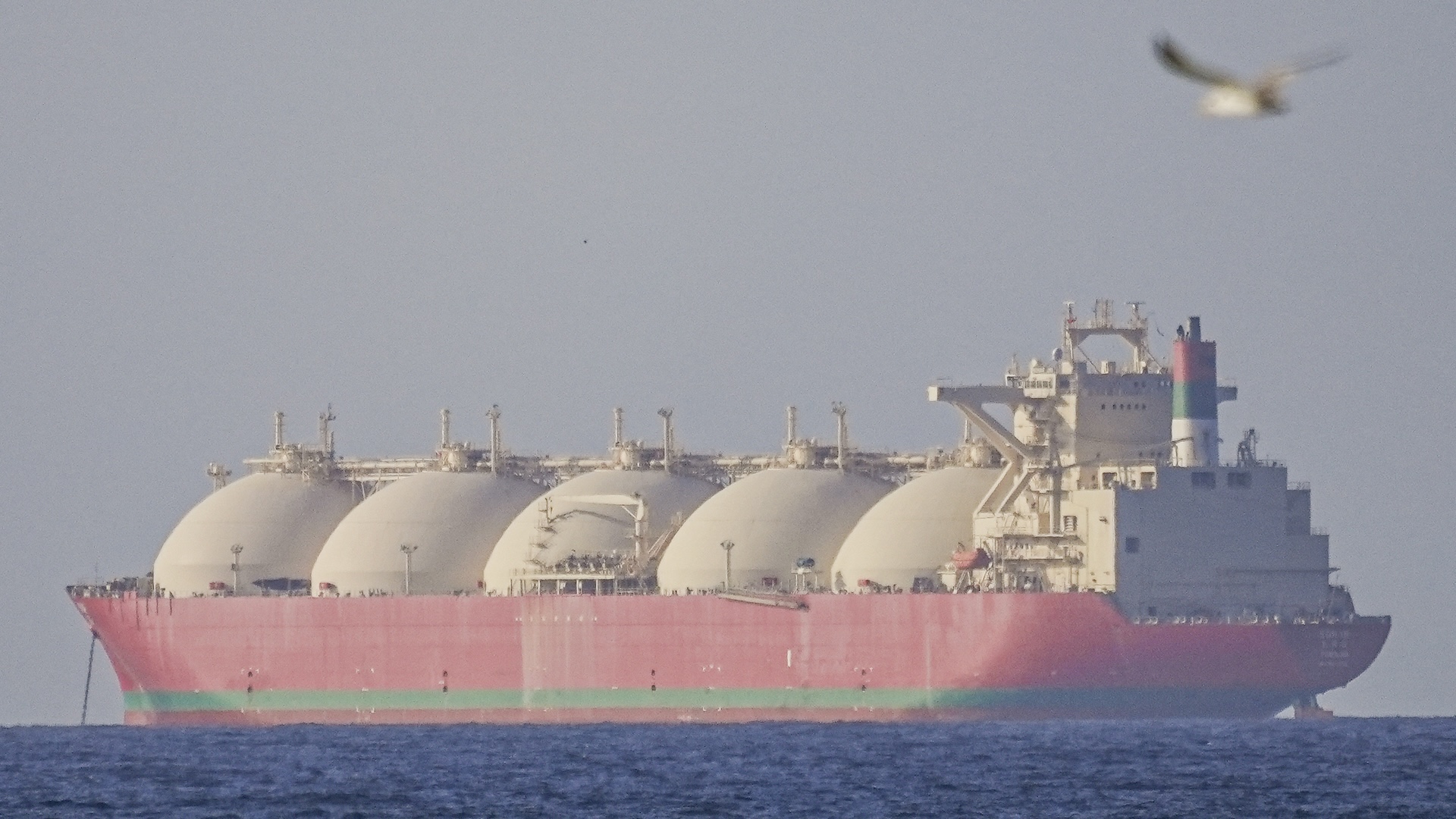
The U.S. military has said it will start enforcing a blockade of all Iranian Gulf ports and coastal areas today. The move follows on from U.S. President Donald Trump’s earlier promise to close off the Strait of Hormuz, the strategic shipping route that Iran has already effectively shut to the vast majority of maritime traffic in response to U.S.-Israeli strikes. It comes after negotiators from both sides failed to reach a deal to end the war, which began on February 28 but is currently under a two-week truce.
U.S. Central Command (CENTCOM) said it would start the blockade at 10:00 a.m. ET, effectively taking control of all maritime traffic linked to Iran.
“The blockade will be enforced impartially against vessels of all nations entering or departing Iranian ports and coastal areas, including all Iranian ports on the Arabian Gulf and Gulf of Oman,” CENTCOM said. “CENTCOM forces will not impede freedom of navigation for vessels transiting the Strait of Hormuz to and from non-Iranian ports.”
Reuters reports that the U.S. military sent the following message to seafarers providing more details of the blockade:
“Any vessel entering or departing the blockaded area without authorization is subject to interception, diversion, and capture,” the note reportedly said. “The blockade will not impede neutral transit passage through the Strait of Hormuz to or from non-Iranian destinations.”
We have reached out to CENTCOM for more details about how this will be enforced and what assets will be involved. In the meantime, The Wall Street Journal reports that “more than 15 U.S. warships” are currently involved in the operation.
Meanwhile, the U.K. Maritime Trade Operations (UKMTO) center has issued the following guidelines to ships:
- The restrictions encompass the entirety of the Iranian coastline, including ports and energy
infrastructure. - Transit passage through the Strait of Hormuz to or from non-Iranian destinations is not
reported to be impeded by these measures; however, vessels may encounter military
presence, directed communications, or right-of-visit procedures during passage. - Neutral vessels currently within Iranian ports have been granted a limited grace period to
depart.
In a lengthy post on his Truth Social platform, Trump said Sunday that the U.S. Navy was going to start “BLOCKADING any and all Ships trying to enter, or leave, the Strait of Hormuz.”
“I have also instructed our Navy to seek and interdict every vessel in International Waters that has paid a toll to Iran. No one who pays an illegal toll will have safe passage on the high seas,” Trump said.
“Any Iranian who fires at us, or at peaceful vessels, will be BLOWN TO HELL!” he continued.
In a statement today, maritime data and intelligence company Lloyd’s List Intelligence said “all traffic” through the strait had indeed stopped after Trump announced the blockade. It added that two vessels that were leaving the strait turned around after the post.
There has been some movement of vessels through the strait since the ceasefire was announced, but this has been extremely limited, and these ships are still exposed to risk.
Referencing Iranian mines in these waters, Trump told Fox News Sunday that “it won’t take long to clean out the strait” and that “numerous countries are going to be helping us,” adding that the United Kingdom and other nations were sending minesweepers. At this stage, we are still awaiting confirmation of non-U.S. military participation in the blockade.
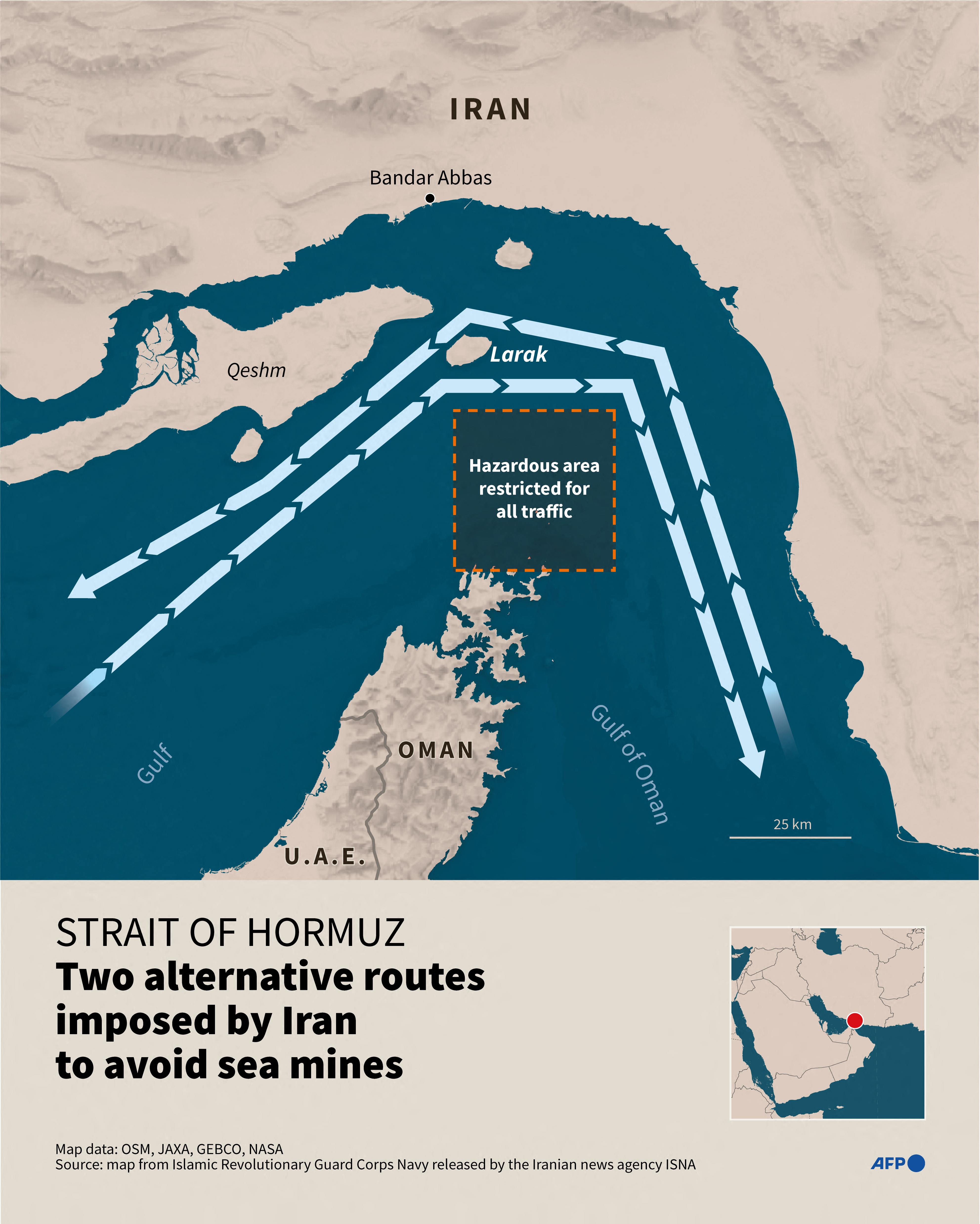
Last week, the Iranian Ports and Maritime Organization published a graphic instructing ships to follow designated entry and exit routes to transit the strait. The organization warned that ships ran the risk of hitting mines outside of these routes. A spokesperson from Lloyd’s List told the BBC: “We know Iran is essentially still in control of the strait, and the assumption is that ship owners will still need to seek permission from the IRGC… and how that’s going to work is still not clear.”
While Trump said the U.S. military would cooperate with other countries to halt maritime traffic through the strait, NATO allies said on Monday they would not take part in the blockade, Reuters reports. Instead, those countries have reportedly indicated they would only consider involvement after the fighting ends.
One country that stands behind the blockade is Israel. Benjamin Netanyahu, Israel’s prime minister, said on Monday that he supports Trump’s decision to impose a naval blockade on Iran and that Tel Aviv is coordinating with Washington on the situation.
“Iran violated the rules [of the peace talks in Pakistan], President Trump decided to impose a naval blockade,” Netanyahu said at a cabinet meeting, according to a video statement released by his office.
In response, Iran’s Islamic Revolutionary Guard Corps (IRGC) warned that “approaching military vessels to the Strait of Hormuz is considered a violation of the ceasefire.”
An Iranian Armed Forces spokesperson said on Monday that restricting vessels in international waters was illegal and “amounts to piracy.”
Iran would decisively implement a “permanent mechanism” to control the Strait of Hormuz, the spokesman added.
“Security in the Persian Gulf and the Sea of Oman is either for everyone or for NO ONE,” the military said, according to the state broadcaster IRIB. “NO PORT in the region will be safe.”
While unclear at this point if related or not, the Ambrey maritime security firm told TWZ that a merchant vessel had sighted an explosion and a fire in the Fateh Oil Field, approximately 45 nautical miles northwest of the port of Jebel Ali, in the United Arab Emirates.
“Video footage and still imagery showed that the fire extended above the horizon to a significant altitude, Ambrey said. “The vessel did not report hearing any distress calls. At the time of writing, no casualties, damage to merchant vessels, or damage to port infrastructure had been reported,” the security firm added.
Iran’s parliamentary speaker, Mohammad Bagher Ghalibaf, took to X with a message to the United States yesterday, posting a map showing gas prices in Washington, DC, and the words: “Enjoy the current pump figures. With the so-called ‘blockade’, soon you’ll be nostalgic for $4–$5 gas.”
Earlier, Ghalibaf said Trump’s new threats would not affect the Iranian nation: “If you fight, we will fight … We will not bow to any threats.”
Trump claims that the U.S. military has already “obliterated” 158 Iranian ships. “Iran’s navy is laying [sic] at the bottom of the sea,” he wrote on his social media platform Truth Social.
The Wall Street Journal previously warned that, while the United States and Israel have wiped out much of Iran’s conventional navy, the fleet of the Islamic Revolutionary Guard Corps, which Tehran relies on to exert control over the Strait of Hormuz, remains largely intact.
The paramilitary IRGC maintains a large fleet of smaller, more agile vessels built to dominate the strategic waterway using missiles, mines, and otherwise to harass commercial shipping.
Farzin Nadimi, an Iran-focused senior fellow with the Washington Institute, a U.S.-based think tank, told the WSJ that more than 60 percent of the IRGC’s fast-attack craft and speedboat fleet remains intact and that it continues to pose a threat.
Reflecting on Iran’s “fast attack ships,” Trump said they are not considered “much of a threat” to the blockade. He threatened to take down these ships using the same “system of kill” used against “drug dealers on boats,” a reference to U.S. military operations in the Caribbean.
Since the conflict began on February 28, the strait’s geography has enabled Iran to use it as a strategic lever, restricting access through the narrow passage and driving up oil prices as a result. Tehran has also been demanding large payments from some vessels for safe passage.
By enforcing the blockade, Trump could deprive the Iranian government of a key source of income, though it also runs the risk of pushing global oil and gas prices even higher.
This also ties in with reports that Trump and his advisers have received warnings from officials and corporate leaders about the potential hit on the U.S. economy from a prolonged war.
On the other hand, there remains a question about just how significant an effect on Iran a blockade of this kind will have.
According to Lars Jensen, the chief executive of analysts Vespucci Maritime, in the near term, the blockade of the strait will only halt “a very tiny trickle of vessels.” Meanwhile, any other ships paying tolls to Iran already face sanctions for funding the regime.
While the blockade is calculated to help pressure Iran into making a deal on American terms, Trump has said he is unconcerned about whether Tehran returns to negotiations. “I don’t care if they come back or not,” he said on Sunday. “If they don’t come back, I’m fine.”
China is becoming an increasing factor in the crisis in the Middle East. With each passing day, Beijing’s energy situation becomes more of a problem, with impacts from the strangulation of oil out of the Strait becoming more pronounced. Iran is a key supplier of oil to China.
In a statement yesterday, before the blockade came into force, the Chinese defense minister, Adm. Dong Jun, said that his country was “monitoring the situation in the Middle East. Our ships are moving in and out of the waters of the Strait of Hormuz,” he added. “We have trade and energy agreements with Iran. We will respect and honor them and expect others to not meddle in our affairs. Iran controls the Strait of Hormuz, and it is open for us.”
CENTCOM declined to respond to our questions about the current rules of engagement or what would happen should a Chinese vessel try to pass through the strait.
According to The Wall Street Journal, citing officials and people familiar with the situation, Trump and his advisers are looking at resuming limited military strikes in Iran in addition to the blockade of the strait. The same officials reportedly said that a full-fledged bombing campaign is considered less likely, “given the prospect of further destabilizing the region and the president’s aversion to prolonged military conflicts.”
UPDATES:
We have concluded our coverage for the day.
UPDATE: 6:25 PM EDT –
In an interview with Fox News this afternoon, Vance said there were some positives to be gleaned from the negotiations with Iran.
”I think it was the first time that you’d ever seen the Iranian government, the U.S. government meet at such a high level, maybe in the history of the current leadership of Iran. So that’s, I think, a positive—and again, we did make some progress in the negotiation,” the vice president proffered. “What the president of the United States has said is number one, Iran can never have a nuclear weapon. So, all of our red lines flow from that fundamental premise.”
USNI is reporting that the aircraft carrier USS George H.W. Bush did not transit the Strait of Gibralter, but is instead “operating off the coast of Namibia, as it sails around the African continent and is set to join a growing naval force in the Arabian Sea amid a U.S. blockade of the Strait of Hormuz…The path around Africa allows the carrier and its escorts to avoid transiting the Red Sea and the Bab el-Mandeb, which were both hubs of activity for the Houthis in their drone and missile attacks on U.S. and commercial shipping in 2024 and 2025.”
UPDATE: 5:00 PM EDT –
UN Secretary General António Guterres is pushing for the United States and Iran to resume negotiations that would end the conflict.
“After weeks of destruction & distress, it is clear that there is no military solution to the current conflict in the Middle East. I call for resumption of talks for an agreement to be reached,” Guterres said on X. “The ceasfire [sic] must absolutely be preserved. All violations must cease. All parties to the conflict must respect the freedom of navigation, including in the Strait of Hormuz, in line with international law.”
UPDATE: 4:40 PM EDT –
President Trump’s remarks on Iran during an impromptu White House press appearance on Monday appeared to dampen expectations for a swift diplomatic resolution to the conflict.
“They will never have a nuclear weapon,” Trump told reporters shortly after accepting a DoorDash delivery of McDonald’s, staged to highlight his tax policy eliminating levies on tips.
“If they don’t agree, there’s no deal. There’ll never be a deal. Iran will not have a nuclear weapon, and we’re going to get the dust back. We’ll get it back, either we’ll get it back from them, or we’ll take it.”
A U.S. official said “there is continued engagement between the U.S. and Iran and forward motion on trying to get an agreement,” multiple outlets reported.
CNN’s coverage of the ongoing U.S.-Iran conflict included a direct quote from the official, while a Reuters alert similarly referred to continued engagement, also attributing the information to an official.
UPDATE: 3:23 PM EDT –
AEI estimates Epic Fury costs between $25 and $35 billion.
UPDATE: 1:30 PM EDT –
The United States asked that Iran agree to a 20-year moratorium on uranium enrichment during talks in Pakistan this weekend, Axios reported Monday.
Citing a source familiar with the situation as well as a U.S. official, Axios said that Iran responded with a proposed “single-digit” timeframe.
Bloomberg reports that it is unclear where Trump got the figure of 34 ships passing through the strait yesterday, saying that it has a smaller figure.
Trump says Iran wants to make a deal and that he will not come to any agreement that allows Tehran to have a nuclear weapon.
He said that Iran had “called this morning” and that “they’d like to work a deal.”
The aircraft carrier USS George H.W. Bush has reportedly passed through the Strait of Gibraltar and is expected to arrive in the eastern Mediterranean before the end of the week. The carrier will take the place of the USS Gerald R. Ford, which suffered a fire while underway in the Middle East, and is now being repaired at Souda Bay in Crete. You can keep up to date on these movements using TWZ’s weekly carrier tracker monitoring America’s flattop fleet, including deployed Carrier Strike Groups and Amphibious Ready Groups, using publicly available open-source information.
U.K. Prime Minister Keir Starmer on Monday reaffirmed that Britain will not take part in any blockade of the Strait of Hormuz.
Speaking to the BBC, Starmer said the government’s priority is ensuring the strait is fully reopened.
“All the time the strait is shut or not free for navigation in the way it should be, that means oil and gas is not getting to market, that means the price is going up, and everybody listening to this is facing higher energy bills,” Starmer said. “I don’t want that to happen. I want their energy bills to be stabilized and lower.”
After the Islamabad talks, it is clear that the Iranian nuclear issue remains the top sticking point. In a cabinet meeting today, Israel’s prime minister, Benjamin Netanyahu, said he had spoken to U.S. Vice President JD Vance about the negotiations. “The explosion came from the American side, which could not tolerate Iran’s blatant violation of the agreement to enter the negotiations,” Netanyahu said. “The agreement was that they would cease fire, and the Iranians would immediately open the gates. They did not do that. The Americans could not accept that. He also made it clear to me that the main issue on the agenda for President Trump and the United States is the removal of all enriched material, and ensuring that there is no more enrichment in the coming years, and that could be in decades, no enrichment within Iran.”
Again, on the nuclear issue, Kremlin spokesman Dmitry Peskov told reporters on Monday that Russia is ready to take in Iran’s highly enriched uranium as part of a future peace deal with the United States.
Israel’s military announced on Monday that it has started what it described as targeted ground operations in the Bint Jbeil area of southern Lebanon.
Although Iran and Pakistan claim that the temporary ceasefire brokered by Pakistan last week also covers Lebanon, Netanyahu stated that there is “no ceasefire in Lebanon” and that Israel will continue to strike Hezbollah “with full force.”
David Ignatius, an associate editor and columnist for The Washington Post, has provided his prediction on what might happen after the failure to reach a deal in Islamabad over the weekend. Ignatius writes:
“After talking Sunday with people close to the negotiations, my sense is that the Islamabad impasse won’t necessarily mean a return to war. The blockade is a pressure tactic, to be sure, but not primarily a military one. Trump has no appetite for further armed conflict. He knows that the upsides are limited and the ‘tail risk,’ as financial traders like to say, is large. His aim instead is to put a severely battered Iran into an economic vise to see if its leaders will set a different course in a big, comprehensive deal.”
Meanwhile, citing a regional source and a U.S. official, Axios reports that Pakistani, Egyptian, and Turkish mediators will continue talks with the United States and Iran in the coming days, “in an effort to bridge the remaining gaps and reach a deal to end the war.”
Pakistani Prime Minister Shehbaz Sharif also indicated on Monday that efforts are still being made to resolve the conflict.
Trump launched a sharp attack on Pope Leo XIV over the weekend, calling him “weak on crime and terrible for foreign policy” and accusing him of harming the Catholic Church. “Leo should get his act together as Pope,” he wrote on Truth Social. The criticism came after Leo condemned the “delusion of omnipotence” as driving the U.S.-Israel war in Iran and urged political leaders to halt the fighting and pursue negotiations.
“I have no intention to debate with [Trump],” Leo said today. “The message is the same: to promote peace,” he added.
Contact the author: thomas@thewarzone.com
Loading comments…
Comments couldn’t be loaded. Please refresh the page.