
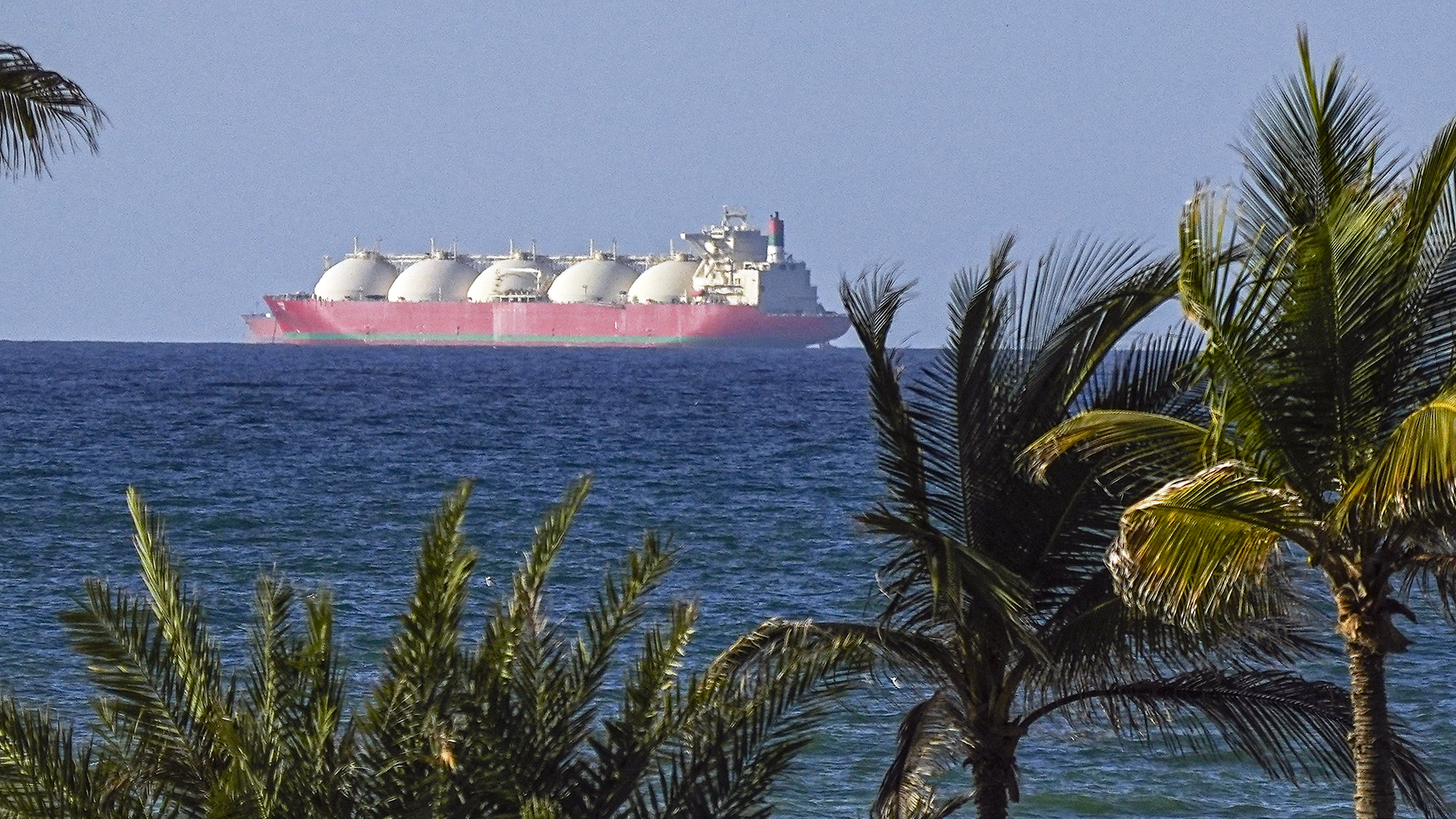
Donald Trump said he is “very optimistic” that a peace agreement with Iran is close, as a diplomatic team led by Vice President JD Vance heads to Pakistan for high-stakes talks this weekend aimed at ending the war. Meanwhile, however, there is no indication that Iran is easing its near-total blockade of the Strait of Hormuz, which has triggered what is reportedly the most severe disruption to global energy supplies on record.
Vance is leading the American delegation, joined by special envoy Steve Witkoff and Donald Trump’s son-in-law Jared Kushner, both of whom participated in three rounds of indirect nuclear talks with Iranian negotiators in Oman before the United States and Israel launched strikes on Iran on February 28.
Boarding Air Force Two on his way to the Pakistani capital of Islamabad, the vice president said, “We’re looking forward to the negotiation. I think it’s gonna be positive. We’ll of course see.”
Vance also cited Trump, adding: “If the Iranians are willing to negotiate in good faith, we’re certainly willing to extend the open hand.”
But he said: “If they’re gonna try and play us, then they’re gonna find that the negotiating team is not that receptive.”
Iran’s parliament speaker, Mohammad Baqer Qalibaf, said on Friday that two previously agreed conditions — a ceasefire in Lebanon and the unfreezing of Iranian assets — must be fulfilled before any negotiations can begin.
Posting on X, he stated that these steps were part of mutual commitments between the parties and cautioned that talks should not proceed until they are implemented, as disagreements over ceasefire terms and ongoing fighting in Lebanon continue to escalate.
President Trump said that Iran has “no cards,” in a post on social media today.
Writing on Truth Social, he said: “The Iranians don’t seem to realize they have no cards, other than a short-term extortion of the World by using International Waterways. The only reason they are alive today is to negotiate!”
The New York Post reports that Trump is preparing military options in case talks with Iran fail. “We’re going to find out in about 24 hours. We’re going to know soon… We’re loading up the ships with the best weapons ever made, even at a higher level than we use to do a complete decimation.”
In regard to the upcoming discussions, the U.S. president had previously said that Iran’s leaders “talk much differently when you’re at a meeting than they do to the press. They’re much more reasonable,” echoing his administration’s view that Tehran’s private messaging differs from its public statements.
Meanwhile, U.S. military transport aircraft are already arriving in Pakistan ahead of the talks, including this Air Force C-17.
At the same time as U.S. negotiators were heading to Pakistan, multiple reports indicated that at least some of their Iranian counterparts were still to depart for the talks.
The delegation was expected to be led by the Iranian foreign minister, Abbas Araghchi, and the parliament speaker, Mohammad Bagher Ghalibaf.
Ghalibaf had previously taken to social media to reiterate that Lebanon and the release of Iran’s blocked assets had been “mutually agreed upon between the parties” but are yet to be implemented. In a post on X, he said: “These two matters must be fulfilled before negotiations begin.”
UPDATES:
We have concluded coverage for the day.
UPDATE: 4:35 PM EDT –
Imagery released by Al Jazeera shows the wreckage of an Iranian Air Force Su-24MK Fencer strike aircraft that was shot down by the Qatar Emiri Air Force over the Persian Gulf while nearing Qatari airspace.
UPDATE: 4:25 PM EDT –
Within the last hour, Jennifer Jacobs, CBS News senior White House reporter, posted this photo to X, showing the aircraft carrying Vice President Vance about to touch down in Paris, en route to Pakistan.
Further to our previous reporting, France has released footage of its Tiger attack helicopters and Rafale fighters intercepting Iranian drones over the Middle East during the Iran war.
UPDATE: 4:20 PM EDT –
The Iranian delegation has reportedly now arrived in Islamabad. Iranian media reports that the Iranian negotiating delegation is led by Parliament Speaker Mohammad Baqer Qalibaf.
UPDATE: 3:30 PM EDT –
According to SPG Energy Oil data shared with NBC News, just two ships crossed the Strait of Hormuz today, the lowest daily total since Trump announced the Iran ceasefire on Tuesday. Prior to the conflict, 130 to 160 ships typically transited the waterway each day.
UPDATE: 3:20 PM EDT –
In a televised address, Pakistan Prime Minister Shehbaz Sharif described upcoming U.S.-Iran talks as “a make-or-break moment.”
“I ask all of you to pray that these talks are successful and countless lives are saved and the world shall see peace,” he said.
UPDATE: 3:10 PM EDT –
President Trump is preparing a $98-billion supplemental spending request for U.S. military operations in Iran, a significantly lower figure than earlier Pentagon proposals, according to two people familiar with the administration’s plans, NOTUS reports.
Defense officials initially proposed packages nearing $250 billion to fund troop, ship, aircraft, and weapons deployments to the region and to speed munitions production — a top Pentagon priority. Estimates put the cost of Operation Epic Fury to date at $25 billion to $35 billion.
Joseph Haboush, Washington correspondent for Al Arabiya, writes that a first phone call between the Lebanese and Israeli ambassadors to the United States will take place imminently. This is expected to pave the way to direct negotiations next week.
Further strain on the current temporary ceasefire comes from continued Israeli strikes on Lebanon, which both Iran and Pakistan say breach the truce. Trump says that he believes Israel is now “scaling back” its operations in Lebanon.
Israel has carried out a new wave of strikes targeting what it described as “Hezbollah launch sites” in Lebanon, after the Israel Defense Forces (IDF) earlier urged residents to evacuate Beirut’s densely populated southern suburbs. Later, Hezbollah said it launched a barrage of rockets toward settlements in northern Israel.
According to the Israeli military, Hezbollah fired around 30 projectiles from Lebanon into Israel on Friday, causing some damage.
The IDF chief of staff, Eyal Zamir, said Israeli forces are continuing combat operations in southern Lebanon and are “not in a ceasefire” with Hezbollah. Zamir added: “The IDF is in a state of war; we are not in a ceasefire, we continue to fight here in this sector, this is our main fighting sector. In Iran, we are in a ceasefire, and we can return to fighting there at any moment, and in a very powerful manner.”
The IDF said in a statement that it has destroyed more than 200 rocket launchers, including approximately 1,300 launch tubes, belonging to the Iran-backed militant group since March 2.
Israeli Prime Minister Benjamin Netanyahu said he had directed his cabinet to begin direct negotiations with Lebanon focused on disarming Hezbollah, while maintaining that “there is no ceasefire” in Lebanon and that Israel will “continue to strike Hezbollah with force.”
Lebanon is now insisting on a ceasefire before direct negotiations with Israel can begin, with Lebanese President Joseph Aoun calling it “the only solution.” Beirut is also demanding that the United States serve as mediator and guarantor of any agreement. Those talks are scheduled for next week and will be hosted by the U.S. State Department in Washington.
In a social media post late Thursday, Trump said that Iran was doing a “very poor job” of allowing oil to go through the Strait of Hormuz. “That is not the agreement we have!” The U.S. leader also slammed Iran for reportedly charging tolls for the tankers that receive permission to transit the strait.
Iran is moving to further tighten its control over maritime traffic through the Strait of Hormuz in an effort to increase pressure on the United States, according to the think tank Institute for the Study of War (ISW).
ISW says the strategy is designed to keep oil prices elevated, giving Tehran greater leverage in upcoming negotiations with Washington and improving its ability to secure concessions.
According to the institute, Iranian officials have indicated that no more than 15 vessels per day will be allowed to transit the strait, down sharply from as many as 140 daily before the war. According to the ISW:
“The Iranian Ports and Maritime Organization published a graphic on April 8 instructing ships to follow designated entry and exit routes in coordination with the Islamic Revolutionary Guards Corps (IRGC) Navy to transit the strait. These routes move international maritime traffic into Iranian-controlled waters. The graphic warns that ships risk hitting mines outside of these routes.”
On Thursday, four tankers and three bulk carriers transited the strait, taking the total number of vessels passing through since the ceasefire to at least 12, according to data firm Kpler.
The Strait could be open, and the supply of oil can return to usual in the next two months, according to National Economic Council Director Kevin Hassett.
“There are boats going through, but at about 10 percent of the normal pace,” Hassett told Fox Business.
IDF officials told a closed Knesset briefing that Iran’s new leadership is “more extreme than its predecessor,” amid ongoing regional tensions and uncertainty over the durability of the ceasefire. The remarks, first reported by i24NEWS Knesset correspondent Amiel Yarchi, come as Israeli officials assess both the outcome of recent operations and the risk of renewed conflict.
Kuwait has accused Iran and its proxies of carrying out drone attacks against its territory on Thursday, despite the ongoing two-week ceasefire in the Iran conflict.
The Kuwaiti foreign ministry said that drones “targeted some vital Kuwaiti facilities” on Thursday evening.
However, Iran’s Revolutionary Guard (IRGC) has denied launching any new strikes on Gulf states.
In a statement carried on Iran’s state-run IRNA news agency, the IRGC said: “If these reports published by the media are true, without a doubt it is the work of the Zionist enemy or America.”
Just before the ceasefire, the number of ballistic missile interceptors left in Israel’s arsenal had reportedly dwindled to “double digits,” according to a Trump administration source with knowledge of the situation.
The critical shortage had led Israeli military officials to be significantly more selective when confronting ballistic missile attacks from Iran as well as from Yemen. “They’re having to pick and choose what they shoot down,” the official told Drop Site.
Hezbollah claims it targeted Israel’s Ashdod naval base with missiles.
“In response to the enemy’s violation of the ceasefire and its repeated attacks on Beirut, and after the Resistance adhered to the ceasefire while the enemy did not, the fighters of the Islamic Resistance targeted… the naval base in the port of Ashdod with missiles,” the group said in a statement.
Volodymyr Zelensky has said that Ukrainian teams sent to the Middle East to strengthen regional air defenses have successfully shot down Iranian Shahed drones.
“We demonstrated to some countries how to work with interceptors,” the Ukrainian president said in a post on X.
“Did we destroy Iranian ‘Shaheds?’ Yes, we did. Did we do it in just one country? No, in several. And in my view, this is a success.”
Zelensky said Ukrainian forces participated in active operations using domestically produced, combat-tested interceptor drones.
“This was not about a training mission or exercises, but about support in building a modern air defense system that can actually work,” he added.
The Israeli military has accused Hezbollah of using ambulances for military purposes.
In a post on X, Avichay Adraee, the Arabic-language spokesperson for the IDF, claimed that the militant group has been making “extensive military use” of ambulances, without providing evidence.
The United Arab Emirates says it will reassess which regional partners it can “rely on” and review its national priorities after bearing the brunt of Iranian attacks during the conflict.
UAE presidential adviser Anwar Gargash said Abu Dhabi will “scrutinize” its “regional and international relationships” while strengthening an economic and financial system that boosts resilience.
The U.K. defense minister, Luke Pollard, has raised the possibility of Britain bringing allies and partners together to work out solutions to reopen the Strait of Hormuz. Pollard said that the United Kingdom can play a “unique convening role.”
He also hit back at Trump’s claims that the Royal Navy is “too old” and that its aircraft carriers “don’t work” and are “toys.” “We’ve got a strong Royal Navy,” he told the BBC. “We’ve got a globally deployed navy at the moment.”
Photos have been published online that claim to show the hulk of Iran’s sea base-like ship Shahid Mahdavi, a converted container ship that missiles and drones could be launched from. It was the target of U.S. airstrikes earlier in the conflict.
Reports out of France, citing French military officials, state that French Army Tiger helicopter gunships deployed in the United Arab Emirates have shot down their first Iranian drones, although when this happened is unclear. The helicopters used their 30mm cannons to bring down the Shahed-type drones, rather than Mistral air-to-air missiles. Meanwhile, the integration of laser-guided rockets for the counter-drone role is said to be making progress.
An intriguing photo of the aftermath of the attack on a U.S. command post in Kuwait that killed six American service members reveals a single Soviet-era free-fall aircraft bomb. This led to much speculation that it may have been dropped on the base by Iran, most likely using a Su-24 Fencer strike aircraft, two examples of which were shot down by Qatar.
Trevor Ball, a conflict researcher at Bellingcat, has got to the bottom of the story, namely that the bomb was an inert example that was placed outside the base as an ornament. The same weapon can also be seen in official photos of the base taken long before the conflict.
Contact the author: thomas@thewarzone.com
Loading comments…
Comments couldn’t be loaded. Please refresh the page.