
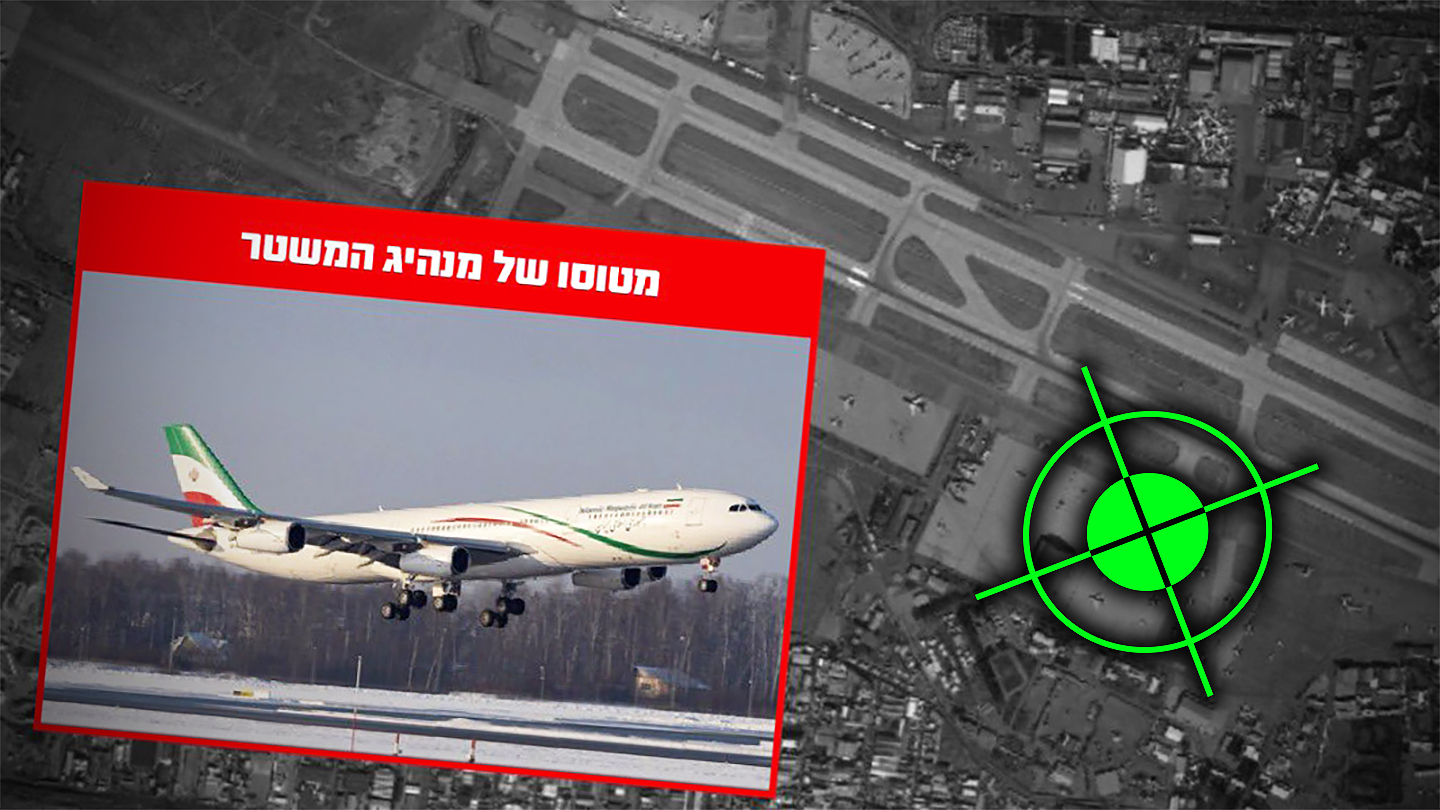
The Israeli Air Force (IAF) claims that it destroyed the Iranian government’s Airbus A340 in a strike on Mehrabad International Airport in Tehran. Last summer, the aircraft had been part of an exodus of Iranian state-operated airliners to Oman, but its apparent demise now underscores the intensity of the current airstrikes against Iran, which have been systematically removing aircraft of all types from the Iranian inventory.
In a statement on X, the IAF described the A340-300 as “the plane of the leader of the Iranian terror regime” and a “strategic asset,” and said that its destruction “impairs the ability to coordinate between the leadership of the Iranian terror regime and Axis countries, in building military power, and in the regime’s rehabilitation capability.” The IAF posted a library photo showing the A340, which it says was also used by “additional senior officials from the terror regime, and elements in the Iranian military, to advance military procurement and manage relations with Axis countries through domestic and international flights.”
The fact that any airlift-capable aircraft, whether military or civilian by design, can be used to move materiel to Iranian proxies has long been a problem for Israel. With the IAF destroying its airlift fleet, Iran will find it harder to connect with proxies, providing support, as well as engaging in a variety of other nefarious activities.
At this stage, it should be noted that the destruction of the A340 has not yet been independently verified. TWZ has approached various commercial providers of satellite imagery for confirmation.
Previous satellite imagery showed the A340 parked in different dispersed areas around the airport, including among derelict airframes. This was almost certainly an effort to complicate targeting.
A satellite image of Mehrabad showing the runway blocked with parked buses and helicopters, rendering it unusable:
The A340 in question has the Iranian civil registration EP-IGA and is the largest aircraft in Iran’s modest government transport fleet. Widely described as ‘Iran Force One,’ in reference to the U.S. president’s Air Force One, the A340 has been used by the Iranian state for a variety of long-haul missions, making use of its widebody capacity and intercontinental range. In general, the A340 has been a fairly popular choice as a government transport, with VIP A340s having been operated by Egypt, France, Jordan, Libya, Qatar, and Saudi Arabia, among others.

In practice, Iran’s supreme leader only left the country occasionally, with the A340 primarily being used to move other high-ranking officials on diplomatic visits. For example, it was used to transport Iranian President Masoud Pezeshkian to the United States for the main annual United Nations General Assembly meeting in 2024.
The A340, which was operated by the Islamic Republic of Iran Air Force (IRIAF), despite its civilian-style livery, had a complicated history. It was first delivered to Air Canada in 1999, before flying under the colors of Air Jamaica, Turkish Airlines, AirBlue, and Asian Express. By 2015, it was owned by Tehran-based Meraj Airlines, which leased it to the Iranian government. It spent a period with Dena Airways, a passenger charter carrier based out of Mehrabad, but by 2018, it belonged to the Iranian government and was registered as EP-IGA.
Serving alongside the A340 in the Iranian government’s transport fleet were at least one Airbus A321-200 and a pair of BAe Avro RJ85 regional jets. Their fates remain uncertain at this stage.
Mehrabad has been hit particularly hard by U.S.-Israeli airstrikes, with targeted aircraft including the unique KC-747 aircraft operated by the IRIAF. The tanker version of the 747 was not flown anywhere else in the world, and Iran had just one flying example. You can read all about the aircraft in this past article.
Smoke rises after a reported Israeli strike on Mehrabad on March 3:
In June 2025, during the previous conflict with Israel, the A340 made an unusual flight to the Oman capital, Muscat. The widebody touched down there together with a pair of Airbus A321s, leading to speculation that they were transporting a delegation from Iran to try to negotiate an end to the fighting before the United States became involved.
Since Iran and Oman had strong diplomatic ties, with the Omanis often serving as an intermediary between the regime in Tehran and the West, this certainly seems a likely explanation.
Other options that we discussed at the time included the evacuation of individuals seeking to escape the current conflict. This became particularly urgent after Israel began striking Tehran, as well as other locations across western Iran, with virtual impunity.
There’s also the very strong possibility that the Iranian government moved these aircraft for their own protection from the Israeli strikes on Iranian air bases, including Mehrabad, where IRIAF F-14 Tomcat fighters were also targeted.
Regardless of the purpose, by the end of June, the United States was not only fending off Iranian attacks but had also bombed three key Iranian nuclear sites in Operation Midnight Hammer.
While the A340 made its way back to Tehran after the Twelve-Day War, its apparent destruction in an Israeli airstrike means that it won’t be able to repeat any such missions, and it is now little more than a symbol of the intensity of the U.S.-Israeli campaign to wipe out the Islamic Republic of Iran Air Force fleet alongside other key military capabilities.
Contact the author: thomas@thewarzone.com
Loading comments…
Comments couldn’t be loaded. Please refresh the page.