
U.S. President Donald Trump continues to weigh a military response to Tehran’s harsh crackdown on anti-regime protesters raging on for a fourth week. During a White House press conference on Tuesday, the U.S. leader refused to rule out a kinetic response against Ayatollah Ali Khamenei and his government. Whatever path Trump chooses, the U.S. military buildup in the Middle East for a possible attack is continuing. The USS Abraham Lincoln Carrier Strike Group (CSG) continues to make its way west toward the region as additional tactical combat aircraft, cargo jets and aerial refuelers fly east.
You can catch up with our previous coverage of unfolding events in the Middle East here.
“Is the military option off the table? No,” Trump proclaimed in response to a question about his plans toward Iran.
Before answering the question, Trump repeated his assertion that Tehran was holding off executing protesters.
“So with Iran, they were going to hang 837 people,” Trump explained. “And we let them know that if that happens, that will be a very bad day for them. And they decided not to do it. They didn’t hang the people.”
“I can’t tell you what’s going to happen in the future, but supposedly they’ve taken that off the table,” he added. “But they were going to last week, they were going to hang on Thursday or Wednesday, they were going to hang – I think – 837 people, and they didn’t hang anybody. So we’re just going to have to see what happens with Iran.”
Trump has repeatedly threatened the regime over its brutal response to protests that have left thousands dead. He also promised those taking to the streets that help was on its way. However, he relented after being told the killings would stop and reportedly called off a strike against Iran last week.
Meanwhile, new images and videos have emerged on social media showing the regime’s violence against its own people. Iranian citizens began speaking out against the regime on Dec. 28 over rising prices, devalued currency that saw the rial crater now to basically nothing, a devastating drought, and brutal government crackdowns.
The current situation in Iran is difficult to determine due to an ongoing government blackout of internet and telephone service.
While there has been no U.S. military action against Iran, the rhetoric between the two nations remains heated. Tehran on Tuesday warned Trump not to take any action against Khamenei.
“Trump knows that if any hand of aggression is extended toward our leader, we not only cut that hand but also we will set fire to their world,” Gen. Abolfazl Shekarchi, a spokesman for Iran’s armed forces, said.
Shekarchi’s comments follow Trump’s call on Saturday for regime change.
“It’s time to look for new leadership in Iran,” Trump told Politico.
Four days before that, Iranian state TV broadcast a direct threat against Trump, showing an image of him after the July 2024 attempted assassination in Butler, Pennsylvania. That image was accompanied by a Persian message reading “this time, the bullet won’t miss.”
Amid the bluster, the Lincoln CSG has passed through the Strait of Malacca and made its way westward into the Bay of Bengal and presumedly toward the CENTCOM region, according to the latest information from the MarineTraffic.com website. However, the ship turned off its transponder and is now traveling ‘dark.’
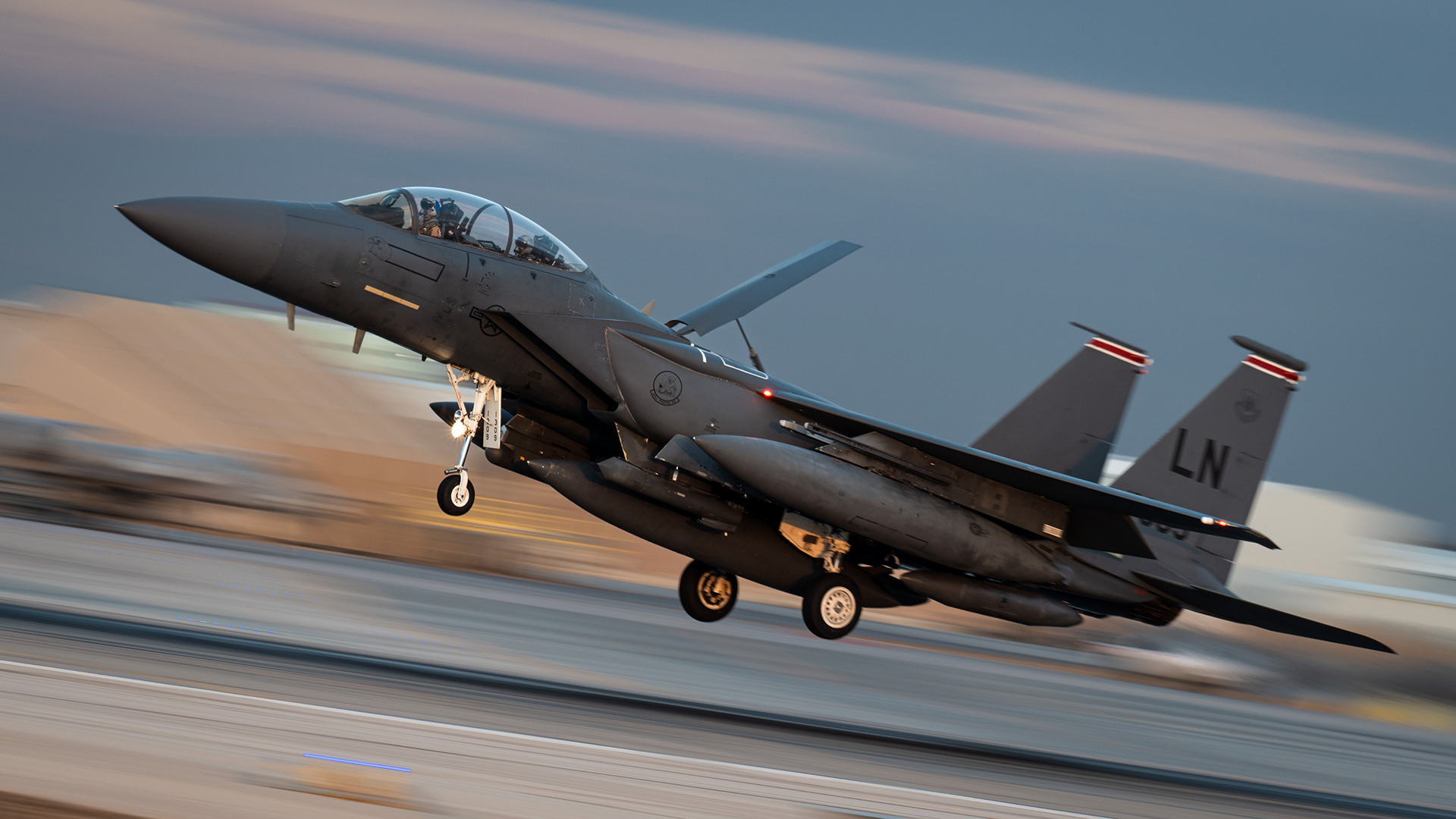
Online flight trackers are reporting that F-15E Strike Eagles, accompanied by KC-135 Stratotanker aerial refueling jets, headed east from RAF Lakenheath in England to the Middle East.
The F-15Es, especially those from RAF Lakenheath, are a staple in the Middle East and have maintained a near constant presence in Jordan for nearly a decade. They also were at the tip of the spear when it came to defending against multiple instances of Iranian drone and cruise missile barrages on Israel. They are now more capable of that mission than ever before. Their departure to the Middle East was largely expected due to the current instability and saber rattling. Beyond its offensive capabilities, if Iran were to launch a major attack on Israel and/or U.S. assets in the region, preemptive or in retaliation, the F-15Es would play a key part in defending against those attacks.
Though it has repeatedly declined to comment on the current status of forces in the region, CENTCOM did post an image of an F-15E landing in the Middle East on Tuesday.
There has also been an increase in C-17 Globemaster III cargo jets heading toward the region as well. Any action against Iran would likely require an influx of air defense systems, materiel and troops, requiring the use of transports.
Though the U.S. will likely need more air defenses, there are some already in the region, like this Electronic Advanced Ground Launcher System showcased by CENTCOM in a recent X post.
The U.S. Air Force has also flown M1 Abrams tanks and M2 Bradley Fighting Vehicles to the region, but it is unclear if that is related to any operations involving Iran.
As we have pointed out before, even though the U.S. has tactical aircraft, six warships and some 30,000 troops in the region, it does not appear to be prepared for any major sustained operations against Iran that could radically alter the status quo, or the expected barrage of missiles and drones that would follow. It remains unclear at the moment whether this buildup is designed for a new offensive against Iran or to defend against any attacks.
As the U.S. military presence in the region grows, Israel is preparing for an attack on and from its archenemy, which it most recently fought during the 12-Day War in June.
Jerusalem “will act with might that Iran has not seen before,” Israeli Prime Minister Benjamin Netanyahu said on Monday.
“We are closely following what is happening in Iran,” Netanyahu told the Knesset, The New York Post noted. “We are all looking with a sense of wonder at the heroic struggle of Iran’s citizens to achieve liberty, welfare and justice. We see the atrocities of the massacre ordered by the rulers of Iran.”
“No one can predict what tomorrow will bring in Iran, but one thing is clear: no matter what happens, Iran will not return to being what it was,” the Israeli leader warned.
Officials in Jerusalem say they are willing to suffer a massive Iranian barrage if it means a new government there.
“Even in an extreme scenario involving the launch of 700 missiles from Iran—compared to approximately 500 launched during Operation Rising Lion—the strategic cost-benefit assessment in Jerusalem remains fundamentally unchanged,” Israel’s YNET news outlet reported. “In the view of Israeli decision-makers, if a military operation could lead to the collapse of the Iranian regime, the price would not only be acceptable but worthwhile, particularly given the capabilities pushed to their limits in the recent conflict.”
The status of Israel’s interceptor stockpiles is unclear, especially when it comes to its advanced and very expensive Arrow anti-ballistic missile defense interceptors. Reports have stated that Israel isn’t prepared to successfully defend against another sustained series of attacks from Iran so soon after the war in June due to concerns over these stockpiles. How much the U.S. can further offset any deficiencies isn’t clear, either, as it already participated deeply in the defense of Israel from Iranian ballistic missiles during the war. At the same time, Iran has pushed production of ballistic missiles into high-gear since the end of the war. Both sides have learned critical lessons from the war in terms of how to be more successful at offense and defense with the weapons they have, as well.
Regardless, if these recent reports are true, it seems clear that Israel either has the interceptors it needs or it’s willing to endure massive damage to put an end to the regime in Tehran.
At the moment, the guns of January remain locked and loaded, but no one has yet to fire the first shot. We will continue to monitor this tense situation and provide updates when warranted.
Update: 7:47 AM Eastern Jan. 21-
As we projected, the U.S. is sending additional Patriot and Terminal High Altitude Area Defense (THAAD) systems to the Middle East to for increased protection from any Iranian attack, The Wall Street Journal reported.
Iran’s Foreign Minister Abbas Araghchi made a direct threat against Trump in an opinion piece published by the Journal.
“Unlike the restraint Iran showed in June 2025, our powerful armed forces have no qualms about firing back with everything we have if we come under renewed attack,” Araghchi wrote, referring to the 12-day war launched by Israel on Iran in June. “This isn’t a threat, but a reality I feel I need to convey explicitly, because as a diplomat and a veteran, I abhor war.”
“An all-out confrontation will certainly be ferocious and drag on far, far longer than the fantasy timelines that Israel and its proxies are trying to peddle to the White House,” he added. “It will certainly engulf the wider region and have an impact on ordinary people around the globe.”
Responding to Iranian threats against him, Trump vowed there would be a massive U.S. response should he be assassinated.
“Well, they shouldn’t be doing it, but I’ve left notification,” Trump told NewsNation Tuesday night. “If anything ever happens, the whole country is going to get blown up. Originally, Biden should have said something. When they made a statement, we always said, ‘why isn’t Biden saying anything?’ Because he didn’t. But a president has to defend a president. If I were here and they were making that threat to somebody, even not even a president but somebody like they did with me, I would absolutely hit them so hard. But I have very firm instructions. If anything happens, they’re going to wipe them off the face of this Earth.”
Contact the author: howard@thewarzone.com
Loading comments…
Comments couldn’t be loaded. Please refresh the page.