
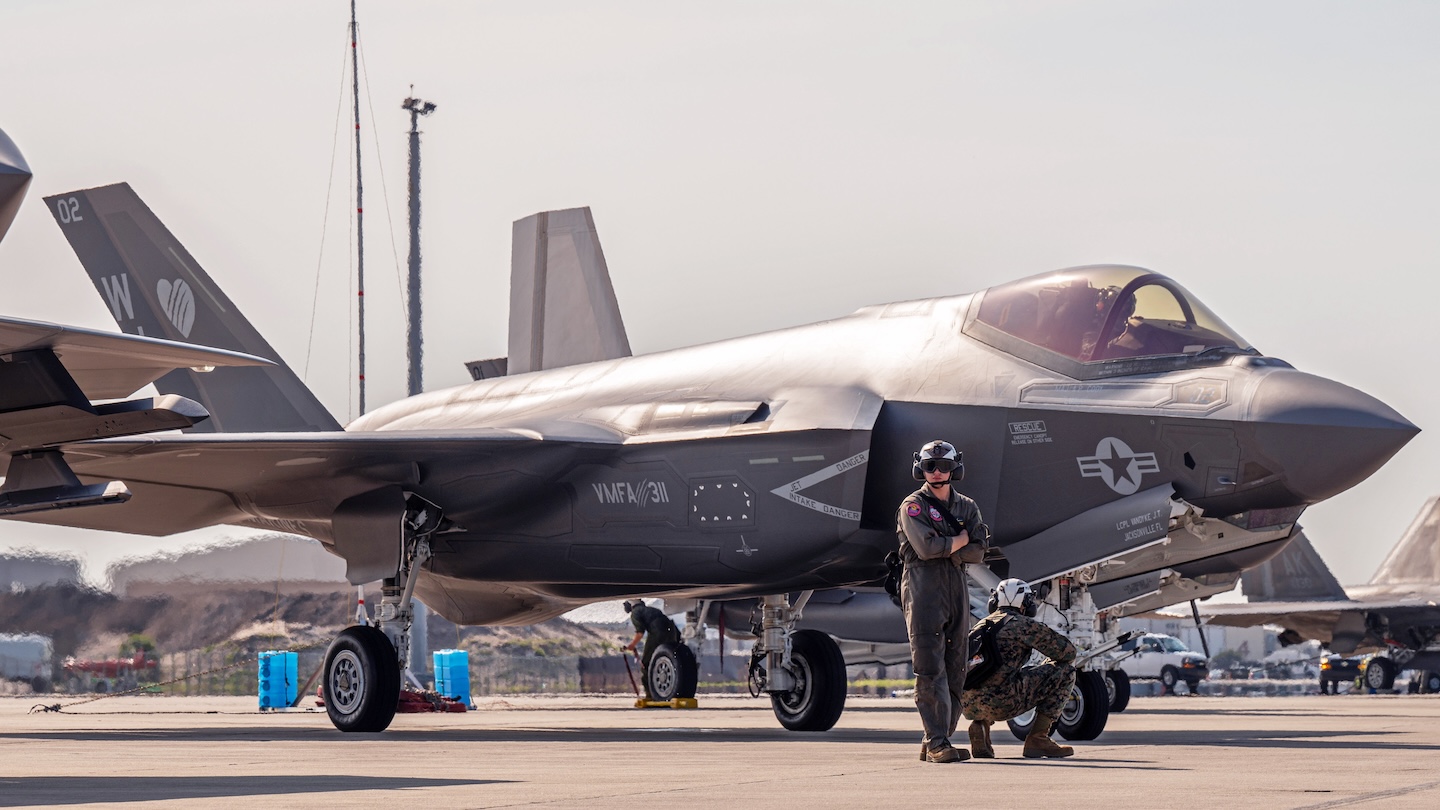
F-35Cs from the U.S. Marine Corps are the latest fighters poised to deploy to the Middle East region for Operation Epic Fury. The movement of these aircraft to RAF Lakenheath in England signals what is set to be the first land-based combat deployment for the F-35C, the carrier variant of the Joint Strike Fighter flown by both the Navy and Marine Corps.
According to open sources, the first five of a planned 10 F-35Cs from Marine Fighter Attack Squadron 311 (VMFA-311), the “Tomcats,” touched down at Lakenheath yesterday. They had been noted departing their home base of Marine Corps Air Station Miramar, California, on March 10.

Their final destination, in the U.S. Central Command (CENTCOM) area of responsibility, is unknown, but they will join a significant force of combat aircraft already flying missions in the region. These include land-based U.S. Air Force F-35As and Marine Corps F-35Cs flying from the carrier USS Abraham Lincoln. Marine Corps F-35Bs are also now reported to be headed to the region aboard two amphibious assault ships, the USS Boxer and the USS Tripoli.
Open-source satellite imagery captured over the Indian Ocean yesterday indicates that the USS Tripoli is now docked at Diego Garcia in the Indian Ocean. Previously, tracking sources had indicated that the Japan-based USS Tripoli was sailing through the South China Sea, moving fast to join U.S. forces amassed in the CENTCOM area of responsibility. You can read more about what capabilities the Tripoli and its Amphibious Ready Group (ARG) could bring to the campaign here.
According to a report from The Wall Street Journal, the USS Tripoli, the amphibious landing dock USS New Orleans, and roughly 2,200 Marines from the 31st Marine Expeditionary Unit are expected to cross into the U.S. Central Command area on Friday — the day President Trump has set as the deadline for Iran to reopen the Strait of Hormuz. It would take another few days to get the ships in closer proximity to the Persian Gulf, where it’s speculated their island objectives are located, if indeed they are commanded to execute a landing operation at all. The F-35Cs now heading to the region would be a critical close air support capability for augmenting the MEU.
The further buildup of U.S. combat in CENTCOM comes as Iran continues to launch waves of missiles at Israel. At the same time, U.S. President Donald Trump says that Iran wants to make a deal to end the conflict.
The Israel Defense Forces (IDF) confirmed today that Iran launched a barrage of missiles toward its territory, triggering an air raid alert in Tel Aviv.
Israel’s biggest city seems to have been especially heavily hit, with extensive damage seen on at least one multi-story apartment building. The local fire and rescue service said they were searching for civilians trapped in a building in the city.
Official Iranian media channels published this video showing the launch of a Sejjil ballistic missile, reportedly toward Israel. The Sejjil is an advanced two-stage, solid-fuel missile, and one that has apparently been used only rarely in the conflict so far.
As well as bombarding Israel, Iranian officials were on the offensive today, pushing back on Trump’s claim that Washington and Tehran have had “very good and productive conversations regarding a complete and total resolution of our hostilities.”
The Speaker of the Parliament of Iran, Mohammad Bagher Qalibaf, refuted the suggestion that any talks had taken place.
“No negotiations have been held with the U.S., and fake news is used to manipulate the financial and oil markets and escape the quagmire in which the U.S. and Israel are trapped,” he wrote on X.
Meanwhile, the Iranian embassy in South Africa posted an image on X showing a child’s pink steering wheel placed on a car dashboard in front of the passenger seat, mocking Trump’s idea that he could control the Strait of Hormuz alongside Iran’s supreme leader.
Three senior Israeli officials, speaking to the Reuters news agency on condition of anonymity, reportedly consider it highly unlikely that Iran will agree to U.S. demands in any new round of negotiations.
Senior Israeli officials also told Reuters that they expected Israeli Prime Minister Benjamin Netanyahu to convene a meeting of security officials for talks on Trump’s proposal for a deal with Iran.
A Pakistani official has said that direct talks on ending the conflict may be held in Islamabad this week. The official said that the negotiations were likely to involve U.S. Vice President JD Vance, and Trump’s Middle East envoys Jared Kushner and Steve Witkoff.
According to a report from Al Arabiya, citing Israeli newspaper Yedioth Ahronoth, Iranian Foreign Minister Abbas Araghchi has secretly informed U.S. envoy Witkoff that Iranian Supreme Leader Mojtaba Khamenei has approved talks and a potential deal.
Pakistan has emerged as a key facilitator in brokering talks between Tehran and Washington.
The White House confirmed that Trump spoke with Asim Munir, the chief of the Pakistan Armed Forces.
An unnamed European official also told Reuters that, while there had been no direct negotiations between the United States and Iran, Egypt, Pakistan, and various Gulf states were all relaying messages.
The Iranian Fars News Agency reports that the foreign ministers of Iran and Egypt had a phone conversation, in which Iran’s Araghchi presented an update on the latest talks with regional and international actors aimed at reducing tensions in the region.
The Israeli military has continued to hit targets in Iran, with objectives in Tehran being struck for a second day in a row. Iranian news agency Nournews reported that air defense systems were activated across the capital and that multiple explosions were heard.
The IDF today said that Israeli Air Force fighters had carried out extensive strikes in central Tehran. Targets in the Iranian capital included key command centers, including facilities associated with the Islamic Revolutionary Guard Corps’ intelligence arm and the Intelligence Ministry, the IDF said.
Overall, the IDF reports that it struck more than 50 other targets overnight, including ballistic missile storage facilities and launch sites.
UPDATES:
We have concluded our update coverage for the day.
4:30PM EST—
Evidence has emerged of the use of towed decoys by U.S. tactical aircraft during the war in Iran. The example here is an AN/ALE-50, a device that is unreeled out behind an aircraft and provides hostile air defense systems a much larger and more enticing target to attack than the host aircraft itself. As a result, the missile homes in on the decoy and blows it off its wire instead of destroying the jet itself. The appearance of the decoy once again illustrates the popular misconception that the U.S. and Israel have achieved total control of the airspace in Iran and sanitized the threat of ground-based air defenses.
Defense Secretary Pete Hegseth, whom President Trump today said wants to keep the conflict going, has offered his thoughts on the success of Operation Epic Fury so far.
“Never in history has a modern military — Iran had a modern military, a modern navy, a modern air force, modern air defenses, leadership, massive bunker — never has a modern military been so rapidly and historically obliterated, defeated, from day one with overwhelming firepower,” Hegseth said during an address in the Oval Office this afternoon.
4:00PM EST—
U.S. President Donald Trump today hinted at some kind of deal having been struck with Iranian officials, who he said: “gave us a present … a very significant amount of money.”
Speaking in the White House, Trump told reporters the following:
“They did something yesterday that was amazing, actually. They gave us a present, and the present arrived today. I’m not going to tell you what that present is, but it was a very significant amount of money. They gave it to us, and they said they were going to give it. So that meant one thing to me: we are dealing with the right people.
Trump added that the “prize” was oil and gas-related, but provided no further details.
3:50PM EST—
Plans reportedly call for the U.K.’s Royal Navy to head up a “Hormuz Coalition” to reopen the key strait, The Times of London reports.
According to the initial reporting, the Royal Navy, French Navy, and the U.S. Navy will team up to send mine-clearing assets, at least some of which are expected to be autonomous.
The British government has also offered to host a summit for the over 30 nations that signed a joint statement offering “appropriate efforts” to ensure shipping in the strait, Politico reports.
3:40PM EST—
Among the recent targets of airstrikes on Iran is this distinctive building, geo-located in the city of Isfahan. Reportedly, the building was used by an Iranian defense optics manufacturer.
Beyond the 82nd Airborne Division, more U.S. troops could be headed to the Middle East, too, according to Phil Stewart, chief national security reporter at Reuters.
2:30PM EST—
CBS News reports that U.S. officials have told them there are at least a dozen underwater mines in the vital Strait of Hormuz, according to current American intelligence assessments. The U.S. officials, speaking to CBS News under condition of anonymity, said the mines currently employed by Iran in the strait are the Iranian-manufactured Maham 3 and Maham 7 types.
Another U.S. official said the count was less than a dozen.
A useful primer on the main Iranian sea mines can be found below:
Another new arrival at RAF Lakenheath today was this U.S. Air Force AC-130J Ghostrider gunship. The aircraft arrived at the English base from Keflavik in Iceland.
Air Force Special Operations Command has 31 AC-130Js in inventory, which are the only AC-130 variants now in service. The Ghostrider’s armament package includes a 105mm howitzer, as well as a single-barreled 30mm GAU-23/A Bushmaster II automatic cannon. The gunships can also employ an array of precision-guided missiles and bombs via Common Launch Tubes (CLT) and underwing racks. You can learn more about how the Air Force AC-130s have evolved since the introduction of the original AC-130A version in the 1960s here and in The War Zone video below.

2:20PM EST—
An interesting Iranian missile seems to have appeared in a recent targeting video released by the Israel Defense Forces (IDF). The video is described as showing a recent airstrike on an Iranian ballistic missile launcher in western Iran, apparently primed for an attack on Israel. Based on the imagery, this has been identified as a likely Kheibar Shekan two-stage, solid-propellant, truck-launched medium-range ballistic missile (MRBM) that Iran first unveiled in 2022. A third generation of the Fateh family of ballistic missiles, Iran claims it has a maximum range of 1,450 kilometers (900 miles).
2:10PM EST—
Former U.S. Defense Secretary James Mattis has provided words of warning on what happens next in the conflict.
“Iran right now, if we declared victory, they would now say they own the strait,” Mattis said. “We’re in a tough spot, ladies and gentlemen. I can’t identify a lot of options.”
Among the warnings from Mattis was “a tax for every ship that goes through” the Strait of Hormuz, a prospect that now appears to be creeping closer.
According to a report from Bloomberg, Iran has started charging ships up to $2,000,000 for safe passage through the strait. The report describes:
Payments of as much as $2 million per voyage are being sought on an ad hoc basis, effectively creating an informal toll on the waterway, according to people familiar with the matter, who requested anonymity to discuss sensitive dealings. Some vessels have made the payment, though the mechanism wasn’t immediately clear — including the currency used — and it doesn’t appear to be systematic, the people said.
1:30PM EST—
In its latest update on the conflict in the Middle East, the U.K. Ministry of Defense confirms that it has deployed the British Army Stormer air defense system, which joins a growing counter-drone force in Cyprus in the eastern Mediterranean. Armed with the Starstreak High-Velocity Missile (HVM), the Stormer has been in use with the British Army since 1997, combining a tracked armored vehicle with eight ready-to-fire rounds, 12 reloads, and a roof-mounted targeting package including an infrared sensor.
1:20PM EST—
On his Truth Social platform, President Trump has reposted the offer of mediation from the Pakistani Prime Minister Shehbaz Sharif.
A large explosion north of Beirut today was caused by the interception of Iranian ballistic missiles, the official National News Agency in Lebanon reports. The explosion resulted in minor injuries, and there are reports, unconfirmed for now, that the target may have been a U.S. asset in the country. The incident in the Keserwan district appears to be the first time that Iranian projectiles have been intercepted over Lebanon since the conflict began.
More information is emerging about the apparent deployment of elements of the 82nd Airborne Division to the CENTCOM region. Fox News now reports that the commander of the 82nd Airborne, Maj. Gen. Brandon Tegtmeier and his command element have been ordered to deploy to the Middle East. There has already been plenty of speculation that the 82nd Airborne might be used in a possible offensive against Kharg Island.
1:00PM EST—
Reports state that British troops downed 14 drones in Iraq overnight, the highest total since the conflict began. These are often fired nearby by Iranian-backed militias, but Iraq has also come under long-range strikes from Iran itself.
The drones were shot down by laser-guided Martlet missiles fired from Rapid Sentry launchers, which are operated by the Royal Air Force Regiment. You can see a video of the system here, in a non-operational context:
Satellite imagery has emerged showing the aftermath of an Iranian drone strike on Ali Al Salem Air Base in Kuwait, earlier in the conflict. Reportedly, the strike destroyed an Italian Air Force MQ-9 in its hangar, and potentially also part of its ground control system. There have also been unverified claims of damage to one or more Italian Air Force Typhoon fighters that were stationed there. In his analysis, missile and drone expert Fabian Hinz argues that it seems likely that the facility was hit by a stray projectile, although deliberate targeting of the Italian contingent remains a possibility.
For the first time in the current conflict, Israel’s defense minister has said that the IDF will occupy southern Lebanon up to the Litani River, marking the first clear statement of intent to seize the territory, according to a report from Reuters.
At a meeting with the military chief of staff, Israeli Defense Minister Israel Katz reportedly said that Israeli forces would “control the remaining bridges and the security zone up to the Litani,” a river that meets the Mediterranean.
The Wall Street Journal and Jerusalem Post are both reporting this morning that Saudi Arabia has decided to open up additional military bases for the use of the U.S. military in its operations against Iran. Reportedly, the facilities include King Fahd Air Base in Taif, in western Saudi Arabia.
In other Saudi news, there are growing signs that the Kingdom might enter the conflict, according to a report from the Wall Street Journal.
Seoul is eyeing a gap in the market for lower-cost air defense systems, it has been reported. South Korea has already made significant efforts to expand its customer base, with several significant arms deals secured in Europe. Now, Middle Eastern nations are reportedly showing interest in its homegrown surface-to-air missile, Cheongung, also known as M-SAM, as an alternative to the U.S.-made Patriot system. Such a need is being driven by stocks of Patriot interceptors running low, a huge backlog of orders, and a dire need for additional air defenses.
The unverified video below is said to have been filmed in Kuwait and appears to show a U.S. Army M142 High Mobility Artillery Rocket System (HIMARS) launcher firing around a dozen missiles toward Iran. The HIMARS has been used to fire ATACMS, as well as Precision Strike Missile (PrSM) short-range ballistic missiles, during Operation Epic Fury. The conflict has seen the first combat use of PrSM, which brings a major boost in range over ATACMS.
Open-source intelligence sources indicate at least 35 C-17 transport flights to the Middle East since March 12, with more flights on the way. Interestingly, the starting point for six of these flights to Al Udeid in Qatar was Powdiz in Poland, which could indicate that the aircraft were transporting Ukrainian counter-drone specialists and associated equipment.
Bloomberg reports that a Chinese-owned fuel tanker passed through the Strait of Hormuz in coordination with Iran recently, demonstrating that there are ways around the Tehran-imposed blockade on the channel. Bloomberg says the Bright Gold left the Gulf on Monday morning via a channel between the Iranian islands of Qeshm and Larak, signaling that it had Chinese ownership.
Two India-flagged gas carriers also used the route this week after New Delhi said it had discussed the safe passage of the ships with Tehran.
A video published by Iran’s Fars News Agency claims to show a damaged U.S. Army LUCAS one-way attack drone, a type that was heavily inspired by Iran’s own Shahed-136 drone. Iran says the interception brings the total number of drones downed to 131. You can read more about the value of the Low-Cost Uncrewed Combat Attack System (LUCAS) kamikaze drone, which made its combat debut in Epic Fury, here.
The U.S. Air Force A-10C attack jet has been surviving in operational service somewhat against the odds, but these aircraft continue to target pro-Iranian militias in Iraq, as the footage below confirms. The video was reportedly taken in Mosul, northern Iraq.
Contact the author: thomas@thewarzone.com
Loading comments…
Comments couldn’t be loaded. Please refresh the page.