
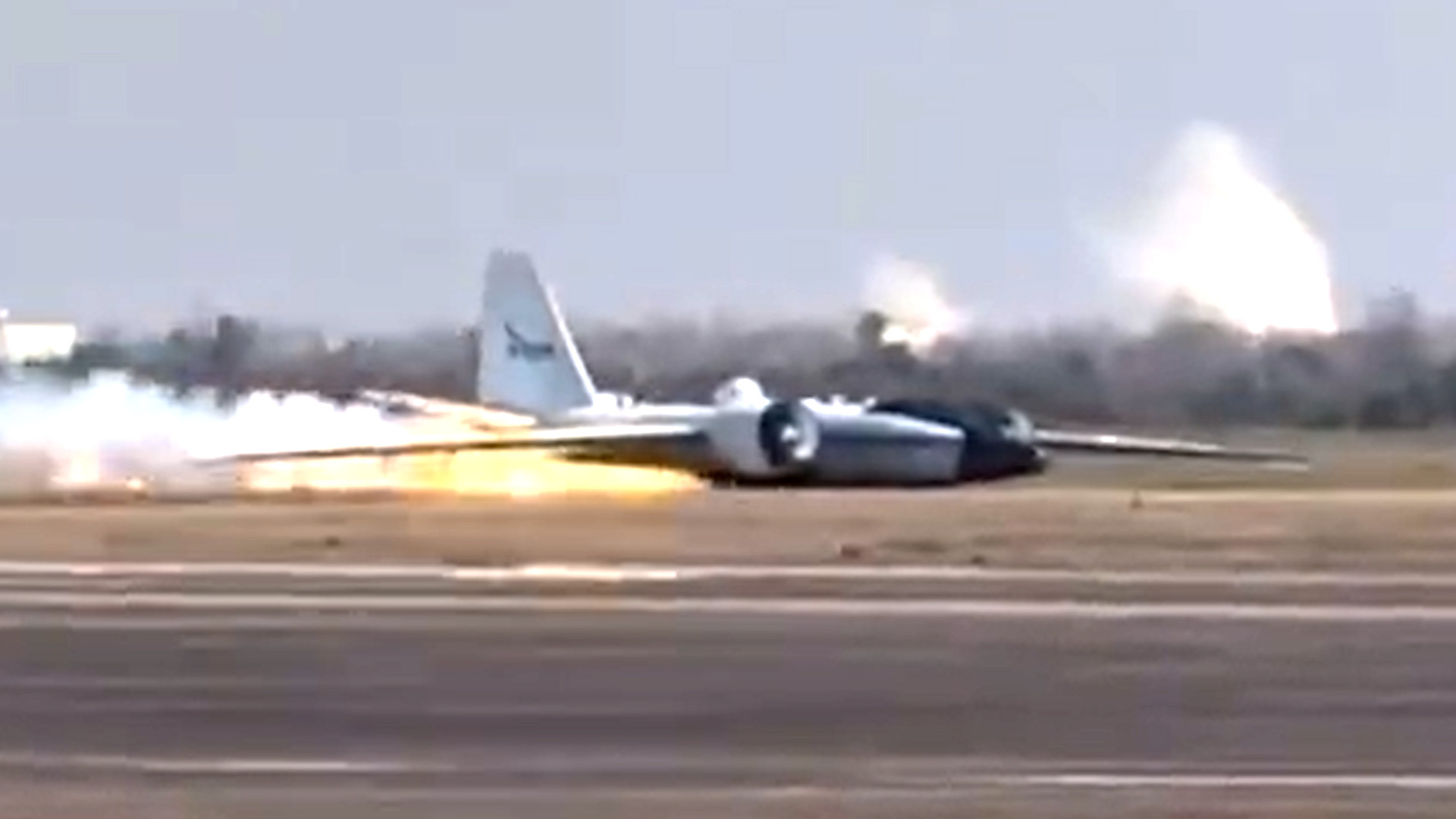
One of NASA’s high-flying WB-57F research aircraft went skidding down the runway on its belly at Ellington Airport in Houston, Texas, earlier today.
The incident occurred at around 11:30 AM local time, according to KHOU, a local CBS affiliate in Houston. KHOU has shared video footage showing the two-seat WB-57F spraying sparks and smoke after making contact with the runway. Additional footage shows the pilot exiting the plane with the help of first responders on the ground.


“Today, a mechanical issue with one of NASA’s WB-57s resulted in a gear-up landing at Ellington Field. Response to the incident is ongoing, and all crew are safe at this time,” NASA’s official account on X wrote in response to KHOU’s report. “As with any incident, a thorough investigation will be conducted by NASA into the cause. NASA will transparently update the public as we gather more information.”
KHOU also reported that Ellington’s runway 17R–35L was closed as efforts were made to move the stricken WB-57F.
All three of NASA’s WB-57Fs are based at the Johnson Space Center, also located in Houston. The aircraft are well known for their high-altitude capabilities, and can fly as high as 63,000 feet depending on how they are configured. They can carry different sensors and other systems in modular payload bays under the fuselage, as well as in their noses and underwing pods. Though roughly similar in some respects, the WB-57F should not be confused with the U.S. Air Force’s higher-flying U-2s. NASA also operates a pair of ER-2 aircraft, which are modified U-2s.
The WB-57Fs, originally developed for the U.S. Air Force during the Cold War as high-flying intelligence-gathering platforms, are now used for various scientific research purposes. The jets have also been used to support various U.S. military operational and test and evaluation-type missions. One of them was notably called upon to help in the response to weeks of still unexplained drone incursions over Langley Air Force Base in Virginia in December 2023, which TWZ was first to report. Many aerial videos of space launches that we see are taken by the WB-57Fs, as well.
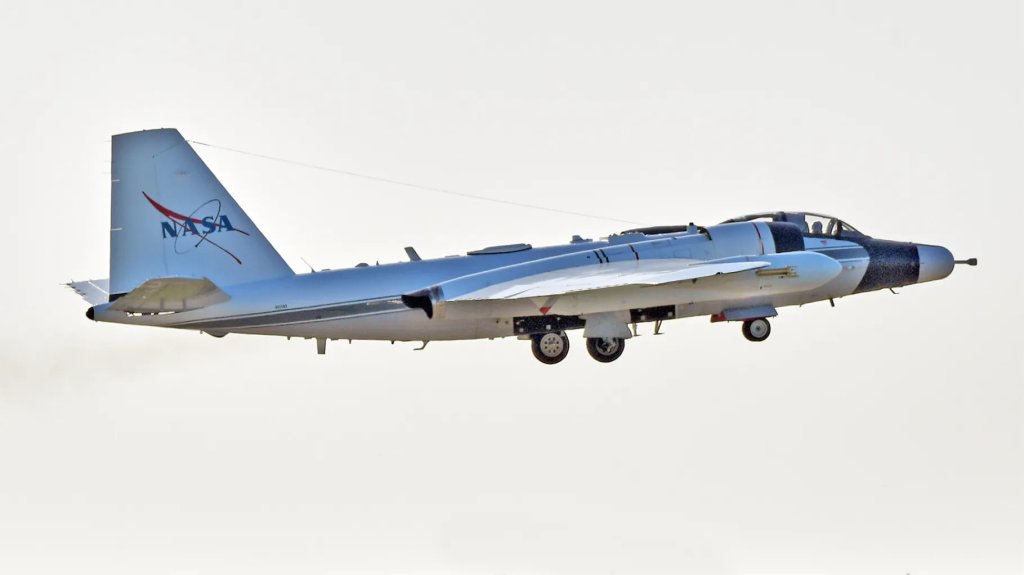
Overall, NASA’s WB-57Fs are the definition of an extremely low-density, high-demand asset, and what long-term impacts today’s belly landing may have on the future of the fleet remain be seen.
Update: 4:20 PM EST —
The Federal Aviation Administration (FAA) has now provided TWZ with the following statement:
“A Martin WB-57 landed with its gear up at Ellington Airport in Houston around 11:25 a.m. local time on Tuesday, Jan. 27. Two people were on board. The FAA will investigate.”
Howard Altman contributed to this story.
Contact the author: joe@twz.com
Loading comments…
Comments couldn’t be loaded. Please refresh the page.