
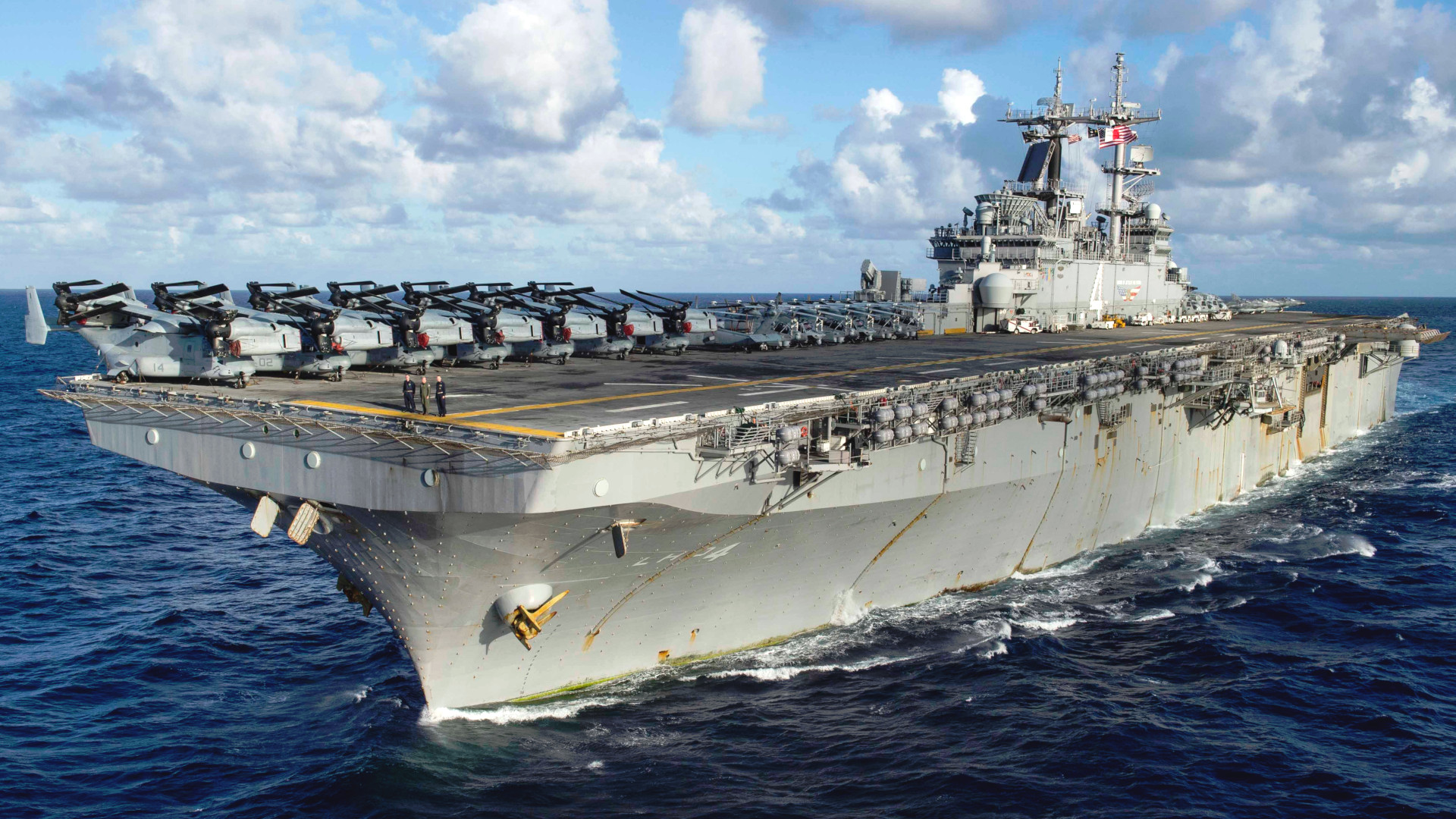
The Pentagon is reportedly sending the Wasp class amphibious assault ship USS Boxer and the rest of its Amphibious Ready Group (ARG), loaded with elements of the 11th Marine Expeditionary Unit (MEU). This comes as the Trump administration is reported to be increasingly considering seizing or blockading Iran’s highly strategic Kharg Island in the Persian Gulf as part of a new phase of Operation Epic Fury.
It has now been widely reported that what is described as an “accelerated” deployment of the Boxer Amphibious Ready Group and the 11th MEU from the West Coast will be in support of Operation Epic Fury.
The Boxer Amphibious Ready Group also includes two other amphibious warfare ships, the San Antonio class USS Portland and the Whidbey Island class USS Comstock. The 11th MEU has roughly 2,500 personnel, in total, and includes air and ground components.
This follows reports last week that the America class amphibious assault ship USS Tripoli and its ARG, carrying elements of the 31st MEU, had also begun moving from the Pacific toward the Middle to support ongoing operations against Iran.
Axios reported today that the Trump administration could be leaning toward establishing a blockade around Iran’s Kharg Island, through which it exports much of its oil, or occupying it, citing unnamed officials. The central goal of doing this would be to step up pressure on the regime in Tehran to, in turn, force it to reopen the Strait of Hormuz. Traffic through that waterway has come to a virtual halt, which is causing massive reverberations across global energy markets.
“[Trump] wants Hormuz open. If he has to take Kharg Island to make it happen, that’s going to happen. If he decides to have a coastal invasion, that’s going to happen,” one official said, according to Axios. “But that decision hasn’t been made.”
The U.S. military carried out extensive strikes on Kharg Island this past weekend. A deployment of U.S. ground troops there would be a major escalation that could have significant ramifications, including domestically.
“We’ve always had boots on the ground in conflicts under every president, including Trump. I know this is a fixation in the media, and I get the politics, but the president is going to do what’s right,” a second official, who also said no decision has yet been made, said, per Axios.
Just yesterday, TWZ spoke with Joseph Votel, the former commander of U.S. Central Command, with a particular focus on the tumultuous Strait of Hormuz, through which around 20 percent of the world’s oil passes. You can read that interview here.
In the meantime, publicly available flight-tracking data indicates that the U.S. Navy is using MQ-4C Triton intelligence, surveillance, and reconnaissance drones to monitor Kharg Island as part of their patrols of the northern Persian Gulf.
Trump has warned that he might consider targeting oil facilities on the island if Iran or other countries “do anything to interfere” with the safe passage of ships through the strait.
Destroying or damaging oil infrastructure on Kharg could have unintended side effects, however. On the one hand, it would further push up global oil prices. The complex nature of infrastructure might take years to repair, which would compound this. In the long term, there is also the question of whether oil infrastructure here should be preserved for the benefit of a potential new Iranian government.
Any successor to the current regime would lose out on vital oil income, potentially driving further internal strife.
There is also the possibility that seizing the island and cutting off the current Iranian government from its most vital source of revenue could be used as a catalyst to bring about its fall.
Then there is the huge question about the kind of military effort that would be required to seize Kharg. This would require a large-scale, sustained operation and would be brought with risk. The island is only 20 miles from the Iranian mainland, putting whatever U.S. force is there at extreme risk of bombardment of multiple types. Getting amphibious assault ships through the Strait and into the Gulf would be an issue, as well, and those ships would be heavily targeted during transit and especially once inside the Gulf. With this in mind, a longer-range aviation assault would be most likely.
A naval blockade of the island might be easier to achieve in the short term, but it would run the risk of Iranian attacks, likely involving uncrewed surface vessels (USVs), drones, and other asymmetric options, as well as anti-ship cruise missiles, the use of which has been limited up to this point, as you can read about here.
As already noted, additional U.S. forces are headed to the region in the form of the Tripoli ARG and the 31st Marine Expeditionary Unit (MEU). While the deployment of the big-deck amphibious assault ship USS Tripoli had already been reported, we now know it is being supported by the amphibious transport docks USS San Diego (LPD-22) and USS New Orleans (LPD-18), thanks to publicly available ship-tracking data.
What exactly the next phase of Operation Epic Fury will look like could be clearer as the Navy amphibious warfare ships and the thousands of Marines they are carrying get closer to the Middle East.
UPDATES
UPDATE: 6:16 PM EST –
There are some mixed messages coming out of Washington about the future of Epic Fury.
President Donald Trump said he is considering “winding down” the war on Iran. His comments, delivered on his Truth Social account, come even though two Marine Expeditionary Units (MEUs) are steaming toward the Middle East and the Pentagon has reportedly drawn up plans to put American troops into Iran with the president’s approval.
Trump added that the U.S. could end the war effort even with the Iranians still closing the Strait of Hormuz.
“We are getting very close to meeting our objectives as we consider winding down our great Military efforts in the Middle East with respect to the Terrorist Regime of Iran,” Trump proclaimed.
He stated that the U.S. has: “(1) Completely degrading Iranian Missile Capability, Launchers, and everything else pertaining to them. (2) Destroying Iran’s Defense Industrial Base. (3) Eliminating their Navy and Air Force, including Anti Aircraft Weaponry. (4) Never allowing Iran to get even close to Nuclear Capability, and always being in a position where the U.S.A. can quickly and powerfully react to such a situation, should it take place. (5) Protecting, at the highest level, our Middle Eastern Allies, including Israel, Saudi Arabia, Qatar, the United Arab Emirates, Bahrain, Kuwait, and others.”
The Strait, Trump added, “will have to be guarded and policed, as necessary, by other Nations who use it — The United States does not! If asked, we will help these Countries in their Hormuz efforts, but it shouldn’t be necessary once Iran’s threat is eradicated. Importantly, it will be an easy Military Operation for them.”
Our coverage has ended for the day. Stay tuned for more.
UPDATE: 5:15 PM EST –
Retired Marine Gen. James Mattis, who served as Defense Secretary and CENTCOM commander, weighed in on the war, saying he doesn’t believe regime change is likely.
Iranian state media warns Iran will target the UAE’s industrial port city of Ras Al-Khaimah if Iranian islands are again attacked from that nation, Arab News reported.
UPDATE: 4:20 PM EST –
Trump ruled out any ceasefire with Iran.
He suggested that re-opening the Strait is “a simple military maneuver.”
The president also declined to say if he will order troops into Iran.
CBS News is reporting that Pentagon officials have made detailed preparations for deploying U.S. ground forces into Iran. The network cited multiple sources briefed on the plans..
“Senior military commanders have submitted specific requests aimed at preparing for such an option as President Trump weighs moves in the U.S.-Israel-led conflict with Iran, the sources said,” according to CBS. The news outlet’s sources do not specify how those troops would be used. Meanwhile, the Trump administration hasn’t committed to any such plan to put boots on the ground, which would greatly escalate the war.
CENTCOM provided us an update of the number of troops wounded so far in Epic Fury. To date there have been 232 wounded, up from about 200 on Monday. Of those troops, 207 returned to duty. The number of seriously wounded has held steady at 10. The Associated Press was the first to report these details.
The command also shared video of what it says was an attack on The Esfahan Khomeynishahr Drone Production Plant that produced Shahed one-way attack drones.
New video shows another Iranian cluster munition exploding over Israel. There were no reports of injuries from the attack, which was the ninth so far this evening, according to Times of Israel military correspondent Emanuel “Mannie” Fabian in a post on X.
NATO provided us a statement about pulling its forces out of Iraq as Iranian-backed militias have carried out several attacks there:
“‘I would like to thank the Republic of Iraq and all the Allies who assisted in the safe relocation of NATO personnel from Iraq,’ said Gen. Alexus Grynkewich, Supreme Allied Commander Europe. “‘ would also like to thank the dedicated men and women of NATO Mission Iraq, who continued their mission throughout this period. They are true professionals.’
The last NATO Mission Iraq personnel departed the country on March 20.
NATO Mission Iraq will continue from Joint Force Command Naples. NMI is a non-combat advisory and capability-building mission to assist Iraq in building more sustainable, transparent, inclusive and effective security institutions and forces, so that they themselves are able to stabilise their country, fight terrorism, and prevent the return of ISIS/Daesh.”
Iraq declared a ”force majeure” on all oilfields developed by foreign oil companies, as attacks in the region have disrupted navigation through the Strait of Hormuz,” Al Arabiya reported on X. This is ”preventing most of the country’s crude exports from moving,” oil ministry sources told the outlet.
A force majeure is a contractual clause freeing parties from liability due to extraordinary, unavoidable events, like the war.
The U.K. Defense Ministry offered its latest update on the war.
The Iranian space program, one of the most advanced in the Middle East, has suffered extensive damage from US and Israeli airstrikes, Bloomberg News reported. The attacks are “potentially driving Tehran to deepen cooperation with China and Russia,” the outlet posited.
UPDATE: 2:12 PM EST –
Earlier in our story, we noted that the USS Boxer (ARG) was deploying to the Middle East. Images emerged on line of the Boxer, the Portland and the Comstock departing San Diego.
Ukrainian President Volodymyr Zelensky is once again touting a deal to provide drones to the U.S., an arrangement Trump has so far dismissed.
“I am very interested in signing this agreement with our close partner – the United States of America,” Zelensky stated on X. “So when President Trump is ready, I will definitely be ready. Our negotiating team will discuss this issue at the meeting in the United States.”
Jerusalem’s Old City, home to some of the most sacred sites in Christianity, Islam and Judaism, was reportedly hit by missile shrapnel that fell near the Al-Aqsa Mosque compound. The official Turkish Anadolu news outlet reported that missile fragments also fell in the Jewish Quarter near Jerusalem’s Old City, amid heightened tension and a security alert in the area.
Shrapnel landed in several locations across Jerusalem, with no immediate details available on the extent of the damage, Anadolu added, citing Israeli media.
Shipping giant Hapag-Lloyd provided us with a statement on the current state of their maritime commerce.
“We are monitoring the situation very closely, but the situation in the Middle East remains very fluid. Based on our current risk assessment, we have suspended all transits through the Strait of Hormuz and the Suez Canal as well as bookings from and to the Upper Gulf region. As a result, schedules and port calls may change at short notice, and some services will be adjusted. We have contingency plans in place, and the safety of our people on ground and ocean remains our top priority. Our teams are working closely together to find the best possible solutions for our customers’ shipments.”
A Greek-owned medium-sized cargo vessel, also known as a panamax, became the first bulk carrier to transit the Strait of Hormuz with its Automatic Identification System on since March 2, according to Lloyd’s List.
Moscow proposed a quid pro quo to the U.S. under which the Kremlin would stop sharing intelligence information with Iran, such as the precise coordinates of U.S. military assets in the Middle East, if Washington ceased supplying Ukraine with intel about Russia, according to a report from Politico. The outlet cited two people familiar with the negotiations.
UPDATE: 1:00 PM EST –
The Israel Defense Forces (IDF) and Iranian media have both reported the death of Iran’s Islamic Revolutionary Guard Corps (IRGC) spokesperson, Ali Mohammad Naeini. The Israeli military said in a post on X that he was killed in an overnight airstrike.
Just before his death, Naeini issued a statement insisting Iran was still able to produce missiles despite the attacks from Israel and the United States.
Naeini made the comment in response to a claim by Israeli Prime Minister Benjamin Netanyahu that Iran could no longer build missiles. Referencing how Iranian schools consider a 20 as a perfect score, Naeini said: “Our missile industry score is 20 and there is no concern in this regard because we are producing missiles even during war conditions, which is amazing, and there is no particular problem in stockpiling.”
Naeini joins a growing list of high-profile Iranian regume figures who have been killed so far in the conflict, others including the former supreme leader Ali Khamenei, the security chief Ali Larijani, head of the paramilitary Basij force, Gholamreza Soleimani, and the intelligence minister, Esmail Khatib.
Tehran has accused the United Kingdom of “participation in aggression,” reflecting the fact that the country has permitted the U.S. Air Force to use its airbases as a launchpad for bombing missions over Iran.
Iranian Foreign Minister Abbas Araghchi warned his British counterpart, Yvette Cooper, and insisted on his country’s right to self-defence. “These actions will definitely be considered as participation in aggression and will be recorded in the history of relations between the two countries. At the same time, we reserve our inherent right to defend the country’s sovereignty and independence,” Araghchi said on his official Telegram channel.
U.S. Central Command says that it has destroyed an Iranian ballistic missile plant in Karaj, to the west of Tehran. The plant was used to “assemble ballistic missiles that threatened Americans, neighboring countries, and commercial shipping,” CENTCOM said.
Satellite imagery from Bandar Abbas suggests that airstrikes have targeted the naval base and port facilities once again. The imagery below shows fires burning at several different structures, although the level of overall damage is not entirely clear.
Other recent targets of U.S. airstrikes appear to include Qeshm Island in the Strait of Hormuz. Satellite imagery shows cratering, but it unclear if the attacks collapsed the IRGC’s tunnel complex that is understood to be on the island. The underground complex is reportedly used to store small boats, missiles, and drones.
Israel conducted airstrikes on Tehran today, as Iranians marked Nowruz, the Persian New Year. In a statement on X, the Israel Defense Forces said: “The IDF has now begun a wave of strikes targeting infrastructure of the Iranian terror regime in the heart of Tehran.”
Meanwhile, there are growing questions about the degree to which Israel and the United States are on the same page as regards the war against Iran.
Israeli Prime Minister Benjamin Netanyahu has said that Israel acted alone in the bombing of Iran’s South Pars gas field, one of the largest in the world. He also confirmed that Trump had asked Israel to stop any further such attacks. “President Trump asked us to hold off on future attacks, and we’re holding out,” Netanyahu explained.
Iran is being “decimated” and no longer had the capacity to enrich uranium or make ballistic missiles, but a revolution in the country would require a “ground component,” Netanyahu added.
When asked whether he had dragged Trump into the conflict, Netanyahu responded: “Does anyone really think that someone can tell President Trump what to do?” Netanyahu told reporters, at a press conference. “He didn’t need any convincing,” he added. “I don’t think any two leaders have been as coordinated as President Trump and I. He’s the leader. I’m, you know, his ally.”
Israel, Kuwait, and the United Arab Emirates today all announced that their air defenses were responding to Iranian missile attacks. Elsewhere in the region, Bahrain’s interior ministry announced an air raid alert, while Saudi Arabia’s defence ministry said it had intercepted a drone in the country’s east.
Kuwait’s state oil firm KPC reported that its Mina Al-Ahmadi refinery was hit by multiple drone attacks early on Friday, causing a fire in some units. No initial casualties were reported, according to the state news agency.
Iranian attacks on energy infrastructure have taken a toll on Qatar, too. Ras Laffan Industrial City in Qatar has been forced to reduce the country’s liquefied natural gas (LNG) export capacity by 17 percent, according to QatarEnergy, the state-run energy giant. The “extensive damage” could reportedly reduce its annual revenues by $20 billion and take “up to five years” to repair.
Iran has also launched strikes against energy infrastructure in Israel.
According to Israel’s energy ministry, an Iranian missile attack — reportedly using cluster warheads — hit oil refineries in the northern port city of Haifa but did not cause “significant damage.” Energy Minister Eli Cohen added that power was disrupted, but electricity was soon restored to most of those who were affected.
The video below purports to show debris from an intercepted Iranian ballistic missile landing on a car in central Israel.
According to the Fars news agency, the Iranian military has reportedly threatened American and Israeli military personnel and officials. In a post on Telegram, the agency quoted a senior spokesperson for Iran’s armed forces as saying: “We are keeping an eye on your cowardly officials and commanders, your wicked pilots and soldiers… From now on, based on the information we have from you, the world’s tourist attractions, resorts, and entertainment centers will not be safe for you either,” the spokesperson reportedly said.
Howard Altman contributed to this report.
Contact the author: thomas@thewarzone.com
Loading comments…
Comments couldn’t be loaded. Please refresh the page.