
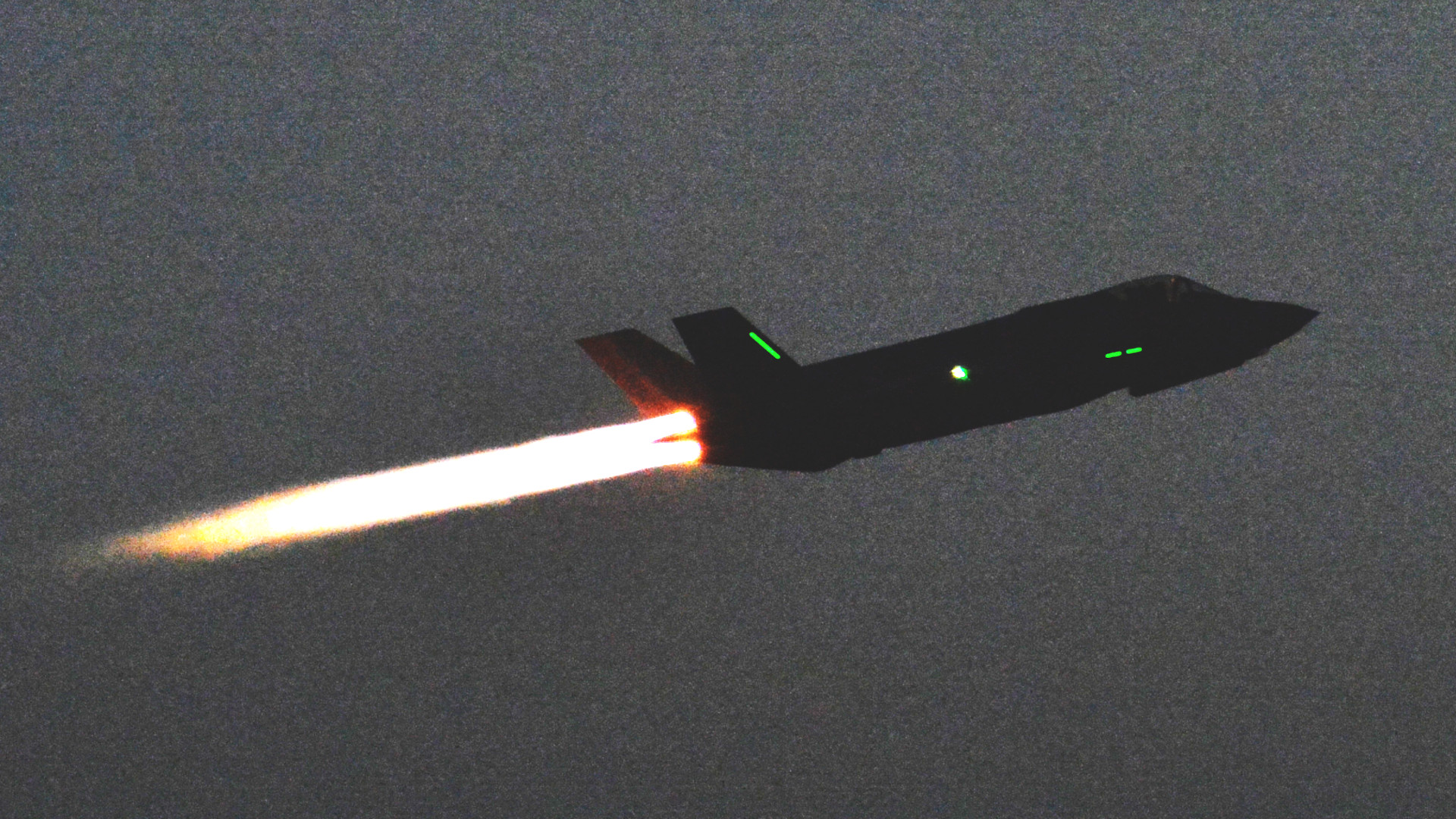
U.S. military aircraft employed GBU-39/B Small Diameter Bombs (SDB) and laser-guided 70mm Advanced Precision Kill Weapon System II (APKWS II) rockets around the operation to strike Iranian nuclear facilities earlier this year, according to Pentagon budget documents. It does seem somewhat unlikely that APKWS IIs were used directly in the strike mission, which we will address directly. Compared to what we’ve learned about the B-2 stealth bombers that dropped GBU-57/B Massive Ordnance Penetrator (MOP) bunker-buster bombs during Operation Midnight Hammer, much is still unknown about the contributions of other U.S. forces to the mission and in the lead-up to it.
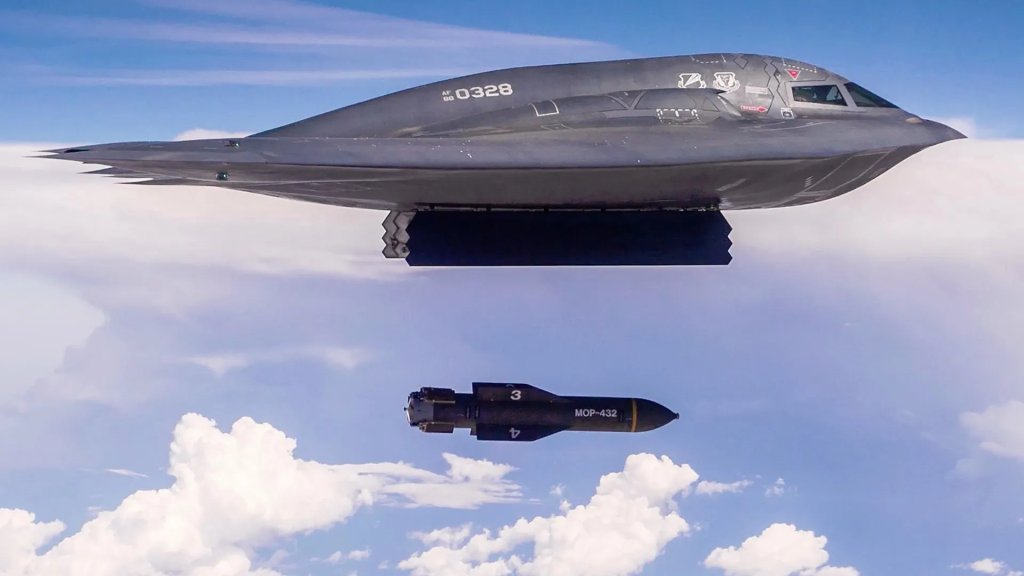
The Pentagon has previously said that 125 aircraft, including the B-2s, took part in Operation Midnight Hammer. President Donald Trump has also said that the force package included stealthy F-22 Raptor and F-35 fighters, as well as dozens of aerial refueling tankers. The B-2s dropped 12 MOPs in total on Iran’s deeply buried nuclear facility at Fordow and another two on an underground site at Natanz, according to U.S. officials. The Iranian nuclear facility at Isfahan was also subjected to a barrage of more than two dozen Tomahawk land-attack cruise missiles fired from a single submarine, very likely the Ohio class guided missile submarine USS Georgia.
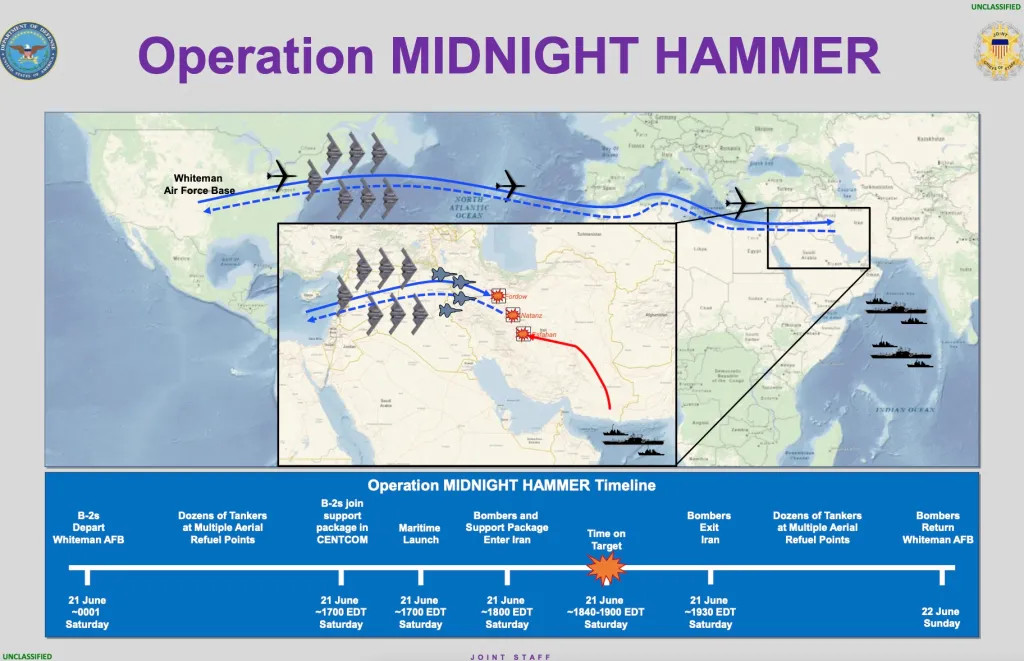
“As the Operation Midnight Hammer strike package entered Iranian airspace, the U.S. employed several deception tactics, including decoys as the fourth and fifth generation aircraft pushed out in front of the strike package at high altitude and high speed, sweeping in front of the package for enemy fighters and surface to air missiles,” Air Force Gen. Dan Caine, Chairman of the Joint Chiefs of Staff, said at a press briefing the morning after the operation, but did not elaborate. “As the strike package approached Fordow and Natanz, the U.S. protection package employed high-speed suppression weapons to ensure safe passage of the strike package with fighter assets employing preemptive suppressing fires against any potential Iranian surface-to-air threats.”

The new disclosures that U.S. forces expended SDBs and laser-guided rockets, as well as the MOPs, in relation to Operation Midnight Hammer come from a Pentagon budget reprogramming document dated August 1, but which was only released recently. By law, the U.S. military has to seek approval from Congress to reallocate funding from one part of its budget to another.
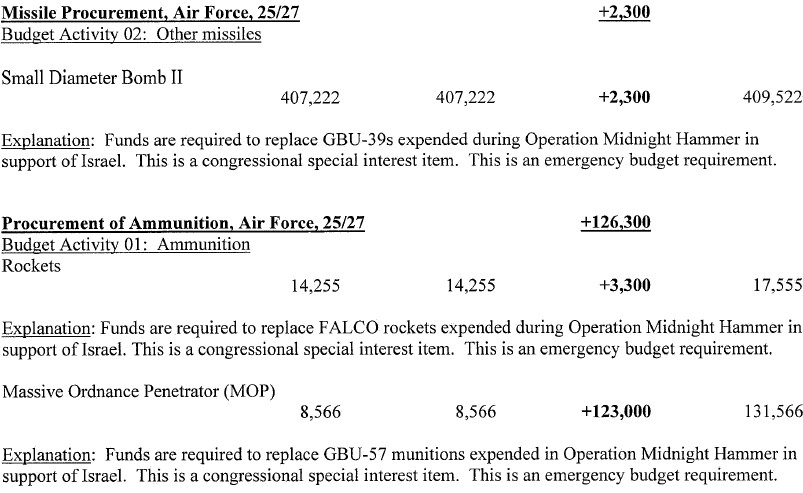
Overall, “this reprogramming action addresses funds for the replacement of defense articles expended in support of Israel through U.S. combat operations executed at the request of and in coordination with Israel and for the defense of lsraeli territory, personnel, or assets during attacks by Iran, and subsequent or anticipated attacks by Iran and its proxies,” the document notes. “Funds are available from division A of the Israel Security Supplemental Appropriations Act, 2024, division A of Public Law 118-50, appropriated to the Department of Defense.”
The reprogramming document specifically lays out the reallocation of $2.3 million, $3.3 million, and $123 million to help replace SDBs, laser-guided rockets, and MOPs employed in relation to the operation to strike Iran’s nuclear sites, respectively. No details are provided about the total number of any munitions expended (though we have the previous details about the number of MOPs dropped) or how many are expected to be purchased with the supplemental funds. Another $9.976 million is also required to pay for “temporary lodging expenses of personnel supporting Operation Midnight Hammer.”
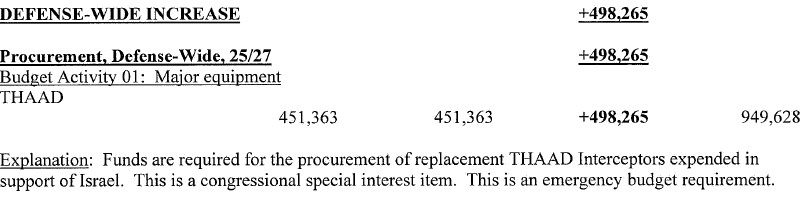
In addition, the document includes the shifting of $498.265 million to provide funds for the replacement of an unspecified number of Terminal High Altitude Area Defense (THAAD) anti-ballistic missile interceptors fired in the defense of Israel, without any explicit mention of Midnight Hammer. The U.S. Army reportedly fired more than 150 THAAD interceptors to defend Israel during its 12-day war with Iran in June, raising significant questions about the depth of the remaining U.S. stockpile of those missiles. You can read more about the THAAD expenditures in detail in TWZ‘s past reporting here.
If the $123 million figure in the reprogramming action reflects the full cost to replace the 14 MOPs dropped on Iran, this would average out to nearly $8.8 million per bomb. However, ancillary costs could also be included in that total. The U.S. government does not appear to have ever provided an official unit cost for the GBU-57/B, with past reports offering $3.5 million and $15 million price points, but without clear sourcing.
The dollar figures for the SDBs and APKWS II rockets raise some immediate questions about the full scope of what might be considered to be “during Operation Midnight Hammer.” The Air Force has pegged the unit cost of a typical GBU-39/B at $40,000 in the past, and more recent budget documents put it at between $70,000 and $80,000. If the $2.3 million figure reflects the total cost of SDBs expended just on June 21-22, this would mean roughly between 30 and 60 SDBs were dropped in one night. Similarly, $3.3 million averages out to around 132 APKWS II rockets based on available cost data. It is possible in this case that “during Operation Midnight Hammer” also includes tangential operational activities. Midnight Hammer came at the tail-end of the Iran-Israel war, during which U.S. forces were heavily engaged in defending the latter’s territory from incoming threats, as underscored by the THAAD interceptor section in the repogramming document.
There are larger questions about why APKWS IIs would have been employed in the context of Operation Midnight Hammer at all, which we will come back to later on. TWZ has reached out to U.S. Central Command (CENTCOM) for more information. You can read more about what is already known about the use of the MOPs in our previous reporting here.
When it comes to the use of GBU-39/Bs, the U.S. Air Force’s most recent budget request for the 2026 Fiscal Year says that the SDB has now been integrated onto the F-35A, as well as the F-22. Air Force F-15E Strike Eagles, F-16C/D Vipers, and A-10 Warthogs, as well as AC-130J Ghostrider gunships, can also employ the 250-pound-class glide bombs, but it is unknown whether any of those types participated in any capacity in support of Operation Midnight Hammer.
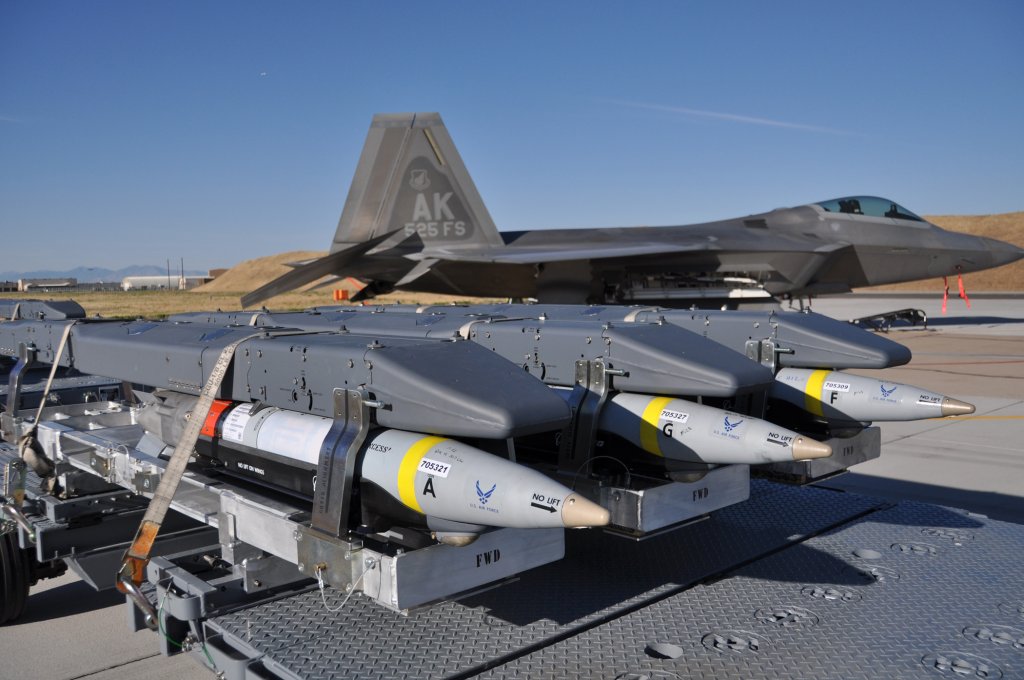
The GBU-39/B has a stated maximum range of at least 46 miles, though this depends on release altitude and other factors. With its GPS-assisted inertial navigation system (INS) guidance package, the baseline SDB is only capable of striking fixed target coordinates, but does have the added ability to penetrate semi-hardened structures. The GBU-39B/B version adds laser-guidance capability, allowing for the engagement of moving targets, but requires active lasing from a platform in relatively close proximity until the bomb hits its mark. The Air Force has also at least experimented with a version of the SDB capable of homing in on certain radiofrequency signal emissions, but its operational status is unclear.
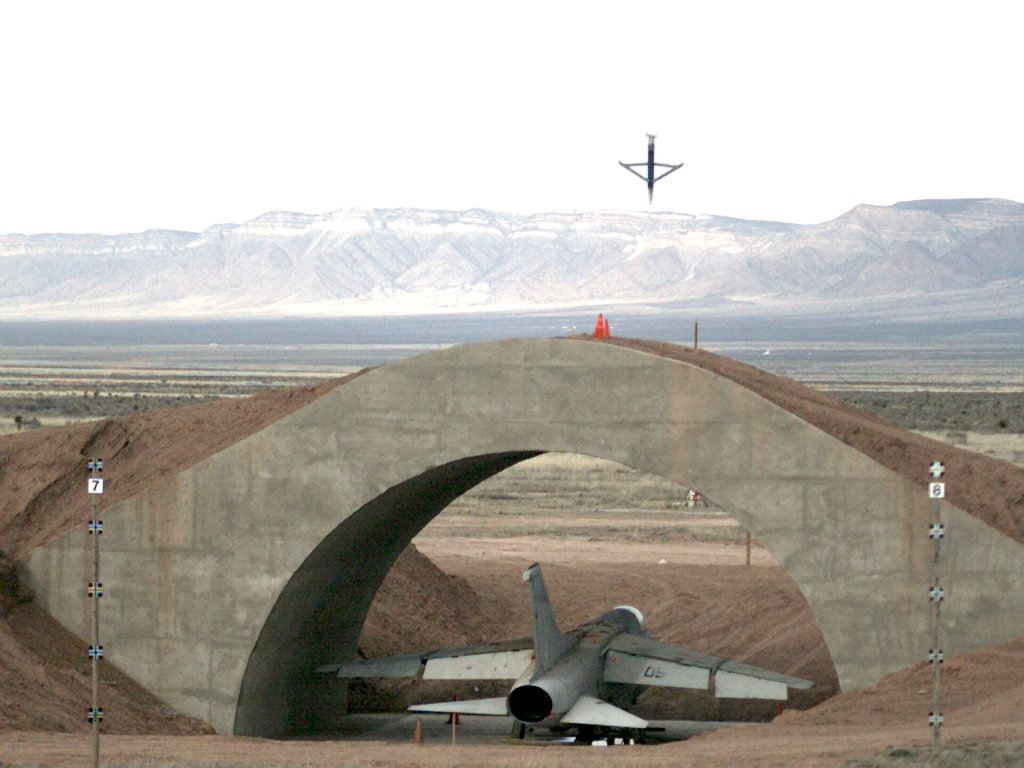
The use of GBU-39/B would fit with Caine’s previous disclosure that aircraft in the Midnight Hammer strike package had conducted pre-emptive strikes on Iranian air defense assets to help clear the way. With its standoff range and precision, the SDB is well-suited to the suppression/destruction of enemy air defense (SEAD/DEAD) mission set, and F-22s and F-35s can also carry them internally while flying in their most stealthy configurations, further reducing their vulnerability. SDBs could have been employed by various other platforms, and against other ground targets, as well.
As noted, there are more questions about how the APKWS II rockets could have factored into Operation Midnight Hammer, especially given that the repogramming action says air-to-air optimized Fixed Wing, Air Launched, Counter-Unmanned Aircraft Systems Ordnance (FALCO) versions were expended.
All APKWS II rockets consist of three main components: a 70mm rocket motor, one of several standardized warheads, and a laser-guidance section sandwiched in between. Originally designed as an air-to-ground munition, APKWS II is cleared for use on Air Force F-15Es, F-16C/Ds, and A-10s, as well as U.S. Marine Corps AV-8B Harriers and F/A-18C/D Hornets on the fixed-wing side. Marine AH-1Z Viper and UH-1Y Venom helicopters, as well as U.S. Navy MH-60R/S Seahawks and U.S. Army AH-64D/E Apaches, can also fire the precision-guided rockets.
The FALCO configuration, also known as the AGR-20F, includes a warhead with a proximity fuze and changes to the software inside the guidance section to improve its ability to zero in on aerial threats. Currently, only Air Force F-15Es, F-16Cs, and A-10s are known to be cleared to employ AGR-20Fs, though other types, such as the U.S. Navy’s F/A-18E/F Super Hornet, are likely to follow. The Strike Eagles only emerged with this capability weeks before the war between Israel and Iran erupted. F-16s first started employing APKWS II rockets in the anti-air role in combat last year, using them to down hostile drones in the Middle East. The air-to-air APKWS II capability was also originally developed as a lower-cost means of engaging subsonic cruise missiles.
FALCO rockets were first employed in combat in the air-to-air role last year in the Middle East, at least against drones, but the air-to-air APKWS II capability was also developed as a means of downing subsonic cruise missiles.
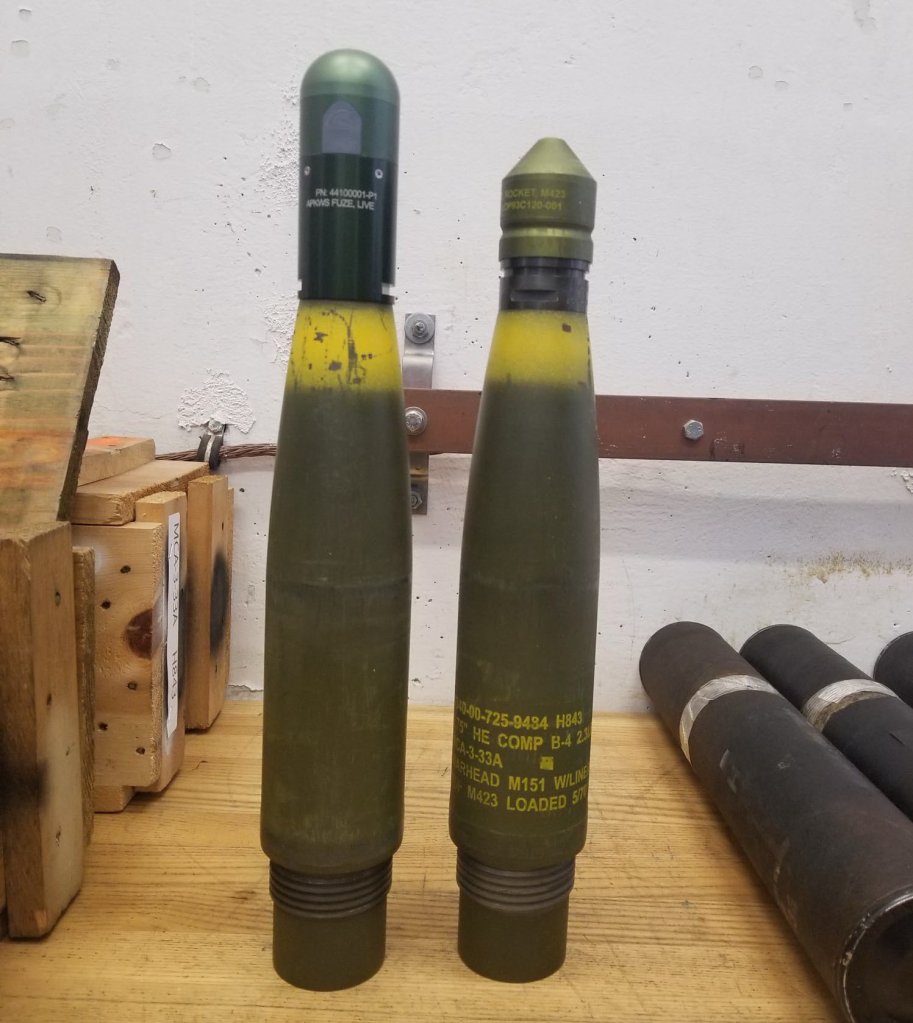
Iran certainly has an extensive arsenal of drones and cruise missiles, but it is not clear why the Midnight Hammer strike package would have been engaging them as it punched its way to Fordow and Natanz. FALCO-configured APKWS IIs could have been employed against ground targets, but this also seems less likely to have been the case. Any use of laser-guided rockets would have required a non-stealthy launch platform, as well. Overall, it seems much more likely that the rockets were expended in the context of the broader defense of Israel and U.S. assets in the region during Iran’s drone and missile barrages.
The full scale and scope of munitions and other capabilities employed during Operation Midnight Hammer is still unknown. Caine’s past comments about decoys and “high-speed suppression weapons” have also raised the possibility that variants of the ADM-160 Miniature Air-Launched Decoy (MALD) and members of the AGM-88 High-speed Anti-Radiation Missile (HARM) family were employed, but this remains unconfirmed. The mention of decoys could also be a reference to the additional B-2 bombers sent flying out into the Pacific as part of an elaborate deception effort in support of the operation.
In the immediate wake of the Operation Midnight Hammer, TWZ highlighted the overall enormity of the resources required for its successful execution, writing:
“It’s also worth discussing what went into making this attack possible. We have been writing about the B-2 and its MOP capability constantly for many years. It has been a critical program that has needed constant enhancement. Mission planners, maintainers, ordnancemen, aircrews, engineers and everyone else in between have been preparing for this exact mission for many years. Many years of technological development went into the hardware to achieve it. We have seen large-scale exercises that certainly looked like rehearsals for yesterday’s mission, too. And it’s not just B-2 and MOP, but the package of aircraft (likely F-22s, F-35s, EA-18Gs, tankers, and possibly one or two we don’t even know about yet), vessels, satellite assets, and the supporting command and control architecture that all played a part.”
“So, seeing it all come together, with apparently perfect timing and coordination, from space to down below the waves, is something to behold.”
Though questions remain, the recently released budget reprogramming document does offer additional insights into the full breadth of Operation Midnight Hammer.
Update: 9/17/2025 –
In response to our queries for more information, CENTCOM directed us to contact the Pentagon, which said it had nothing further to add at this time.
Howard Altman contributed to this story.
Contact the author: joe@twz.com
Loading comments…
Comments couldn’t be loaded. Please refresh the page.