
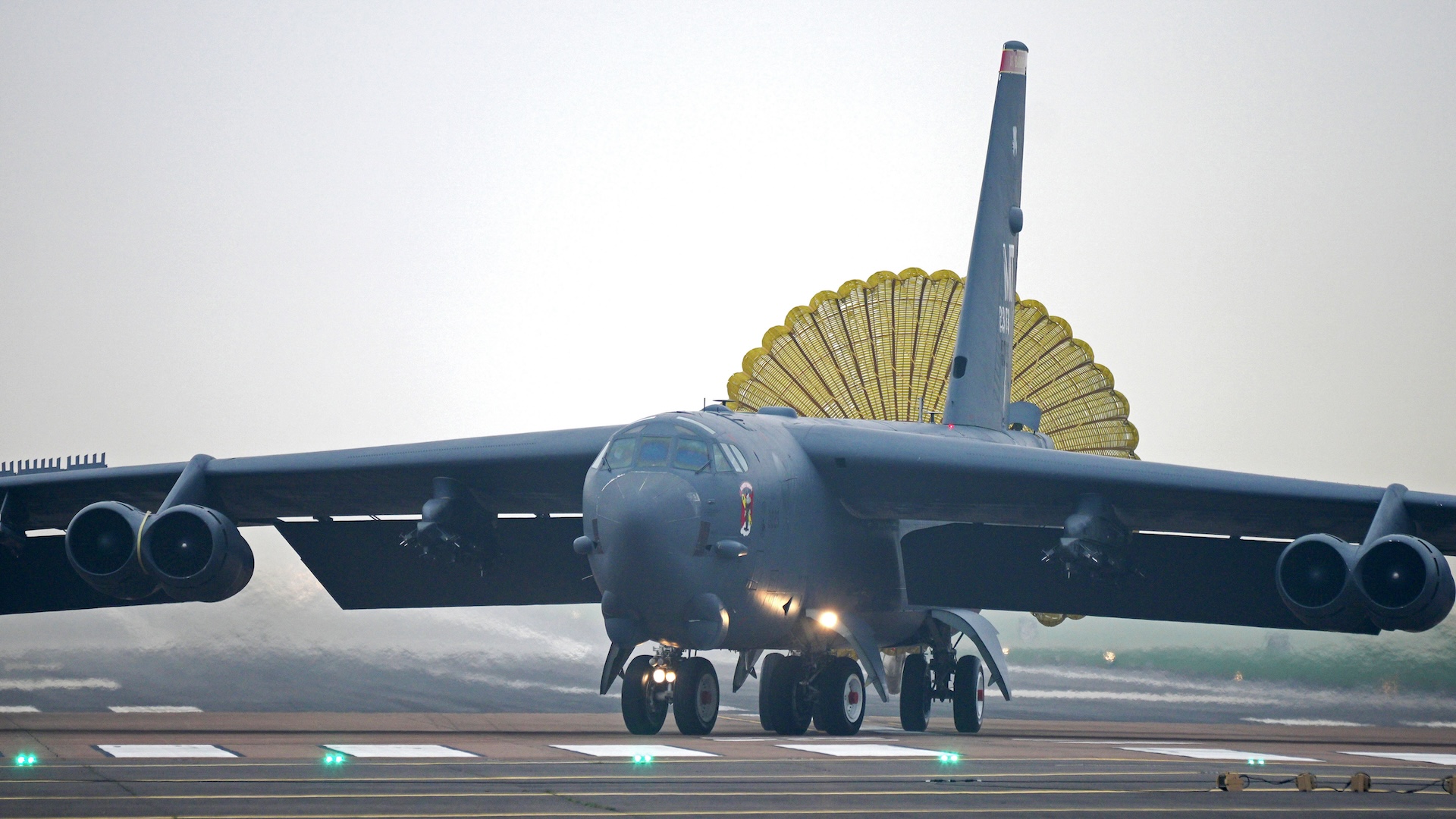
The war is now in its 10th day, and Israel and the United States continue to trade blows with Iran, with further missile and drone strikes across the Middle East. Meanwhile, the U.S. military’s ability to execute more rapid heavy airstrikes against Iranian targets was stepped up further today, with the arrival at RAF Fairford in England of three U.S. Air Force B-52H Stratofortress bombers. The aircraft are from the 5th Bomb Wing at Minot Air Force Base, North Dakota.
The bombers arrived at Fairford after U.K. Prime Minister Sir Keir Starmer approved so-called defensive U.S. actions against Iranian targets from British bases. This includes striking Iranian missile sites prior to them launching attacks.
The B-52s are part of a growing fleet of U.S. bombers at Fairford. The base received a single B-1B Lancer on Friday, and another two of the swing-wing bombers arrived on Saturday.
As well as making use of RAF Fairford to strike Iran, the change in U.K. government policy covers Diego Garcia in the Indian Ocean. Satellite imagery from today that TWZ has reviewed via Planet Labs shows no sign of bombers on the island, but heavy transport aircraft continue to show up there, along with the handful of tankers and five F-16s currently operating from the Indian Ocean outpost.
B-52s have already flown missions against Iran from bases in the United States, delivering AGM-158 JASSM stealthy cruise missiles. These missiles would have launched from outside Iranian airspace, likely over Iraq or another friendly Arab country. You can read more about the implications of standoff strikes such as these in our previous analysis of the enduring Iranian air defense threat here.
As we have discussed repeatedly in recent weeks, having the bombers forward deployed to England and/or Diego Garcia will drastically increase sortie rates and decrease wear-and-tear on the precious bomber fleet compared to flying from the U.S. and back. This will become even more relevant if the B-1 and B-52 force move from making standoff strikes to direct attacks on Iranian targets, even if just over limited parts of the country where air supremacy is more guaranteed.
LATEST UPDATES
We have concluded our rolling coverage in this piece.
UPDATE: 7:30 PM EST –
Trump held a Monday evening press conference to address the situation in the Middle East. Among other things, Trump hinted, without offering specifics, that lasers are now being used for air and missile defense. CENTCOM pushed us to the White House for more details and we are awaiting their response.
Trump also said that Iran has Tomahawk missiles, which it doesn’t.
Here are some of the key takeaways from the briefing—
On when the war will be over:
Very soon. Look, everything they have is gone, including their leadership. In fact, they have two levels of leadership. And even actually, as it turns out, more than that. But two levels of leadership are gone. Most people have never even heard about the leaders that they’re talking about….We’re achieving major strides toward completing our military objective. And some people could say they’re pretty well complete.
On the use of lasers for air and missile defense:
So as you probably saw, they had a tremendous number of missiles, most of which have now been used or destroyed and very unsuccessfully used, because we have been able, for the most part, to shoot them all down. What incredible technology. The Patriots have been unbelievable. And other things. And the laser technology that we have now is incredible. It’s coming out pretty soon. Where literally lasers will do the work of, at a lot less cost, do the work of what the Patriots are doing or what other things are doing.
On whether U.S. Tomahawk missiles destroyed an Iranian girls’ school and whether the U.S. will take responsibility for that.
I will say that the Tomahawk, which is one of the most powerful weapons around, is used by, you know, sold and used by other countries. You know that, and whether it’s Iran who also has some Tomahawks, I wish they had more. But whether it’s Iran or somebody else, the fact that a Tomahawk – a Tomahawk is very generic. It’s sold to other countries, but that’s being investigated right now.
Responding to a reporter about why he is the only one in the administration suggesting that “Iran somehow got its hands on a Tomahawk and bombed its own elementary school on the first day of the war.”
Because I just don’t know enough about it. I think it’s something that I was told is under investigation, but Tomahawks are used by others. As you know, numerous other nations have Tomahawks. They buy them from us. But I will certainly – whatever the report shows – I’m willing to live with that report.
On whether the new Supreme Leader “has a target on his back.”
I don’t want to say whether or not he does, because that would be inappropriate.
On how many U.S. troop deaths he is willing to accept in this war.
Well, as I said before, when you have conflicts like this, you always have death. And I was in Dover yesterday, I met the parents, and they were unbelievable people. They were unbelievable people, but they all had one thing in common. They said to me, one thing every single one, finish the job. Sir, please finish the job. And I’ll leave you at that.
UPDATE: 5:40 PM EST –
“We’re crushing the enemy in an overwhelming display of technical skill and military force,” Trump told the Republican House leaders.
He also extolled the virtues of the B-2 Spirit stealth bombers, saying “Israel would have been wiped out” without them.
Australia will deploy a surveillance aircraft and supporting ADF personnel to the Middle East for at least a month, as well as provide air-to-air missiles to the United Arab Emirates, Australian Prime Minister Anthony Albanese said.
Albanese said an E-7 Wedgetail radar jet would help provide long range reconnaissance capability to help “secure the airspace above the Gulf.”
“The Wedgetail and supporting Australian Defence Force personnel will be deployed for an initial four weeks in support of the collective self defence of Gulf nations. Additionally, in response to a request, my government intends to provide advanced, medium range air to air missiles to the United Arab Emirates,” he explained.
CENTCOM released its latest operational update. So far, more than 5,000 targets have been hit, including 50 Iranian vessels damaged or destroyed, the command stated.

UPDATE: 4:58 PM EST –
Speaking to Republican leaders today, Trump called Epic Fury “a short-term excursion.”
“We’re making America great again,” the president proclaimed. “We’re doing it much faster than we thought, and it’s better, stronger. Our country is doing really well, at a level that nobody thought. We took a little excursion because we felt we had to do that to get rid of some people. And I think you’ll see it’s going to be a short term excursion. How good is our military? In my first term, we rebuilt our military, and I didn’t know I’d be using it so much in the second term. But we have a military like no other as not even close.”
With Trump hinting that the war could soon be over, Israeli officials are racing to hit as many targets as possible, I24 News Diplomatic Correspondent Guy Azriel stated on X.
The Lebanese government “proposed direct negotiations with Israel — through the Trump administration — aimed at ending the war and reaching a peace agreement,” Axios reported, citing five sources with knowledge of the matter.
If the war ended today, it would take two weeks to restore Persian Gulf shipping, and another two months to get oil production back to normal levels, The Wall Street Journal reported.
Iran says it is prepared to form a joint team with Turkey to investigate “allegations” of Iranian missile attacks on Turkey.
The White House posted a video on X showing what appears to be targets hit by F-22 Raptor stealth fighters. The video opens up with the aircraft flying, followed by several targets hit. The White House titled the post “If you don’t know, now you know.”
UPDATE: 4:17 PM EST –
Russia’s President Vladimir Putin and U.S. President Donald Trump discussed the Iran war and Ukraine conflict during a “frank and constructive” telephone call today, the Kremlin said.
The one-hour call, the first since December, was sought by Washington, Putin’s diplomatic advisor Yuri Ushakov claimed, according to Russian media.
“The accent was placed on the situation surrounding the conflict with Iran and the bilateral negotiations underway with the representatives of the United States on settling the Ukrainian question,” Ushakov proclaimed.
The U.S. has lost two more MQ-9 Reaper drones, bringing the total to 11 so far during Epic Fury, CBS News reported.
The Israeli Air Force (IAF) bombed six Iranian military air bases during a wave of strikes in Iran last night, according to the IDF.
IRGC Gen. Ebrahim Jabbari said Iran is ready for 10 years of war with America and that its “weapons stockpiles are full and the production of missiles and drones continues.”
UPDATE: 3:41 PM EST –
In a phone interview with CBS News senior White House correspondent Weijia Jiang, Trump said the war could be over soon.
“I think the war is very complete, pretty much,” Trump told the network, according to a post on X. “They have no navy, no communications, they’ve got no Air Force.”
The U.S. is “very far” ahead of his initial 4-5 week estimated time frame, the president added.
Still, the Department of War stated on X that “We Have Only Just Begun To Fight.”
During a broadcast, Fox News caught Israeli interceptors firing at missiles launched toward Tel Aviv.
Hezbollah has initiated “preliminary feelers to start negotiations for a ceasefire,” Israel’s N12 News reported on X. “Discussions are underway in Israel on the matter, with the key question being whether to launch a broad operation to eliminate the organization or to achieve a strategic gain in the form of severing the connection between Iran and the Lebanese terror group, which Iran has financed at a rate of one billion dollars per year.”
Pilots participating in long missions over Iran as part of Operation Roaring Lion “have admitted to using stimulant pills to maintain concentration,” The Jerusalem Post reported. This is leading doctors “to warn against the phenomenon spreading from the tightly controlled system in the IDF to the general public, where it could end in cardiac arrhythmias and seizures.”
More video is emerging of the remnants of Tomahawk Land Attack Cruise Missiles (TLAMs) found in Iran.
The French Embassy shared video of President Emmanuel Macron aboard the aircraft carrier Charles de Gaulle in the Mediterranean.
The U.K. MoD provided its latest assessment of operations in the Middle East.
The U.K. stated that its military aircraft “operated over the UAE alongside our Emirati hosts.”
UPDATE: 2:59 PM EST –
Trump has told aides “he would back the killing of new Iranian Supreme Leader Mojtaba Khamenei if he proves unwilling to cede to U.S. demands, such as ending Iran’s nuclear development,” The Wall Street Journal reported, citing current and former U.S. officials.
Mojtaba Khamenei was wounded in an airstrike, according to Iranian TV.
“The anchors read reports describing him as ‘janbaz,’ or wounded by the enemy, in the ‘Ramadan War,’ which is how media in Iran refer to the current conflict,” according to the Times of Israel.
The reports do not elaborate on Khamenei’s condition or say how or when he was wounded.
U.S. Secretary of State Marco Rubio laid out the goals of Epic Fury.
Israeli strikes on Iran have killed more than 1,900 Iranian commanders and troops, IDF spokesman Brig. Gen. Effie Defrin told the media.
German Chancellor Fredrich Merz continues to back the strikes against Iran.
In a post on Truth Social, Trump announced a 5:30 p.m. address to the nation. The topic is not immediately known.
Beachgoers in the UAE witnessed a wild scene of an Iranian Shahed-136 drone being chased down at a low level by an Emirate Air Force F-16E, which fired at least one munition at the drone.
1:44 PM EST –
The U.S. Embassy in Kurait is being evacuated as the result of Iranian attacks on that country.
CENTCOM highlighted the use of the Army High Mobility Rocket Systems (HIMARS) attacks on Iran. The post, on X, includes an image of a HIMARS firing an Army Tactical Missile System (ATACMS) warhead.
CBS News posted video of the remnants of an Iranian ballistic missile with a cluster munition warhead that landed in Tel Aviv.
High-ranking Iranian official Ali Larijani said on X that “It is unlikely that any security will be achieved in the Strait of Hormuz amid the fires of the war ignited by the United States and Israel in the region, especially if that is by the design of parties that were not far removed from supporting this war and contributing to its fanning.”
Watching oil prices spike during Epic Fury, Russian President Vladimir Putin is reportedly considering trying to export oil to Europe. Crude oil prices hovering near $100 a barrel could be very beneficial for the Russian economy, which relies heavily on energy exports.
The planes that entered Iran at the beginning of Operation Roaring Lion “did so at great risk and with partially reestablished air defenses, a senior Israel Air Force officer told Israeli media on Monday.
“The planes that entered Iran first were at very high risk,” the officer explained. “I was there. I led the people from the air, the pilots took this risk out of a deep understanding that we would be able to attack a surface-to-surface missile squadron that could hit Israel and its citizens.”
Hezbollah reportedly launched a new wave of missiles deep into Israel and hit a satellite communications site.
The Lebanese group “claims to have targeted the IDF Home Front Command headquarters in Ramle, known as Rehavam Base, as well as a ‘satellite communications station’ in Haela Valley near Beit Shemesh, in its missile attack on central Israel this afternoon,” the Times of Israel reported. “The missile fire marks the deepest attack in Israel carried out by Hezbollah since hostilities intensified last week.”
The IDF only acknowledged that missiles were fired from Lebanon.
“Following the sirens that sounded in several areas in Israel, several projectiles that crossed from Lebanon into Israeli territory were identified,” the IDF stated. “The Israeli Air Force intercepted several launches and several additional launches fell in an open area. Additionally, a report was received regarding an impact in central Israel.”
A few senior officials in Israel “are starting to voice concern about the escalating, open-ended attack on Iran — and suggesting possible exit ramps that might halt the war before it further damages the region and the global economy,” David Ignatius opined in The Washington Post.
“Talk of an endgame is early, and a decision about whether to stop the attacks rests largely with President Donald Trump, who continues to seek all-out victory,” he wrote. “But in a telephone conversation Sunday, a senior Israeli official familiar with the planning and strategy for the Iran war discussed alternatives to Trump’s call for “unconditional surrender.” The official requested anonymity because of the sensitivity of the Iran situation.”
Reports are emerging that despite Iranian claims that it has closed the Strait of Hormuz, at least one ship has passed through by turning off its transponders. There are questions about whether Iran still has the sensor capability to track ships given constant U.S. and Israeli attacks.
1:02 PM EST –
The U.S. has intercepted encrypted communications believed to have originated in Iran that may serve as “an operational trigger” for “sleeper assets” outside the country, ABC News reported, citing a federal government alert sent to law enforcement agencies.
The alert cites “preliminary signals analysis” of a transmission “likely of Iranian origin” that was relayed across multiple countries shortly after the death of Ayatollah Ali Khamenei. Khamenei, the supreme leader of Iran, was killed in a U.S.-Israeli attack on Feb. 28.
CBS News broke down targets hit across the Middle East since Epic Fury was launched.
Iranian Foreign Minister Seyed Abbas Araghchi posted a list of oil prices that have spiked since the launch of what he calls “Operation Epic Mistake.”
“…oil prices have doubled while all commodities are skyrocketing,” Araghchi stated on X. “We know the U.S. is plotting against our oil and nuclear sites in hopes of containing huge inflationary shock. Iran is fully prepared.”
It should be noted that prices are volatile and subject to frequent change.
“I don’t see any room for diplomacy anymore,” Kamal Kharazi, Foreign Policy Advisor to the office of the Supreme Leader, told CNN in an exclusive interview in Tehran. He also said he believes the regime can continue with the war for a long time.
The IDF posted images it said were from the aftermath of an Iranian cluster munition attack on the city of Rishon Lezion.
Iranian Gen. Majid Mousavi, head of the IRGC Aerospace Force, claimed his nation has a new tactic for launching missiles.
Only those with warheads over one ton will be fired, and the frequency will increase, Mousavi posited.
UPDATE:12:28 PM EST –
The Trump administration has discussed seizing Kharg Island, a strategic terminal responsible for roughly 90% of Iran’s crude oil exports, according to Axios.
Trump took to his Truth Social platform to say that short-term oil price hikes are worth the long-term removal of the Iranian nuclear threat.
U.S. officials were reportedly surprised by Iran’s sustained response to Epic Fury.
Gulf states have been surprised that Iran has carried out widespread attacks across the region.
Iran’s Isfahan Optics plants was reportedly leveled by U.S.-Israeli airstrikes this morning.
American allies “are watching in disbelief as the Pentagon reroutes weapon shipments to aid the Iran war, angry and scared that arms the U.S. demanded they buy will never reach them,” Politico reported.
European nations that have struggled to rebuild arsenals after sending weapons to Ukraine “fear they won’t be able to ward off a Russian attack,” the outlet added. “Asian allies, startled by America’s rate of fire, question whether it could embolden China and North Korea. And even in the Middle East, countries aren’t clear if they will get air defenses from the U.S. for future priorities.”
U.S. military transport planes have flown out of South Korea in recent days, after Seoul confirmed it was discussing the possible redeployment of American military assets as the Iran conflict escalates, Bloomberg News reported, citing flight tracking data.
“Data from the Flightradar24 website indicated that US military transport planes, including C-17 and C-5, flew out of South Korea’s Osan Air Base in Pyeongtaek, one as recently as Saturday,” the news outlet stated. “It wasn’t immediately clear what the aircraft were carrying.”
France will deploy an aircraft carrier, two helicopter carriers and three other warships for an international defensive naval mission to reopen the Strait of Hormuz after the most intense part of Epic Fury subsides, French President Emmanuel Macron announced.
The UAE MoD said Iran launched 15 ballistic missiles and 18 drones overnight, adding that all but one were intercepted, Fox News reported on X. That represents a sharp decline of drone attacks on the Gulf nation, which had been averaging 124 a day over the past week.
UPDATE: 12PM EST—
U.S. Central Command has previously released a video confirming the employment of ground-launched Army Tactical Missile System (ATACMS) short-range ballistic missiles as part of the strikes on Iran. Now, there appears to be evidence that at least some of the missiles are being fired from Kuwait. We have seen another video showing a HIMARS launcher fire from a beach in Bahrain, as well.
Among the targets of recent U.S. strikes are what is left of the Islamic Republic of Iran Navy. There have been more attacks against Iranian vessels in coastal waters, one of them being struck while anchored off the coast of Bandar Lengeh earlier today. The warship in question has been widely identified as a Shahid Soleimani class missile corvette. One of these unusual catamaran vessels had been sunk in an earlier U.S. strike, as you can read about here.
Iran has named its new supreme leader, Mojtaba Khamenei, who is succeeding his father, Ali Khamenei, after he was killed on February 28, as part of a series of Israeli airstrikes around Tehran aimed at high-ranking Iranian officials. While the Iranian regime remains under the highest level of pressure from continued U.S. and Israeli attacks, the appointment of Mojtaba Khamenei represents continuity for the regime and signals that hardliners remain in charge — for now.
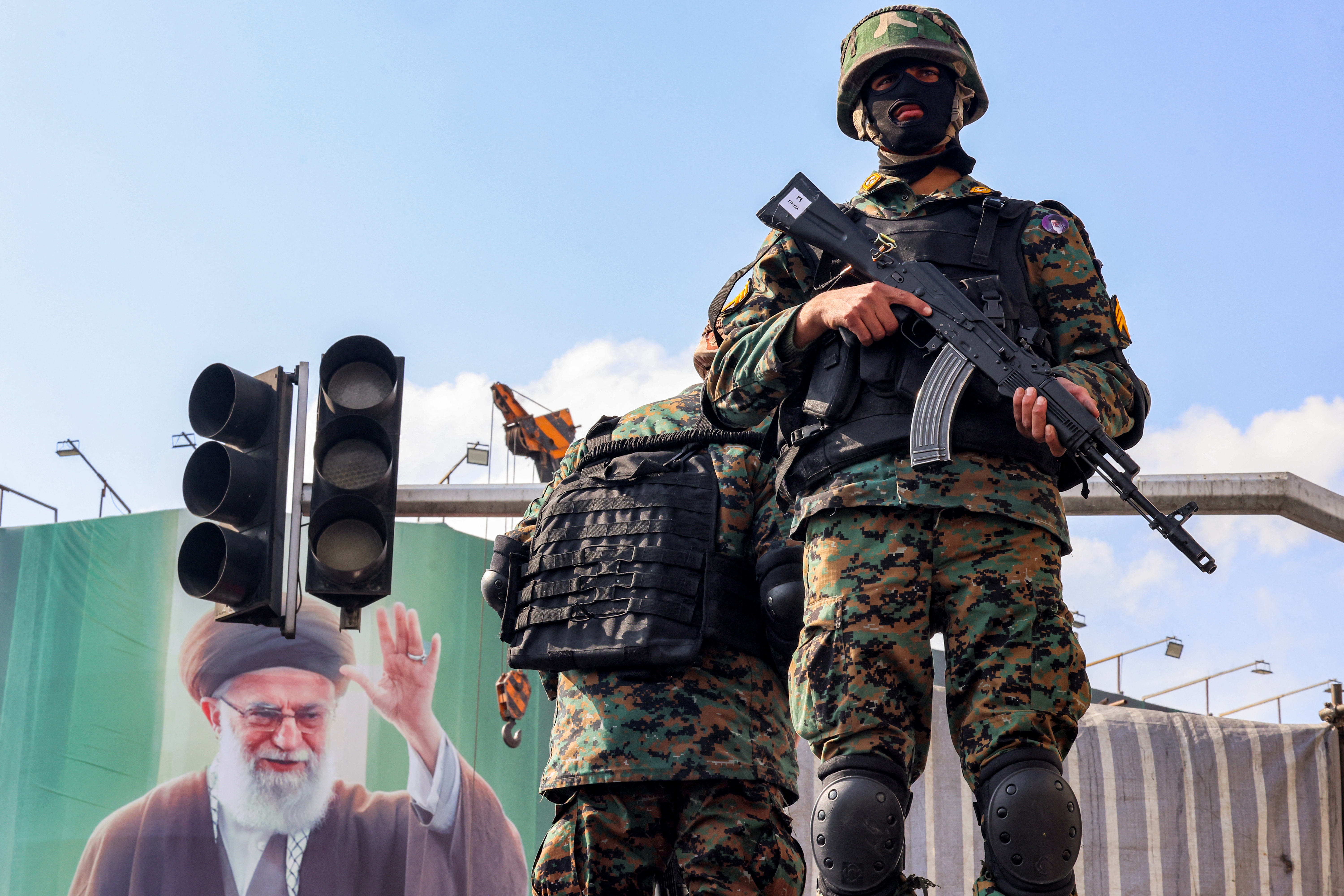
Russian President Vladimir Putin was among the international leaders to congratulate Mojtaba Khamenei on his appointment.
The Israeli military said today that it had begun a new wave of attacks against targets in Tehran, Isfahan, and elsewhere in central and southern Iran.
It also said that it struck targets associated with the Iran-backed Hezbollah militant group in Beirut.
According to Hezbollah, its fighters are meanwhile engaged with Israeli forces who entered eastern Lebanon via helicopter. Hezbollah said it detected “the infiltration of approximately 15 Israeli enemy helicopters” from the Syrian side of the border into Lebanon. The Iran-backed militant group said in a statement that its fighters “engaged the helicopters and the infiltrating force with appropriate weapons” and that the confrontation was ongoing.
Lebanon’s state-run National News Agency described “fierce clashes … towards the outskirts of the town of Nabi Sheet to repel Israeli forces that carried out a landing by helicopters” in the area. Two Hezbollah officials told AFP that an Israeli helicopter was downed, but this has not been independently verified.
A previous Israeli commando raid was launched into Lebanon overnight on Friday. Among its aims was the recovery of the remains of Ron Arad, an Israeli airman missing since 1986. The fighting left three Lebanese soldiers and 41 residents of the Bekaa Valley dead, according to the Lebanese Ministry of Health.
The Israeli military confirmed that two of its soldiers were killed in southern Lebanon.
The Israel Defense Forces (IDF) today issued a new warning in Lebanon, calling for residents of the southern suburbs of Beirut to evacuate the area. An IDF spokesman said that the Israeli military will act “forcefully” against terrorist infrastructure in “the coming hours.”
The IDF also said it conducted targeted strikes against the Iranian Lebanon Corps in Beirut over the weekend.
Human Rights Watch (HRW) has accused Israel of unlawfully using white phosphorus munitions in the town of Yohmor in southern Lebanon. HRW verified and geolocated various images that confirmed the airburst use of white phosphorus munitions over a residential part of the town last week.
“The Israeli military’s unlawful use of white phosphorus over residential areas is extremely alarming and will have dire consequences for civilians,” Ramzi Kaiss, Lebanon researcher at Human Rights Watch, said in a statement.
White phosphorus is not a chemical weapon, as sometimes described, since it is primarily an incendiary weapon, although it’s also regularly used for making smokescreens and for target marking. Burning at around 1,500 degrees Fahrenheit, white phosphorus can obviously inflict terrible injuries, and its use in densely populated areas violates international law.
As we discussed last week, Israel may be using a version of the Joint Direct Attack Munition (JDAM) that includes white phosphorus in its warhead. However, this particular weapon was designed to attack chemical and biological weapon stockpiles.
Iran and its proxies launched more attacks across the region over the weekend and into Monday.
There are reports that strikes targeted a U.S. diplomatic facility near Baghdad’s international airport but were apparently intercepted.
Another successful drone interception reportedly occurred east of Saudi Arabia’s northern Al-Jawf region. The Saudi Ministry of Defense has released footage showing Iranian drones being taken out by Royal Saudi Air Force (RSAF) F-15 and Typhoon fighters. The RSAF has plenty of practice in this, having targeted drones launched by the Houthis in Yemen for many years.
However, Iran was more successful in its targeting of the Bapco (Bahrain Petroleum Company) oil refinery — the only one in Bahrain.
Videos show smoke rising from the refinery, where operators declared a state of emergency.
A statement from the company said it “hereby serves notice of force majeure on its group operations which have been affected by the ongoing regional conflict in the Middle East and the recent attack on its refinery complex.”
The Bahrain Ministry of Interior earlier today said that the fire at the refinery had been brought under control, with no casualties reported.
Earlier today, Bahrain said an overnight Iranian drone attack on the island of Sitra injured 32 people.
Other countries in the region have also reported being targeted by more retaliatory Iranian strikes.
In central Israel, a man was killed, and several more were injured in an airstrike, according to local emergency services. It is unclear who launched the attack, but several people were reportedly injured as they made their way to a shelter.
The recent Iranian missile strikes on Israel reportedly also involved the use of warheads carrying cluster munitions.
In the United Arab Emirates, authorities reported two people injured in two separate locations in Abu Dhabi. Both are said to have been hit by debris from intercepted airstrikes.
Meanwhile, the fallout from an attack last week on the Fujairah Oil Industry Zone in the UAE is threatening to further disrupt the flow of oil out of the region.
The United Arab Emirates is now using AH-64 Apache attack helicopters in a counter-drone role. The footage below shows Apaches from the UAE Joint Aviation Command — reportedly the latest AH-64E versions, rather than the earlier AH-64Ds — using their 30mm guns to bring down Iranian UAVs. While the U.S. Army and other operators using AH-64s to swat down lower-end long-endurance drones might be relatively new, it’s worth noting that Israel has been using the Apache in an air defense role for this purpose for many years.
AFP reports several explosions heard today in the Qatari capital of Doha.
Qatar’s defense ministry said that its forces had intercepted and destroyed two drones heading toward the Shaybah oil field in the southeast of the country. These were just a fraction of a much larger barrage of ballistic missiles and drones sent toward Qatar, according to the defense ministry.
In Kuwait, the defense ministry reported that air defenses were working to intercept a missile and drone attack on Monday.
Footage purportedly showing a burning high-rise building in Kuwait after it was struck by an Iranian drone over the weekend.
Cyprus, which has also been on the receiving end of drone strikes, received six Turkish Air Force F-16 fighters today. The jets were deployed to the breakaway Turkish Republic of Northern Cyprus to bolster local defenses for the Turkish Cypriot state.
Turkey has also reportedly come under attack from at least one Iranian ballistic missile, which the local defense ministry said was brought down by “NATO air and missile defense assets” based in the eastern Mediterranean.
In a statement provided to TWZ, a NATO spokesperson added:
“In less than 10 minutes, NATO service members identified a threat to Allies, a ballistic missile, confirmed its trajectory, alerted land- and sea-based missile defence systems, and launched an interceptor to defeat the threat and protect our territory and its people.”
The U.S. military has confirmed the death of a seventh American soldier due to injuries sustained during Iran’s initial counterattack. The Department of War said that Sgt. Benjamin N. Pennington, 26, of Glendale, Kentucky, died of his wounds yesterday. He had come under enemy attack on March 1, 2026, at Prince Sultan Air Base, Saudi Arabia, where he served with the 1st Space Battalion, 1st Space Brigade.
However, unverified reports of the death of an eighth U.S. service member during the current campaign have proven to be erroneous.
According to a report from Axios, U.S. President Donald Trump, together with envoys Steve Witkoff and Jared Kushner, plans to travel to Israel tomorrow for talks with Israeli Prime Minister Benjamin Netanyahu.
However, reports from Israel suggest that the visit has been postponed.
Regardless, Trump has said that the end of the war will be a “mutual” decision to be made with Netanyahu, the Times of Israel reported.
“I think it’s mutual…a little bit. We’ve been talking. I’ll make a decision at the right time, but everything’s going to be taken into account,” Trump said.
In a telephone interview with the Times of Israel on Sunday, Trump said that Iran would have destroyed Israel if it weren’t for his and Netanyahu’s actions.
“Iran was going to destroy Israel and everything else around it…We’ve worked together. We’ve destroyed a country that wanted to destroy Israel,” the U.S. president said.
Contact the author: thomas@thewarzone.com
Loading comments…
Comments couldn’t be loaded. Please refresh the page.