
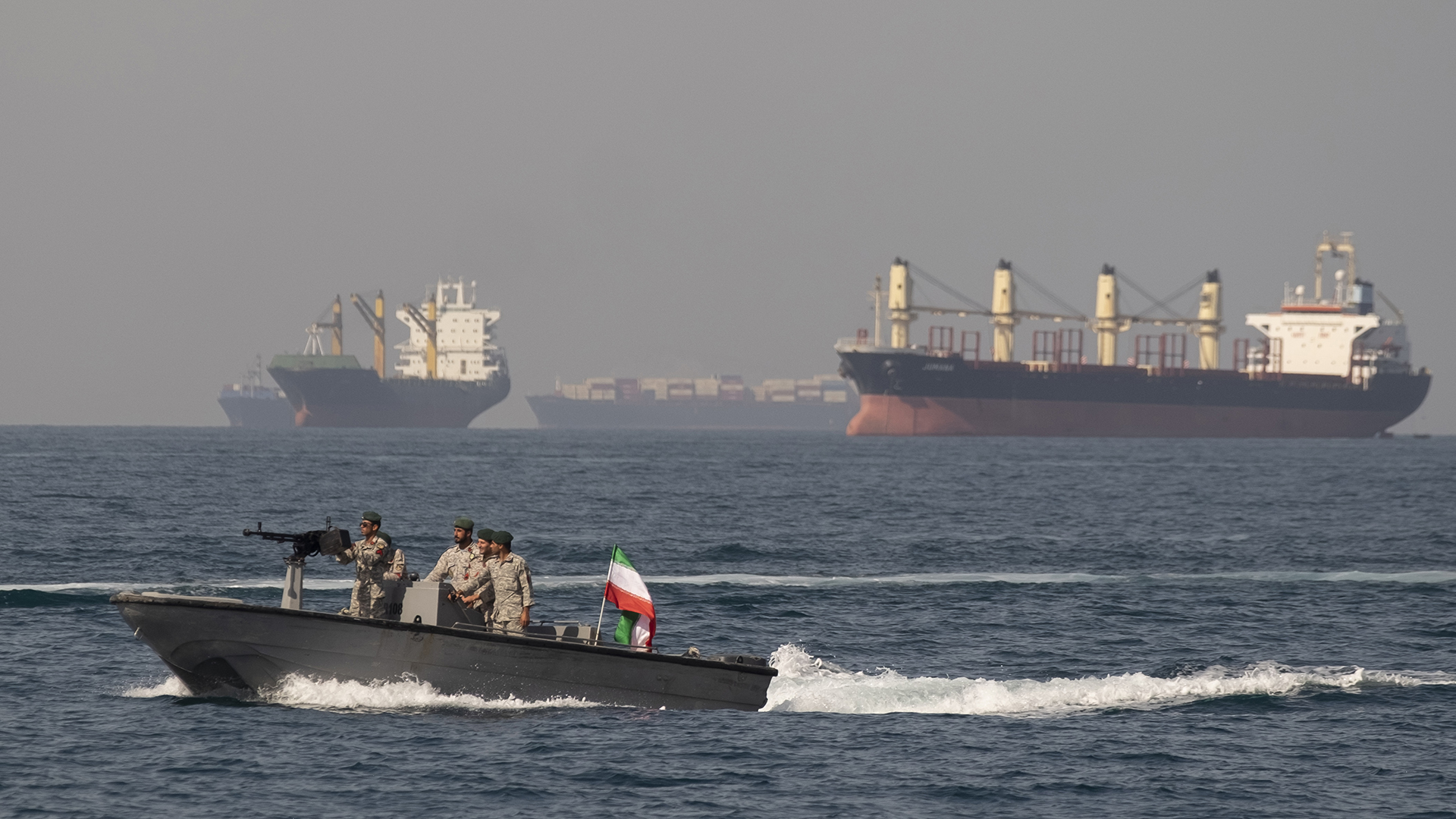
Iran is reportedly working to solidify its control over the Strait of Hormuz despite U.S. objections by seeking a joint deal to impose fees on ships transiting the strategic waterway with Oman. The move comes amid increasing hopes of a peace deal to end the war that began Feb. 28 and highlights just how difficult it will be to reach such an agreement. Iran’s closure of the Strait has created severe global economic impacts and spurred the Trump administration to stand up Project Freedom, a short-lived effort to provide military protection for ships stuck in the Persian Gulf and trying to get out.
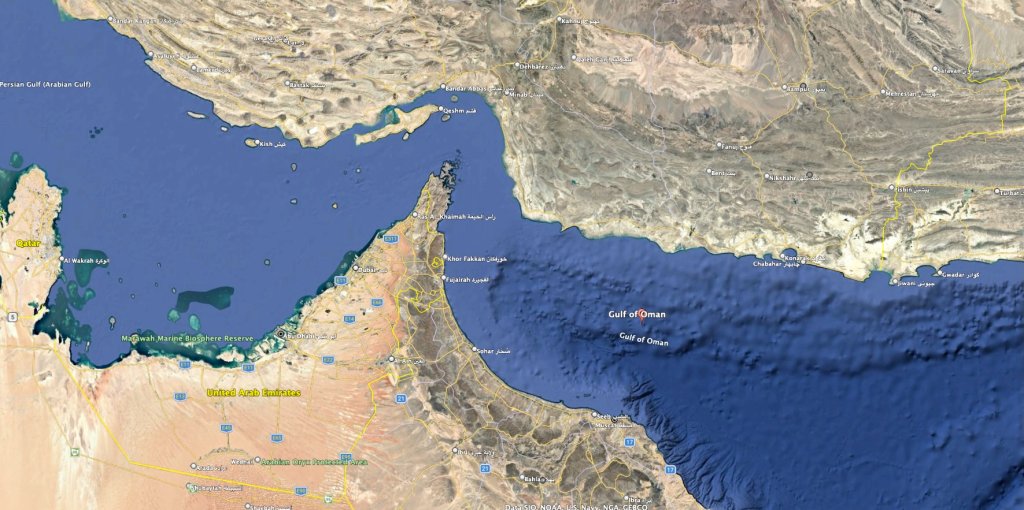
Though U.S. President Donald Trump has insisted the Strait remain open and free of any tolls, Iran is in discussions with Oman, a U.S. ally, to impose financial burdens on vessels passing through the critical chokepoint, The New York Times reported. Together, the countries border both sides of the Gulf of Oman, through which any ship must pass to get into or out of the Strait.
Two people familiar with the discussions over management of the waterway said that “Iran was not planning a toll system, which would charge simply for transit,” according to the Times. Instead, the talks with Oman have “explored a proposal to charge vessels fees for services.”
“Oman had initially rejected a joint partnership with Iran on the strait but is now in discussion over a share of the revenues,” the newspaper stated, citing two Iranian officials familiar with the talks. “The officials said Oman told the Iranians that it was willing to use its influence with neighbors in the Gulf, including Bahrain, Kuwait, Qatar, Saudi Arabia and the United Arab Emirates, and with the United States to push the plan, having realized the potential economic benefits of a fee system.”
Iran and Oman “appear to be emphasizing that the proposed system would involve fees, not tolls, a legally significant distinction,” the Times posited. “A tolling system that simply charges ships to pass through the waterway would be illegal under international law, but charging fees for actual services rendered to vessels, such as waste disposal at a port, is allowed under certain circumstances.”
On Wednesday, Iran’s newly created Persian Gulf Strait Authority declared on X that it has “defined the boundaries of the Strait of Hormuz management supervision area” as the “line connecting Kuh Mobarak in Iran and the south of Fujairah in the UAE in the east of the strait to the line connecting the end of Qeshm Island in Iran and Umm al-Qaiwain in the UAE in the west of the strait.”
Iran’s claimed area of control includes the coastal waters of the United Arab Emirates (UAE) and Oman in addition to its own.
In the face of Iran’s insistence on controlling the Strait, Rubio on Friday reiterated that the Trump administration rejects any form of Iranian tolling on the Strait.
“That’s just not acceptable. It can’t happen,” Rubio said of any Iranian effort to impose payment for the safe passage of vessels. “If that were to happen in the Straits of Hormuz, it will happen in five other places around the world.”
Rubio added that NATO allies are beginning to think through a worst-case scenario if Iran refuses to open the Strait of Hormuz.
“We all would love to see an agreement with Iran in which the Straits are open and they abandon their nuclear ambitions and so forth,” he told reporters. “We also have to have a plan B…We have to start thinking about what do we do if, a few weeks from now, Iran decides ‘We don’t care, we’re going to keep the Straits closed. We’re going to sink any ship that doesn’t listen to us or doesn’t pay us.’ Then someone’s going to have to do something about it.”
Since implementing the blockade on Iranian ports on April 13, “U.S. forces have redirected 97 commercial vessels and disabled 4 since the start of the blockade,” CENTCOM claimed on X.
Regardless of the blockade, Japan is anticipating the arrival of the first tanker full of oil that transited the Strait of Hormuz since the war began.
The Idemitsu Maru, a very large crude carrier that passed through the waterway in late April, could dock as soon as Monday, according to the trade ministry. Hauling two million barrels of Saudi crude, the vessel is on track to arrive at Idemitsu Kosan Co.’s Aichi refinery, the Ministry of Economy, Trade and Industry said in a briefing document on Friday, according to Bloomberg News.
The announcement highlights the difficult choices many nations now have as a result of the war. Japan is a key U.S. ally and risks running afoul of Trump, who maintains opposition to Iranian control of the vital waterway, including tolls on shipping levied by Iran, something Trump vehemently opposes. But Japan is also one of the world’s importers of Middle Eastern oil and the inability to get what it needs as a result of the Iranian Strait closure is having dramatic economic effects.
Most of the ships passing through the Strait under the new Iranian system “were linked to Southeast Asian nations that maintain friendly relations with Iran,” the official state broadcaster IRIB claimed on Friday in a post on X.
There has been a large increase in the number of Iranian-trading tankers at anchor off the country’s main oil export port of Kharg Island in the past week, according to the Windward maritime intelligence firm’s multi-source intelligence (MSI) analysis.
“MSI images show 27 tankers off Kharg Island as of May 21, including 18 assessed as very large crude carriers (VLCC),” Windward reported. “This has expanded from 14 tankers a week ago on May 14, a 93% increase. All were ‘dark’ and not broadcasting their position via AIS.”
Windward “assesses the majority of VLCCs at anchor off Kharg Island are being used for floating storage. About two-thirds of Iranian-trading tankers are now constrained in the Gulf of Oman or Arabian Gulf by the U.S. blockade. The remaining third are either waiting at ports off China or at anchor off the Riau archipelago, in Malaysia’s EEZ.”
UPDATE: 5:25 PM EDT –
Trump convened a meeting with his senior national security team on the war with Iran on Friday morning, Axios reported Friday evening, citing two U.S. officials.
The president “is seriously considering launching new strikes against Iran barring a last-minute breakthrough in negotiations, sources who have spoken directly with the president say,” the news outlet stated.
Vice President JD Vance, Secretary of Defense Pete Hegseth, CIA Director John Ratcliffe, White House chief of staff Susie Wiles and other officials attended the meeting along with Trump, the sources told Axios.
Hours later, Trump issued his cryptic message on Truth Social about not attending his son’s wedding due to “circumstances pertaining to Government.”
Iran insists it is ready with new tactics, weapons and a threat to extend the conflict beyond the region should a new round of fighting break out.
UPDATES
There are growing indications that the U.S. and Iran could be moving closer to a deal to end the war. However, both sides are poised to resume fighting as major sticking points remain over Iran’s nuclear ambitions, its control over the Strait of Hormuz and the future of its ballistic missile arsenal as well as U.S. sanctions.
In a sign that progress has been made in talks to reach a deal, Pakistani and Qatari negotiators are now in Tehran.
“Field Marshal Asim Munir, is traveling to Tehran on Friday in an effort to reach a deal under which the U.S. and Iran would agree to end the war and launch negotiations for a broader agreement,” Axios reported on Friday, citing a Pakistani security source.
The Qatari negotiating team arrived in Tehran on Friday ”in coordination with United States to help secure a deal to end the war with Iran and resolve outstanding issues,” Reuters reported on X, citing a source with knowledge of the matter. “Doha, which has worked as a mediator in the Gaza war and other areas international tensions, had till now distanced itself from playing a mediation role in the Iran war after it came under attack from Iranian missiles and drones during the latest conflict.”
Confirmation of Munir’s trip to Tehran, from several media outlets, came after U.S. Secretary of State Marco Rubio said there was “slight progress” in negotiations with Iran.
“I don’t want to exaggerate it, but there’s been a little bit of movement, and that’s good,” Rubio said at a meeting of NATO foreign ministers in Sweden, on Friday.
In a post on X, the Saudi-based Al Arabiya news outlet claimed it has obtained a “final draft of a possible agreement between the United States and Iran, mediated by Pakistan” that is “expected to be announced within hours.”
The purported details of the nine-point plan are as follows, according to the publication:
- Immediate, comprehensive, unconditional ceasefire on all fronts, including land, sea, air.
- Mutual commitment not to target military, civilian or economic infrastructure.
- End to military operations and halt media war.
- Commitments to respect sovereignty, territorial integrity and non-interference in internal affairs.
- Guarantees freedom of navigation in the Arabian Gulf, the Strait of Hormuz and the Gulf of Oman.
- Joint mechanism to monitor implementation and resolve disputes
- Negotiations on outstanding issues would begin within seven days.
- Gradual lifting of US sanctions in exchange for Iran’s commitment to the terms of the agreement.
- Draft agreement reaffirms compliance with international law and UN Charter.
However, the reported draft agreement does not explicitly mention Trump’s key demands, including the dismantling of Iran’s nuclear program and export of its stockpile of 60%-enriched uranium, limiting its ballistic missiles and ending its support for Iranian proxies like Hezbollah, the Houthis and several groups in Iraq.
Trump has repeatedly stated that Iran must dismantle its nuclear weapons program, turn over the enriched uranium and reopen the Strait.
Given the American leader’s stance on the issues, it seems unlikely that he would agree to such a deal as stated by Al Arabiya. TWZ cannot verify the validity of these details. Asked if they are accurate, the White House gave us the following response:
“Iran will never be allowed to have a nuclear weapon, and while President Trump always prefers a diplomatic solution, he has been clear about the consequences if Iran refuses to make a deal,” a White House official told us. “As the president stated, he will only make a good deal for the American people. He is not going to be rushed into making a bad deal. Due to the successes of Operation Epic Fury, Economic Fury, and the blockade, President Trump holds the cards and has all the time he needs to make the best deal for the United States and the world.”
The White House, however, pushed back on a Reuters report that Iranian Supreme Leader Mojtaba Khamenei told his country’s decision-makers not to agree to any deal to remove enriched uranium out of the country. A White House official told Fox News that the claim is untrue and that as of yet, no decision has been made on the matter by either side.
With the status of the peace process uncertain, Trump claimed he decided not to attend the wedding this weekend of his eldest son, Donald Trump Jr., to socialite Bettina Anderson due to “circumstances pertaining to Government, and my love for the United States of America.”
“I feel it is important for me to remain in Washington, D.C., at the White House during this important period of time,” Trump stated on Truth Social.
Amid talk of diplomacy, U.S. Central Command (CENTCOM) indicated that the Abraham Lincoln Carrier Strike Group, loitering in the Arabian Sea, “is maintaining peak readiness while enforcing the U.S. blockade against Iranian ports.”
The post messaged that should negotiations break down, the U.S. is ready to resume attacking Iran should Trump so order.
For its part, the Islamic Revolutionary Guard Corps (IRGC) has threatened to push the war “beyond the region” if the U.S. or Israel resume attacks, promising “crushing blows … in places you cannot even imagine.”
Despite a bombing campaign that top U.S. officials say has severely crippled Iran’s ability to produce drones and missiles, Tehran has reportedly used the six-week old ceasefire to rearm far faster than anticipated.
“While the time to restart production of different weapons components varies, some US intelligence estimates indicate Iran could fully reconstitute its drone attack capability in as soon as six months,” CNN reported on Thursday, citing a source familiar with those assessments. “The Iranians have exceeded all timelines the IC had for reconstitution,” the US official said.
The network claimed that Iran is “rebuilding…military capabilities, including replacing missile sites, launchers and production capacity for key weapons systems destroyed during the current conflict.”
Iran “also still maintains ballistic-missile, drone-attack and anti-air capability despite the serious damage inflicted by US-Israeli strikes,” the network claimed, citing recent US intelligence assessments. That means “the quick rebuilding of military production capacity isn’t starting from scratch.”
These efforts are being aided by China and Russia, CNN added.
The U.S. military “has depleted much of its inventory of advanced missile-defense interceptors after expending far more high-end munitions defending Israel amid hostilities with Iran than Israeli forces used themselves,” The Washington Post reported, citing Defense Department assessments.
“The imbalance, according to three U.S. officials who spoke on the condition of anonymity to discuss sensitive security matters, underscores the extent to which Washington has shouldered the burden of countering Iranian ballistic missile strikes duringOperation Epic Fury, and raises questions about U.S. military readiness and security commitments around the world,” the publication added. “The United States launched more than 200 Terminal High Altitude Area Defense, or THAAD, interceptors in defense of Israel — roughly half of the Pentagon’s total inventory — along with more than 100 Standard Missile-3 and Standard Missile-6 interceptors fired from naval vessels in the eastern Mediterranean, said the U.S. officials, who, like others in this article, spoke on the condition of anonymity to discuss sensitive security matters.”
By contrast, the newspaper noted, “Israel fired fewer than 100 of its Arrow interceptors and around 90 David’s Sling interceptors, some of which were used against less sophisticated projectiles fired by Iran-backed groups in Yemen and Lebanon.”
Acting Navy Secretary Hung Cao on Thursday testified before the Senate that the U.S. is pausing arms sales to Taiwan because of the war with Iran.
“Right now we’re doing a pause in order to make sure we have the munitions we need for Epic Fury,” Cao told Sen. Mitch McConnell.
Ukraine’s ambassador to the U.S. Olga Stefanishyna, however, told Politico Washington Bureau Chief Dasha Burns that the war with Iran has not yet affected U.S. weapons shipments to Kyiv. Still, she said American military officials told Ukraine “there’s nothing that could be guaranteed for the future.”
The war is facing increasing opposition in Washington. House Republicans on Thursday “abruptly canceled a vote on a resolution directing Trump to withdraw U.S. forces from Iran or win approval from Congress to continue the war, after it became clear they lacked the votes to defeat the measure,” The New York Times reported. “The retreat was a striking setback that exposed fractures within the G.O.P. over the conflict at a moment when the party has begun pushing back forcefully on Mr. Trump and his agenda.”
In another sticking point to a peace deal, Israel continues to hit Hezbollah targets in southern Lebanon.
The Israeli Air Force (IAF) on Friday released video it claims struck a structure in which five Hezbollah fighters “were located north of the forward defense line in southern Lebanon and eliminated.”
Contact the author: howard@TWZ.com
Loading comments…
Comments couldn’t be loaded. Please refresh the page.