
Iran appears to be increasingly focusing its retaliatory attacks against energy production infrastructure in Gulf Arab States. The U.S.-Israeli operation against Iran is also continuing at a significant tempo, including a major new wave of Israeli strikes going after leadership targets in Tehran.
Readers can catch up on previous developments in the ongoing conflict in our previous rolling coverage here.
Increased targeting of Gulf Arab States’ oil and natural gas production is part of a clear Iranian strategy to put pressure on those countries to, in turn, create complications for the United States. As the economic pressure builds, the idea is that these countries will seek to end the conflict, and/or that relations with the U.S. will sour. The prospect of major, long-term disruptions in energy exports from the region has global ramifications, as well, which could bring immense external pressure to end the conflict. There is also the aspect of drawing Arab countries into the conflict, which would complicate it politically and militarily. In addition, some energy targets are not as well defended as U.S. bases in the region, for instance, and scoring hits with the now finite weapons Iran has on hand becomes easier.
So, it’s not surprising that Iran has morphed its tactics in this manner. How this will all play out is unknown. But if the war continues on for a prolonged period, and interceptors run low while Iran’s stocks of drones and missiles don’t dry up, this entire issue could become greatly magnified.
So far, Qatar and the United Arab Emirates, as well as the United States, have pushed back on reports that interceptor stocks are dwindling and the U.S. is resisting replenishing them due to its own stockpile concerns. It isn’t clear if this is a case of strategic counter-messaging or if indeed stockpiles remain in the green, although from everything we understand about the stockpile issue overall, the former seems far more likely.
Impacted energy-related targets are relatively wide-ranging and the scope of attacks appears to be becoming larger with time.
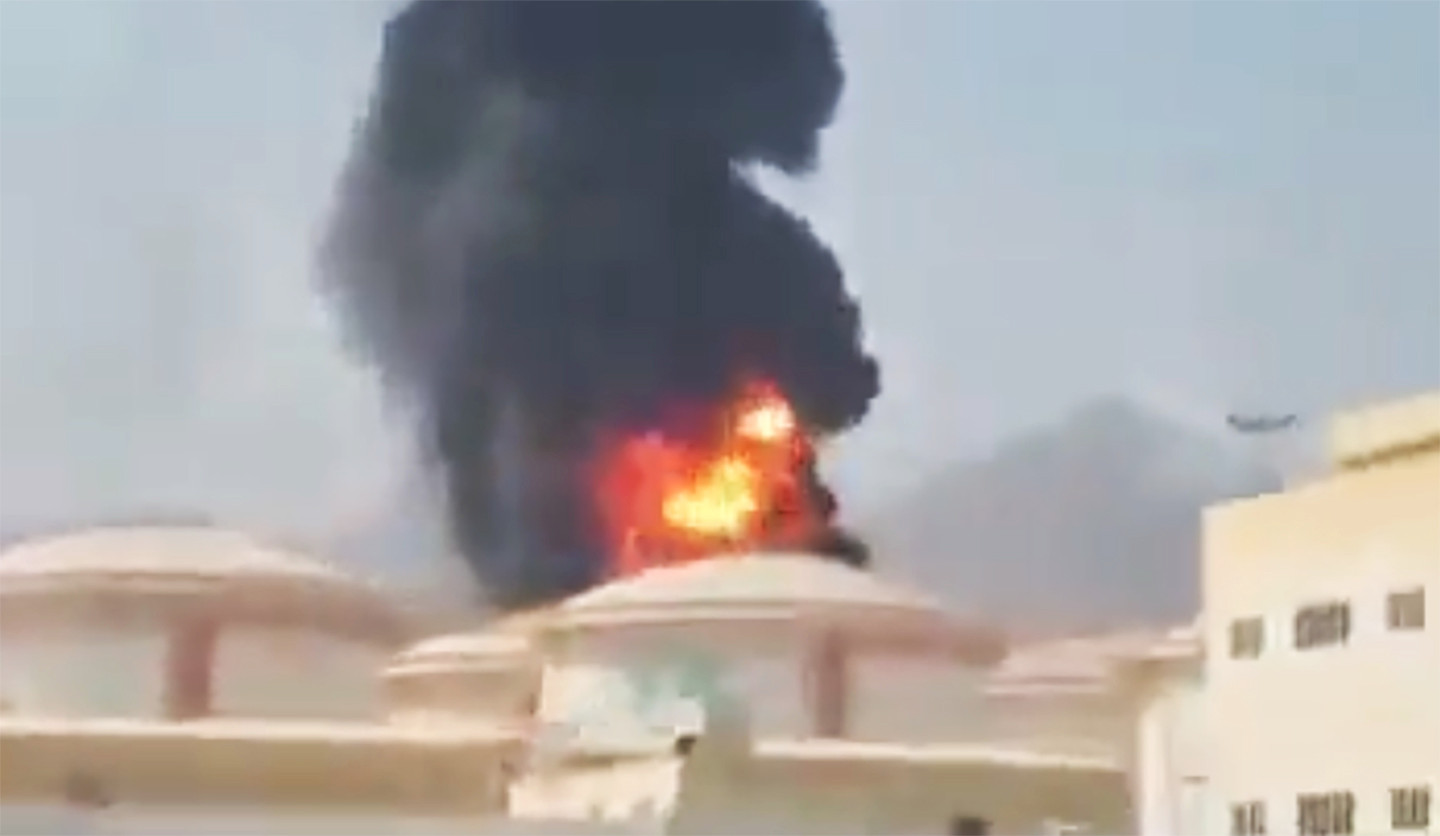
A large fire broke out today in the Oil Industry Zone in Fujairah in the United Arab Emirates (UAE), reportedly caused by falling debris from the interception of an Iranian drone. The port of Fujairah sits on the Gulf of Oman, on the other side of the highly strategic Strait of Hormuz.
According to state-run Oman News Agency, two Iranian drones were shot down today above the Dhofar governorate in southern Oman, while a third came down close to the port of Salalah. No casualties or damage were reported.
The Port of Duqm in Oman was also targeted by several drones, according to the country’s state news agency. One of these is said to have struck a fuel tank.
Several ships attempting to cross the Strait of Hormuz have also come under attack, as you can read about here. Yesterday, U.S. Central Command denied Iranian claims that the Strait was closed. Online ship tracking data shows a major slowdown in traffic overall, but there is still some movement through this highly strategic waterway. Imagery is also emerging showing a backlog of ships waiting to pass through.
Oil production at Iraq’s largest oil field, in Shafaq, has reportedly been halted, as has the flow of oil through a pipeline that links its northern Kurdish autonomous region with Turkey. There are reports that Iraqi oil exports, overall, have slowed dramatically due to the ongoing conflict.
This all follows Iranian attacks yesterday that caused a halt to some operations at the Ras Tanura refinery in Saudi Arabia and a shutdown in liquid natural gas production by state-owned QatarEnergy in that country.
Further rolling coverage can be found below, with the newest updates at the top.
We have concluded our rolling coverage in this piece. We will be back soon to continue our reporting.
UPDATE: 7:46 PM EST –
CENTCOM commander Adm. Brad Cooper provided a video update on Epic Fury. Here are some of the highlights:
- 50,000 troops, 200 fighters, two aircraft carriers and bombers from the United States are participating in this operation, and more capabilities on the way.
- 100 hours into this operation, and we’ve already struck nearly 2,000 targets with more than 2,000 munitions.
- ..we’ve destroyed 17 Iranian ships, including the most operational Iranian submarine that now has a hole in that side. Today, there’s not a single Iranian ship underway in the Arabian Gulf, strait of Hormuz or Gulf of Oman.
- In retaliation, the Iranian regime has launched over 500 ballistic missiles and over 2,000 drones. To be clear, Iran is indiscriminately targeting civilians as they launch these missiles and drones. You’ve seen it on TV. The evidence is crystal clear and overwhelming.
- Also for the first time, U.S. Central Command’s drone task force, called Task Force Scorpion Strike, launched countless one-way attack drones achieving massive effects. I’d like to point out these drones were originally an Iranian design. We took them back to America, made them better, and fired them right back at Iran.
UPDATE: 7:03 PM EST –
“The scene here in [Tehran] was dominated by the sound of airplanes and massive explosions across the city, and the smell of smoke drifting in the air,” Al Jazeera reported. “This is very massive, and this is heavier bombardment compared to the first days of the initiation of these strikes.”
You can get a sense of what these attacks have been like in the following video.
A screencap from a video released by CENTCOM shows the loadout on a U.S. Air Force F-15E Strike Eagle. TWZ Editor-in-Chief Tyler Rogoway breaks it down.
As Epic Fury rages on, U.S. Sen. Chris Murphy is calling for Senate debate on an authorization for the use of military force against Iran.
“This is as serious as it gets,” he told reporters after a closed-door briefing. “This is war and peace. They told us in that room that there are gonna be more Americans that are gonna die, that they’re not gonna be able to stop these drones…We have to have a debate in the US Senate on an authorization of military force.”
UPDATE: 6:10 PM EST –
The Pentagon announced the names of four of the six troops killed in an Iranian drone attack on a U.S. facility in Kuwait. The four were Army Reserve soldiers.
“Capt. Cody A. Khork, 35, of Winter Haven, Fla.; Sgt. 1st Class Noah L. Tietjens, 42, of Bellevue, Neb.; Sgt. 1st Class Nicole M. Amor, 39, of White Bear Lake, Minn.; and Sgt. DeclanJ. Coady, 20, of West Des Moines, Iowa, died on March 1, 2026, in Port Shuaiba, Kuwait, during an unmanned aircraft system attack. All Soldiers were assigned to the 103rd Sustainment Command, Des Moines, Iowa. The incident is under investigation.”
Video emerged of Israeli AH-64 Apache attack helicopters using their M230 chain guns to shoot down several Iranian Shahed-136 kamikaze drones.
B-2 Spirit stealth bombers “have been targeting command and control nodes of the Islamic Revolutionary Guard Corps, as well as weapon depots and an assembly facility for Iran’s rocket program,” CBS News reported on X.
Secretary of State Marco Rubio told reporters that attacks against Iran will intensify.
“We’re going to unleash Chang on these people in the next few hours and days,” Rubio said. “You’re going to really begin to perceive a change in the scope and intensity of these attacks as, frankly, the two most powerful air forces in the world take apart this terroristic regime.”
The term “unleash Chang” reportedly dates back to “Unleash Chiang,” an inscription on a sword former Florida Gov. Jeb Bush gave Rubio two decades ago.
The term was “the rallying cry of John Birchers in the 1950s, who urged the United States to arm Chiang Kai-shek, the Chinese Nationalist leader of Taiwan, so he could retake Red China from Mao,” Politico reported in 2015.
UPDATE: 6:04 PM EST –
After a closed-door briefing about Epic Fury, U.S. Sen. Richard Blumenthal told reporters that “I am more fearful than ever after this briefing, that we may be putting boots on the ground, and that troops from the United States might be necessary to accomplish objectives that the administration seems to have.
UPDATE: 5:53 PM EST –
After Spain refused to let the U.S. military use its bases for missions linked to attacks on Iran, Trump threatened to impose a full U.S. trade embargo.
“Spain has been terrible,” Trump told reporters during a meeting with German Chancellor Friedrich Merz. He also told Treasury Secretary Scott Bessent to “cut off all dealings” with Spain.
“That’s all right,” Trump exclaimed. “We can use their bases. If we want, we can just fly in and use it.”
As we have reported in the past, the U.S. has used the Rota and Moron bases as transit points for fighter aircraft, electronic attack jets and aerial refueling tankers.
UPDATE: 5:38 PM EST –
The IDF said Tuesday it struck a secret underground nuclear complex in Tehran, describing it as a key site where Iran was developing components for a nuclear weapon. Fighter aircraft targeted the covert “Minzadehei” compound, an underground facility where Iran’s nuclear weapons group operated under the country’s Defense Ministry.
UPDATE: 5:32 PM EST –
U.S. Sen. Lindsey Graham told reporters today that new attacks against Iran are imminent and that there is a growing coalition of allies willing to take part in the fight against Iran.
UPDATE: 5:12 PM EST –
The IDF released details of its Operation Roaring Lion attack on Iran. It claims that more than 200 fighters flew more than 700 sorties. There were 47 senior leaders killed, while 600 “terror sites” were “dismantled.” The War Zone cannot independently verify these claims.
UPDATE: 5:06 PM EST –
Hundreds of Iranian university professors and tech experts have reportedly signed a statement declaring the Constitution of the Islamic Republic illegitimate. The statement also calls for the immediate transfer of power to the people, while endorsing Prince Reza Pahlavi’s democratic transition plan.
UPDATE: 4:58 PM EST –
French President Emmanuel Macron has ordered the aircraft carrier Charles de Gaulle to the eastern Mediterranean amid the ongoing war.
Macron is also working to build a coalition that would help secure maritime traffic imperiled by the escalating crisis in the Middle East.
In a televised address to the nation, Macron said that action needed to be taken with the Straits of Hormuz closed and the Suez Canal and Red Sea shipping routes threatened by the widening conflict.
UPDATE: 4:50 PM EST –
A suspected Iranian drone attack hit the CIA’s station in Saudi Arabia “in what would amount to a significant symbolic victory for the Islamic Republic,” The Washington Post reported.
“An internal State Department alert obtained by The Washington Post said the attack ‘collapsed’ part of the embassy’s roof and ‘contaminated’ the inside with smoke,” the publication stated. “The notice said the embassy sustained ‘structural damage’ and personnel ‘continue to shelter in place.’”
The extent of the damage was not immediately clear, the Post added. There was no indication that any CIA personnel were wounded.
UPDATE: 4:43 PM EST –
Officials in Dubai say the fire near the US Consulate in Dubai has been fully extinguished with no injuries recorded. The area had been hit by an Iranian drone.
UPDATE: 2:46 PM EST-
The IDF says it has now destroyed 300 Iranian missile launchers since the start of the conflict. Israeli authorities also say the country’s fighters have flown more than 1,600 sorties and dropped more than 4,000 munitions.
The IDF says it has targeted an Iranian facility on the outskirts of Tehran where scientists “worked secretly to develop capabilities required for nuclear weapons.”
The IDF is also still assessing the results of its strike targeting Iran’s Assembly of Experts in Qom. There are reports that none of the 88 clerics who make up this group were in the building when it was hit. Iranian quasi-state media claims a vote for the next Supreme Leader of the country was held remotely for security reasons.
The satellite imagery below shows damage to Iranian leadership targets in Tehran from Israeli strikes earlier today.
U.S. Central Command has also released new footage showing strikes targeting Iranian kamikaze drone capabilities.
Imagery has emerged that is said to show a fire at a U.S. diplomatic facility in Dubai following an Iranian drone attack.
There are reports that President Donald Trump’s administration is considering using military assets to escort oil and natural gas tankers through the Strait of Hormuz. Any warships supporting these operations would also have to operate in the Strait, with all the potential risks entailed. The report says that the U.S. government could also seek to back maritime insurance, where some rates have been hiked and some policies outright cancelled as a result of the current conflict.
Iraqi authorities say that all refineries “are operating continuously and at their full design capacity to produce various petroleum derivatives,” according to the country’s Rudaw news outlet.
President Donald Trump has said that “it would seem to me that somebody from within [Iran] maybe would be more appropriate” when asked if Reza Pahlavi, the eldest son of Mohammad Reza Pahlavi, the last Shah of Iran, is someone the U.S. might look to as part of a new Iranian government.
“Yes, the State Department is actively securing military aircraft and charter flights for American citizens who wish to leave the Middle East,” Assistant Secretary of State for Global Public Affairs Dylan Johnson has written in a post on X in response to questions about what steps are being taken to help American citizens depart the Middle East. However, at the time of writing, the phone number he has given out starts with a recorded message advising callers not to rely on the U.S. government.
UPDATE: 1:29 PM EST-
The Israel Defense Forces have confirmed strikes in Isfahan and elsewhere in Iran. In Isfahan, the targets are said to have been related to the Iranian ballistic missile arsenal rather than the nuclear facility there.
Israel has now also issued an explicit threat to strike Iranian officials in Lebanon if they do not leave within 24 hours. The IDF said earlier that it killed Daoud Alizadeh, the Islamic Revolutionary Guard Corps’ (IRGC) Quds Force’s acting commander in charge of operations in Lebanon, in strikes on targets in Tehran. The IDF has also continued to target Iranian-backed Hezbollah militants in Lebanon.
A British F-35B Joint Strike Fighter has shot down an Iranian drone while flying over Jordan. This is the first time one of the United Kingdom’s F-35Bs has shot down an aerial target in combat, at least that we know of. The U.K. Ministry of Defense now also says it is sending Wildcat helicopters to Cyprus, primarily to support counter-drone operations. The Wildcat has a demonstrated ability to knock down drones using the Martlet missile.
The UAE’s Ministry of Defense has now shown wreckage of Iranian missiles and drones. Included in the display were the remains of Shahed 136 and Shahed 107 kamikaze drones, as well as Qiam short-range ballistic missiles and Paveh ground-launched land-attack cruise missiles.
The UAE says now that it has successfully intercepted 172 ballistic missiles, 8 cruise missiles and 812 kamikaze drones launched by Iran, in total. One ballistic missile and 57 drones have “impacted within state territory.” Another 13 ballistic missiles have come down in the sea around the country.
Axios has reported that the UAE is now considering taking “active defense measures against Iran” in the face of continued attacks.
“To the very large numbers of people who have been in touch from all 4 corners of the globe: Oman appreciates the support you have shown for our efforts to stop the war,” Oman’s Foreign Minister Badr Albusaidi, who had been helping mediate U.S.-Iran talks before the conflict erupted, has written in a post on X. “Strengthened by your solidarity, Oman reaffirms its call for an immediate ceasefire and a return to responsible regional diplomacy. There are off ramps available. Let’s use them.”
UPDATE: 12:32 PM EST-
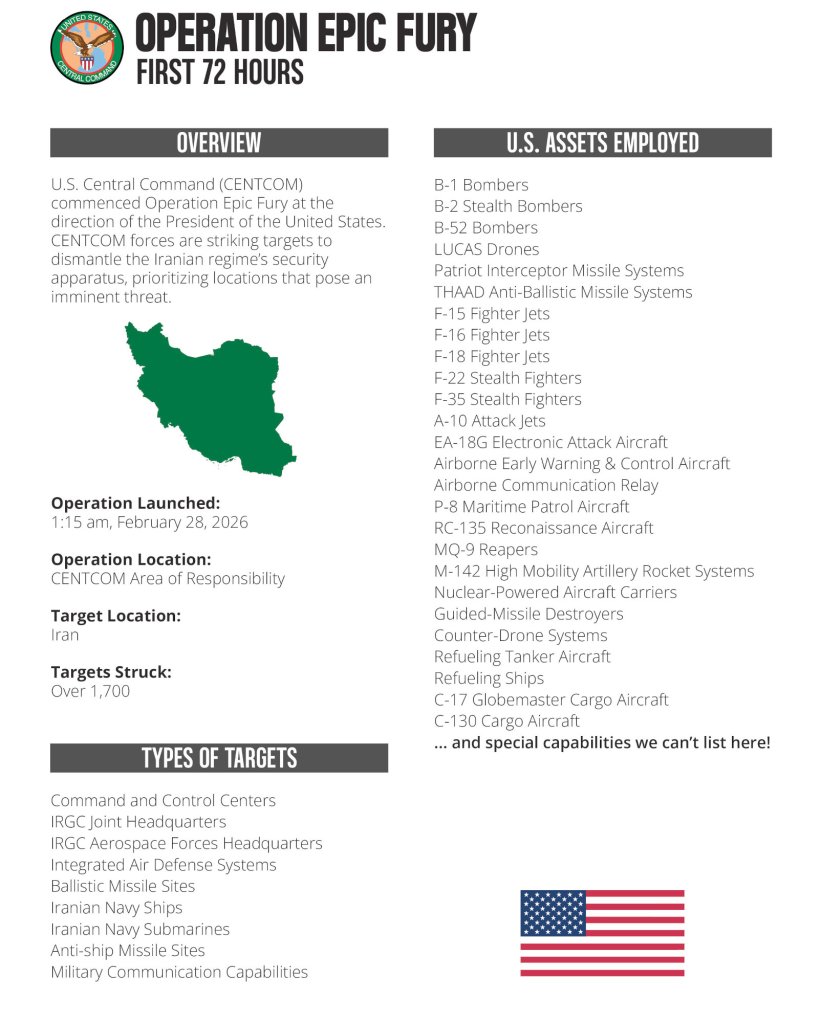
U.S. Air Force B-52 bombers have joined the air campaign against Iran, according to a new fact sheet from U.S. Central Command seen below. American forces have now struck more than 1,700 targets in total.
U.S. President Donald Trump has said Iran “is running out of [missile] launchers” and “running out of areas to shoot them, because they’re being decimated,” according to Politico’s Sophia Cai.
Trump also told Cai that it is “not too late” to work in some fashion with a new Iranian government. He pushed back again on concerns about low stocks of anti-air interceptors, as well.
During a press conference alongside German Chancellor Friedrich Merz at the White House today, Trump pushed back on reports that the Israeli government had pressured him into attacking Iran. He also reiterated previous comments that “most of the people we had in mind” as potential partners in a new Iranian government “are dead.”
“We will see what happens, but first we have to finish off the military,” he added.
President Trump has also said that he has ordered an end to “all dealings” with Spain. Spanish authorities have blocked access to military bases in the country to U.S. forces supporting Operation Epic Fury.
President Donald Trump has also now said that the reason why various U.S. embassies in the region were not evacuated ahead of the start of U.S.-Israeli strikes this past weekend was that the situation moved too fast to allow for it. The U.S. State Department has now issued evacuation orders for embassies in several Middle Eastern countries.
Imagery has emerged showing what looks to show the aftermath of strikes on facilities belonging to the naval army of Iran’s Islamic Revolutionary Guard Corps in the port of Jask. U.S. authorities have said the destruction of Iran’s naval capabilities is a top objective of Operation Epic Fury.
“We don’t see a structured program to manufacture nuclear weapons,” International Atomic Energy Agency (IAEA) Director General Rafael Grossi has reiterated today. “Countries have either other information or political considerations, which are not for me to validate, as I said, or invalidate.”
The IAEA has also now confirmed new damage to Iran’s Natanz Fuel Enrichment Plant (FEP) based on satellite imagery, which has also been circulating online. “No radiological consequence expected and no additional impact detected at FEP itself, which was severely damaged in the June conflict,” the IAEA added in a statement.
Alexey Likhachev, head of Russia’s state-run nuclear company Rosatom, has said he has lost all contact with his counterparts in Iran and that operations at the country’s Bushehr nuclear power plant had been halted. Russian personnel assist with operations at Bushehr.
UPDATE: 11:46 AM EST-
U.S. Central Command and the Israel Defense Forces have shared more video clips showing strikes on Iranian missile launchers.
The Ministry of Defense in the United Arab Emirates has released footage, which looks to have been shot via targeting pods on aircraft, of intercepts of incoming Iranian missiles and drones.
The video below is said to show munitions impacting a target in the Iranian city of Urmia as part of ongoing U.S.-Israeli strikes.
Imagery is emerging showing new strikes on Mehrabad International Airport in Tehran.
Imagery showing the aftermath of strikes on other targets in Tehran has also emerged.
The video below shows a commercial airliner taking off from Beirut International Airport in Lebanon amid Israeli strikes.
Qatari authorities are pushing back on reports that they have conducted strikes on targets in Iran.
An Iranian drone strike overnight on the U.S. Embassy in Riyadh, Saudi Arabia, reportedly caused part of the roof to collapse. Saudi authorities had initially said the resulting damage to the building was minimal. The Saudi government has also condemned that attack.
Despite pushback elsewhere, Polish Defence Minister Wladyslaw Kosiniak-Kamysz has warned that demand for air defense capabilities in the ongoing conflict in the Middle East could upend deliveries of U.S.-made systems globally, including to Ukraine. The Chosun Ilbo newspaper in South Korea has also published a story raising questions about whether U.S. air defense assets in that country could be redeployed to the Middle East, but it does not say such movements are imminent.
Iranian authorities say the current death toll from U.S.-Israeli strikes is now 787, but how many of those individuals are members of the country’s military or security forces is unclear. Lebanese authorities also say that 40 people have been killed and 246 more wounded in Israeli strikes on that country over the past two days.
UPDATE: 11:23 AM EST-
U.S. and Israeli strikes on Iran continue. The Israel Defense Forces say a wave of 100 jets dropped 250 munitions on leadership targets in Tehran earlier this morning. A building in the city of Qom, where Iran’s Assembly of Experts was reportedly meeting as part of the process of choosing a new Supreme Leader, was also struck.
Iranian President Masoud Pezeshkian has issued a statement regarding the delegation of authorities to regional officials to enable “quick decision making” amid ongoing strikes targeting the country’s leadership.
The video below is said to show a Centurion Counter-Rocket, Artillery, Mortar (C-RAM) system in Iraq firing on an incoming Iranian drone. The Centurion is a ground-based version of the Phalanx Close-In Weapon System (CIWS) used on various U.S. and foreign warships, and is armed with a six-barrel 20mm Vulcan Gatling-type cannon.
French fighters are now flying over the United Arab Emirates to help bolster that country’s defenses. France is also reportedly sending anti-air and anti-drone capabilities to help protect Cyprus in the Eastern Mediterranean.
U.K. Prime Minister Sir Keir Starmer has also announced the deployment of the Type 45 destroyer HMS Dragon to bolster the defense of Cyprus.
Iranian media reports say the country’s Islamic Revolutionary Guard Corps has targeted dissident groups in northern Iraq. Axios has also reported that President Donald Trump spoke with Iraqi Kurdish leaders this past week about “what might come next.” There have been reports raising the possibility of armed Iranian Kurdish groups in Iraq launching a ground incursion even before the current conflict began.
U.S. President Donald Trump has now said that it is “too late” to negotiate with Iran’s new leadership, according to Fox News. U.S. Special Envoy Steve Witkoff, who took part in negotiations in the lead-up to the current conflict, claims that Iranian officials say they “have enough enriched uranium for 11 nuclear bombs.”
Contact the author: thomas@thewarzone.com
Loading comments…
Comments couldn’t be loaded. Please refresh the page.