
United States Secretary of War Pete Hegseth has said that today will be “the most intense day of strikes,” as the U.S. and Israeli militaries increase their attacks on Iran. Meanwhile, Hegseth said that, in the last 24 hours, Iran has launched its lowest number of weapons since the conflict began, suggesting that these strikes are starting to more significantly erode Tehran’s ability to hit back at Israel, U.S. interests in the Middle East, and the wider region.
Hegseth said that the aftermath of the conflict is “going to be in America’s interests” and says it “will not live under a nuclear blackmail” from Iran.
Among the U.S. assets involved in the recent strikes is the Arleigh Burke class destroyer USS Frank E. Petersen Jr., seen firing a Tomahawk Land Attack Missile at Iran yesterday.
The aircraft carrier USS Gerald R. Ford is reportedly on the move. Based on open-source flight tracking data, the supercarrier is apparently now operating in the central Red Sea, off the coast of Jeddah, Saudi Arabia. This suggests that the carrier strike group is heading closer to the theater of combat. Whether it will pass the Bab El Mandeb Strait, which the Iranian proxies in Yemen can put under threat, is yet to be seen.
According to The Washington Post, citing U.S. officials, the U.S. military expended munitions to the value of $5.6 billion in only the first two days of its attack on Iran. Statistics like these have raised questions about how fast some of the Pentagon’s most valuable stockpiles of weapons — including Tomahawk cruise missiles — have been eroded, and the capacity of the defense industry to make good the deficit.
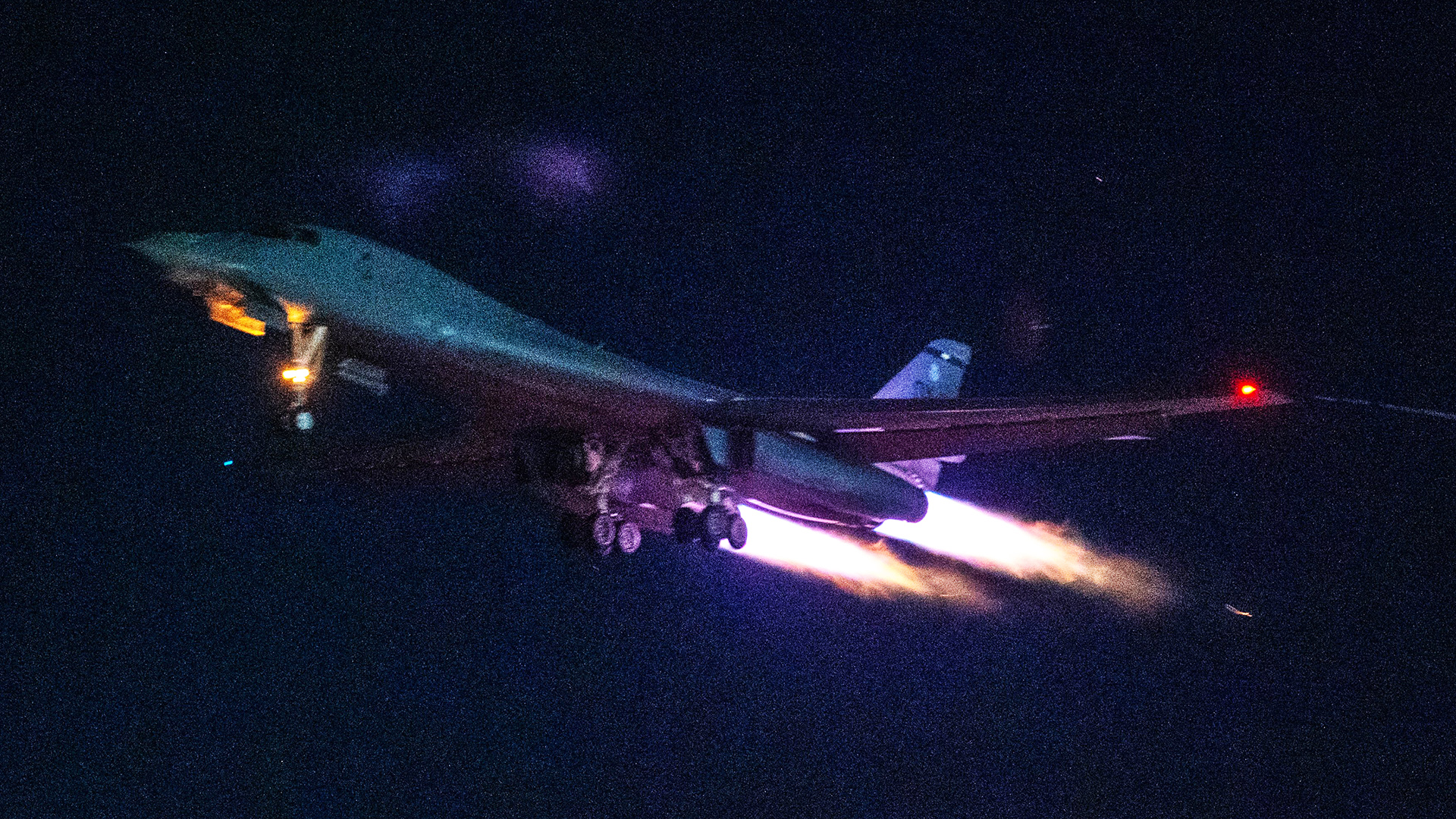
Further U.S. long-range strike firepower has arrived at RAF Fairford in England, where another three B-1B bombers touched down today. These join three more B-1s that arrived on Friday and Saturday, as well as three B-52Hs that landed at the airbase yesterday, as you can read about here. As we have discussed repeatedly in recent weeks, having the bombers forward deployed to England and/or Diego Garcia will drastically increase sortie rates and decrease wear-and-tear on the bomber fleet compared to flying from U.S. airbases and back. This will become even more relevant if the bomber force shifts from making standoff strikes to direct attacks on Iranian targets, even if just over limited parts of the country where air supremacy is more guaranteed.
Gen. Dan Caine, the chairman of the Joint Chiefs of Staff, today also provided an update on the progress made in Operation Epic Fury, which he described as “gritty and tireless work.”
Caine added that the joint force remains focused on three main objectives: destroying Iran’s missile and drone capability, striking and degrading Iran’s naval capability, and preventing Tehran from being able to attack the United States and its partners “for years to come.”
Iran’s nuclear program was not mentioned by Caine. However, recent satellite imagery indicates that Iranian nuclear facilities are still being attacked, in this case, the Parchin nuclear complex.
Caine also reported a reduction in Iranian strikes, stating that “ballistic missile attacks continue to trend downwards, down 90 percent from when we started.”
Satellite imagery points to recent strikes on at least two different Iranian missile bases, at Baharestan and Khormuj. Attacks have targeted specific points on the surfaces of these facilities, primarily the tunnel entrances, restricting the ability to move missiles out of their underground storage, or indeed to put them underground for their protection. As we have repeatedly noted, keeping these facilities sealed is clearly a top priority for the U.S. and Israel as it negates all the standoff weapons entombed within.
Nevertheless, Iranian media continues to show launches of various missiles against targets in the wider region, with those in the video below claimed to be directed against U.S. military facilities in Kuwait. As well as the more familiar short-range ballistic missile, the imagery also includes Iranian Paveh-series ground-launched cruise missiles.
More footage has emerged of the aftermath of the U.S. strike on an Iranian Shahid Soleimani class missile corvette off the port of Bandar Kong yesterday. One of these unusual catamaran vessels had been sunk in an earlier U.S. strike, as you can read about here.
Bandar Abbas, that sits on the Strait of Hormuz, home to extensive naval facilities, as well as an Iranian air base, continued to be bombarded. The latest satellite imagery indicates new direct hits on the primary naval berths, as well as efforts by the Iranian Navy to disperse its assets. These include Ghadir class midget submarines, which have been spread around the harbor for their protection.
As well as a fresh wave of attacks on Tehran, the Israel Defense Forces (IDF) continues its campaign in Lebanon.
The IDF today launched a warning strike on Beirut’s southern suburbs, Lebanon’s state-run National News Agency reports.
Ahead of that, the IDF warned that it would be targeting Hezbollah infrastructure in the area of Tyre and Sidon on the western coast of southern Lebanon. It also said it would be operating in the area south of the Litani River, around 50 miles south of the capital. The IDF once again urged those in the area to leave.
Despite the reported dip in Iranian missile and drone strikes, air defenses in the United Arab Emirates have again been busy. Today, the UAE’s defense ministry reported the interception of eight missiles and 26 drones. A ninth missile fell into the sea while nine more drones fell into the country’s territory.
In total, since the start of the conflict, UAE air defenses have identified 262 ballistic missiles, eight cruise missiles, and 1,475 drones heading toward UAE territory, the defense ministry added.
Despite the combined U.S.-Israeli onslaught, Iran’s Revolutionary Guard Corps (IRGC) remain resolute.
The IRGC said they targeted a U.S. base in Iraq’s Kurdistan region. “The headquarters of the invading U.S. Army in Al-Harir Air Base in the Kurdistan region was targeted with five missiles,” the Guards said in a statement on Telegram today.
Since the start of the conflict, it is reported that Iran and Iran-affiliated militants in Iraq have carried out 196 drone, missile, and rocket attacks across the Kurdistan region.
The IRGC also said that they would not allow “one liter of oil” to be shipped from the Middle East as long as the attacks continue.
In response, U.S. President Donald Trump said the U.S. military would hit Iran “20 times harder” if it blocked tanker traffic through the Strait of Hormuz, which handles a fifth of the world’s oil supply.
“Death, Fire, and Fury will reign upon them,” Trump added, in a statement on his Truth Social media channel.
Otherwise, Trump has delivered some mixed messages on the course of the war so far.
The U.S. president described the campaign as “very complete, pretty much,” and ahead of schedule. But Trump also said he would not declare the U.S. mission accomplished, saying: “We’ve already won in many ways, but we haven’t won enough.”
Signs of a more enduring campaign are also found in Trump’s War Powers Resolution notice to Congress. This includes the words: “Although the United States desires a quick and enduring peace, it is not possible at this time to know the full scope and duration of military operations that may be necessary.”
In a televised interview, Trump also appeared to threaten Mojtaba Khamenei, who Iran has named as its new supreme leader, succeeding his father, Ali Khamenei, after he was killed on February 28.
Speaking of Trump, high-ranking Iranian official Ali Larijani said on X: “The Iranian people are not afraid of your threats … be careful, or you will be the one who is eliminated.”
The latest update from the U.K. Ministry of Defense states that a British counter-uncrewed aerial systems (C-UAS) unit took out a drone in Iraqi airspace, as well as announcing the deployment to the region of the RFA Lyme Bay, an auxiliary dock landing ship with extensive humanitarian and medical facilities.
The U.K. Ministry of Defense has also released more footage of Royal Air Force Typhoon fighter jets in action against Iranian drones over Jordan.
The UAE Ministry of Defense has confirmed the deaths of two members of the country’s armed forces. The fatalities occurred when a helicopter crashed due to “a technical malfunction while performing their national duty in the country” yesterday. Unverified reports suggest the crew was killed in the crash of an AH-64 Apache attack helicopter engaged on drone-hunting duties.
Apaches, this time Israeli-operated, appear to be responsible for downing the Iranian Shahed-136 drones seen in the video below.
The U.K. Maritime Trade Operations (UKMTO) said today it had received a report of an incident 36 nautical miles north of Abu Dhabi, United Arab Emirates. The report suggests that an explosion took place in close proximity to a bulk carrier. The UKMTO urged vessels to transit with caution.
Iranian Foreign Minister Abbas Araghchi addressed Gulf countries, attempting to justify Tehran’s attacks on their infrastructure.
“If they have the right to take all necessary measures to protect their facilities, I think we are even,” Araghchi said in a televised address. “In fact, we have even more right to take all necessary measures to defend ourselves and protect our people. And this is exactly what we are doing.”
Araghchi said that the conflict “is not our war … not our choice. This war was imposed on us. We are under aggression, and we are defending ourselves.”
Hitting out at the U.S. government’s war-planning and the timeline for the campaign, Araghchi argued: “I don’t think they have any realistic endgame in mind.”
Araghchi also wrote off the prospect of negotiations with the U.S. government and warned that Iran would continue to launch attacks in the region “for as long as necessary,” according to AFP.
The Turkish Ministry of Defense says that a NATO-operated Patriot air defense system has been deployed in Malatya in the Eastern Anatolia region of Turkey. The surface-to-air missile system is part of efforts to beef up air and missile defense capabilities in the region.
The effects of the conflict continue to be felt by the global economy as the oil market comes under pressure.
Saudi Aramco CEO Amin Nasser has warned that ar could have “catastrophic consequences” for the oil market and global economy if it continues.
Oil infrastructure in the region continues to come under Iranian missile and drone attack.
Case in point, the Ruwais Industrial Complex in Abu Dhabi, where a fire reportedly broke out as a result of a drone attack.
Reports are coming from Iraq indicating that airstrikes targeted the headquarters of the Iran-backed Hashd Al-Shaabi forces near the city of Kirkuk today. According to a report from Reuters, four Hashd Al-Shaabi members were killed.
From South Korea, there are indications that the U.S. Army has moved critical Patriot and THAAD air defense systems from that country to address threats in the Middle East.
According to Yonhap News, South Korean President Lee Jae-myung said today, “We are opposing the withdrawal of some air defense weapons … but we cannot fully enforce our opinion.”
However, the South Korean leader also said that the widening of the war in Iran would not seriously affect Seoul’s ability to defend itself against North Korea.
Meanwhile, we have gotten what might be our first look at the U.S. Army THAAD system engaging incoming Iranian missiles during the current campaign.
According to a report from Axios, the U.S. Department of War snubbed a Ukrainian offer for combat-proven anti-drone technology almost seven months ago. Axios says that it obtained a PowerPoint presentation that showed exactly how such systems could be used to protect U.S. forces and their allies in a potential conflict in the Middle East. Last week, the Pentagon was forced to reverse course after a heavier-than-expected bombardment from Iranian drones.
Saudi Arabia is reportedly also a new customer for Ukrainian anti-drone technology, placing an order for interceptor missiles, according to The Kyiv Independent, citing a source within the Ukrainian defense industry.
The Nightly, an Australian online newspaper, reports three Royal Australian Navy crew members who were on the nuclear-powered attack submarine USS Charlotte when it sank the Iranian warship Dena in the Indian Ocean last week were sent to their sleeping quarters during the engagement. This was to ensure that they were not direct participants in the offensive strike.
There are suggestions coming out of Israel that the country may have used unorthodox and unconventional means to help hobble the Iranian leadership during the first waves of strikes, or indeed beforehand. According to a former Mossad official, now at the Jerusalem Center for Security and Foreign Affairs: “I can say that big things have happened in Iran, on the scale of the beepers and perhaps even more. They may not photograph as dramatically, but over time, we will hear about them, and they are no less amazing. There are also other significant things that remain up the sleeve.”
UPDATES:
We have concluded our rolling coverage in this piece.
7:09 PM EST—
CENTCOM has released additional footage showing what it says are minelaying vessels being struck near the Strait of Hormuz.
“I am pleased to report that within the last few hours, we have hit, and completely destroyed, 10 inactive mine-laying boats and/or ships,” President Donald Trump also wrote in a post on his Truth Social social media network.
“At the direction of President Trump, @CENTCOM has been eliminating inactive mine-laying vessels in the Strait of Hormuz—wiping them out with ruthless precision,” Secretary Pete Hegseth has also written in a post on X. “We will not allow terrorists to hold the Strait of Hormuz hostage. To the weakened Iranian regime: you have officially been put on notice!”
The Israel Defense Forces has shared new details about targets it says it has struck in Iran.
Axios has reported that American authorities asked their Israeli counterparts to refrain from further strikes on Iranian oil infrastructure and other energy targets, and to at least give them advance notice if they do.
The video below is said to show a new round of Iranian ballistic missile strikes targeting Tel Aviv in Israel, but is unconfirmed at this time.
Qatari Foreign Ministry Spokesman Majed Al-Ansari has said years of warnings about the risks of unchecked escalation spreading across the Middle East have gone unheeded, and has described the current situation as now being a regional conflict. He also called it “the biggest ‘I told you so’ in the history of ‘I told you so’s’,” while saying there are still opportunities for containment despite everything being on a “dangerous trajectory.”
3:45 PM EST—
CENTCOM just posted video of multiple strikes on Iranian ships and submarines. This includes one of the Shahid Soleimani class catamaran corvettes.
CNN reports that Iran has begun to lay mines. Trump threatens Iran preemptively if it attempts to mine the strait, but says his administration has no reports that indicate they have been doing so:
Major air carriers are cancelling flights to key hotspots in the Middle East, with British Airways saying they are doing so for flights to Abu Dhabi for the rest of the year. We assume this could be reversed at any time.
2:30 PM EST—
We have been tracking a bizarre situation here where DOE Secretary Chris Wright put out a tweet saying convoy operations in the Strait have begun. Then he promptly deleted it. We reached out to the Pentagon on this and they flatly denied it.
CBS reports that Iran may attempt to lay mines in and around the Strait of Hormuz. Remember that even small boats can deploy mines.
140 service members have been wounded in Epic Fury. Most minor injuries, but a smaller number are serious.
1:53 PM EST—
Senate Democrats seem pretty dismayed about what they are hearing about the conflict in closed door briefings. Sen. Richard Blumenthal largely focused his comments on the war’s timeline, cost, and especially the possible help Russia is giving Iran:
Israel continues to strike Basij (Iranian internal police) targets. If there was any chance of an internal uprising taking over the country, it would require the degradation of these units.
Contact the author: thomas@thewarzone.com
Loading comments…
Comments couldn’t be loaded. Please refresh the page.