
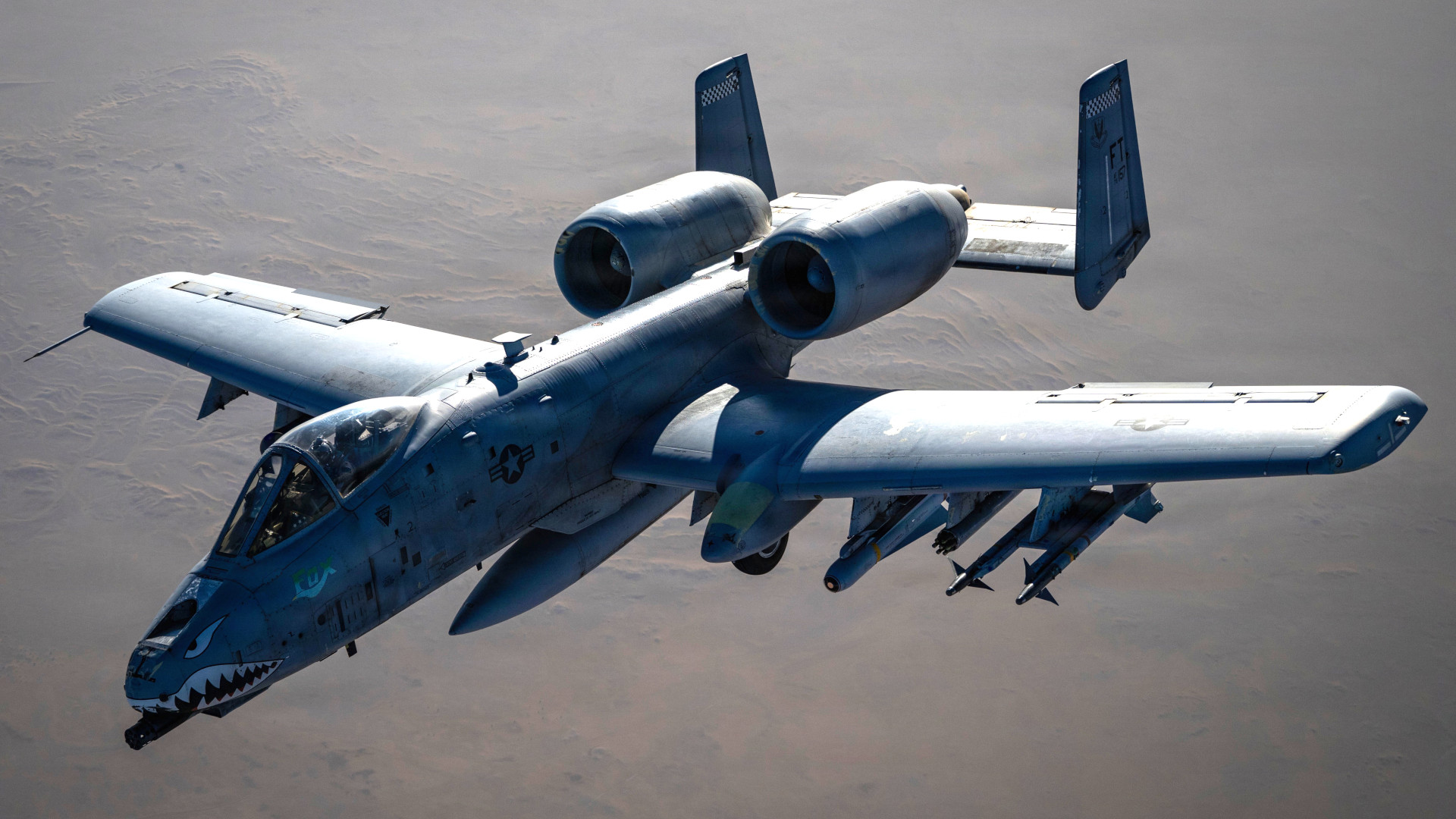
Venerable A-10 Warthog attack jets are helping dismantle Iran’s Navy. Though the A-10 is most commonly associated with missions over land, the jets have a long-standing, if often obscure, maritime role. Moreover, Warthog pilots have been training for decades for the specific scenario of hunting Iran’s fleets of fast boats in and around the highly strategic Strait of Hormuz. All of this comes as the U.S. military works to find ways to reopen the critical waterway to normal maritime commerce, which has ground to a virtual halt in the face of Iranian attacks on shipping and its declaration that the strait is closed.
Chairman of the Joint Chiefs of Staff U.S. Air Force Gen. Dan “Razin” Caine discussed the A-10’s contribution to the current conflict with Iran at a Pentagon press conference this morning. The U.S. military has previously disclosed the basic fact that Warthogs have been supporting what is dubbed Operation Epic Fury. A-10s have previously been seen attacking Iranian-backed militias in Iraq. The A-10 is very much in the twilight of its career, with the Air Force hoping to have the type retired for good by the end of the decade, if not sooner.
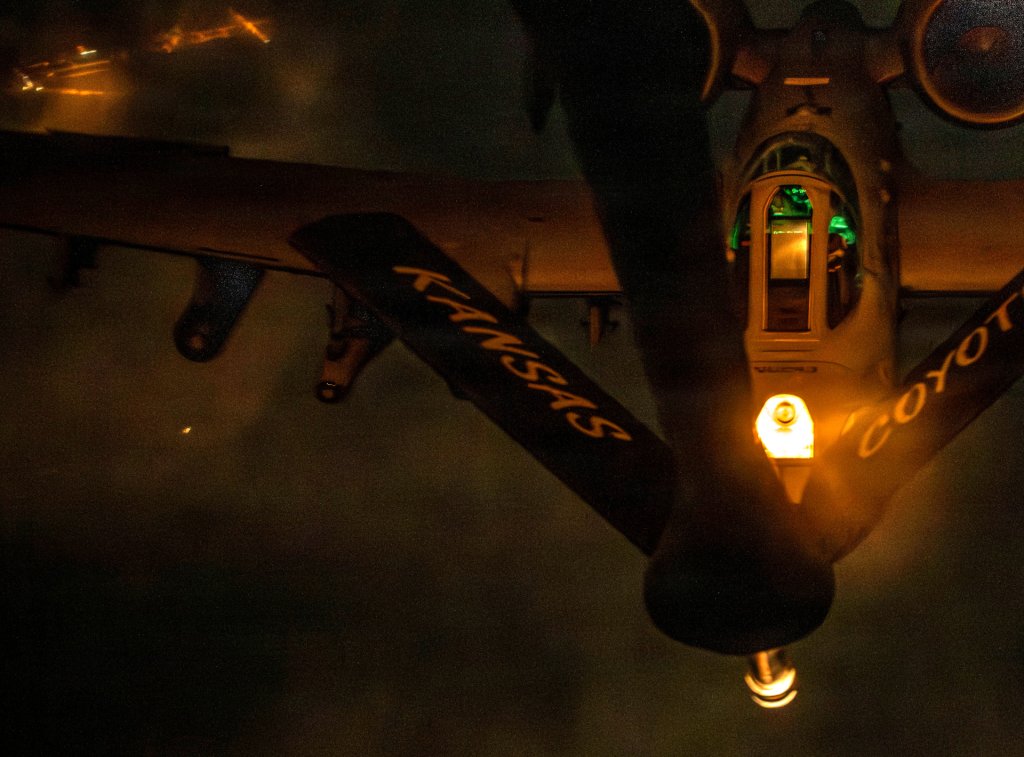
“The A-10 Warthog is now in the fight across the southern flank [of Iran] and is hunting and killing fast attack watercraft in the Strait of Hormuz,” Caine said.
Caine also said that AH-64 Apache attack helicopters are now operating in a similar manner as the A-10, but did not say specifically that they were being used against maritime targets. He did note that U.S. allies in the region have been using their own AH-64s to help shoot down incoming Iranian drones, something that has been observed already in the course of the current conflict. Israel has long used Apaches in the counter-drone role, and TWZ has been closely tracking work to expand the helicopter’s capabilities in this regard, including by the U.S. Army.
“We continue to hunt and kill [Iranian] afloat assets, including more than 120 vessels and 44 mine layers,” the Chairman also said, speaking more broadly. The total destruction of Iran’s naval forces is one of the core stated goals of Operation Epic Fury.
When it comes to the A-10, as noted, despite years of the aircraft being referred to as a ‘single mission’ platform geared solely to close air support missions in support of ground forces, it has long had a maritime role. Just weeks before the current conflict erupted, the U.S. military underscored this reality by releasing pictures showing Warthogs training together with the USS Santa Barbara, a U.S. Navy Independence class Littoral Combat Ship (LCS) in the Persian Gulf.
“The irony here is that the A-10’s continued use in the Middle East goes against a prevailing narrative that the Warthog needs to go because its utility is limited on the modern battlefield. This argument is not without merit, but it assumes that every tactical air asset in the inventory needs to be able to fight on the front lines on day one of a conflict with a peer-adversary, and that there are not many other tasks needing to be done beyond firing the shots at the ‘tip of the spear’ during such a conflict. It’s also worth noting that the A-10 remains the least expensive tactical jet to operate in the USAF’s stable.”
“Regardless of the A-10’s impending fate, its ability to deliver rapid, highly precise attacks on small, fast-moving targets, and its ability to loiter for extended periods while soaking up small arms fire, means that its talents can be applied directly to the maritime domain. This is especially true when it comes to countering small boats that can pose a big danger to much larger ships. Such asymmetric dangers are only amplified for ships operating in tight, complex littoral environments, where threats can emerge quickly and attack in large packs, leaving even the most powerful warship’s defenses overwhelmed.”
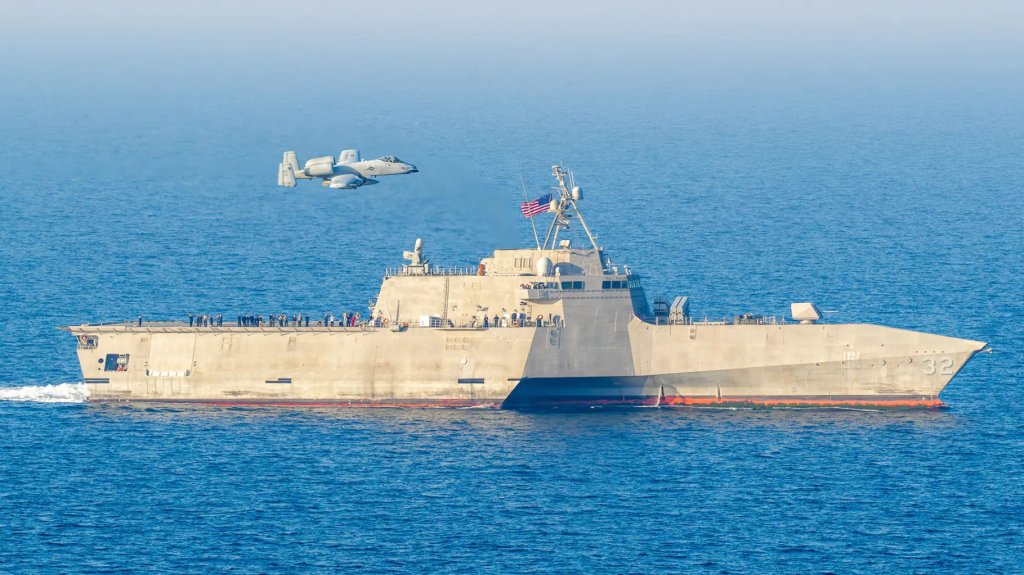
This particular exercise also underscored the danger posed by Iranian naval mines, and how A-10s could help protect ships tasked to clear them. The Santa Barbara is one of three Independence class LCSs configured for minesweeping duties that had been forward deployed in the Middle East last year to fill gaps left by the decommissioning of a quartet of Avenger class mine hunters. Those ships have become a separate topic of discussion after two of them, the USS Tulsa and USS Santa Barbara, emerged thousands of miles away to the east, first in Malaysia and now in Singapore. Why the Navy sent those ships not just out of harm’s way in the Middle East in the run-up to the current conflict, but then to an entirely different theater remains largely unexplained.
In general, threats posed by small boats, especially operating in swarms, are not new. This is also an area where Iran’s Islamic Revolutionary Guard Corps has invested heavily for decades, as TWZ has explored in the past. U.S. officials have previously declared the Iranian Navy to have been rendered combat ineffective, but many of the more than 120 ships it has targeted so far have been larger vessels. Iran has hundreds of fast boats, some of which are armed with short-range anti-ship missiles, as well as artillery rockets and other weapons. They can also be used to lay naval mines. These fleets are inherently harder to find and fix, and do not need large ports to operate from. The A-10’s attributes, including its long loiter time, make it a key tool for interdicting these threats.
All of this is now further magnified by the expanding use of explosive-laden drone boats. Though kamikaze uncrewed surface vessels are now firmly in the public consciousness as a result of their use in the conflict in Ukraine, Iran and its regional proxies pioneered their use in Middle Eastern waterways years beforehand. This is a capability that Iran has now brought to bear in its efforts to keep the Strait of Hormuz closed to regular maritime traffic.
In terms of air defense threats around the Strait of Hormuz, this likely comes mainly from shoulder-fired surface-to-air missiles, or man-portable air defense systems (MANPADS), at this point in the conflict. Despite concerns voiced about their survivability over the years, A-10s are capable of fighting in that kind of threat ecosystem.
U.S. Central Command has previously released pictures showing Warthogs flying in support of Epic Fury carrying loadouts that include 70mm APKWS II laser-guided rockets and AGM-65 Maverick air-to-surface missiles, as well as AIM-9M Sidewinder air-to-air missiles. The A-10s also have their iconic built-in 30mm GAU-8/A Avenger cannons. APKWS IIs, AGM-65s, and the GAU-8/A are all weapons that can be effectively employed against targets at sea, including small boats, along with various threats on land.
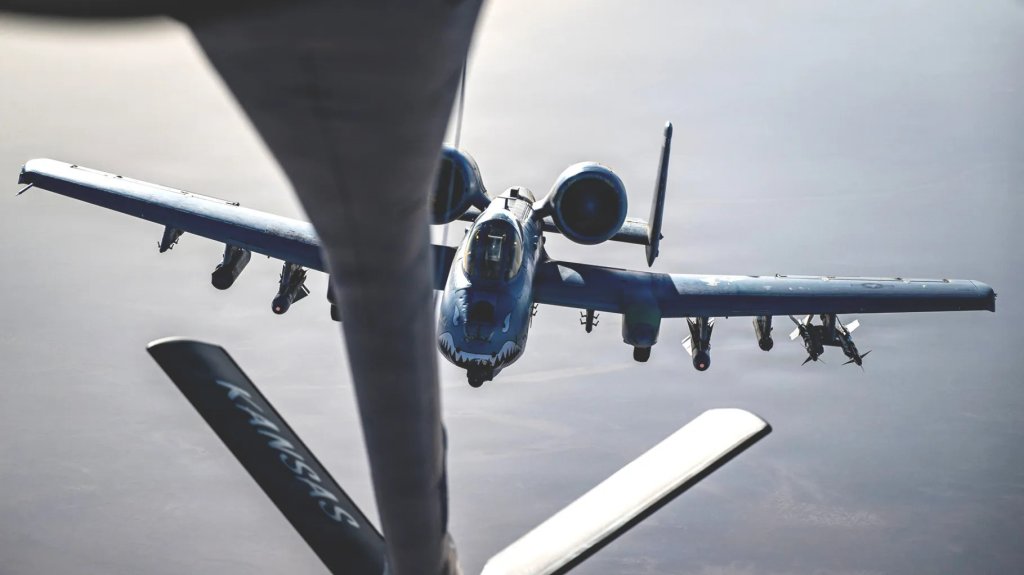
These are also just the A-10 loadouts that have been shared publicly. The Warthogs can carry a wide array of other precision-guided munitions that could be employed against Iranian boats sitting in port or on the move in and around the Strait of Hormuz, as well as other targets.
As an aside, when A-10s carry AIM-9Ms, it is typically for self-defense, but the Warthogs could also possibly use those missiles to engage Iranian one-way attack drones if the opportunity were to arise. A-10s are also capable of employing air-to-air optimized versions of the APKWS II rocket against drones, as you can read more about here.
Chairman Caine’s confirmation this morning that A-10s are flying missions over and around the Strait of Hormuz also comes amid a clear uptick in overall U.S. operations in this particular area.
“As reported by U.S. Central Command yesterday, the U.S. military dropped 5,000-pound penetrator weapons into underground storage facilities storing coastal defense cruise missiles and other support equipment,” Caine also said. “These [bunker-buster] weapons are bespokely designed to get through concrete and or rocks and function after penetrating those barriers.”
The Chairman did not name the bombs in question, which have previously been reported to have been new GBU-72/B types, as you can learn more about here.
“We continue to hunt and kill mine storage facilities and naval ammunition depots,” Caine added.
It is possible that the A-10’s role in the littorals along Iran’s southern coast could expand in the coming weeks. Reuters reported yesterday that the U.S. military is considering a range of new options for trying to reopen the Strait of Hormuz, including a possible ground incursion to temporarily occupy parts of the Iranian shoreline. A potential mission to seize control of Iran’s highly strategic Kharg Island in the Persian Gulf has also been raised. A group of Navy amphibious warfare ships laden with Marines is already reportedly on its way to the Middle East. U.S. Navy warships escorting convoys of commercial vessels through the strait is another possibility, but American officials have downplayed the prospect of that starting any time soon. Any of these courses of action entails significant risks.
U.S. President Donald Trump has notably gone back and forth in recent days about a desire for a broader international mission to help get commercial ships flowing again through the strait. After being publicly rebuffed by several allies and partners, Trump said the United States no longer required any help.
“I wonder what would happen if we ‘finished off’ what’s left of the Iranian Terror State, and let the Countries that use it, we don’t, be responsible for the so called ‘Straight?’ [sic],” Trump then wrote yesterday in a post on his Truth Social site. “That would get some of our non-responsive ‘Allies’ in gear, and fast!!!”
In the meantime, we know that A-10s are now actively on the hunt for Iranian maritime threats around the Strait of Hormuz as part of what could be one of the Warthog’s last major combat deployments ever.
Contact the author: joe@twz.com
Loading comments…
Comments couldn’t be loaded. Please refresh the page.