
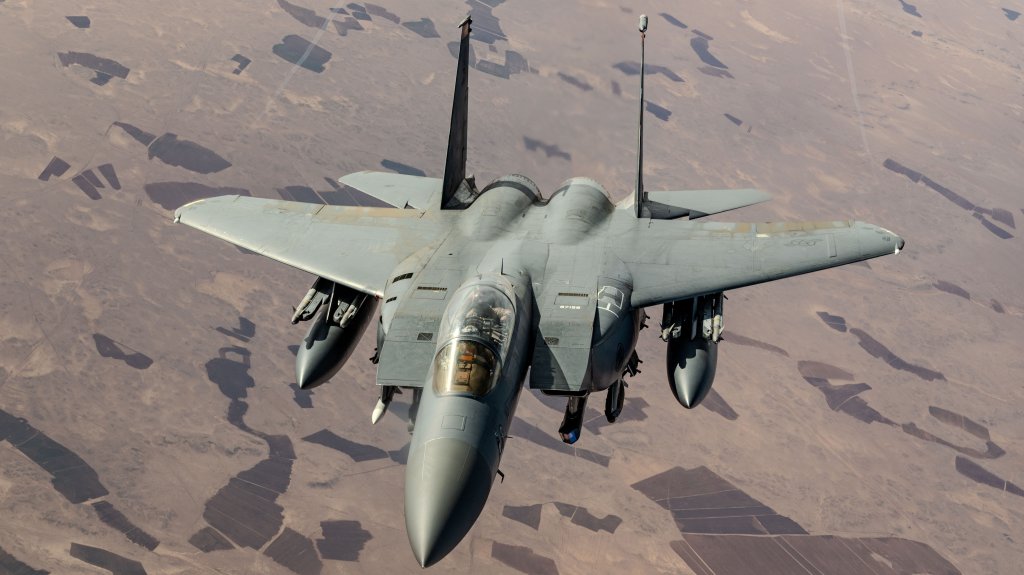
Bleeding from injuries incurred ejecting from his F-15E Strike Eagle fighter and climbing a craggy mountain to escape, the U.S. Air Force Weapon Systems Officer (WSO) hid out in a crevice as both rescuers and Iranians frantically searched for him. Monday afternoon, President Donald Trump and Air Force Gen. Dan Caine, chairman of the Joint Chiefs of Staff, offered new details about the complex and dangerous missions to rescue the WSO and pilot – call signs DUDE44 Bravo and DUDE44 Alpha – whose Strike Eagle had been shot down April 3, the first loss of crewed aircraft to enemy fire during Epic Fury. While they offered the government’s narrative of events, and it should be treated as such, other details emerged that we will address later in this story.
These rescue missions involved hundreds of troops, scores of aircraft and diversion operations over more than a half dozen different parts of Iran. It required risking the lives of many of those personnel to recover the two airmen.

The WSO’s recovery occurred on Easter Sunday some 50 hours after being shot down. It all began in the early morning hours of April 3 in Iran. After the F-15E was shot down, officials at U.S. Central Command received a message that would kick-start the operation.
“A U.S. Air Force F-15E Strike Eagle, call sign DUDE44… was down in hostile Iranian territory, the pilot and weapon systems officer had both safely ejected and were isolated behind enemy lines,” Caine told reporters during a White House briefing. “Following confirmation of active rescue beacons, and on the direction of the Secretary [of War Pete Hegseth] and by order of the President, a rescue operation was launched with the stated purpose of bringing both Americans home safely.”
A U.S. Air Force combat search and rescue (CSAR) task force was quickly spun up, Caine explained. It included 10 A-10C Thunderbolt II close support jets, HC-130J Combat King CSAR planes, HH-60W Jolly Green II CSAR helicopters and Air Force special operations airmen.
“A package comprised of combat rescue officers and pararescuemen operators audaciously penetrated enemy territory in broad daylight to find, fix and recover DUDE44 Alpha from behind enemy lines,” Caine proffered.
As the CSAR package, protected by a fighter strike package, crossed into Iran, “A-10s and …drones and other tactical aircraft were violently suppressing and engaging the enemy in a close-in gunfight to keep them away from the front seater and allow the pickup force to get into the objective area,” Caine noted. During this engagement, one of the A-10s – “the one primarily responsible for communicating with the downed pilot, was hit by enemy fire,” said Caine. “This pilot continued to fight, continued the mission, and then upon exit, flew his aircraft into another country and determined that the airplane was not landable… The pilot then made the decision to eject over friendly territory, and was quickly and safely recovered and is doing fine.”

After picking up the F-15E pilot, the HH 60W Jolly Green “was engaged by every single person in Iran who had a small arms weapon, and one of the aircraft, the trailing aircraft, took several hits,” Caine told reporters. “The crew sustained minor injury, and they are going to be fine.”
“The A-10 force and the rescue force did a fantastic job rescuing DUDE44 Alpha,” Caine continued. “He was recovered Friday afternoon, as I said, and the nation needs to know this. This was an incredibly brave and courageous mission, and a testament to the courage, skill and tenacity of the joint force and our leaders, and especially a daylight option.”
Rescuing the pilot was only the first step. The WSO was still out there, alone and being hunted by the military and civilians. Officials in Tehran put out a large bounty for his recovery. If he was captured or killed, it would have been a tremendous propaganda coup for Iran and a huge problem for America.
“Meanwhile, the second crew member, the weapon system officer, a highly respected colonel, had landed a significant distance away from the pilot,” Trump explained. “When you’re going at those speeds, even if you go out two or three seconds later, it’s miles and miles away, because you’re going fast.”

The WSO “was injured quite badly and stranded in an area teeming with terrorists from the Islamic Revolutionary Guard Corps, a rough group, as well as the Basij militia and local authorities,” recounted Trump, who was watching it all unfold in real time. “Despite the peril, the officer followed his training and climbed into the treacherous mountain terrain and started climbing toward a higher altitude, something they were trained to do in order to evade capture.”
“He scaled cliff faces bleeding rather profusely, treated his own wounds and contacted American forces to transmit his location,” the president continued. “They have a very sophisticated beeper type apparatus that is on them at all times.”
The WSO was located thanks in large measure to help from the CIA.
“As an agency, the CIA possesses unique capabilities that only the president can deploy,” said its director, John Ratcliffe, who also spoke at the presser. “Some of these capabilities fall under covert action authorities, and because covert means exactly that I’m not going to be able to tell you everything that you want to know. At the President’s direction, we deployed both human assets and exquisite technologies that no other intelligence service in the world possesses to a daunting challenge, comparable to hunting for a single grain of sand in the middle of a desert.”
Trump praised Ratcliffe and the agency.
“And John Ratcliffe was incredible,” the president proffered. “It was actually their genius that called us from – he was 40 miles away – and he said, ‘you know, we’re seeing something moving up in a mountain.’ It’s at night and they kept the camera on for 45 minutes. He wasn’t moving. And they said, ‘you know, probably wrong, but we’re seeing something moving.’ This is a vast mountain, vast, thick with bushes, trees. He said, ‘We see something moving 40 miles away…I’m telling you, it’s moving.’ And then all of a sudden, 45 minutes later, he moved a lot, stood up, and they said, ‘we have him.'”
“And that was really the beginning of something incredible,” Trump added. “We had an idea where he was, but not specifically. That’s [a] big mountain. So I want to thank the CIA too. I don’t think they get enough credit for the great job they’ve done.”
Once the WSO was located, “[w]e immediately mobilized a massive operation to retrieve him from the mountain,” Trump continued. “He kept going higher and higher. The mountain kept getting rougher and rougher, and was really, very, very hard to find. The second rescue mission involved 155 aircraft, including four bombers, 64 fighters, 48 refueling tankers, 13 rescue aircraft and more.”
All these assets, however, weren’t just for the spot where the WSO was located. Many of these aircraft were taking part in diversion efforts to throw Iranians off the trail.
“We were bringing them all over, and a lot of it was subterfuge,” Trump stated. “We wanted to have them think he was in a different location, because they had a vast military force out there, thousands and thousands of people were looking. So we wanted them to look in different areas. So we were scattered all over, like we were right on top of them. We had seven different locations where they thought, and they were very confused. They said, ‘Well, wait a minute, they’ve got groups here. They’ve got groups there.’”
As the WSO hid, the military had created a forward arming and refueling point on a farm, Trump noted. You can read more about how the Air Force would set up and defend such a location in our interview with a former Air Force Special Tactics Squadron airman here.
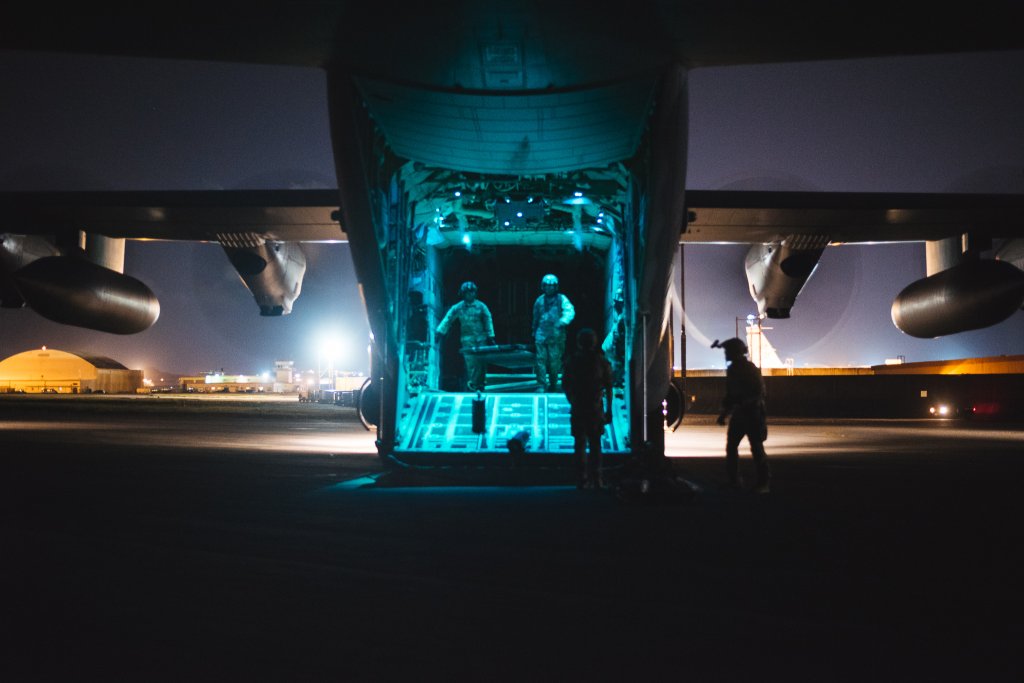
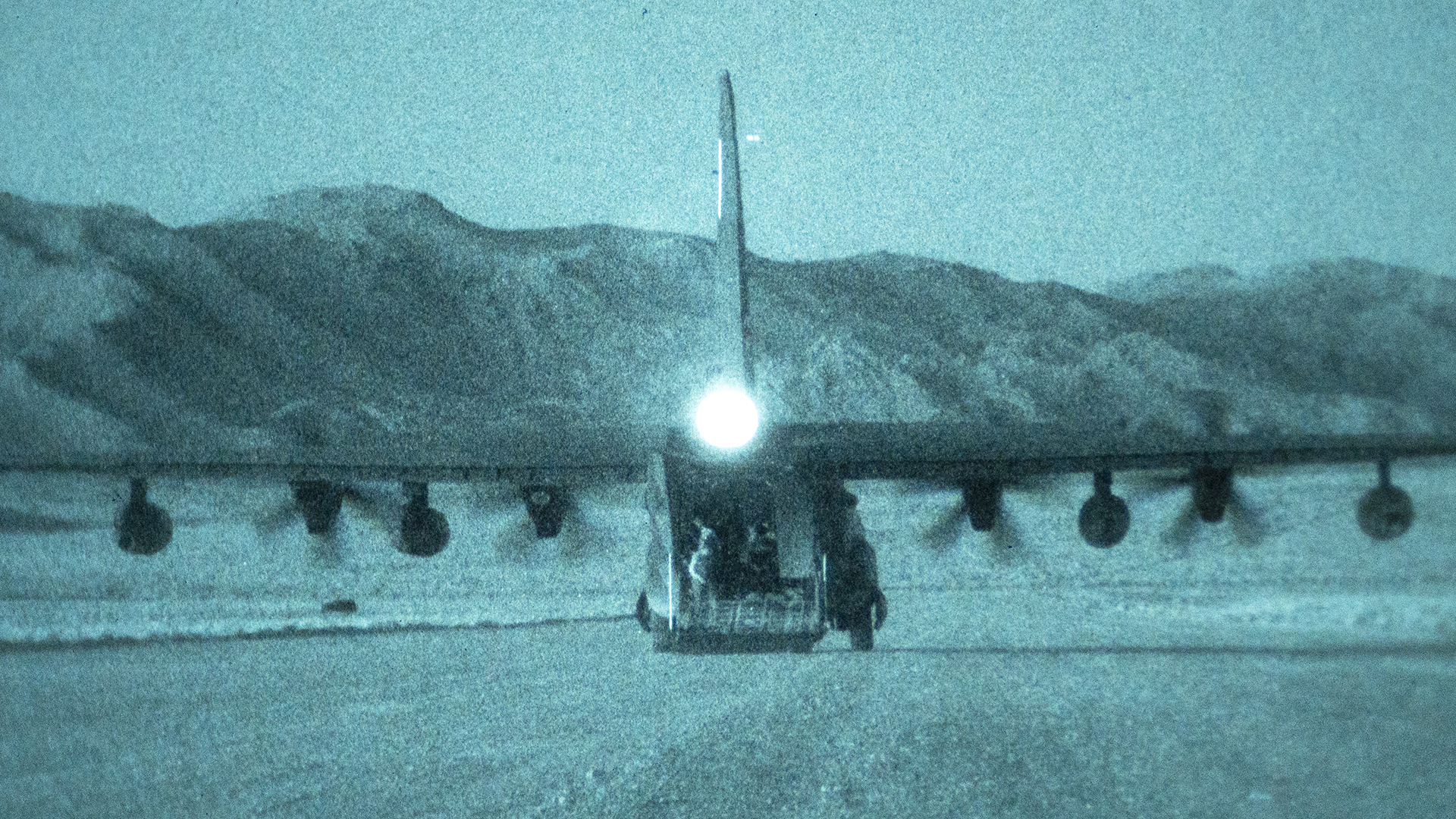
That location, the president proffered, was less than ideal for such operations, which involved landing two heavily loaded MC-130J Commando II special operations cargo planes that included several H-6 Little Bird special operations helicopters among other equipment in their holds.
“This was not much of a runway,” the president stated, adding that the ground was wet and sandy, making landing, and especially takeoff, a challenge. “This was a farm, not a runway. It’s a farm. But it did the trick.”
After the wounded WSO was found, he was whisked back to the FARP, but getting him and the aircraft brought in to help find him was a tremendous challenge.
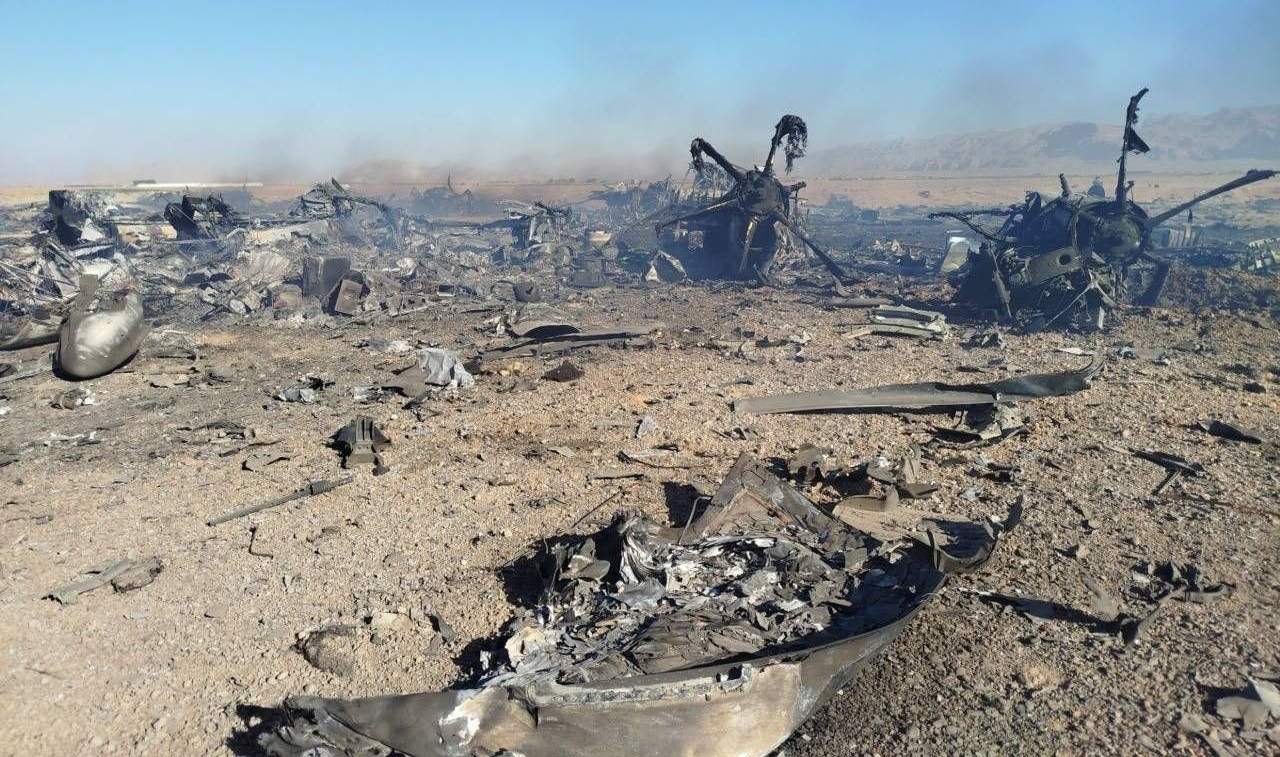
Trump said that with the MC-130s stuck in the wet, sandy soil, “we blew them up to smithereens.” The Little Birds were also blown up in place as well, because the aircraft that replaced the Commando IIs weren’t capable of exfilling them.
To replace the C-130s, “lighter, faster aircraft came in, and they took them out,” Trump said about the personnel and equipment. He was almost certainly referring to the CASA C-295W, a short take off and landing (STOL) twin turboprop that are modified for the special operations role.
A video has previously emerged said to show a C-295W flying at extremely low altitude in the general vicinity of the crash site. The U.S. Air Force operates a handful of these aircraft, likely assigned to the secretive 427th Special Operations Squadron. This unit is known to specialize in covert and clandestine infiltration and exfiltration missions, among other duties.
You can see that video below.
During the press conference, Trump pointed out not everyone in the military was in agreement that the U.S. should commit so many resources, human and equipment, to such a dangerous effort to rescue two men.
“There was military people, very professional, that preferred not doing it,” explained the president. “There were military people that said, ‘you just don’t do this. You don’t go into the heart of a very powerful military.'”
Trump of course listened instead to Caine and Hegseth, each of whom implored him to green light the missions.
Now with the official account of the mission behind us, here are some additional details about the rescue that were reported elsewhere.
The communication device the airmen used was the CSEL, or Combat Survivor Evader Locator, according to Ynet. The manufacturer, Boeing, describes it as being “like a global 911 emergency call system for downed personnel, providing U.S. forces with a tactical advantage.”
The CSEL system uses a flexible, modular communications architecture over multiple satellite links for secure communications and sends simple messages in bursts, with a low probability of intercept (LPI). These messages can include basic information about the status of the downed airman. It can then switch to a less stealthy line-of-sight radio when extraction forces are nearby.
Approximately 14 hours after the jet was hit, “U.S. officials got a lock on the weapons officer’s location via a beacon he was carrying.” According to The New York Times, in addition to the CSEL, the CIA “used a special piece of technology unique to the agency to locate the airman hiding in the mountain crevice and confirm his identity.”
Intelligence gathered by U.S. and Israeli officials was put together to determine if the airman was alone, surrounded by Iranians, or whether he had been captured, and this was an attempt to dupe them, The New York Times noted.
Prime Minister Netanyahu confirmed that Israel had assisted the U.S. military in the rescue, according to the Times of Israel. Netanyahu said he had spoken to President Trump and “congratulated him on his bold decision and a perfectly executed American mission.”
“The president expressed his appreciation for Israel’s help,” Netanyahu added. “I am deeply proud that our cooperation on and off the battlefield is unprecedented, and that Israel could contribute to saving a brave American warrior.”
To try and buy more time, the CIA put together a deception plan, throwing the Iranians off the scent by making it look as if the airman had been found and was being moved out of the country in a ground convoy, which would take them to the coast for a maritime exfiltration.
Meanwhile, one of several Iranian search parties had assembled at the base of the mountain where the WSO was hiding.
Forces deployed to the remote airstrip provided suppressive fire but did not engage in an actual firefight with the enemy. But the U.S. military took additional steps, “jamming electronics and bombing key roads around the location to prevent people from getting close,” in an area denial operation, Reuters reported, citing a U.S. source familiar with the planning . Satellite imagery shows roads approaching the landing area were cratered in a uniform fashion with precision munitions.
There are reports from Fox News, citing high-ranking U.S. sources, that B-2 bombers were using Massive Ordnance Penetrators to strike an IRGC underground headquarters outside of the Iranian capital, Tehran, while the rescue was ongoing.
This rescue operation was certainly a bright spot for a White House and Pentagon beleaguered by global criticism of an unpopular war that has dragged on for more than a month with no clear end in sight. It also highlights that, no matter how much damage the U.S. and Israel have done to the Islamic Republic’s air defense infrastructure through a devastating aerial campaign, Iran still presents a danger to the aircrews flying in its airspace. Above all else, it is a reminder of just how far the U.S. will go and what it is willing to sacrifice in terms of lives and material in order to get their people back.
UPDATE: 12:24 AM EDT—
Axios reports that the F-15E was shot down by a MANPADS, according to Trump. The report says the president stated “they got lucky.” If this is indeed how the incident began, it would mean the F-15E was flying inside the MANPADS envelope, which is roughly under 15,000 feet in most cases.
Editor’s note: We removed a section on how Israel’s units assisted with the raid until we can further confirm the associated reports. The removal did not further impact the totality of our report.
UPDATE: 11:11 AM EDT –
CBS News reported many new details about the rescue of both the pilot and WSO. Here are some of the highlights:
- U.S. forces fired 339 munitions over 50 hours of operations for both rescues.
- Other planned operations were halted as U.S. military power — and the president’s attention — pivoted to the combat rescue mission.
- The downed pilot, call sign Dude 44A, was saved within hours. He sustained serious injuries, and there was a time shortly after he ejected when Trump officials were worried he would not survive.
- At the Pentagon on Friday, the colonel was designated “DUSTWUN” — military speak for Duty Status — Whereabouts Unknown.
- U.S. Central Command and the Joint Special Operations Command received some messages from the missing officer. One was a four-digit number.
“We said, ‘What is he talking about?'” an official said.
They soon realized it was police code for an officer in distress or urgent assistance needed.
- The team could communicate with the colonel, so they asked him a question about his father that only he would know. The answer was correct. His identity was authenticated.
- U.S. intelligence had learned the Iranians had dogs sniff the F-15E’s ejection seats that were on the ground. This alarmed the president’s team, but it turned out the dogs weren’t effective at tracking the scent.
- The team was in touch with the weapon systems officer’s wife and read her in on the deception operation CIA and CENTCOM were running. To scatter militants in several directions, they worked to dupe them into thinking the weapons systems officer was on the move — heading toward the border with Afghanistan, or north to the Caspian Sea, or on a route south, out of Iran.
- The Pentagon planned at least four strategies for rescuing the officer — scenarios using rotary-wing and fixed-wing aircraft.
- Hegseth chose a fixed-wing option, using two MC-130 transport planes. U.S. intelligence indicated the Iranians thought that they would be coming via helicopter. Weather was also a factor – low cloud ceiling complicated a rotary-wing rescue. Planners studied two landing zones – one 17 miles from the stranded officer and one 10 miles from him. They chose the closer one, on farmland.
- U.S. intelligence showed Iran was searching at night, too, using smaller drones, but its forces lacked sophisticated night-vision capabilities.
- None of the intelligence hinted that the Iranian forces knew where the airman was, in a mountainous area south of Isfahan. At least half of Iran’s nuclear stockpile is believed to be stored at a facility nearby.
- The plan was to land the fixed-wing aircraft on the agricultural runway, secure the area, offload the helicopter in pieces from the MC-130s, and re-assemble them, which would take about 15 minutes. Aviators would fly the Little Bird MH-6 helicopters the seven minutes to the ridgeline where the weapon systems officer was located, and fly back another seven minutes to the landing strip.
Fox News is reporting that “both the pilot and WSO [the weapon systems officer]” are in Landstuhl [Regional Medical Center] in Germany. The facility, near Ramstein Air Base, is where many wounded troops are first sent before heading home.
Both airmen ”will soon be en route to the United States,” Fox added. “The pilot is in good shape, and the second crew member is a bit more banged up, but will recover.”
TWZ deputy editor Joe Trevithick contributed to this report.
Contact the author: howard@thewarzone.com
Loading comments…
Comments couldn’t be loaded. Please refresh the page.