
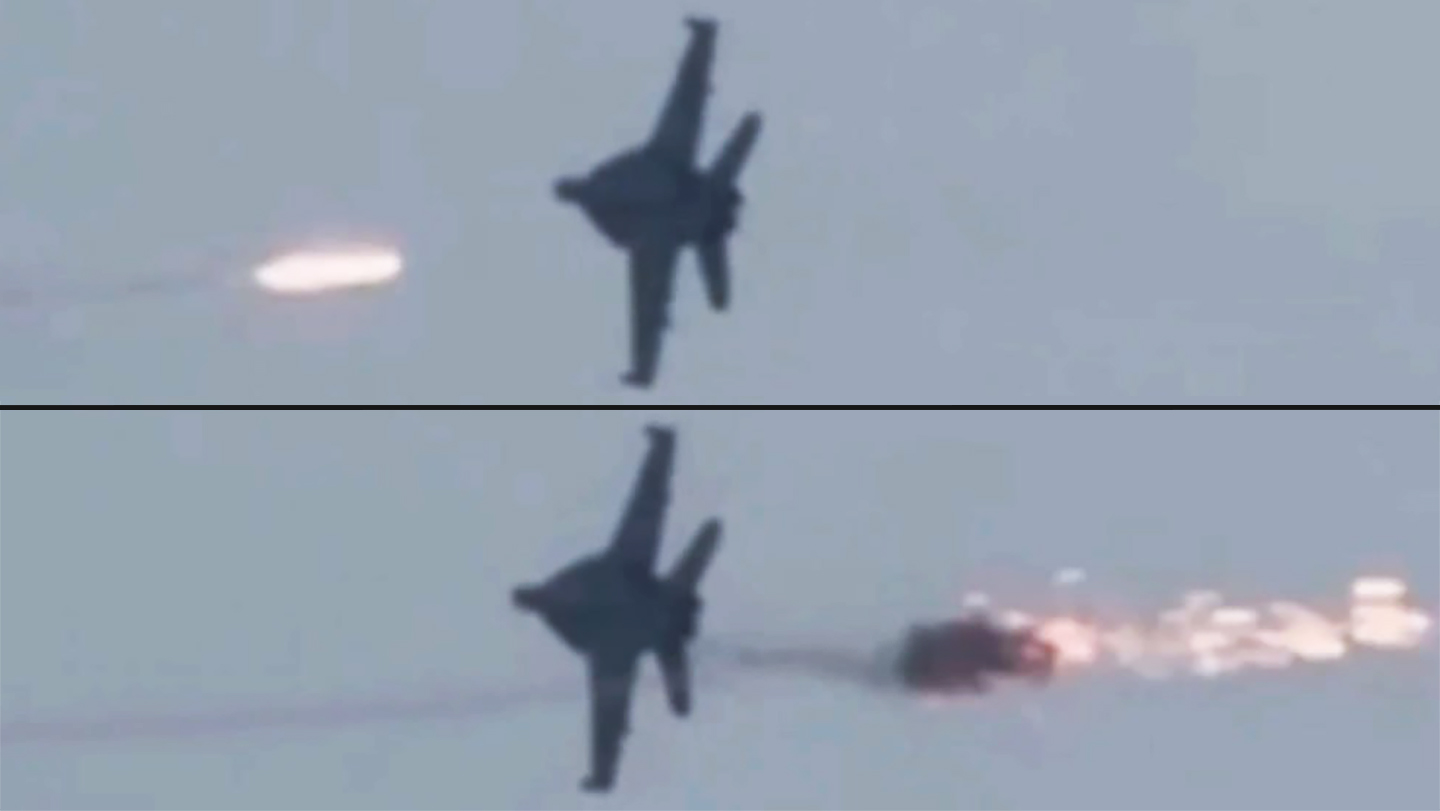
Videos have emerged showing an apparent very close call for a U.S. Navy F/A-18E/F Super Hornet after it was targeted by an Iranian man-portable air defense system (MANPADS) while conducting a low-level strafing run during an Operation Epic Fury mission. The persistent threat posed by Iranian air defenses, whatever is left of them, is something that we have repeatedly drawn attention to.
The videos have been geolocated to the port of Chabahar in Iran’s Sistan and Baluchestan province, which is located along the country’s eastern shore, near the Pakistan border. This would explain, at least to a degree, why the Super Hornet is operating so low over hostile territory. This coastal area was hit hard by strikes from the start of the war, and the near proximity to the ocean means combat search and rescue would be easier to execute in a pinch. There is also a better understanding of what air defense threats remain than, say, in the eastern part of the country.
The date of the incident is unconfirmed, but it is reported to have occurred yesterday.
Previously, we have seen plenty of evidence of Super Hornets conducting strafing runs with their M61A1 Vulcan rotary cannons in coastal areas of Iran. Some of these are seen in the videos posted directly below.
In the sequence, the distinctive zipping sound of the cannon can be heard, as well as a puff of smoke as the rounds are unleashed.
The F/A-18 makes a left-hand turn before the missile comes into view. It is unclear if the pilot was aware of the threat and maneuvered to avoid it or was unaware of the missile. There is no obvious sign of infrared countermeasures being deployed, although BOL IR-type countermeasures can be harder to see in daylight.
The missile is then seen exploding behind the aircraft, leaving shrapnel in its wake.
While it is not immediately obvious whether or not the F/A-18 was struck, it appears to have escaped relatively unscathed, suggesting this may have been a very lucky near-miss for the crew of the jet.
The Islamic Revolutionary Guard Corps (IRGC) claimed that the Super Hornet crashed in the Indian Ocean. Iran’s Fars News Agency published the statement from the IRGC:
“The enemy F-18 fighter jet was accurately hit in the sky of Chabahar by missiles from the IRGC Navy’s advanced modern air defense system, under the command of the country’s integrated air defense network, and crashed in the Indian Ocean.”
U.S. Central Command responded by denying that any U.S. fighter aircraft had been shot down by Iran, but its statement on X did not immediately rule out a near-miss or damage to the aircraft.
There have been multiple Iranian claims of U.S. aircraft being hit by air defenses. So far, however, there is credible evidence for only one previous such incident.
This was the U.S. Air Force F-35A that the IRGC claimed was hit over Iran, and which U.S. officials confirmed made an emergency landing, with the pilot having sustained shrapnel injuries. The IRGC released a video that they claimed shows the F-35 being hit by a missile, as seen through a forward-looking infrared (FLIR) system.
As we have explained in the past, while the U.S. has claimed air supremacy over Iran, it certainly does not yet possess it across the entire country. There remain very real risks, especially as the air campaign moves more toward increasing direct attacks farther east in the country, bringing aircraft closer to potential lingering threats.
For all the defense-suppression missions that have been flown, Iran still possesses road-mobile air defenses as well as more exotic types that can pop up virtually anywhere and give aircrews very little time to react. These systems can be easily hidden and will remain a threat on the battlefield long after static air defenses are destroyed. Beyond that, there are MANPADS, which, while less of a menace in terms of outright performance and engagement envelopes, are impossible to entirely remove from the battlespace.
UPDATES:
We have ended our rolling coverage on Epic Fury for the day.
UPDATE: 4:30 PM EST –
The open-source researchers at the Bellingcat organization say they have identified the mines found overnight in Kafari, Iran, as U.S.-made BLU-91/B anti-tank mines, usually associated with the Gator Scatterable Mine System.
There have been suggestions that the mines may have been dropped along roads to try to prevent Iranian mobile missile launchers from deploying out of their mountain bases and heading to launch sites.
It looks as if President Trump has suspended his ultimatum on the Strait of Hormuz for another 10 days. Trump, under increasing domestic pressure as oil prices soar, had last week warned that the U.S. military would “obliterate” Iranian power plants if the strait is not open before a 48-hour deadline.
UPDATE: 4:00 PM EST –
U.S. Secretary of State Marco Rubio stated today that a “growing amount of energy” is flowing through the Strait of Hormuz as indirect contacts between the United States and Iran show progress.
“There’s a growing amount of energy that’s been flowing through the strait, not as much as should be flowing, but some of it has picked up. There’s been some progress in regards to the exchange of messages, but that’s an ongoing and fluid process, and not one we’re going to negotiate or talk about in the media,” Rubio explained to reporters.
President Donald Trump today reiterated his estimated timeline for ending the war with Iran, saying that he still plans for it to last just four to six weeks.
Trump made the statement during a Cabinet meeting at the White House, telling reporters that the U.S. is already “way ahead of schedule” on the conflict.
“We estimated it would take approximately 4 to 6 weeks to achieve our mission, and we’re way ahead of schedule. If you look at what we’ve done in terms of the destruction of that country, I mean, we’re way ahead,” Trump said.
UPDATE: 3:50 PM EST –
President Trump has slated the U.K. Royal Navy’s Queen Elizabeth class aircraft carriers as “toys” compared to the flattops of the U.S. Navy.
In his latest spat with the United Kingdom, Trump said America “doesn’t need” British help in the conflict, despite repeatedly criticizing its reluctance to get involved.
Relations between Trump and U.K. Prime Minister Keir Starmer have been tense ever since Starmer refused America permission to launch its initial strikes on Iran from RAF bases.
UPDATE: 3:40 PM EST –
Trump has revealed the nature of the “present” from Iranian officials, which he alluded to earlier this week.
Trump said that Iran has allowed 10 oil tankers through the Strait of Hormuz as a sign of good faith for talks to end the war. Trump told reporters: “[Iran said] we’re going to let you have eight boats of oil, eight boats, eight big boats of oil. This was two days ago. And they’ll sail up tomorrow. That was three days ago. And I didn’t think much about it. And then I watched the news, and they said, a very good anchor actually happened to be Fox. But I watched it, and they said something unusual is happening. There are eight boats that are going right up the middle of the strait. Eight big tankers are going loaded up with oil right through. And I said, well, I guess, I guess they were right. And they were they were real. And I think they were Pakistani-flagged. And, I said, well, I guess we’re dealing with the right people. And, actually, they then apologized for something they said, and they said, we’re going to send two more boats. And we ended up being 10 boats.”
Today, however, publicly available ship-tracking data revealed only two Iran-linked LPG carriers were seen leaving the Persian Gulf, possibly the “extra two” vessels Trump referred to.
UPDATE: 2:05 PM EST –
In its latest update on the situation in the Middle East, the U.K. Ministry of Defense claims that Russia was likely providing intelligence and training to the Iranian military ahead of the United States and Israel launching their operations. Russian expertise for Iran likely encompassed drone technology and electronic warfare, drawing from their own experience in Ukraine.
The commander of U.S. Central Command (CENTCOM), Adm. Brad Cooper, has provided his view on the death of Iran’s Islamic Revolutionary Guard Corps (IRGC) Navy commander in an Israeli airstrike.
According to Cooper, under Adm. Alireza Tangsiri’s command for eight years, the IRGC Navy “harassed thousands of innocent merchant mariners, attacked hundreds of vessels with one-way attack drones and missiles, and killed countless innocent civilians.”
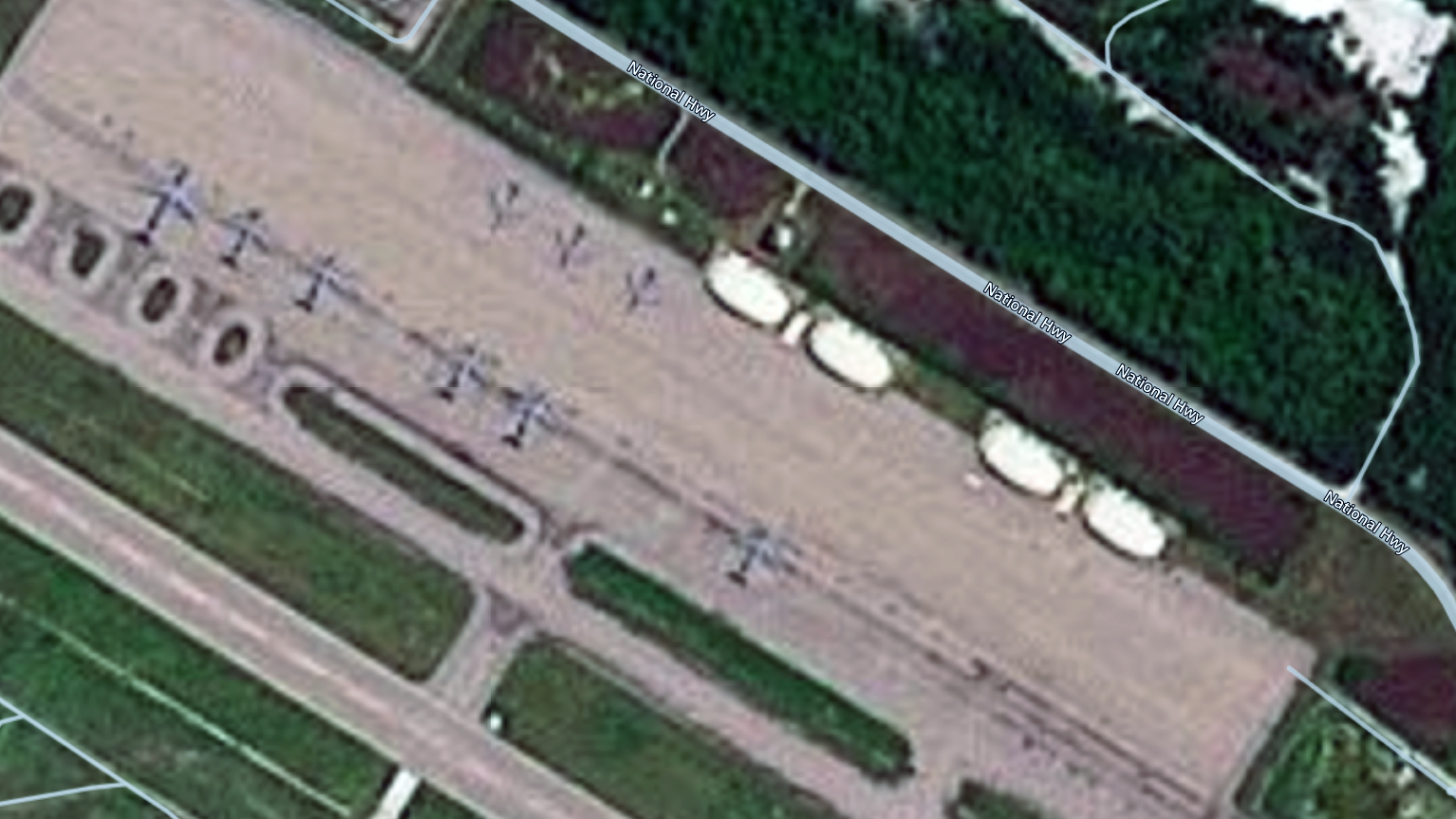
We are seeing a major airlift operation underway at the remote American outpost in the Indian Ocean, Diego Garcia. Five C-17s and a C-5 were visible on the main ramp at the airfield today. This is a sudden uptick in aerial logistics on the island.
There has been a contingent of KC-135R tankers that have been using the island, as well as a handful of F-16s protecting it. And while a transport or two would be seen coming and going, this is an airlift operation that is much larger. There had been some talk that air defenses were being moved from Asia to the island after Iran supposedly took two ballistic missile shots at it. The Navy also continues to use its port facilities there to support ships that are taking part in Epic Fury. The USS Tripoli and its escorts just stopped by there on their way to the Middle East, for instance. But this could also be the logistics surge before a bomber deployment. While B-52s and B-1s operate at a high tempo from RAF Fairford in the UK, the B-2s are still flying missions from the United States. This could be about to change.
Russia is close to completing a phased shipment of drones to Iran, according to Western intelligence reports about Moscow’s efforts to keep its embattled partner in the fight against Israel and the United States. As well as drones, Moscow is set to provide Tehran with medicine and food, the Financial Times reports. However, Russia appears to have turned down Iranian requests for long-range air defense systems.
The British newspaper cites two officials who were briefed on the intelligence report. They state that senior Iranian and Russian officials began secret discussions on the delivery of drones only days after Israel and the United States attacked Iran.
The first shipment of Russian-made drones reportedly began to be delivered to Iran in early March and was due to be completed at the end of the same month.
The reports provide the first firm indication since the start of the war that Moscow is providing Iran with lethal, as well as non-lethal, support. Russia is also understood to provide Iran with other critical military capabilities, including satellite imagery, targeting data, and intelligence support.
Although the types of drones included in the deal are not disclosed, they very likely include the Geran-2, which is a Russian-based version of the Iranian Shahed-136.

Asked about Moscow sending drones to Iran, Kremlin spokesperson Dmitry Peskov told the FT: “There are a lot of fakes going around right now. One thing is true — we are continuing our dialogue with the Iranian leadership.”
Russian support for Iran is not just about ensuring that Iran remains able to hit back at Israel and the United States, but also about securing its own interests: namely, keeping a pro-Kremlin regime in control in Tehran.
Publicly, Moscow has voiced its support for Tehran but has presented its support as humanitarian, rather than military. In particular, Russia has publicized its provision of humanitarian aid to Iran since the start of the conflict.
On the other hand, the Russian provision of Geran-series drones makes a lot of sense for Iran. So far, Tehran has relied heavily on long-range one-way attack drones to hit targets across the Middle East. Reportedly, it has fired more than 3,000 of these drones since the start of the fighting.
While the Shahed-136 is notably cheap to manufacture, Iran is clearly burning through its accessible stocks of the drones, while its production capacity is also coming under attack by Israel and the United States. With a production line already up and running in Russia, and reportedly churning out thousands of Geran drones each month, Iran would clearly benefit from tapping into this supply.
Russia has also been producing more advanced versions of the one-way attack drones for use in its own war in Ukraine. Modifications include measures to better evade air defences and to carry heavier and more varied payloads, as well as more precise navigation systems. Such developments would likely be of interest to Iran, as well.
Ultimately, in the next stage of the deepening Russia-Iran relationship, Tehran could start to manufacture drones incorporating some of the advances that have been introduced and combat-tested by Russia.
Regardless, Israel is already actively interdicting shipments between Iran and Russia on the Caspian Sea via airstrikes. Moving large volumes of drones across that waterway will be an increasing challenge as those shipments will be a top target of the IAF and Mossad.
At the same time, Tehran looks set to miss out on advanced air defense capabilities that it had requested from Russia.
Russia has declined, however, Iranian requests for the S-400, the FT reports, based on information provided by current and former Western officials. It is assumed that Moscow wants to avoid further escalation with the United States, especially if Iran were to use the S-400 to target U.S. military jets.
However, Russia did close a deal last December to deliver 500 Verba man-portable air defense systems (MANPADS) as well as 2,500 of the associated 9M336 missiles over three years. The Verba was developed as a replacement for the widely used Igla. Its primary advantage is its advanced multispectral seeker, operating in the ultraviolet, near infrared, and mid-infrared bands, for improved discrimination between targets and decoys.
An official marketing video showing the Verba (SA-29 Gizmo) MANPADS:

U.S. President Donald Trump has issued another warning to Iran, while repeating his claim that Tehran is “begging” for a deal to end the war.
Trump warned that Tehran “better get serious soon, before it is too late.”
It is unclear whether Iran is serious about negotiations, after reports that the Trump administration offered Tehran a 15-point ceasefire plan earlier this week. The plan was reportedly presented to Iranian officials via Pakistan.
In public, Tehran has said it rejects the proposal, although there have been suggestions that Iranian officials are at least reviewing it.
Iranian Foreign Minister Abbas Araghchi told state media that his government has not engaged in talks to end the war and that it does not plan on any negotiations. While he acknowledged the United States had tried to send messages to Iran through other nations, he said that was “not a conversation nor a negotiation.”
Writing on his Truth Social app, Trump said: “The Iranian negotiators are very different and ‘strange.’ They are ‘begging’ us to make a deal, which they should be doing since they have been militarily obliterated, with zero chance of a comeback, and yet they publicly state that they are only ‘looking at our proposal.’ WRONG!!! They better get serious soon, before it is too late, because once that happens, there is NO TURNING BACK, and it won’t be pretty!”
The White House has reiterated this hard line, with a warning that the U.S. military was prepared to “unleash hell” if Iran did not accept defeat. Press secretary Karoline Leavitt said the U.S. president preferred a peaceful path but was prepared to “hit [Iran] harder than they have ever been hit before” if necessary.
Negotiations as soon as this weekend seem less likely, at least according to Ishaq Dar, the foreign minister and deputy prime minister of Pakistan. In a statement on X, he wrote:
“There has been unnecessary speculation in the media regarding peace talks to end the ongoing conflict in the Middle East. In reality, U.S.-Iran indirect talks are taking place through messages being relayed by Pakistan. In this context, the United States has shared 15 points, being deliberated upon by Iran. Brotherly countries of Turkiye and Egypt, among others, are also extending their support to this initiative. Pakistan remains fully committed to promoting peace and continues to make every effort to ensure stability in the region and beyond. Dialogue and Diplomacy is the only way forward!”
Options for what the U.S. military might do next include deploying ground forces and/or a massive bombing campaign, according to Axios, which cites two U.S. officials and two sources with knowledge of the ongoing discussions.
In terms of ground forces, the United States is looking at the option of invading or blockading Kharg Island; invading the island of Larak, another strategic outpost in the Strait of Hormuz; seizing the strategic island of Abu Musa and two smaller islands, which lie near the western entrance to the strait; and blocking or seizing ships that are exporting Iranian oil on the eastern side of the Hormuz Strait.
We have previously looked at reported plans to send American troops to take Kharg Island or even far deeper into the country to seize stocks of enriched uranium. Any such option would represent a huge escalation for Operation Epic Fury, and an attempt to seize Kharg Island would be very challenging — something that we have discussed with former CENTCOM commander Joseph Votel.
The possibility of the U.S. military seizing one or more islands belonging to Iran or taking control of the Strait of Hormuz is also unlikely to find favor with Israeli officials.
Operations of this kind would be “complex and fraught with danger,” and would likely trigger “massive Iranian attacks on energy infrastructure, the laying of mines, and, in any case, a severe escalation.” This is the assessment of unnamed Israeli security officials speaking to journalist Nadav Eyal.
Trump has also lashed out at NATO allies for doing “absolutely nothing” to assist the United States in the conflict.
Adopting all caps for his Truth Social post, Trump wrote: “NATO NATIONS HAVE DONE ABSOLUTELY NOTHING TO HELP WITH THE LUNATIC NATION, NOW MILITARILY DECIMATED, OF IRAN. THE U.S.A. NEEDS NOTHING FROM NATO, BUT ‘NEVER FORGET’ THIS VERY IMPORTANT POINT IN TIME!”
Israel has announced the latest senior Iranian military official to have been killed in an airstrike: the commander of the Islamic Revolutionary Guard Corps (IRGC) Navy.
According to the Israeli defence minister, Israel Katz, the Iranian naval commander of the IRGC, Alireza Tangsiri, was killed along with other “senior officers of the naval command” in an overnight strike in southern Iran. Tangsiri was “directly responsible for the terrorist operation of mining and blocking the Strait of Hormuz” and has been “blown up,” Katz said in a video statement. Iran has yet to comment.
According to The New York Times, citing three Israeli officials, Tangsiri was targeted while he was in an apartment hideout alongside other IRGC officers. Some Israeli media outlets report that Tangsiri was killed in a strike in the southern Iranian city of Bandar Abbas.
Israel’s military said today that it had carried out a wave of strikes across Iran, including extensively in the central city of Isfahan. It said Israeli forces “completed a wide-scale wave of strikes targeting infrastructure” of the regime.
Meanwhile, Iran has launched further attacks on Israel, with reports of explosions in Jerusalem, as well as in the central town of Kafr Qasim. Both those areas have seen non-stop air raid alerts today, with reports that Iran launched at least six missiles, including some apparently carrying cluster munitions.
Reports indicate that missile fragments or cluster munitions struck the outskirts of Jerusalem, while more missile debris reportedly came down in the Modiin area, just outside Jerusalem.
An Iranian missile attack on Kafr Qasim reportedly left six people “lightly injured by blast effects.” The city’s mayor, Haitham Taha, said the blast this morning was caused by cluster munitions. A video purportedly taken in Kafr Qasim this morning showed a car being flipped over by a nearby blast.
Iranian bombardment of U.S. military facilities in the wider region appears to be having a significant effect, according to a report from The New York Times.
Citing military personnel and American officials, the newspaper states that many U.S. troops have been forced to relocate from their bases to hotels and office spaces throughout the region.
“So now much of the land-based military is, in essence, fighting the war while working remotely, with the exception of fighter pilots and crews operating and maintaining warplanes and conducting strikes,” the article contends.
The need to keep the U.S. military and its allies in the Middle East supplied with weapons could be bad news for Ukraine. The Washington Post reports that the Pentagon is considering whether to divert to the Middle East critical munitions earmarked for Ukraine. The report cites three people familiar with the matter, but notes that a final decision to redirect the equipment has not yet been made.
The weapons that could be diverted away from Ukraine would almost certainly include air defense interceptor missiles, badly needed by Kyiv, but also by allies in the Middle East that continue to come under Iranian drone and missile attack.
The Israel Defense Forces (IDF) remain heavily engaged on a second front in Lebanon. Israeli Prime Minister Benjamin Netanyahu has said that Israel will expand its occupation of southern Lebanon, creating what he described as a “larger buffer zone” to push back the threat of Hezbollah.
Today, the IDF confirmed that another Israeli soldier has been killed in combat in southern Lebanon, amid ongoing fighting with Hezbollah militants along the border. Reportedly, the soldier, part of the Golani Brigade’s Reconnaissance Unit, was killed in an exchange of fire with Hezbollah gunmen, during which another Israeli soldier was lightly hurt.
This brings the number of Israeli soldiers killed in southern Lebanon to three, after the military said two were killed on March 8.
Hezbollah chief Naim Qassem has said any negotiations with Israel would amount to “surrender,” and the Iran-backed group is continuing to launch attacks on Israel.
After a brief lull, Iranian missile and drone attacks are once more targeting the United Arab Emirates.
In Abu Dhabi, the capital of the United Arab Emirates, two people were killed by falling debris after an Iranian missile was intercepted, according to local media. In a post on X, the official Abu Dhabi Media Office said three others were injured in the incident. Since the war began, at least 10 people have been reported killed in the UAE from Iranian attacks.
Kuwait has said it had arrested six people over an alleged Hezbollah plot to assassinate leaders in the Gulf state. The interior ministry said five of those arrested were Kuwaiti citizens. It added that 14 more members of the group had fled the country.
An Iranian envoy has said South Korean ships could pass through the Strait of Hormuz only after coordinating with Tehran, the Yonhap News Agency reported.
Iranian Ambassador to South Korea Saeed Koozechi said that his country has asked Seoul to provide details of the vessels stranded in the key waterway. Reportedly, 26 South Korean ships with about 180 crew members aboard remain stranded in the shipping lane, effectively blocked by Iran following attacks by the United States and Israel.
Contact the author: thomas@thewarzone.com
Loading comments…
Comments couldn’t be loaded. Please refresh the page.