
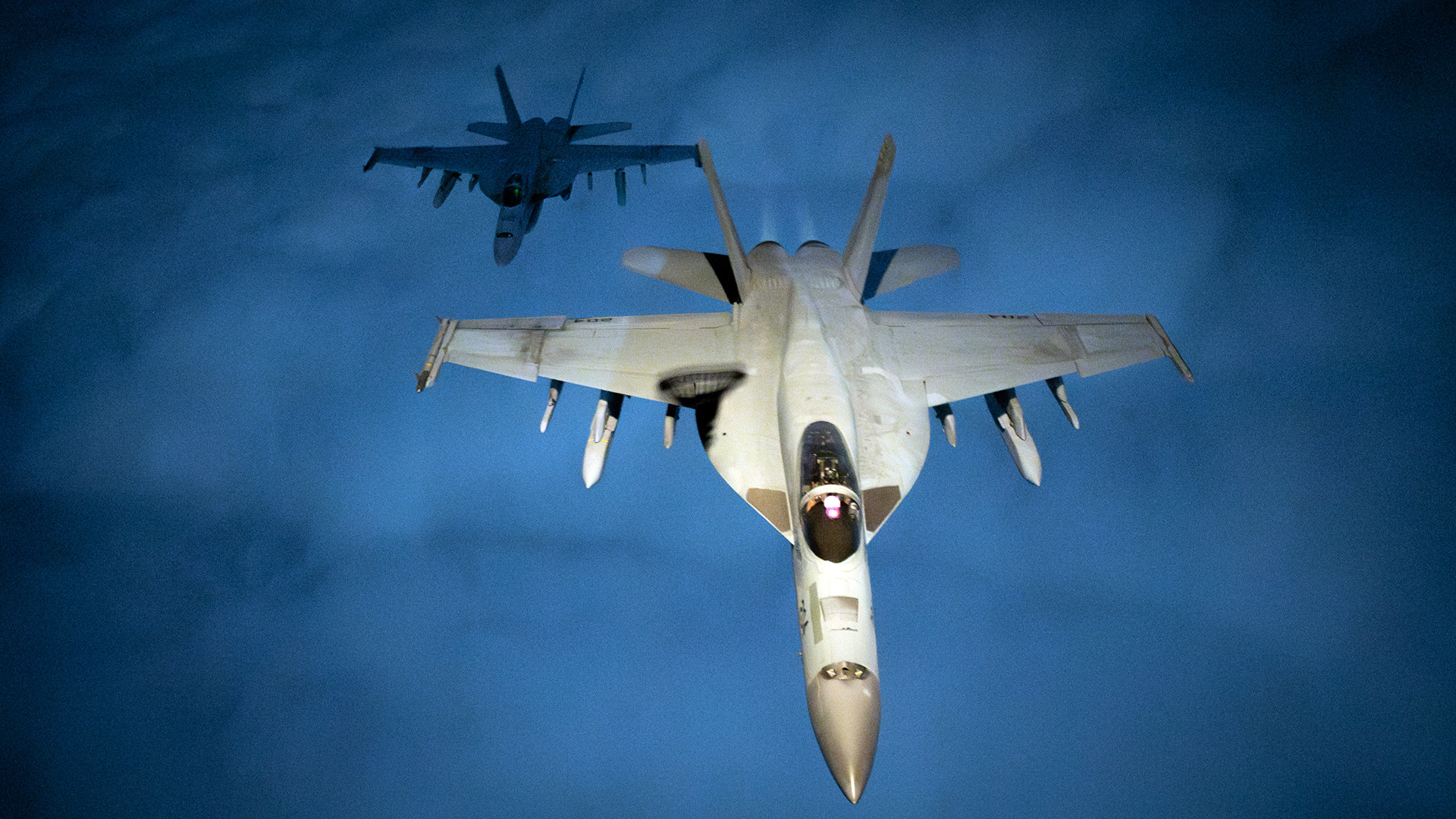
Online flight tracking data shows that a pair of U.S. Navy F/A-18 Super Hornets flew right into the center of the Gulf of Venezuela earlier today, and stayed there for some 40 minutes. This is a relatively small body of water bounded on three sides by Venezuela’s national territory, and is in the same general area where American forces are known to have previously probed that country’s air defenses. The sorties represent a new escalation in the maximum pressure campaign against Venezuelan dictator Nicolas Maduro that President Donald Trump’s administration has been conducting for months now.
The two Super Hornets, callsigns Rhino 11 and Rhino 12, look to have remained in international airspace throughout the duration of their sorties in the Gulf of Venezuela today, though this remains unconfirmed. Spoofing aircraft in open-source flight tracking is possible and does happen, but in this case, considering what we are seeing, and the recent history of certain U.S. platforms making their presence very known off the coast of Venezuela, this seems unlikely.
Even flying tight orbits in the middle of the Gulf could easily have brought the jets close to the Venezuelan coast. The body of water is approximately 75 miles long, north to south, and 150 miles wide, east to west, at its longest points. The opening to the Gulf from the Caribbean Sea to the north is only some 52 miles across, with Venezuela’s national airspace extending 12 miles from either side. Venezuelan authorities have claimed the entire body of water to be internal to the country’s national territory, something the United States has openly challenged for decades.
In addition to the F/A-18s, a pair of Navy EA-18G Growler electronic warfare jets, with the callsigns Grizzly 1 and Grizzly 2, were also tracked flying orbits in the Caribbean just north of the Gulf of Venezuela. One of the Navy’s MQ-4C Triton maritime surveillance drones also flew a mission further out in the Caribbean opposite Venezuela’s coastline at around the same time. It is highly probable that other U.S. military aircraft were also operating in the same broad area, but were not visible online. That the Super Hornets and Growlers were broadcasting their positions means they were intended to be seen, and to send a clear message to authorities in Venezuela.
Where the F/A-18s or EA-18Gs were operating from during their sorties has not been confirmed. However, these types of aircraft are among those currently embarked on the Navy’s supercarrier USS Gerald R. Ford, which has been sailing in the region since last month.

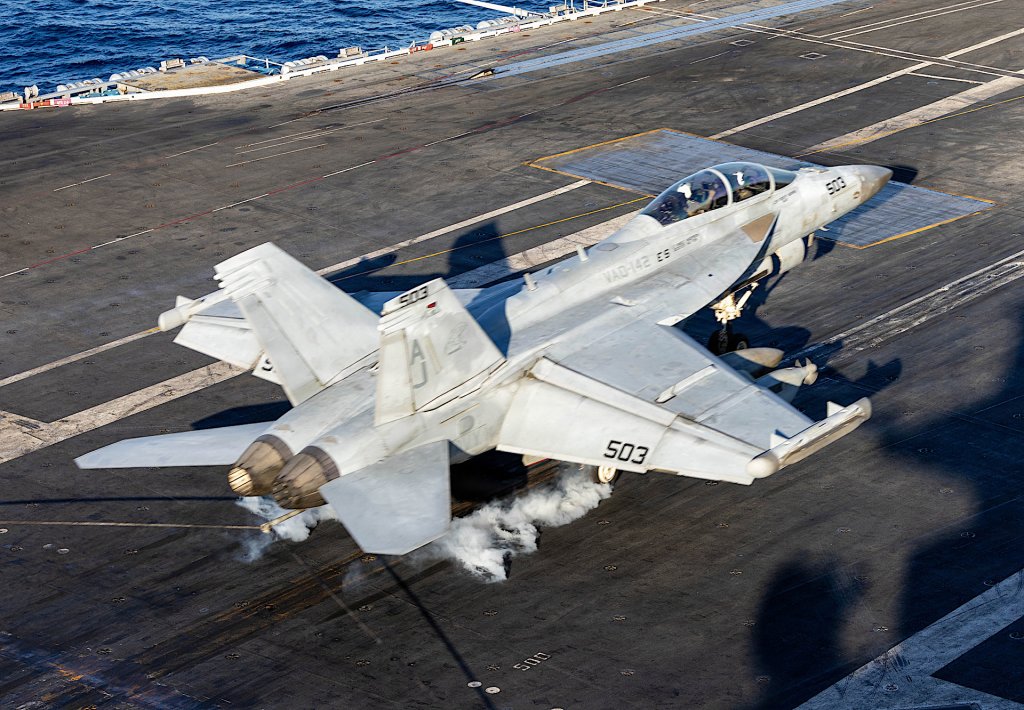
Ford was recently observed leaving St. Thomas in the U.S. Virgin Islands. U.S. Southern Command (SOUTHCOM) also posted pictures of Super Hornets and Growlers operating from the carrier, all of which were taken back in November, on social media at around the time of today’s flights off the coast of Venezuela.
Super Hornets from Ford have also been spotted recently at Luis Muñoz Marín International Airport in Puerto Rico. Since September, Marine fighters and other aircraft have been operating from the former Naval Station Roosevelt Roads on the island in support of operations in the Caribbean, as well. TWZ has reached out to the Navy and U.S. Southern Command (SOUTHCOM) for more information about today’s flights near Venezuela.
The combination of F/A-18s and EA-18Gs, with the latter flying in a standoff position, is exactly what one would expect to see during actual strikes on targets in Venezuela. The Growlers would provide electronic warfare support to help cover the Super Hornets penetrating into the threat envelope of hostile air defenses on the way to their targets. Such a mission would also include a host of additional aircraft and other assets providing command and control, aerial refueling, surveillance and reconnaissance, and other support further away from the objective areas.
Whether or not the Venezuelan Air Force made any attempt to intercept any U.S. aircraft flying around the country’s borders today is unclear. The Gulf of Venezuela, as well as Lake Maracaibo, which lies immediately to the south, and the surrounding areas, are all highly strategic locales. Lake Maracaibo, in particular, is the country’s main oil-producing region. Tankers regularly sail in and out of the area, where key refineries are also situated.
As mentioned, this is not the first time that U.S. military aircraft have operated in this same general area, and with the explicit intent of testing and otherwise gathering intelligence about Venezuela’s air defenses. Those assets do present varying degrees of risk, as you can read more about here.
Back on November 20, Navy Super Hornets notably flew just north of the Gulf of Venezuela while a U.S. Air Force RC-135W Rivet Joint intelligence, surveillance, and reconnaissance (ISR) aircraft monitored the situation from a station further out in the Caribbean. Air Force B-52 bombers, which also now regularly take part in shows of force aimed at Venezuela, were tracked in the area at around the same time. One of the main missions of the Air Force’s Rivet Joint fleet is to help in crafting so-called “Electronic Orders of Battle” of enemy or potentially hostile forces in a given area, especially air defense nodes. EA-18Gs can collect information to help with this, as well.
“They are normal operational training flights from the aircraft carrier USS Ford and platforms performing training exercises,” a U.S. official told TWZ about those sorties. “They are also testing Venezuelan sensors and responses, and it is part of the pressure campaign to show U.S. capabilities in the Caribbean.”
It should be noted here that there has been a significant buildup of U.S. forces in the Caribbean overall since August, with approximately 15,000 personnel in total now deployed in the region. This includes Ford and a host of other major naval assets, as well as various crewed and uncrewed aircraft, and supporting elements on the ground. Special operations forces are also now heavily deployed in the region. President Trump also previously confirmed he had authorized the Central Intelligence Agency (CIA) to conduct covert operations inside Venezuela.
All of this is ostensibly in support of enhanced counter-narcotics operations, now dubbed Operation Southern Spear. The U.S. government accuses Maduro of being directly involved in drug trafficking in association with an entity referred to as the Cartel of the Suns, which is now also designated as a terrorist organization. Questions have been raised about those links. Maduro has been under indictment in the United States since 2020 on narcotics and other charges, and American authorities currently have a $50 million bounty out for information leading to his arrest.
The sorties today follow weeks of escalating shows of force, as well as reports that the Trump administration could be getting closer to launching strikes or conducting other direct action missions on targets inside Venezuela. U.S. operations in the Caribbean already now include routine strikes on alleged drug-smuggling boats. Serious questions have been raised about the underlying intelligence behind those strikes, as well as their legality.
“I don’t want to say that,” President Trump said just today when asked about how far he might go to remove Maduro from office during an interview with Politico’s Dasha Burns.
“His [Maduro’s] days are numbered,” Trump added in response to a follow-up question simply about whether he would like to see Maduro out of power.
He also declined to rule out a ground invasion of Venezuela or any other kind of military action, the potential prospect of which TWZ has recently explored.
If nothing else, today’s sorties in and around the Gulf of Venezuela make clear that the U.S. government remains committed to ratcheting up the pressure on Maduro.
Update, 7:00 PM EST:
There are indications that a new contingent of tactical jets, possibly EA-18G Growlers, has deployed from Naval Air Station Whidbey Island in Washington State to the Caribbean. The aircraft may be headed to the former Naval Station Roosevelt Roads in Puerto Rico based on online flight tracking data. Land-based EA-18Gs, on top of the Growlers already in the region aboard the USS Gerald R. Ford, would not be a typical show of force, but would represent a key force multiplier for any future strike operations.
Update, 12/10/2025:
In response to our queries yesterday, the U.S. Navy directed us to U.S. Southern Command (SOUTHCOM). In turn, a SOUTHCOM spokesperson provided the following statement:
“We conduct routine, lawful operations in international airspace, including over the Gulf of Venezuela. We will continue to fly safely, professionally, and in accordance with international law to protect the homeland, monitor illicit activity, and support stability across the Americas.”
The deployment of a contingent of EA-18G Growlers to Puerto Rico has also now been confirmed, as you can read more about in our latest reporting here.
Contact the author: joe@twz.com
Loading comments…
Comments couldn’t be loaded. Please refresh the page.