
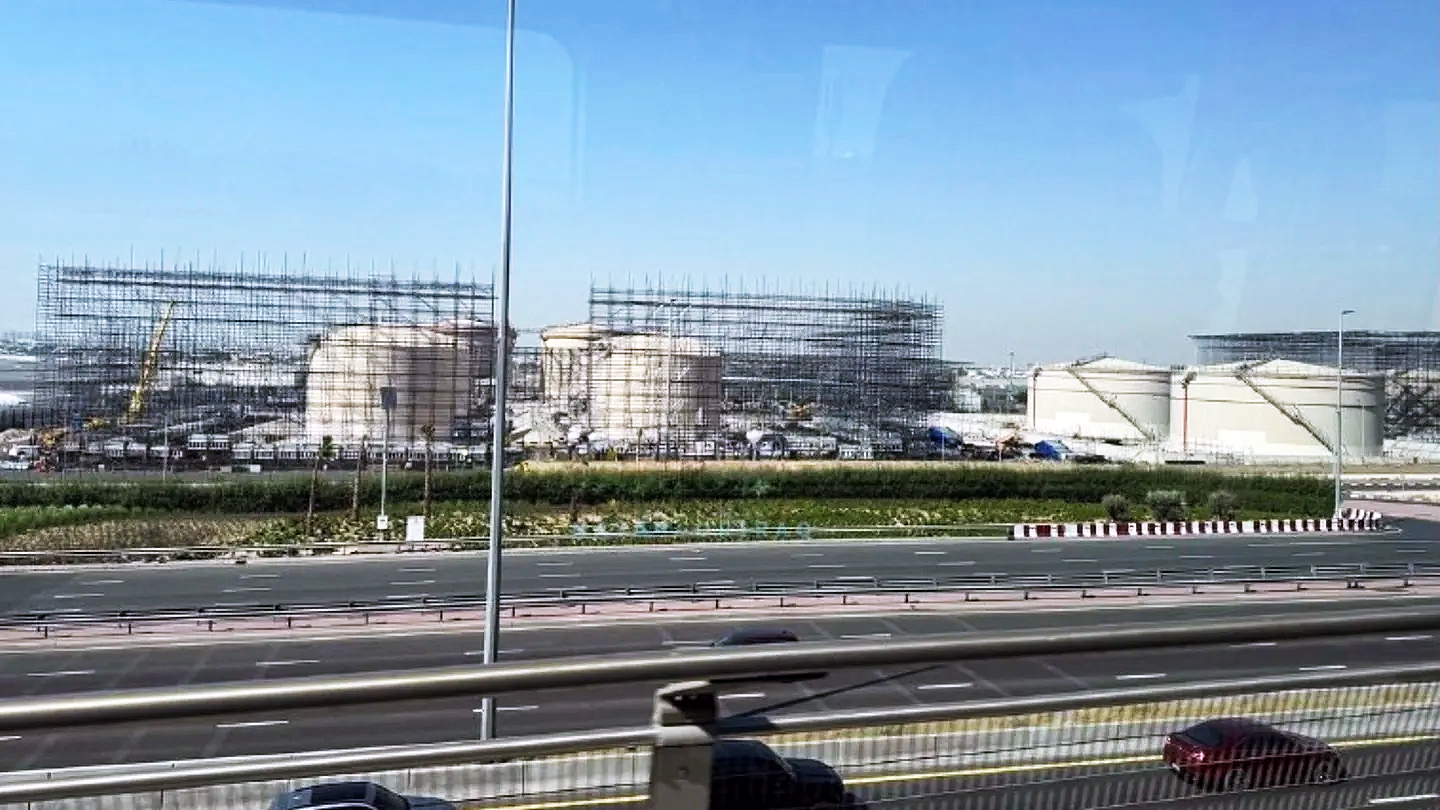
Forced to defend against thousands of Iranian drone and missile attacks before and after the ceasefire in the now-paused U.S.-Israel war on Iran, the United Arab Emirates (UAE) appears to have taken a play from Russia and its war with Ukraine in an attempt to secure some of its energy facilities with massive metal ‘cope cages.’
An image posted on X by Israel’s I24 News outlet shows what it claims is caging around oil tanks near Dubai International Airport. In the far-right section of the photo, what appears to be a more complete metal enclosure of some of the fuel tanks can be seen, while in the foreground, construction looks to be taking place on caging for additional tanks.
This seems to be the first sighting of these structures in the UAE and across the Gulf Arab nations. It is unclear when construction on the structures began or how many of these barriers the UAE is building or plans to build. We have reached out to the UAE Embassy in Washington for more details.
As we have reported in the past, the idea behind these kinds of metal structures is to mitigate the damage caused by incoming munitions by creating a barrier between the point of weapon impact and the target. The caging depicted is not designed to protect against Iranian ballistic missiles, and even cruise missiles could be a challenge. These kinds of structures are made to help defend against one-way attack munitions, such as the Shahed-136, many of which Iran has launched against the UAE. They can also protect from near-field small suicide drone attacks, although these have not been a major issue in the UAE during this conflict.
As noted earlier, while these structures may be new to the UAE, it is not the first time metal caging and even mesh nets have been used to protect critical energy infrastructure. Russia has employed these measures on its oil storage facilities in attempts to protect them from repeated Ukrainian drone attacks for a number of years now.
You can see some of those defensive measures in the following images and videos.

It is no surprise that the UAE would resort to such measures. Since the conflict broke out on Feb. 28, the Emirates have been particularly hard hit by Iranian attacks, especially on its energy infrastructure.
The UAE Defense Ministry says its air defenses “have engaged a total of 551 ballistic missiles, 29 cruise missiles, and 2,265 UAVs” fired by Iran.
Two of the UAE’s major energy infrastructure sites – the oil storage facilities at the UAE Port of Fujairah and the Habshan natural gas processing facility – have been damaged by Iranian missiles and drones. You can see video of some of the Iranian attacks on the UAE below.
Habshan, the main natural gas plant supplying the fuel in the United Arab Emirates “will only return to full capacity next year, highlighting the long recovery times for some of the region’s most critical infrastructure that was damaged in the Iran war,” Bloomberg News noted.
The most recent Iranian attack on the UAE came on May 10, more than a month after the U.S. and Iran agreed to a ceasefire that is barely holding on. The Emirates, however, haven’t just taken defensive measures. As we noted earlier this week, reports emerged that it carried out secret airstrikes on Iranian targets.
The war has once again highlighted the need for hardened structures to protect valuable assets, an issue TWZ has frequently covered. Meanwhile, shortly before the war broke out, the U.S. took a step toward acknowledging the importance of these kinds of defensive systems. The Pentagon issued new guidance for protecting critical infrastructure against drone attacks that calls for increased use of netting, cables, and other kinds of passive physical defenses.
The following video shows War Secretary Pete Hegseth introducing the Pentagon’s new approach to protecting infrastructure from drone attacks.
The new plan represented a notable shift in policy within the department. For years now, U.S. military officials have often pushed back on the utility and cost-effectiveness of investing more in the physical hardening of bases and other critical facilities, especially shelters to shield aircraft from drones and other threats.
Whether the new structures UAE is building to defend its energy infrastructure actually work will only be known should Iran launch a new round of attacks that target these sites. Clearly, the world will be watching and taking notes.
Contact the author: howard@twz.com
Loading comments…
Comments couldn’t be loaded. Please refresh the page.