
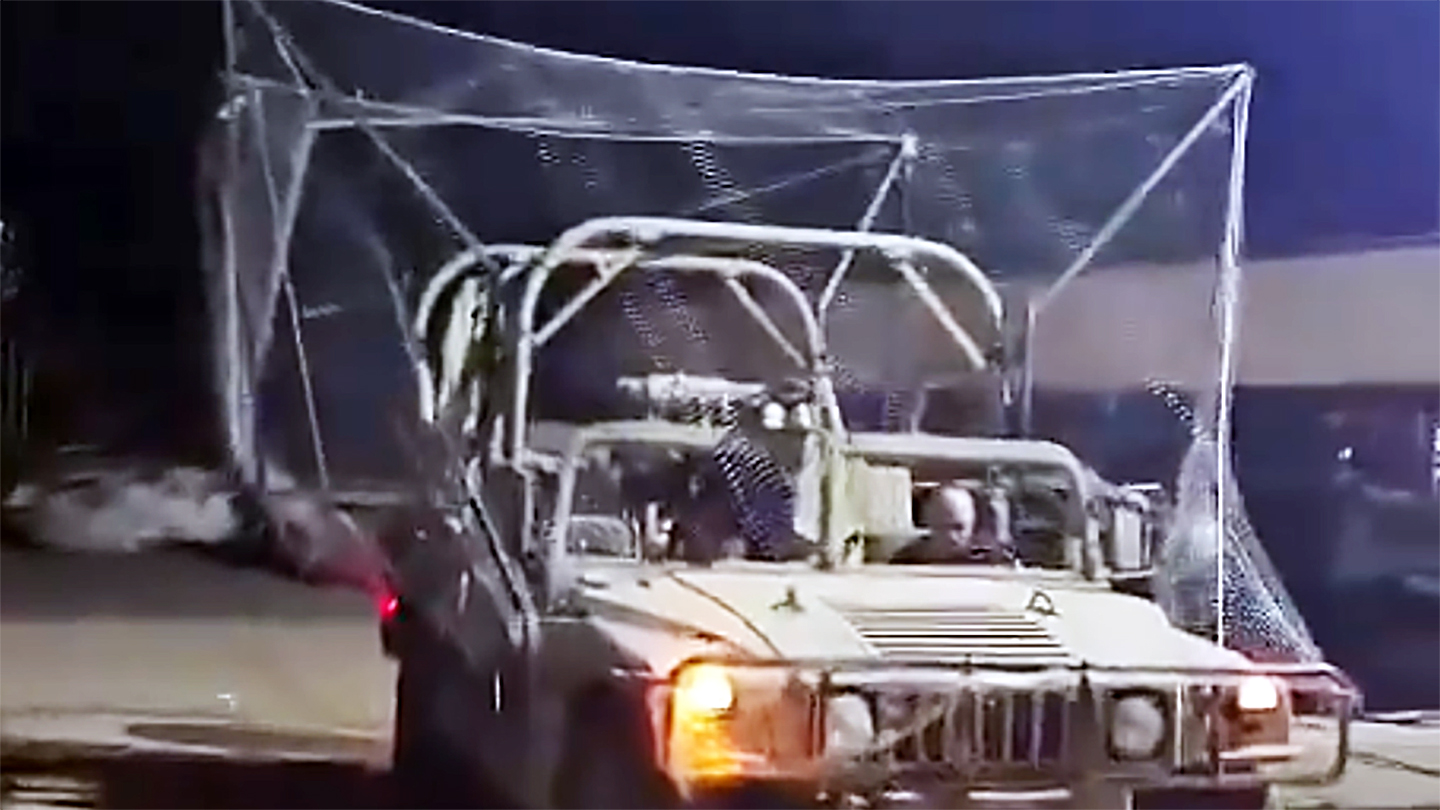
Over the course of a nearly two-month old war with Israel, Hezbollah has been increasing its use of fiber-optic controlled first-person view (FPV) drones against Israeli troops and vehicles, something we were among the first to note. Now, it appears that Israel is resorting to the use of anti-drone netting on its vehicles to help protect them from the one-way attack drones. These attacks are occurring even amid an ongoing, though extremely fragile, ceasefire.
A video emerged Wednesday on social media showing an Israeli vehicle festooned with the netting, draped like a soccer goal from metal arms extending out and above. The idea, as we have reported in the past, is that drones will get caught up in the nylon or mesh metal nets and become disabled, or the nets will help keep the drones far enough from the occupants before exploding to keep them from being killed. The latter is a far more limited scenario and depends on the vehicle type and the warhead on the drone. Based on the video we are seeing, the level of protection netting can provide passengers in the open-top Israeli vehicle if a trapped drone’s warhead were to detonate is likely very little.
The video began to circulate amid growing controversy in Israel over what is perceived as the IDF’s inability to counter the Hezbollah FPV drone threat. The frustration reached a new level over the weekend, after an Israeli soldier was killed and six were wounded by a Hezbollah drone. A followup attack was launched while the IDF was medevacing the wounded, narrowly missing the helicopter.
You can see the drone narrowly miss the helicopter in the following video.
“The attack laid bare a growing vulnerability: the Israel Defense Forces’ lack of preparedness for first-person view (FPV) drones in Lebanon, which have been an increasingly prominent weapon in Hezbollah’s arsenal during the current fighting,” the Times of Israel reported on Monday. “The Israel Defense Forces has reported dozens of drone-related injuries in recent weeks, though most were minor. Sunday’s attack marked the first fatal FPV drone strike on Israeli forces.”
“Yet the emergence of fiber optic-guided drones should not have come as a surprise,” the paper highlighted. The reason is what we noted in our previous story about this issue. The militant Lebanese group has used FPV drones against Israel since 2024 and they have been widely used by both sides in the Ukraine war for several years, as well as in other conflicts zones around the globe.
These strikes have become more prevalent the deeper Israel went into southern Lebanon. Videos of these recent attacks have been showing up on social media.
Moreover, Israeli Merkava tanks began sporting metal additions on top of vehicles meant to deflect top-down attacks from drones during the conflict in Gaza two years ago, which you can read more about here. Some of those tanks that have come under attack recently have been observed with them as well. So Israel has been working to deal with the evolving FPV drone threat, on some level, for some time and it is not alone in struggling with it. Most militaries in the world face the possibility of this same vexing threat with no clear blanket countermeasure to deal with it.
Israeli military officials acknowledge that the IDF still lacks an effective counter to fiber-optic-guided drones, the Times of Israel noted, for reasons we have frequently reported. Fiber optic cables mitigate the effect of electronic warfare efforts to jam radio signals as well as some of the limitations imposed by geographical features that can impede the line-of-sight radio connection between drone and operator.
“The IDF initially assessed that Hezbollah’s fiber optic drones could only operate over a few kilometers,” the outlet stated. “Later, the military discovered launches occurring from distances of up to 15 kilometers (nine miles).”
“The gap was underscored on April 11, when the Defense Ministry’s Directorate of Defense Research and Development issued a public call for solutions to the threat — nearly two years after such systems first surfaced in Ukraine, and weeks into the current conflict with Hezbollah,” according to the Times of Israel. “The Defense Ministry is seeking additional capabilities to address this threat. The purpose of this request is to identify innovative and mature technologies.”
It’s unclear how widespread the use of netting is currently by the IDF in southern Lebanon.
“The issue of drones carrying fiber-optic cables is currently a threat without a clear solution,” a high-ranking IDF official, who just returned from Lebanon, told us. “What’s been shown in the video seems more like an experimental concept rather than something that is already operational in the field.”
“In practice, forces are using various improvised solutions—fishing nets, camouflage nets, even soccer nets, along with drills involving small-arms fire at drones,” he added. “However, I personally haven’t seen the specific net system mentioned being used on the ground yet.”
The official said someone from the IDF’s ground forces research and development team told him that the conclusion in the military is that “this solution is highly problematic. It allows the lower parts of the vehicle to remain exposed, areas that the net doesn’t cover. The likely next step for the adversary would be to detonate the drone at a distance from the net, causing shrapnel to disperse toward the forces.”
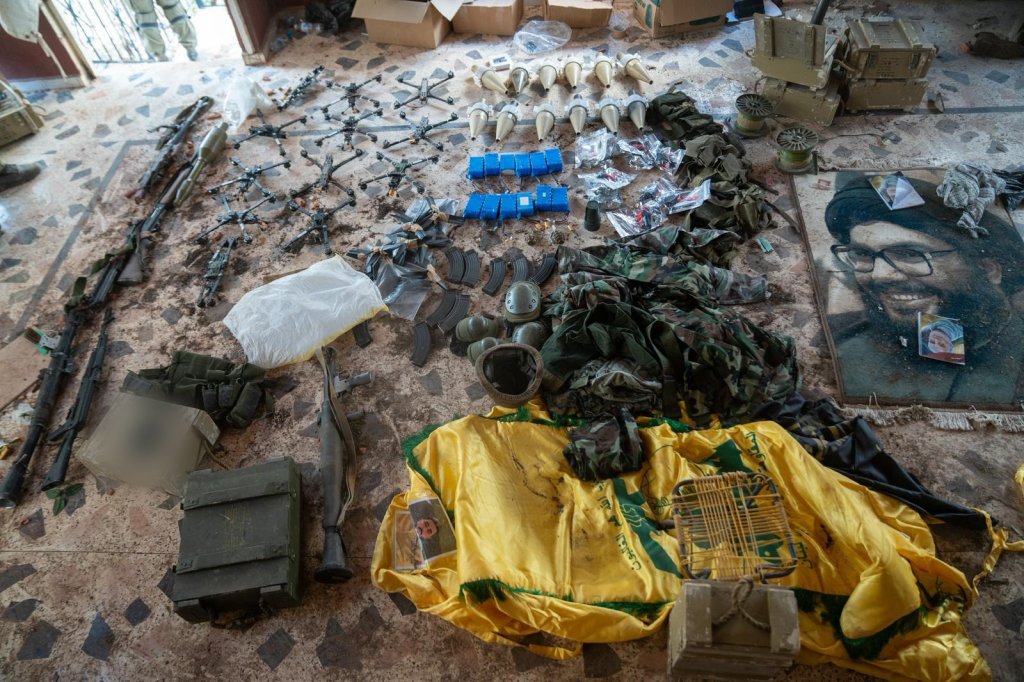
In a post on X Tuesday, Israeli military journalist Doron Kadosh said the issue of how to deal with Hezbollah FPV drones “took up significant volume in [Monday]’s discussion at the IDF’s senior command forum at Ramat David. The commander of the 282nd Artillery Brigade, which is currently fighting in Lebanon, Col. G., told the commanders: ‘The drone threat is a significant operational challenge that we’re dealing with. We need to think about how to organize better against this threat.’”
IDF combat unit commanders fighting in Lebanon “now express great frustration with the drone threat and the few tools the IDF has to counter them,” Kadosh added. “‘There’s not much you can do about it,’ says a commander currently fighting in Lebanon. The briefing the forces receive boils down to— ‘Stay alert, and if you spot a drone—shoot at it.'”
Some IDF units “have already begun developing independent responses to the threat—for example, nets deployed over positions, houses, and windows—so that the drone gets caught in the net and doesn’t hit its target,” Kadosh continued. “This is an improvised response; we’ve started deploying it with some of the forces, but it’s far from sufficient,” an officer currently fighting in Lebanon told the reporter. This would follow exactly what we saw in Ukraine, as both sides looked to improvised forms of protection from incoming drones, leading to rapid experimentation and many dead ends.
Despite the limitations, this netting has become fairly common in Ukraine, with both sides using netting over vehicles, buildings and miles and miles of roadway to provide safer corridors of travel.
As we noted in our last piece on the growing FPV threat to Israeli forces, active protection systems (APS) on armored vehicles are being adapted to provide hard-kill counter-drone protection. These systems use sensors to detect incoming rocket-propelled grenades, missiles, and other projectiles, and fire projectiles to hit them before they strike the vehicle. Israel is a major pioneer in the APS space, with systems being deployed for decades, but just how soon it can upgrade existing systems, such as Iron Fist, for this application isn’t clear. Also, this doesn’t help many lighter vehicles that do not have APS capabilities. Still, it is one bright spot of hope of creating a defense against fiber optic FPVs, at least for lower volume attacks, although these are also very costly systems.

Regardless, we are likely to see more Israeli vehicles equipped with nets and other forms of passive protection in the coming days, and likely more advanced countermeasures if the war grinds on for a prolonged period.
Contact the author: howard@thewarzone.com
Loading comments…
Comments couldn’t be loaded. Please refresh the page.