
Secretary of State Marco Rubio updated U.S. legislators on Iran just hours before President Donald Trump issued warnings over Tehran’s nuclear ambitions in his State of the Union address. In the past days, U.S. military forces in the region have grown to the highest levels seen since the lead-up to the invasion of Iraq in 2003. New assets that have arrived include U.S. Air Force F-22 Raptors, reportedly in Israel, while F-16s have been deployed to Diego Garcia to protect the Indian Ocean outpost against potential Iranian attacks.
Rubio provided a rare intelligence briefing for congressional leaders — the so-called “gang of eight” — which includes the senior lawmakers from both parties in the House and Senate, as well as the chairs and ranking members of the House and Senate intelligence committees. The contents of the briefing are classified, but it underscores the wider preparations for potential significant military action against Iran.
The “gang of eight” receives classified intelligence from the White House in the form of briefings, and their content can include preparations for military operations. It is notable that the last time Rubio publicly briefed the group was on January 5, one day after the U.S. military launched its successful operation to capture Venezuela’s Nicolás Maduro.
As he left yesterday’s briefing, Senate minority leader Chuck Schumer said: “This is serious, and the administration has to make its case to the American people.”
“I’m very concerned,” added Jim Himes, the ranking democrat on the House intelligence committee. “Wars in the Middle East don’t go well for presidents, for the country, and we have not heard articulated a single good reason for why now is the moment to launch yet another war in the Middle East.”
Rubio’s intel update preceded Trump’s State of the Union address last night, during which the U.S. president reaffirmed that Iran would never be permitted to acquire nuclear weapons.
In his address, Trump stated that he would rather handle rising tensions with Iran through diplomatic means. However, he also claimed that Tehran was developing ballistic missile technology that could potentially reach the United States, without providing further details.
“They’ve already developed missiles that can threaten Europe and our bases overseas,” Trump said. “And they’re working to build missiles that will soon reach the United States of America.”
This might be a reference to Iran’s burgeoning space-launch capability. Under this effort, Iran’s Islamic Revolutionary Guard Corps (IRGC) is developing advanced space-launch vehicles able to put satellites into orbit. While the program is officially non-offensive, there have been concerns that the same technologies could be used to help the IRGC develop long-range ballistic missiles.
Trump has repeatedly called upon Iran to give up its nuclear program, abandon its production of ballistic missiles, and terminate its support for overseas proxies such as Hezbollah in Lebanon and the Houthis in Yemen.
“We are in negotiations with them,” Trump continued. “They want to make a deal. But we haven’t heard those secret words: we will never have a nuclear weapon.”
The developments came as U.S. military assets continued to flow into the region, providing more options for an operation against Iran, should Trump order it. Over the weekend, U.S. Air Force tankers and transports continued to arrive in the wider region after transatlantic flights.
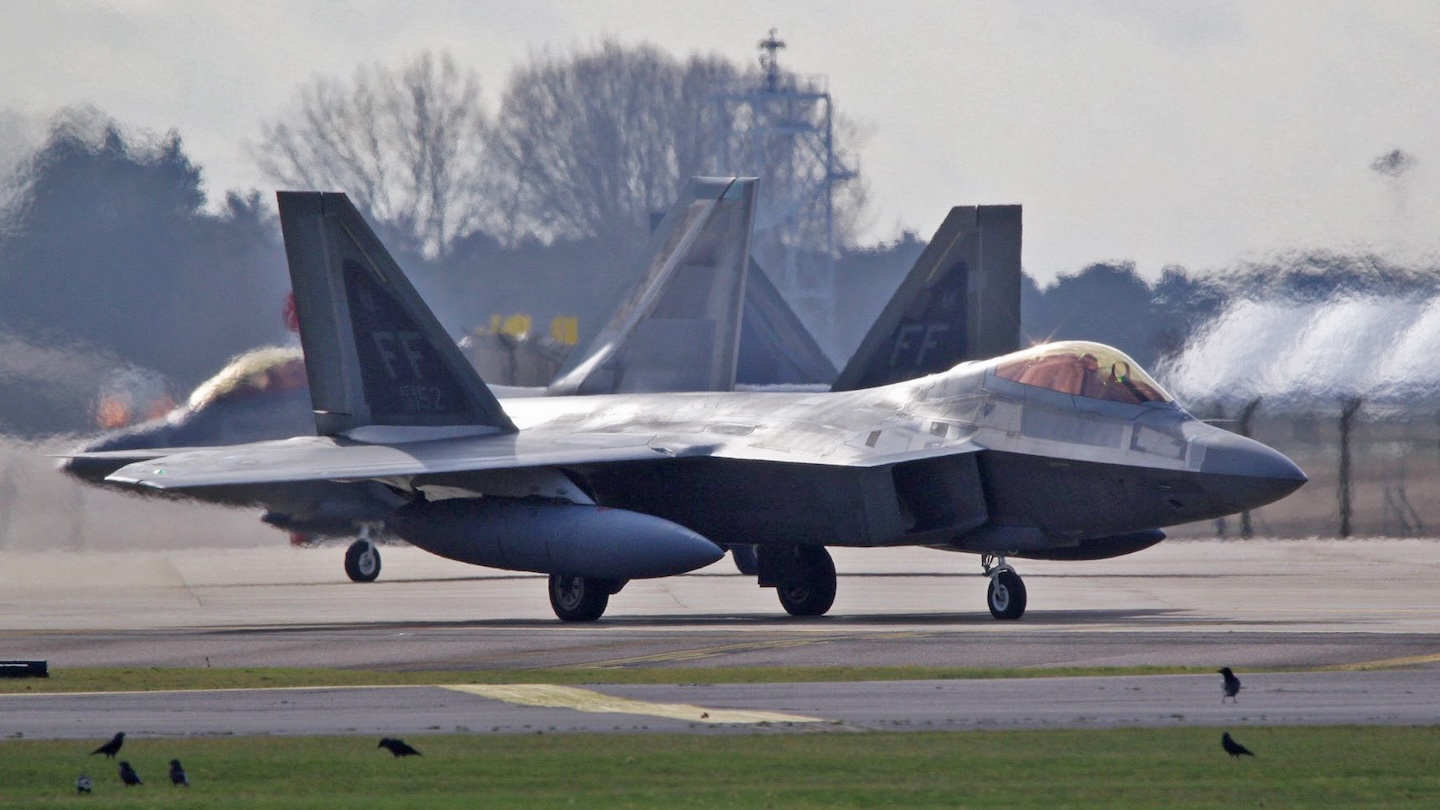
As well as a second aircraft carrier, the USS Gerald R. Ford, which arrived in the eastern Mediterranean earlier this week, F-22s have also arrived in-theater, according to multiple reports.
The stealth jets took off from RAF Lakenheath in England yesterday, confirmed by open-source flight tracking data and aircraft spotters, and are now at an Israeli Air Force base in the south of Israel, according to The Times of Israel. The base in question is reportedly Ovda, home to an Israeli Air Force F-16C unit.
A total of 12 F-22s were seen taking off from Lakenheath, although one apparently returned to the airbase due to a technical issue. The Raptors had arrived at the base last week.
The presence of F-22s — as well as KC-135 Stratotankers — in Israel reflects the fact that Israel will almost certainly be fully integrated into any potential U.S. operation against Iran. Furthermore, the United States has limited basing options in the region, including countries that have said they would not allow U.S. operations to have access to their airspace. Meanwhile, the threat of Iranian short-range missiles and drone strikes also limits where these U.S. assets can go.
Meanwhile, recent satellite imagery from Diego Garcia in the Indian Ocean reveals the build-up of aircraft at the base, which could be important to any U.S. plans for a sustained campaign of airstrikes against Iran. While long-range bombers periodically operate out of Diego Garcia, the facility is now hosting cargo and refueling support aircraft, as well as F-16CM fighters from the 35th Fighter Wing that recently deployed there from Misawa Air Base in Japan. These would be key assets in defending the island from a possible Iranian attack. As we reported last week, the United Kingdom has apparently said it would not allow the use of the island for strikes on Iran, although this position may well change. Regardless, the importance of the force-protection mission at Diego Garcia — increasingly threatened by Iranian long-range attack drones and missiles — is something we have discussed in the past.
The Israeli media further reports that the country’s officials now believe that a U.S. attack on Iran is “unavoidable.”
One Israeli official quoted by the country’s Channel 12 news yesterday reportedly said that a diplomatic resolution to the conflict would be the “surprise of the year.”
However, such accounts should be treated with great caution, considering that such claims have been repeated relentlessly by Israeli media.
The next round of U.S.-Iran talks is scheduled to take place in Geneva tomorrow.
Iranian Deputy Foreign Minister Majid Takht-Ravanchi said that his country was “ready to reach an agreement as soon as possible,” in an interview with NPR.
“We want to do whatever’s necessary to make it happen,” he continued. However, Takht-Ravanchi added that the talks would relate only to Iran’s nuclear program, which may well not be enough to satisfy U.S. officials.
The U.S. delegation in Geneva will be led by Trump’s Middle East envoy Steve Witkoff. As well as Rubio, they will also include Trump’s advisor Jared Kushner, Vice-President JD Vance, CIA Director John Ratcliffe, Secretary of Defense Pete Hegseth, White House Chief of Staff Susie Wiles, and Director of National Intelligence Tulsi Gabbard.
Speaking last week, Trump said that if Tehran didn’t agree to a deal, the United States would have to “take it a step further.” The U.S. president gave a time limit of 10 days before “really bad things” would happen to Iran.
There have been other recent signs that the United States may be gearing up for an imminent operation.
Earlier this week, the U.S. Embassy in Beirut evacuated “dozens” of non-essential personnel as “a precautionary measure due to anticipated regional developments.”
In other news out of Lebanon, Hezbollah has reportedly said that it will not hit back against the United States and its allies should the U.S. military launch “limited” strikes against Iran.
Elsewhere in the Middle East, Reuters reports that Saudi Arabia is ramping up its oil production and exports as part of a contingency plan in case a potential U.S. strike on Iran disrupts supplies from the region.
Meanwhile, Rubio reportedly delayed a Saturday meeting with Israeli Prime Minister Benjamin Netanyahu to Monday, according to Israeli officials.
There have been concerns, at the highest levels, that, should the United States become involved in a conflict with Iran, the U.S. military could rapidly burn through its stockpiles of certain key weapons.
Reportedly, Gen. Dan Caine, the chairman of the Joint Chiefs of Staff, has warned Trump that such a campaign could have a severe impact on the U.S. stockpile of anti-missile interceptors, including the Patriot, Terminal High-Altitude Area Defense (THAAD), and ship-launched missiles such as the Standard series.
Trump pushed back against those warnings, claiming that Caine was “against us going to war with Iran.”
“General Caine, like all of us, would like not to see War but, if a decision is made on going against Iran at a Military level, it is his opinion that it will be something easily won,” Trump wrote on his Truth Social platform. Caine “has not spoken of not doing Iran, or even the fake limited strikes that I have been reading about, he only knows one thing, how to WIN and, if he is told to do so, he will be leading the pack.”
As to when a possible U.S. operation could be launched, Charles Wald, a retired Air Force general and former deputy commander of U.S. European Command, told The Guardian, “We could go now.”
Ward suggested that Trump’s ultimatums, combined with the scale of the military buildup, could force him into taking action.
Should that happen, the U.S. president’s options would include limited strikes intended to force Tehran to comply with Washington’s demands in the negotiations. Potentially, the U.S. military could also launch a more concerted offensive intended to decapitate or destabilize the Iranian government.
Much will likely hinge on the progress of the talks in Geneva tomorrow.
Contact the author: thomas@thewarzone.com
Loading comments…
Comments couldn’t be loaded. Please refresh the page.