
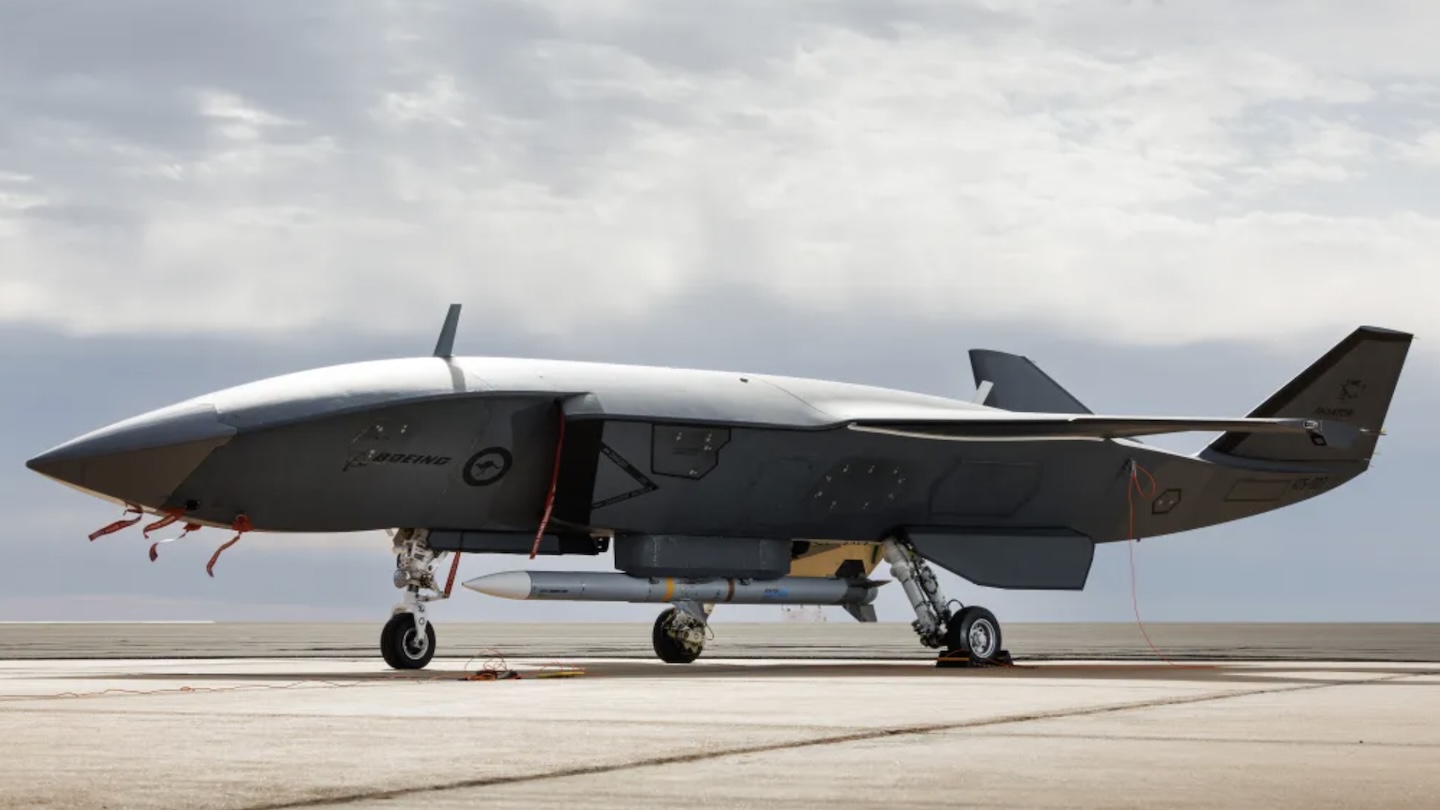
As the MQ-28A Ghost Bat drone heads toward operational capability with its launch customer, Australia, Boeing has provided details about the changes incorporated in the upcoming Block 3 version. The company also says it’s pursuing sales for the MQ-28 elsewhere in the Indo-Pacific region, specifically.
An update on the MQ-28 was provided by Glen Ferguson, the program director, speaking to the media at this week’s Singapore Airshow. In attendance was TWZ contributor Roy Choo.
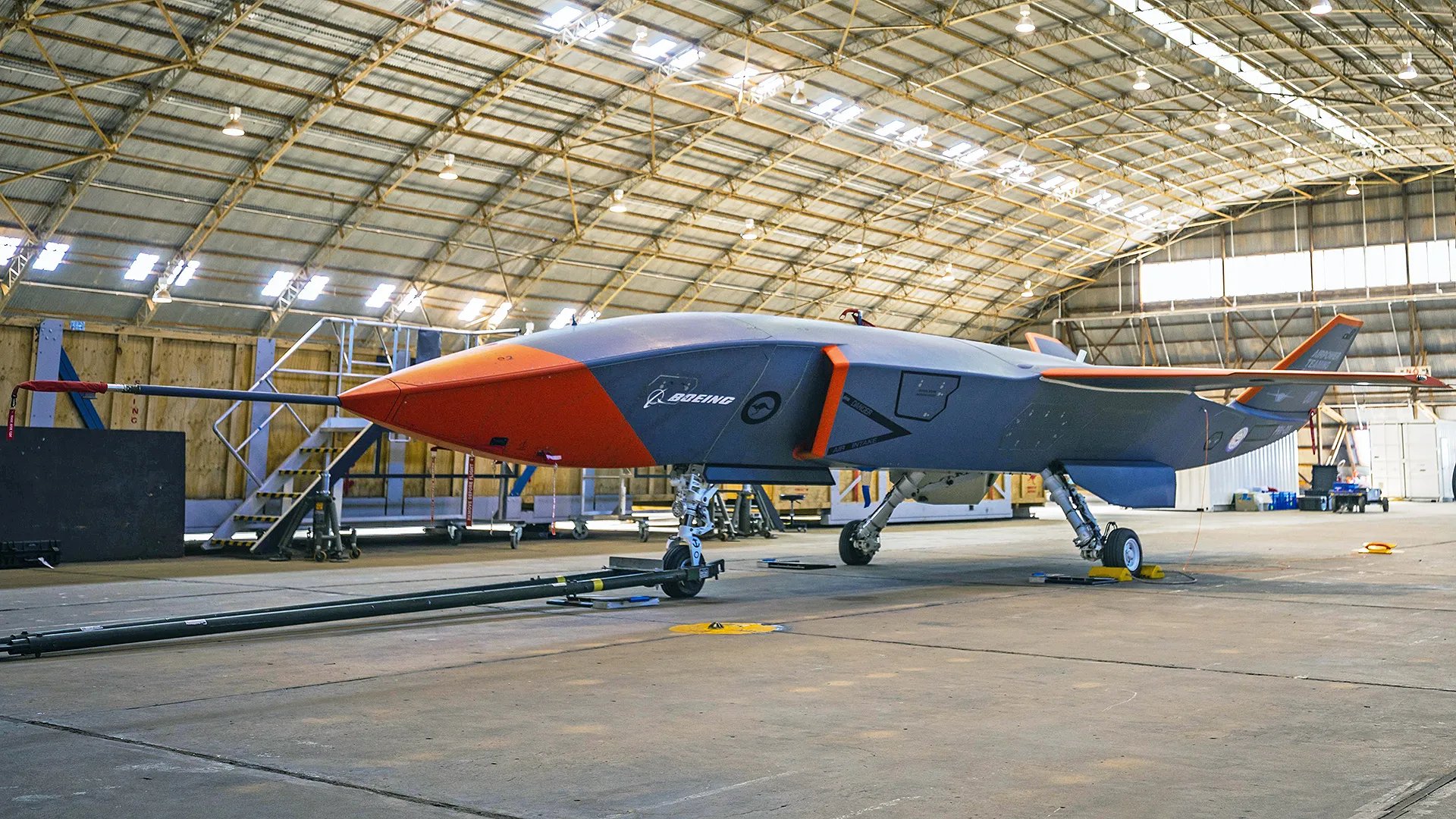
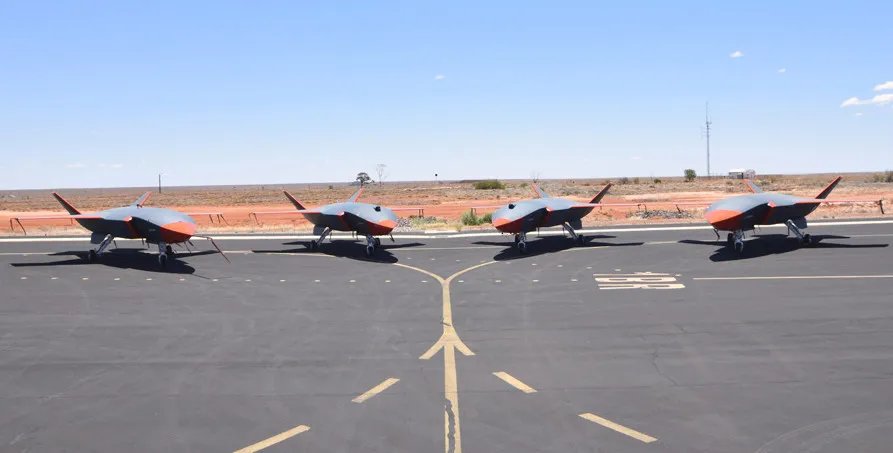
The Block 3 aircraft is currently the most ambitious iteration of the MQ-28 and will follow on from Block 2, which is now in production for the Royal Australian Air Force (RAAF).
Late last year, Australia placed contracts with Boeing Defense Australia (BDA) for six Block 2 aircraft, having previously ordered three to the same standard.
Australia has already acquired eight Block 1 MQ-28s, which are configured as pre-production prototypes.

While the Block 2 drones are seen as a pathway to an operational capability, when that might actually materialize remains unclear. Speaking at the Singapore Airshow, Ferguson pushed questions about this to the Australian Ministry of Defense.
At the same time that it ordered its latest tranche of Block 2 drones, Australia placed a contract for the development of the enhanced Block 3, about which Ferguson provided more information.
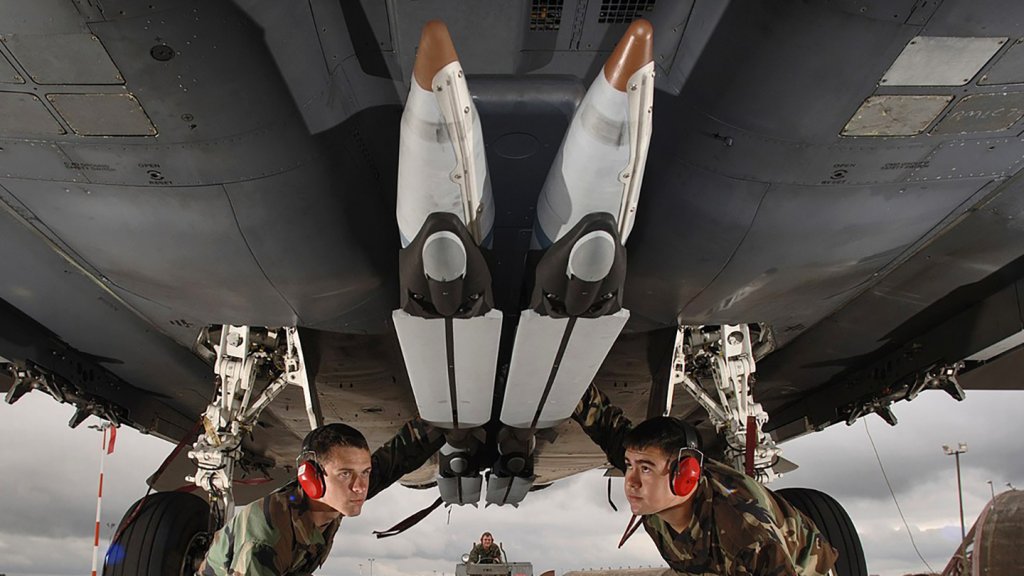
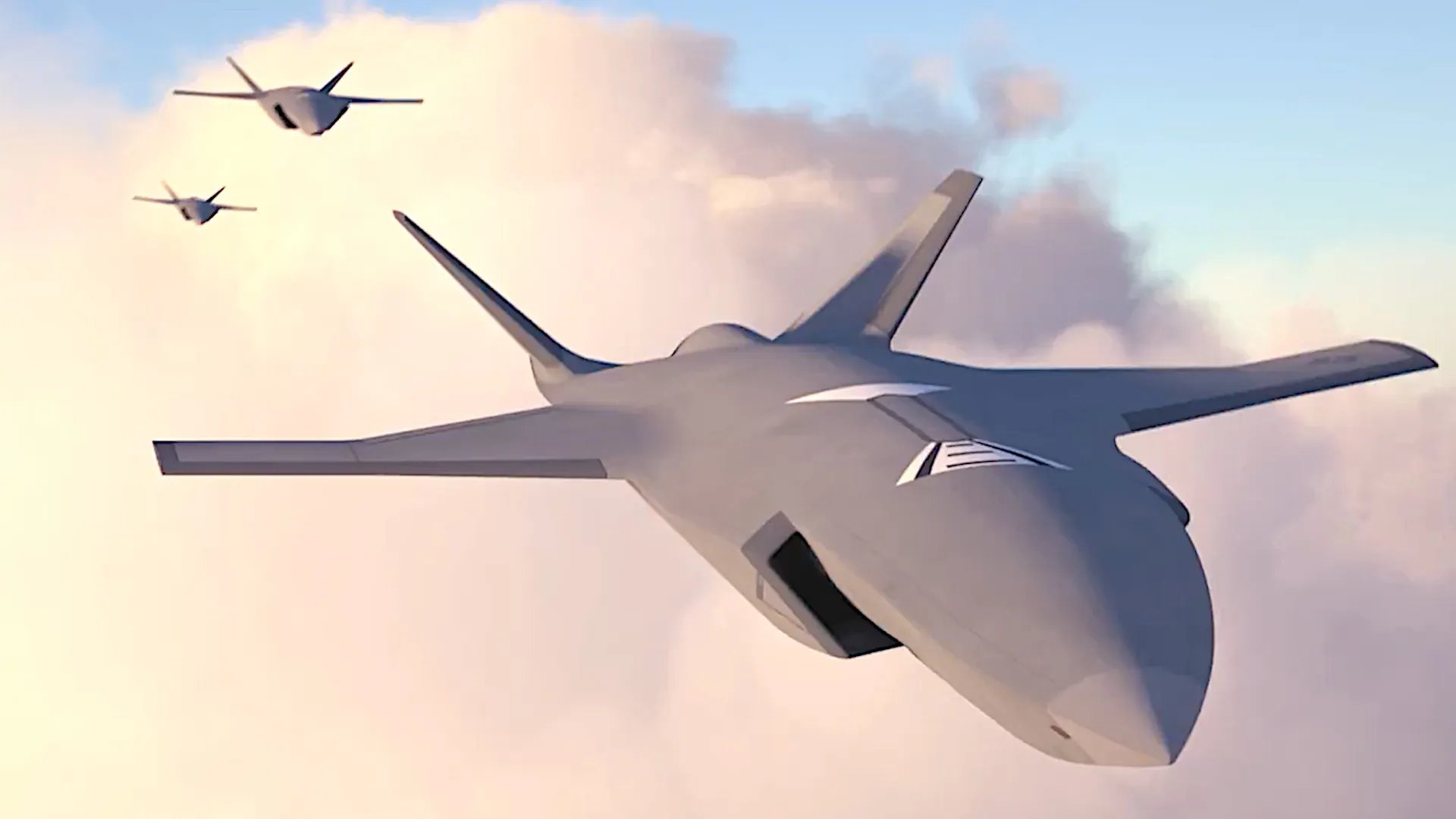
As had been expected, the Block 3 will include an internal weapons bay. We now know that this will be scaled to accommodate one AIM-120 Advanced Medium-Range Air-to-Air Missile (AMRAAM) or two GBU-39/B Small Diameter Bombs (SDB) or equivalents, in terms of size. A pair of SDB IIs, also known as the GBU-53/B StormBreaker glide bomb, would be another option, but Ferguson stressed this was potentially just the starting point.
“The best language to use is what we provision for in the weapons bay,” Ferguson explained. “The reality is, because we are modular, and because we have an open architecture, and because we have the ability for people to do things on their own, we can put any weapon in, across the board […] Now, which ones we use is really up to customers.”
In fact, the Block 1 and 2 aircraft also have the space to accommodate a weapons bay, which could be retrofitted if the Royal Australian Air Force (RAAF) decides to.
Late last year, a Block 2 aircraft was fitted with a single AMRAAM carried on a prominent external pylon for a landmark live-fire weapons shot. This saw the MQ-28 operate as a loyal wingman with an RAAF E-7A Wedgetail airborne early warning and control (AEW&C), with “support” provided by an F/A-18F Super Hornet. A live AMRAAM was used to “successfully engage and destroy” an Australian-made Phoenix jet-powered target drone.
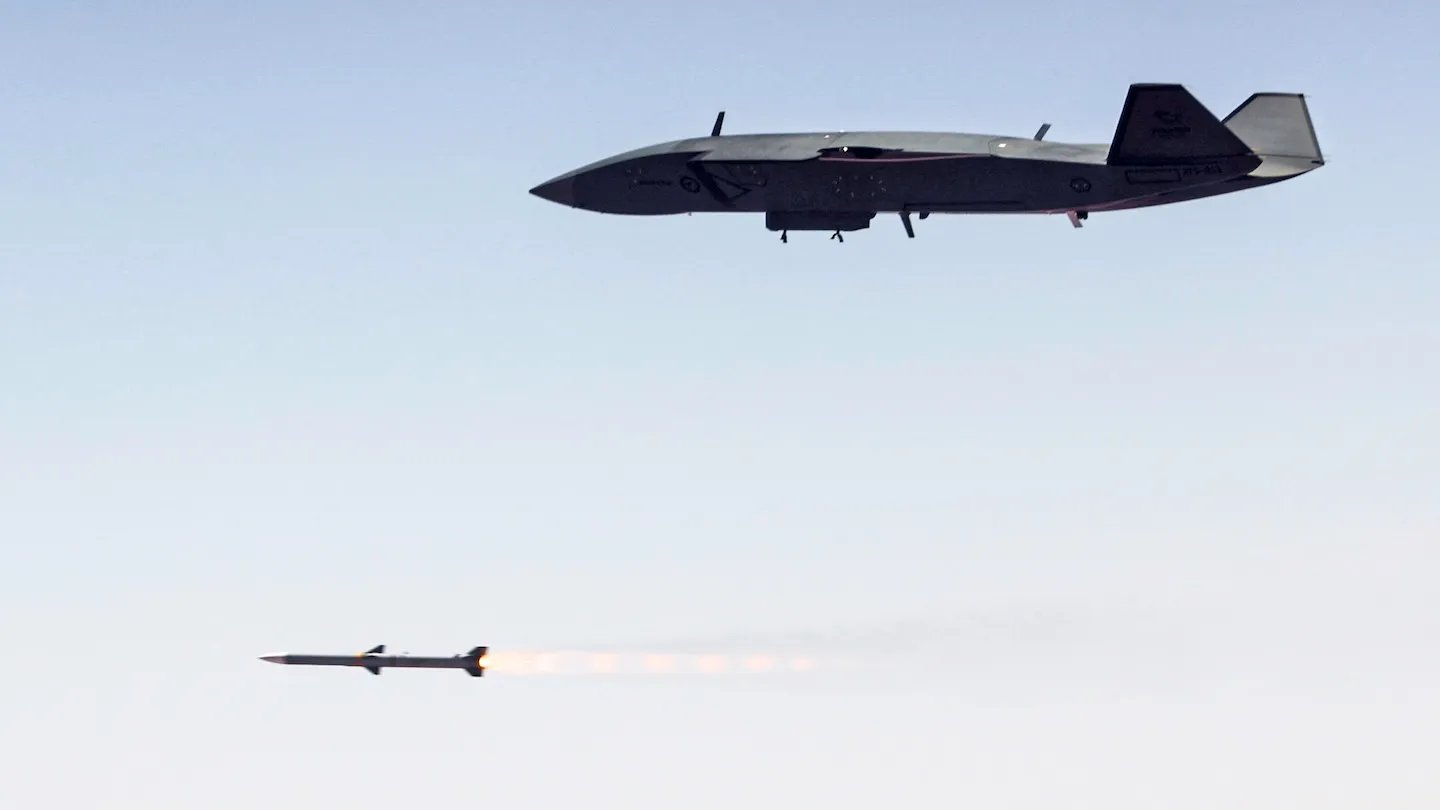
In Singapore, Boeing provided more details of the live-fire weapons test, part of the Australian Defense Force’s Trial Kareela 25-4, including how the different tasks were shared among the three RAAF assets.
During the test, the F/A-18 acquired the target, while the E-7 authorized it and managed elements of the kill-chain flow. The MQ-28 was provided with authority to engage and destroy that target.
According to Boeing, the MQ-28 received only four major commands to achieve this. The first was to take off. The second was to establish an orbit in a defensive counter-air patrol (CAP). The third was to leave the CAP and then autonomously intercept the target. The fourth was to arm its weapon system and release its AMRAAM once within firing parameters. Everything else, the MQ-28 did autonomously, Boeing said.
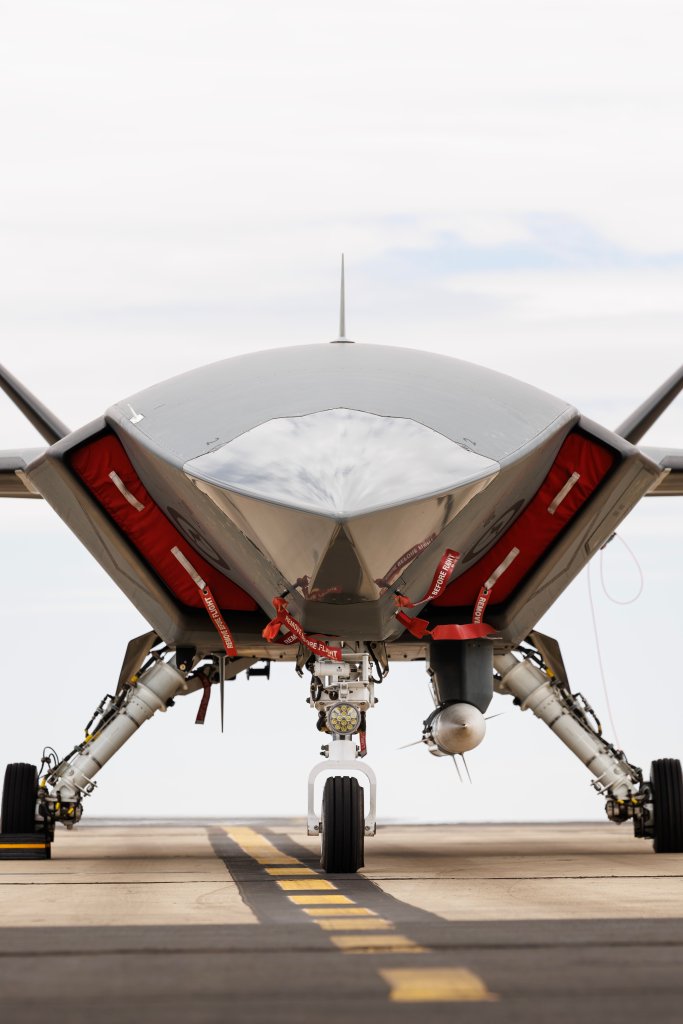
A key feature of the MQ-28 is its highly modular design, meaning various munitions, sensors, and other payloads can be integrated; the entire nose can be swapped out to accommodate different payloads.
On the Block 2 aircraft, we have already seen an infrared search and track (IRST) sensor fitted in the nose of at least two MQ-28s. This is understood to be a Selex system.
For Block 3, Ferguson confirmed that Boeing is working on “three or four” alternative sensor payloads, although he declined to elaborate on these.
As well as internal weapons carriage and new weapons and sensors, the Ghost Bat will also grow in size with Block 3. According to details published by Breaking Defense, the drone’s wingspan will increase from 20 to 24 feet (6 meters to 7.3 meters), providing a roughly 30 percent increase in fuel capacity.
“One of the reasons we put the bigger wing on the Block 3 jet is for range,” Ferguson added. “Remember the Pacific mission: You obviously need range.”
While not directly addressed, there have been hints in the past that Boeing has been looking at adding receptacles on top of the MQ-28’s fuselage to allow for aerial refueling from boom-equipped tankers. This would further extend the drone’s reach and on-station time, but would also add complexity and cost to the design, as you can read about here.
Having the Block 3 version of the drone being better optimized for the Indo-Pacific region should make it more attractive not just to the U.S. military but also to allied air forces in the same region. Ferguson said he was unable to talk about any potential plans for acquiring the MQ-28. In 2022, the Pentagon confirmed that it had acquired at least one MQ-28 to be used to support the U.S. Air Force’s advanced uncrewed aircraft and autonomy efforts. Meanwhile, the U.S. Navy has deployed a test and evaluation squadron to Australia to work on the aircraft, and an MQ-28 has also been operating out of Naval Air Station Point Mugu, California.
Nevertheless, “the opportunities for CCAs [Collaborative Combat Aircraft] in Southeast Asia are immense,” Ferguson said. “We are having a conversation with a lot of [potential] customers right now about how they might field, determine, or deliver a CCA capability. What I would say, though, is that for the people out there who have not started thinking about it, there’s a risk that in about three or four years, you’re going to be disappointed as you’re behind everyone else. What we’re seeing is a massive appetite for adoption of CCAs and people working on how they can put them in the force mix.”
Again, with its baked-in modularity, the MQ-28 is intended to be flexible enough for other operators to integrate their own capabilities depending on their required mission sets.
“For other nations looking at an MQ-28 capability, what they actually get is a core air vehicle and a core system, and the system is so critical, in that it allows them to have their own sovereign capabilities. They can adapt their own autonomous behaviors. They can apply their own sensors if they wish. They can apply their own weapons without needing to involve us at the levels you might expect on a normal crewed platform […] We have that with the RAAF, and we’re looking to share that with other countries as they look to embrace a CCA capability.”
When asked about specific potential customers discussing the MQ-28 with Boeing, Ferguson was only willing to identify Japan. In this case, Australia and Japan have already discussed collaborating on the program.
During a meeting of Australian and Japanese defense ministers in September last year, an agreement was signed to boost bilateral defense cooperation, including on the MQ-28, with plans for Japan Air Self-Defense Force (JASDF) participation in MQ-28 flight test observation and training this year.
As we have laid out in detail, the MQ-28 seems uniquely suited for a cooperative production and operation program across multiple allies nations, even plugging into the existing AUKUS architecture between the U.S., Australia and the U.K. You can read all about this here.
Regardless, the RAAF is set to be the first service to put the MQ-28 into operational service. The next big milestones will be in 2028, with the planned service introduction of the Block 2 aircraft and the initial production of the Block 3 aircraft.
But with so much happening in the world of CCAs and ‘loyal wingman’-type drones, there will very likely be more significant developments in the program before that date.
Contact the author: thomas@thewarzone.com
Loading comments…
Comments couldn’t be loaded. Please refresh the page.