
The U.S. government has accused China of secretly conducting at least one “yield-producing nuclear test” in recent years despite the country having a stated moratorium on such activities. Last year, U.S. President Donald Trump announced plans to engage in new nuclear testing “on an equal basis” with China and Russia, but it remains unclear what that might mean and what action has been taken. The new test allegation also comes as American officials continue to call for a new nuclear arms control treaty that includes China to succeed the New START agreement with Russia, which sunset yesterday.
“Today, I can reveal that the U.S. government is aware that China has conducted nuclear explosive tests, including preparing for tests with designated yields in the hundreds of tons,” Thomas DiNanno, Under Secretary of State for Arms Control and International Security, said during a speech at the Conference on Disarmament in Geneva, Switzerland this morning. “The PLA [China’s People’s Liberation Army] sought to conceal testing by obfuscating the nuclear explosions because it recognized these tests violate test ban commitments.”

China is a signatory to the Comprehensive Nuclear-Test-Ban Treaty (CTBT), but has never ratified it. The same is true of the United States. Both countries have stated self-imposed moratoriums on yield-producing nuclear testing. The CTBT does not prohibit sub-critical testing, which does not involve a full-fledged nuclear reaction. China’s last acknowledged critical-level nuclear test was in 1996. The last U.S. test of that kind was in 1992.
“China has used decoupling – a method to decrease the effectiveness of seismic monitoring – to hide its activities from the world,” DiNanno added. “China conducted one such yield-producing nuclear test on June 22nd of 2020.”
The CTBT’s primary verification method is a global network of hundreds of seismic monitoring stations.
As an aside, the last official nuclear test in Russia came in 1990, just before the fall of the Soviet Union. The United Kingdom, France, India, and Pakistan also conducted yield-producing nuclear tests at various points in the 1990s. North Korea is the only country known to have conducted such tests since 2000, with the detonation of five devices in separate instances between 2006 and 2017.
The video below offers an excellent graphical representation of the extent of known nuclear testing, covering detonations between 1945 and 1998.

At the time of writing, the U.S. government does not appear to have provided further details about the newly alleged Chinese nuclear testing. When American officials arrived at their current assessments about these activities is also unclear.
The U.S. State Department made no mention of any such testing in China in its most recent routine international arms control compliance report, published in April 2025. That report did reiterate previous U.S. accusations that Russia has engaged in supercritical nuclear testing in violation of its commitments to multiple test ban treaties, something DiNanno also highlighted in his speech today. Russia is a signatory to the CTBT and had previously ratified it. Russian President Vladimir Putin revoked that ratification in 2023 after the country’s parliament, or Duma, passed a law approving that action.
The Pentagon’s annual report to Congress on Chinese military developments, published in December 2025, also makes no mention of Chinese nuclear testing.
President Trump may have alluded to this allegation in an interview with CBS News‘ “60 Minutes” last November.
“They [China and Russia] don’t go and tell you about it,” Trump said. “You know, as powerful as they are, this is a big world. You don’t necessarily know where they’re testing. They — they test way under — underground where people don’t know exactly what’s happening with the test.”
“You feel a little bit of a vibration. They test and we don’t test,” Trump continued. “But Russia tests, China — and China does test, and we’re gonna test also.”
In an earlier compliance report, the State Department had raised concerns about work China was observed doing at its Lop Nur nuclear test site in 2019. That report was notably published in June 2020, the same month Under Secretary DiNanno says the PLA conducted the yield-producing test.
“China’s possible preparation to operate its Lop Nur test site year-round, its use of explosive containment chambers, extensive excavation activities at Lop Nur, and lack of transparency on its nuclear testing activities – which has included frequently blocking the flow of data from its International Monitoring System (IMS) stations to the International Data Center operated by the Preparatory Commission for the Comprehensive Nuclear Test-Ban Treaty Organization – raise concerns regarding its adherence to the ‘zero yield’ standard adhered to by the United States, the United Kingdom, and France in their respective nuclear weapons testing moratoria,” the report explained.
Following Trump’s interview in November 2025, Chinese authorities had pushed back and reiterated the country’s stated commitment to its moratorium on nuclear testing.
“China notes that the U.S. continues in its statement to hype up the so-called China nuclear threat. China firmly opposes such false narratives,” Chinese Ambassador Shen Jian, Deputy Permanent Representative of the People’s Republic of China to the United Nations Office at Geneva and other International Organizations in Switzerland, said today following Under Secretary DiNanno’s remarks, according to Reuters. “It (the United States) is the culprit for the aggravation of the arms race.”
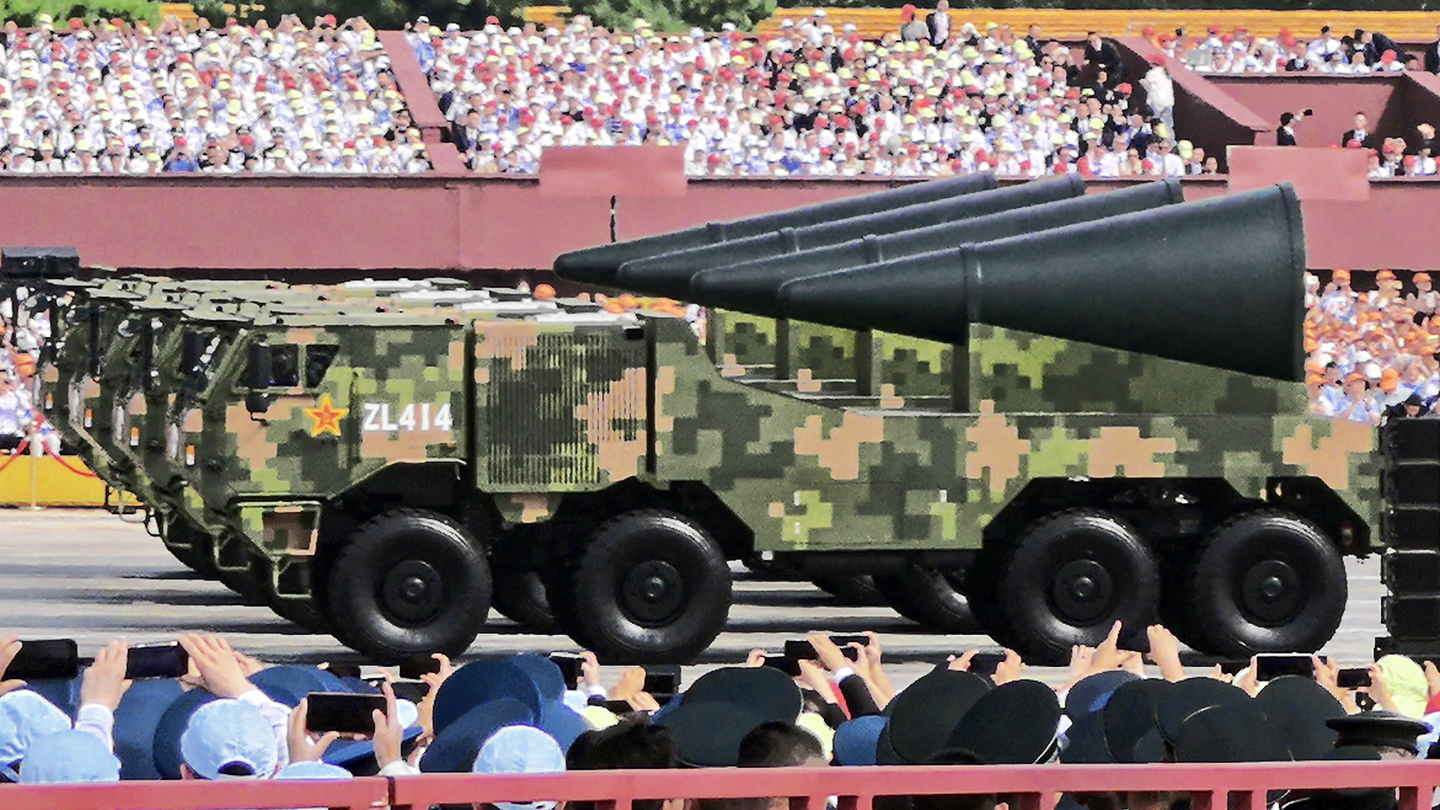
For years now, China has been engaged in a massive expansion of its nuclear arsenal, both in terms of warheads and delivery systems, something that was showcased at a military parade in Beijing last September. This has included the construction of huge new fields of silos for intercontinental ballistic missiles and work on a system that involves launching a nuclear-capable hypersonic glide vehicle into orbit, among other new capabilities. The U.S. government has assessed that the Chinese have around 600 warheads in their stockpile at present, but that this number is on track to grow to 1,000 by 2030 and to 1,500 by 2035.
It should also be pointed out that the United States and Russia are both generally assessed to have roughly 4,000 warheads each. The U.S. figure has been declining in recent years, while the Russian one has been growing, according to the Federation of American Scientists (FAS) think tank in Washington, D.C.
As noted, successive U.S. administrations have been pushing for a new nuclear arms control regime that includes China. Negotiations in the past have focused more heavily on bilateral agreements with Russia, and the Soviet Union before it. The most recent of these deals, New START, expired as scheduled yesterday, following the conclusion of a one-time five-year extension. There are still unconfirmed reports that the U.S. and Russia may be working on an interim and non-legally-binding arrangement to keep the New START limits at least for some amount of time, as you can read more about here.
“New START was signed in 2010 and its limits on warheads and launchers are no longer relevant in 2026, when one nuclear power is expanding its arsenal at a scale and pace not seen in over half a century and another continues to maintain and develop a vast range of nuclear systems unconstrained by New START’s terms,” Under Secretary DiNanno also said in remarks today. “[China’s] buildup is opaque and unconstrained by any arms control limitations.”
“Rather than extend ‘NEW START’ (A badly negotiated deal by the United States that, aside from everything else, is being grossly violated), we should have our Nuclear Experts work on a new, improved, and modernized Treaty that can last long into the future,” President Trump had written yesterday on his Truth Social platform.
“The President’s been clear in the past that in order to have true arms control in the 21st century, it’s impossible to do something that doesn’t include China because of their vast and rapidly growing stockpile,” U.S. Secretary of State and acting National Security Advisor Marco Rubio also said during a press conference on Wednesday in response to a question about New START.
Chinese officials have repeatedly rebuffed calls to join negotiations on a new nuclear arms control agreement.
The allegations Under Secretary DiNanno raised today prompt new questions about the future of U.S. nuclear testing, as well. As mentioned, there has been little elaboration on exactly what President Trump meant by his announcement last year about future testing “on an equal basis” with Russia and China. At that time, U.S. Secretary of Energy Chris Wright had downplayed the possibility of a resumption of American yield-producing nuclear tests.
“Since the President’s statement, we have received many questions about what he meant,” DiNanno said during his speech in Geneva today, before diving into the accusations about Chinese and Russian tests. However, the Under Secretary did not explicitly say whether or not this meant the United States intends to conduct its own testing at this level going forward. He did say later on in his remarks that the U.S. government is committed to efforts to “restore responsible behavior when it comes to nuclear testing.”
You can read more about what it would actually take for the U.S. government to resume full-scale nuclear testing in this previous TWZ feature.
The end of New START has already been fueling renewed concerns about a new nuclear arms race, and one that would not necessarily be limited to the United States, Russia, and China.
Following today’s revelations in Geneva, more details at least about the new U.S. allegations about Chinese nuclear testing activities may begin to emerge.
Update: 1:50 PM EST –
In light of today’s remarks from Under Secretary DiNanno, the Comprehensive Nuclear-Test-Ban Treaty Organization’s (CTBTO) Executive Secretary Robert Floyd has issued a statement.
”The CTBTO’s International Monitoring System (IMS) is capable of detecting nuclear test explosions with a yield equivalent to or greater than approximately 500 tonnes of TNT, including detecting all six tests conducted and declared by the DPRK [North Korea]. Below 500 tonnes is roughly 3 percent of the yield of the explosion that devastated Hiroshima,” Floyd says. “Mechanisms which could address smaller explosions are provided by the Treaty but can only be used once the Comprehensive Nuclear-Test-Ban Treaty enters into force. That is why it is important that the nuclear arms control framework includes the entry into force of the CTBT. The need is more urgent now than ever.”
“Regarding reports of possible nuclear tests with yields in the hundreds of tonnes, on 22 June 2020, the CTBTO’s IMS did not detect any event consistent with the characteristics of a nuclear weapon test explosion at that time. Subsequent, more detailed analyses have not altered that determination,” he adds. “Any nuclear test explosion, by any state, is of deepest concern.”
Contact the author: joe@twz.com
Loading comments…
Comments couldn’t be loaded. Please refresh the page.