
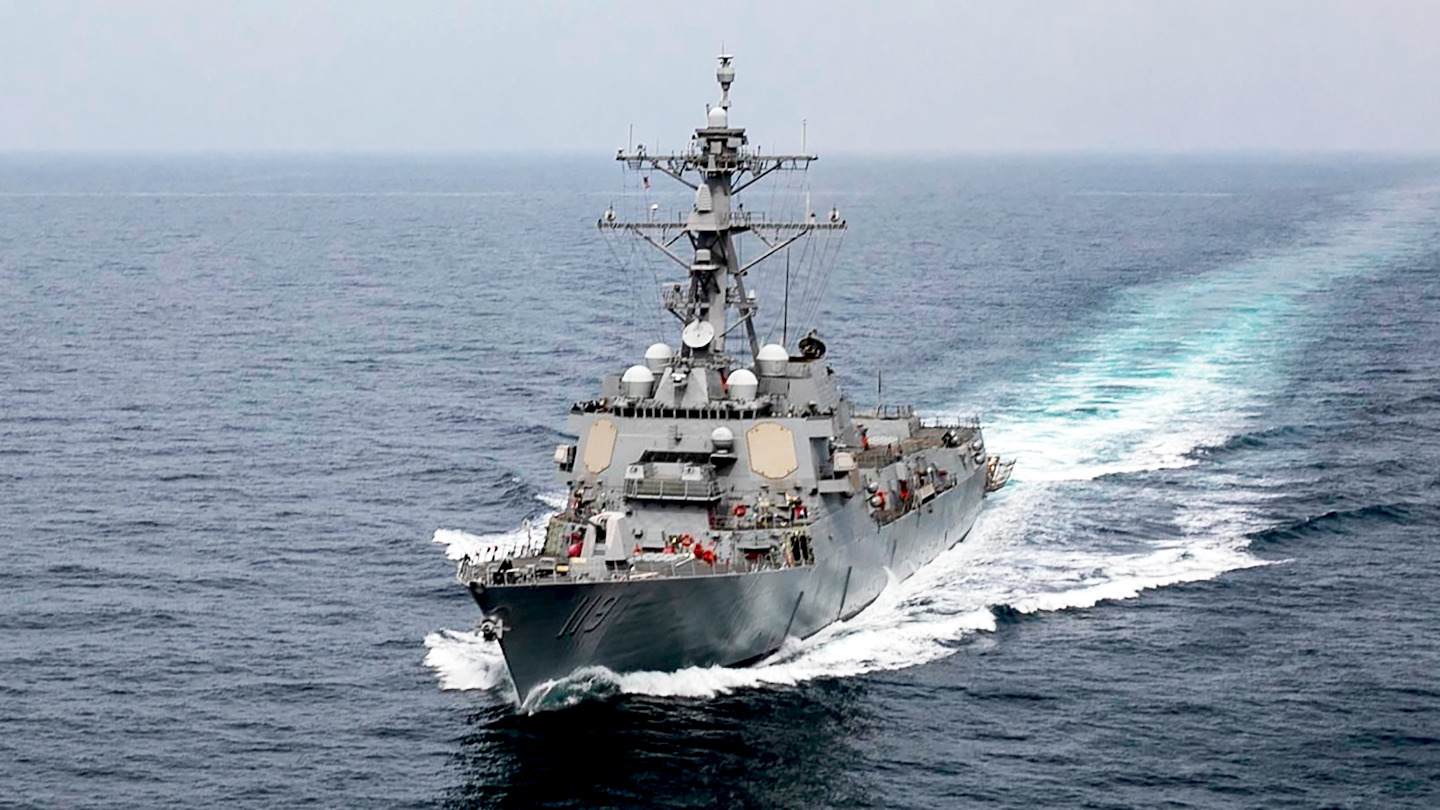
As U.S. President Donald Trump is again touting a “massive armada” of ships heading to the Middle East amid growing tensions with Iran, more assets continue to pour into the region, including an electronic intelligence collection plane, which would be critical to addressing a range on contingencies, and another destroyer. Meanwhile, Secretary of State Marco Rubio testified before the Senate that U.S. forces are needed in case of a potential attack from Iran and that the administration does not know what will happen next if the government of Ayatollah Ali Khamenei falls.
You can catch up with our most recent coverage of events in the Middle East here.
“A massive Armada is heading to Iran,” Trump stated Wednesday morning in a post on his Truth Social platform, referring to the USS Abraham Lincoln Carrier Strike Group (CSG). “It is moving quickly, with great power, enthusiasm, and purpose. It is a larger fleet, headed by the great Aircraft Carrier Abraham Lincoln, than that sent to Venezuela. Like with Venezuela, it is ready, willing, and able to rapidly fulfill its mission, with speed and violence, if necessary.”
It remains unclear what Trump meant by a larger fleet. A Navy spokesman confirmed to us Wednesday morning that the Lincoln and three Arleigh Burke class guided missile destroyer escorts are now in the CENTCOM region. That’s the same number of ships the Gerald R. Ford CSG deployed with to the Caribbean ahead of the Maduro capture.
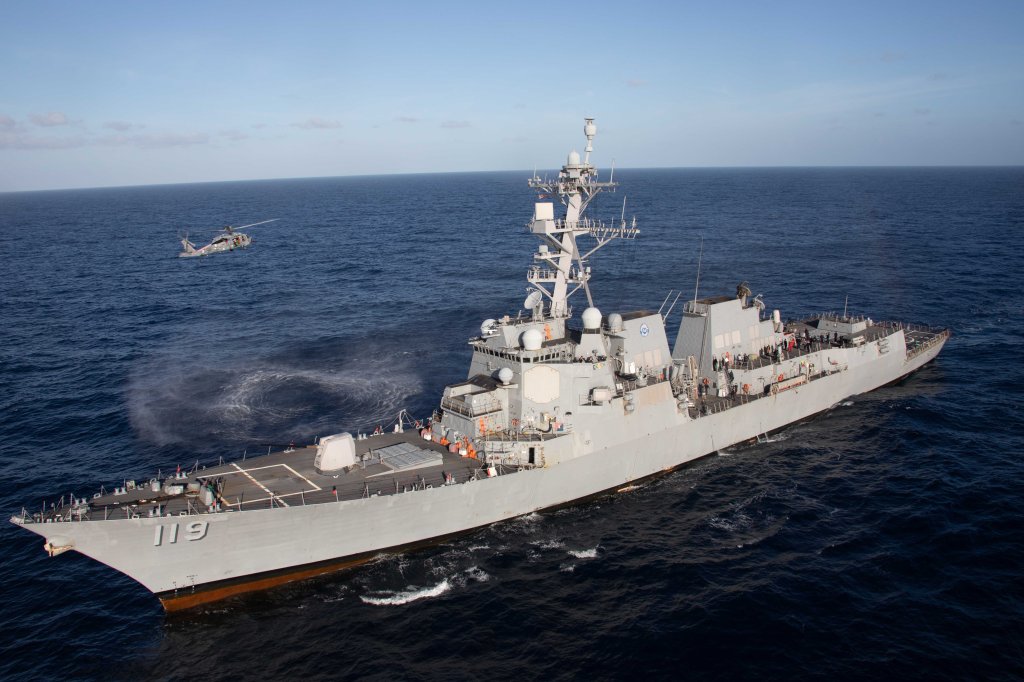
All told, the Navy now has 10 warships in the CENTCOM area of responsibility (AOR). The Arleigh Burke class guided missile destroyer USS Delbert D. Black just joined that force, a Navy official told us.
A destroyer would provide picket defense against missiles and drones, as well as standoff call strike capabilities. This is something especially important in that part of the Middle East right now since the Houthi rebels of Yemen have threatened to attack U.S. and Israeli targets should Iran come under fire.
By comparison, there are 12 warships in the Caribbean, the official explained. That force, along with a number of destroyers and carrier USS Gerald R. Ford, includes the Iwo Jima Amphibious Readiness Group (ARG)/22nd Marine Expeditionary Unit (MEU) made up of three amphibious assault vessels, and a Ticonderoga class guided missile cruiser. In addition, the Ocean Trader, a special operations mothership, was also plying those waters. It’s also worth noting that CSGs deploy with at least one fast attack submarine that isn’t usually disclosed.
When we asked for more details about Trump’s claim, the White House referred us to the Truth Social post, and CENTCOM referred us to the White House.
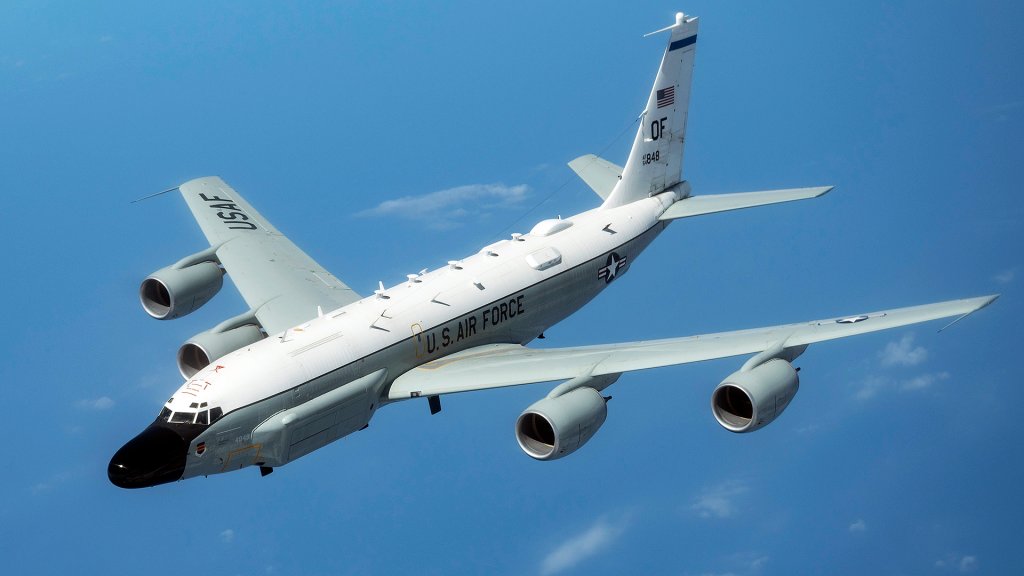
While the Navy’s deployments are getting a lot of attention, a U.S. Air Force RC-135V Rivet Joint electronic surveillance plane has flown to Al Udeid Air Base in Qatar, according to online flight trackers. The aircraft, callsign Olive48, arrived at Al Udeid on Wednesday morning Eastern time, according to FlightRadar24.
The Rivet Joint departed from Offutt Air Force Base in Nebraska and stopped at RAF Mildenhall before arriving at Al Udeid.
The RC-135 is one of America’s most capable intelligence-gathering assets. Each airliner-sized jet contains a large array of signals intelligence (SIGINT) systems that detect and intercept communications and other electronic emissions. The aircraft can also geolocate and categorize the emitters sending out those signals, from radios to radars. The RC-135s are often used to build a electronic order of battle of an adversary nation, locating their air defenses and command and control nodes, as well as intercepting communications as to how they respond to various stimuli or just during mundane operations. This information is critical to building an effective war plan and it needs to be updated just prior to launching an operation. It is also very important for defensive monitoring and understanding an enemy’s intentions and the status of its military at any given time.
Rivet Joint deployments happen around the globe regularly, including to the Middle East. In November, a U.S. official confirmed to us that one of these jets had been deployed to the U.S. Southern Command region “testing Venezuelan sensors and responses, and it is part of the pressure campaign to show U.S. capabilities in the Caribbean.” This matched our prior analysis as to their presence there. The information gathered would have played a key role in the effective capture of Maduro.
We’ve reached out to CENTCOM and the 55th Wing at Offutt, which operates the Rivet Joints, for comment.
There are also indications that other unique airborne capabilities may be headed to the Middle East.
Flight trackers are showing that an E-11A Battlefield Airborne Communications Node (BACN) jet is heading to Souda Air Base in Crete, a common route for deployments to the Middle East. While we have no confirmation of where this jet might go next, a move to the Middle East ahead of a potential conflict makes sense. E-11As are highly specialized communications gateway nodes designed to create an ‘active net’ over the battlespace and quickly transfer data sent using a variety of distinct waveforms between different aerial platforms and forces on the ground/surface. With these capabilities, the aircraft can also serve as valuable communications relay nodes. You can find out more about BACN and its history in this past War Zone feature. It’s also worth mentioning the BACNs spent many years exclusively deployed to the Middle East during the Global War on Terror.
In addition, it appears six U.S. Navy E/A-18G Growlers electronic warfare jets have departed from their assignment to the Caribbean and are headed east across the Atlantic, potentially for deployment to the Middle East. Again we have no confirmation of why the jets are making this flight.
The EA-18Gs in the Middle East would be critical force multipliers. Such a deployment could be indicative of what one would see in the lead-up to a kinetic operation centered heavily on strikes on targets in inland areas, such as ones the U.S. and possibly Israel might carry out in Iran in the future. Growlers can provide electronic warfare support for standoff munitions and/or aircraft penetrating into enemy air defenses, among other battlefield effects.
There are also signs that HC-130J Combat King II combat search and rescue (CSAR) planes are moving toward the Middle East, another indication that Trump could be considering airstrikes inside Iran. The aircraft would be needed for rapid rescues of any aircrews that are lost during military operations, specifically over contested territory. They can also support special operations aircraft with aerial refueling for non personnel recovery missions.
As we have previously reported, at least a dozen additional F-15E Strike Eagle fighters were recently deployed to Muwaffaq Salti Air Base in Jordan. Aerial refueling tankers have also trickled into the Middle East. Other tactical jets remain in the region, including A-10s. But despite the potential presence of the Growlers and the movements of the F-15Es, there has still been no mass influx of USAF tactical airpower into the Middle East. This is something we would likely see if the U.S. intends to execute a sustained campaign, even if limited in scope, against Iran. This points to a more limited operation, unless Israel steps in to provide its tactical fighter force in a joint operation. It’s also very possible that these assets will deploy in the coming days.
In addition, online flight tracking indicates the movement of new air and missile defense systems to the Middle East as well. As we predicted, the U.S. is sending additional Patriot and Terminal High Altitude Area Defense (THAAD) systems to the Middle East for increased protection from any Iranian attack, The Wall Street Journal reported.
Amid the U.S. buildup, Rubio offered some insights about why this is happening.
“On the issue of our presence in the region, here’s the baseline I want to set for everybody,” Rubio said during his testimony to the Senate in a hearing on the situation in Venezuela. “The baseline is this: we have 30,000 to 40,000 American troops stationed across eight or nine facilities in that region. All are within the reach…of an array of thousands of Iranian one-way UAVs and Iranian short-range ballistic missiles that threaten our troop presence.”
“We have to have enough force and power in the region just on a baseline to defend against the possibility that at some point, as a result of something, the Iranian regime decides to strike at our troop presence in the region,” he added. “The president always reserves the preemptive defensive option. In essence, if we have indications that, in fact, they’re going to attack our troops in the region, to defend our personnel in the region.”
In addition, Rubio noted that “we also have security agreements, the defense of Israel plan, and others that require a force posture in the region to defend against that. And so I think it’s wise and prudent to have a force posture within the region that could respond and potentially, not necessarily what’s going to happen, but if necessary, preemptively, prevent the attack against thousands of American servicemen and other facilities in the region and our allies.”
The U.S. Secretary of State also noted that at least thousands of protesters have been killed by government forces during the unrest that began in Iran on Dec. 28. The uprising occurred due to rising prices and devalued currency that saw the rial crater now to basically nothing, as well as a devastating drought, and ongoing harsh treatment from the regime.
While Trump has previously stated that Iran needs new leadership, Rubio testified that what happens should Khamenei fall is unknown.
“That’s an open question,” Rubio responded to a question about who would lead Iran next. “No one knows what would take over. Obviously, their system is divided between the supreme leader and the IRGC that responds directly to him. And then you’ve got these quasi-elected individuals, the ones that wear the suits on television, who are part of their political branches, but ultimately have to run everything they do by the Supreme Leader. So I don’t think anyone can give you a simple answer as to what happens next in Iran if the Supreme Leader and the regime were to fall.”
In his Trump Social post on Wednesday, the president issued one of his most serious threats against Iran to date. The American leader, who began his recent round of warnings to Ayatollah Ali Khamenei in the wake of the regime’s deadly crackdown on anti-government protesters, is also pressuring Iran to end its nuclear weapons program.
“Hopefully Iran will quickly “Come to the Table” and negotiate a fair and equitable deal – NO NUCLEAR WEAPONS – one that is good for all parties,” Trump proclaimed. “Time is running out, it is truly of the essence! As I told Iran once before, MAKE A DEAL! They didn’t, and there was “Operation Midnight Hammer,” a major destruction of Iran. The next attack will be far worse! Don’t make that happen again…”
Trump was referring to the attack last June on Iranian nuclear facilities.
The American president gave no specifics about the deal he was demanding, “but U.S. and European officials say that in talks, they have put three demands in front of the Iranians: a permanent end to all enrichment of uranium, limits on the range and number of their ballistic missiles, and an end to all support for proxy groups in the Middle East, including Hamas, Hezbollah and the Houthis operating in Yemen,” The New York Times reported on Wednesday.
“Notably absent from those demands — and from Mr. Trump’s post on Truth Social on Wednesday morning — was any reference to protecting the protesters who took to the streets in Iran in December, convulsing the country and creating the latest crisis for its government. Mr. Trump had promised, in past social media posts, to come to their aid, but has barely mentioned them in recent weeks.”
Iran, for its part, said there are no direct negotiations underway.
Iran’s Foreign Minister Abbas Araqchi said he had not been in contact with U.S. special envoy Steve Witkoff in recent days or requested negotiations, Reuters reported on Wednesday, citing Iranian media.
“There was no contact between me and Witkoff in recent days and no request for negotiations was made from us,” Araqchi told state media, adding that various intermediaries were “holding consultations” and “were in contact with Tehran.”
“Our stance is clear, ” he added. “Negotiations don’t go along with threats and talks can only take place when there are no longer menaces and excessive demands.”
Still, there are backchannel talks taking place, according to the official Iranian IRNA News Agency.
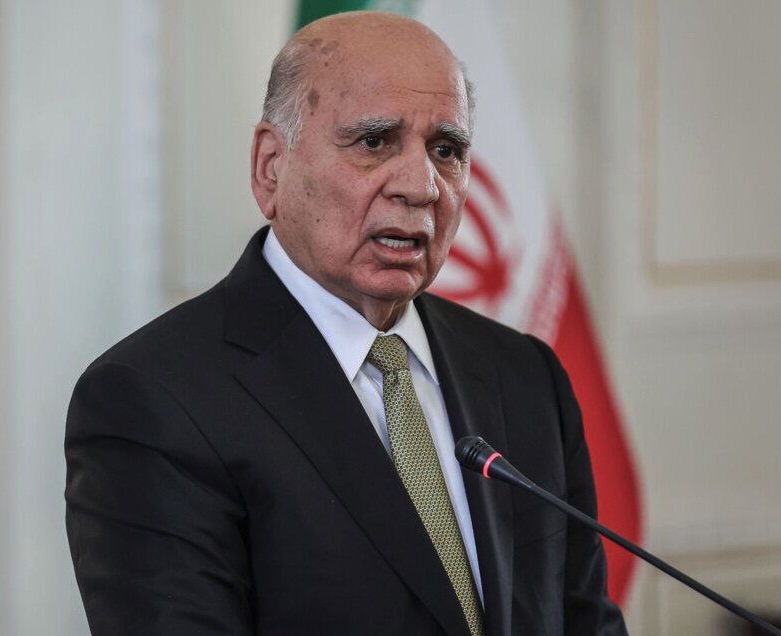
“Iraqi Foreign Minister Fuad Hussein says Iran has announced its readiness for dialogue with the United States, but it has yet to receive any response from Washington,” according to IRNA. “Speaking with Rudaw, a Kurdish digital news network based in Iraq’s Kurdistan region, the foreign minister said late on Tuesday that messages are exchanged between Iran and the US, but no meeting has been held yet.”
“The main problem is that there is no direct communication,” Hussein said, adding that messages are exchanged without holding a meeting, which complicates the situation. “If a decision is made to hold a meeting, Iraq would be able to play a role, but the U.S. has yet to decide if it would hold discussions.”
Wary Israeli officials, who are preparing for an attack on or from Iran, are closely monitoring these unofficial talks, according to the Jerusalem Post.
“Israel is assessing reports that the United States and Iran are holding discreet contacts and that Washington has presented preconditions for possible negotiations on a new nuclear agreement,” the Post reported. “Israeli officials have expressed concern over the possibility of an agreement they view as unfavorable.”
Likely to participate in any strike against Iran, Israel was once again the target of Tehran’s wrath.
Ali Shamkhani, an advisor to Iranian Supreme Leader Ali Khamenei, threatened strikes on Israel if the U.S .attacks Iran.
“The limited strike is an illusion,” he said, according to Israel National News. “Any military action by America, from any source and at any level, will be considered the beginning of war, and the response to it will be immediate, comprehensive, and unprecedented, targeting the aggressor, the heart of Tel Aviv, and everyone who supports the aggressor.”
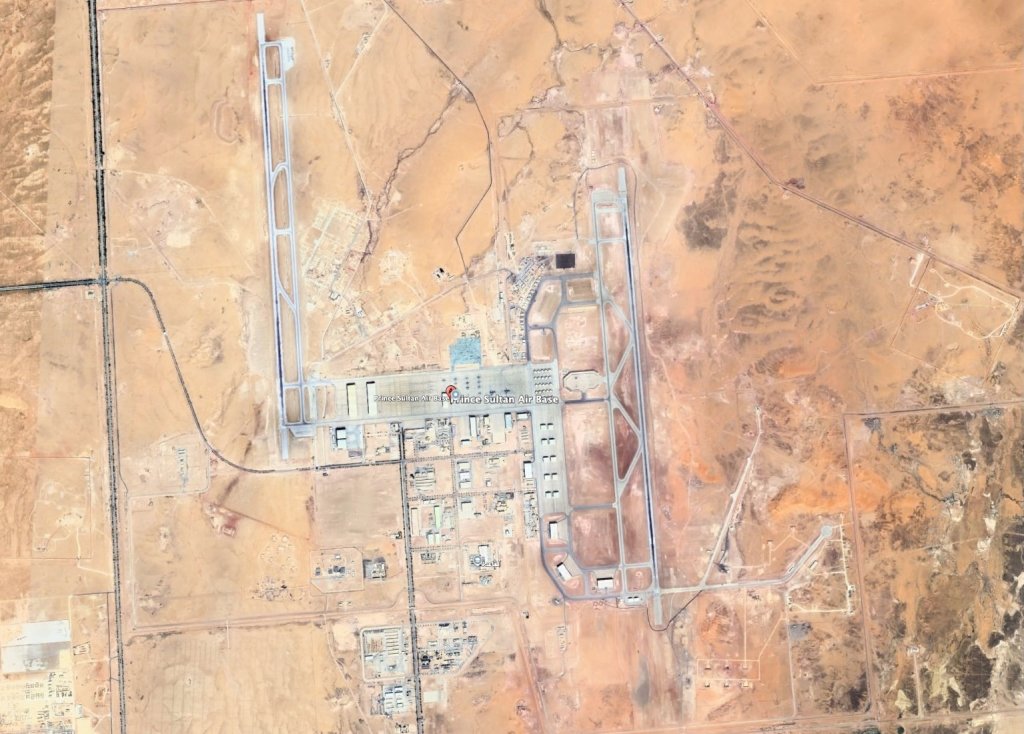
Should a conflict between the U.S. and Iran break out, two key regional allies have said they won’t be involved. Saudi Arabia on Tuesday said it would not allow the U.S. to use its facilities or airspace to attack Iran. That follows a similar statement made by the United Arab Emirates (UAE).
These public statements could be strictly aimed at internal audiences that might not favor involvement in an attack on another Muslim nation, especially involving Israel. They could also be to deter Iran from barraging their territory in retaliation to an attack. However, if Saudi Arabia and the UAE are serious about their reticence, it would affect U.S. basing in those countries, limiting Trump’s options to attack Iran. There are other bases in the region, like Al Udeid in Qatar, Muwaffaq Salti in Jordan, and Naval Support Activity (NSA) Bahrain, among others. Still, any reduction in facilities to store and launch aircraft makes any strike more challenging and potentially increases the risk to host countries from Iranian missiles and drones. Taking airspace over Saudi Arabia and the UAE out of the picture also reduces the vectors from which the U.S. can launch attacks from the Gulf region, limiting them to a narrower set of funnels. This is also why the carrier strike group is so important.
Meanwhile, NATO ally Turkey urged Trump not to attack Iran.
“It’s wrong to attack on Iran, it’s wrong to start the war again. Iran is ready to negotiate on nuclear file again,” said Turkish Foreign Minister Hakan Fidan.”My advice to the American friends: close the files one by one with Iranians. Start with nuclear, close it, and not get it as a package. If you put them as a package, it will be very difficult for our Iranian friends to digest and to go through this. It might seem humiliating for them and difficult to explain to the leadership. If we can make things better tolerated, it would help.”
German Chancellor Friedrich Merz, on the other hand, said the Iranian regime’s days are numbered.
Despite the Iranian regime’s crackdown, the protests appear to be ongoing. A new video emerged showing a large demonstration in Tehran, calling for the end of the regime.
As the pressure mounts against Khamenei, a video emerged purporting to show an inside view of his compound, something observers say they’ve never seen before.
So far, there are just harsh words being exchanged in the Middle East, not munitions. However, the warning lights are blinking hot that a conflict could soon break out, something we will continue to monitor closely.
Update: 9:46 PM Eastern –
Trump is now considering options that “include U.S. military airstrikes aimed at Iran’s leaders and the security officials believed to be responsible for the killings, as well as strikes on Iranian nuclear sites and government institutions,” CNN reported, citing sources. “Trump has not made a final decision on how to proceed, sources said, but he believes his military options have been expanded from earlier this month now that a US carrier strike group is in the region.”
Contact the author: howard@thewarzone.com
Loading comments…
Comments couldn’t be loaded. Please refresh the page.