

The Trump administration’s goal for the ongoing enhanced narcotics mission in the Caribbean also aimed at Venezuelan dictator Nicolas Maduro, remains unclear. Strikes on the South American nation appear to be off the table for now, but other options reportedly remain. Regardless, the U.S. military presence in the region, and the interdiction campaign it’s executing, may still grow further.
You can catch up with our previous coverage about the Caribbean operation here.
“There are site surveys ongoing to see if more military assets should be sent to the region,” a U.S. official told The War Zone Friday morning. The official offered no details about what kinds of equipment or a timeline for a decision. We reached out to the Pentagon for more details and will update this story with any pertinent information provided.
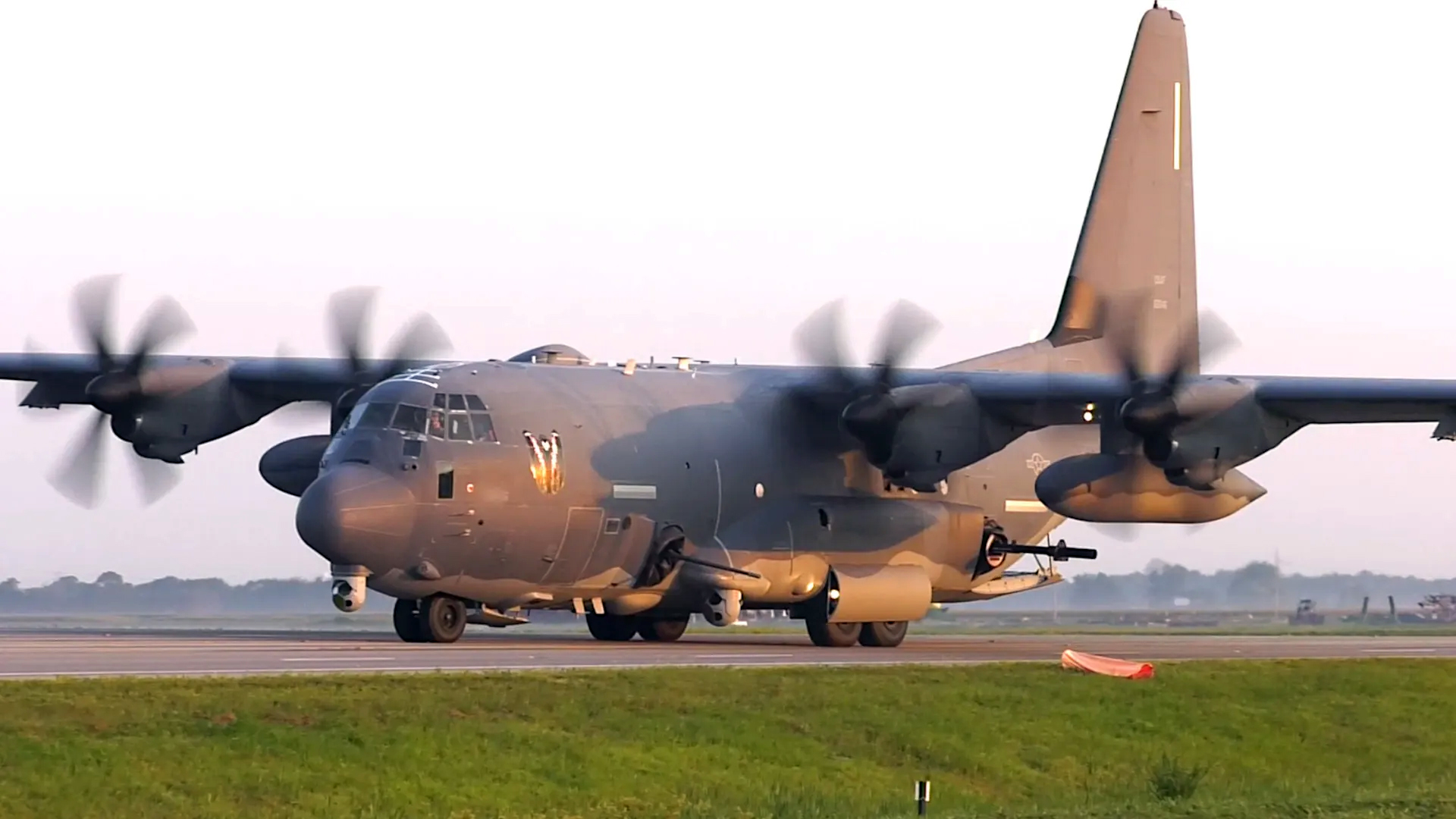
Meanwhile, the U.S. footprint in the region has expanded. There are at least three U.S. military planes in El Salvador, including an AC-130 Ghostrider gunship, according to The New York Times and open source investigators.
“Along with the Ghostrider gunship, there is also a Navy P-8A reconnaissance plane,” the Times added.
“A third military aircraft, the unmarked C-40 Clipper, has been at the base since mid-October. Little is known about its purpose, but flight-tracking data has shown it occasionally flying with surveillance aircraft. It is rarely spotted in public and its deployment to El Salvador, especially alongside an attack plane, is highly unusual.”
The P-8 Poseidon is the most advanced maritime patrol aircraft (MPA) in the world and is specifically capable of collecting multiple types of intelligence to find small targets in vast bodies of water. With this in mind, the AC-130 and P-8 could be working in a hunter-killer capacity, with the P-8 finding targets and the AC-130 stalking and destroying them. Several weeks ago, we suggested that video of at least one of the strikes showed the telltale signs of having been conducted by an AC-130.
Asked if the Ghostriders have taken part in any of the attacks on suspected drug boats, which you can read more about later in this story, the Pentagon provided the following statement: “We won’t go into details on targeting and weaponeering of the kinetic strikes as that information is not shared under operations security measures.”

C-40s typically work as transports, with some taking on VIP airlift roles. That aircraft in particular is of unique interest, although what its role would be for interdiction operations is unclear.
Regardless of the buildup in the region, it does not appear that an attack on Venezuela is imminent. As we highlighted yesterday, CNN reported that the administration has decided, for now, not to carry out land strikes against Venezuela. The decision is over concerns that there was no legal justification for such attacks. However, on Thursday afternoon, the U.S. Senate rejected a bipartisan war powers resolution that would have blocked the use of the U.S. Armed Forces to engage in hostilities within or against Venezuela, unless authorized by Congress.
While the administration continues to mull its options about striking targets inside Venezuela, it has no qualms about blowing up suspected drug boats. Late last night, War Secretary Pete Hegseth announced on X that the U.S. conducted another such mission, destroying the vessel and killing the three people on board. That was at least the 17th kinetic strike on these boats, which have resulted in more than 60 deaths.
The boat strikes have been criticized for being extrajudicial attacks without Congressional authorization. The administration has justified the strikes by declaring drug cartels to be “ unlawful combatants,” and U.S. President Donald Trump has said each sunken boat has saved 25,000 American lives, presumably from overdoses. The boats, however, “appear to have been transporting cocaine, not the far more deadly synthetic opioids that kill tens of thousands of Americans each year,” The Associated Press reported on Friday.
Meanwhile, the aircraft carrier USS Gerald R. Ford appears to be back on the move. The vessel had been holding off the coast of North Africa for two days after transiting the Strait of Gibraltar on Nov. 4.
The Ford’s exact position now is unclear. A U.S. defense official told us that it “is in the North Atlantic, not in the vicinity of the Strait of Gibraltar.” Asked about the ship’s destination, the Pentagon referred us to spokesman Sean Parnell’s Oct. 24 announcement that it was ordered to the Caribbean.
The flattop is currently operating with three of its escort ships, the Arleigh Burke class guided missile destroyers USS Bainbridge, USS Mahan and USS Winston Churchill, the official added. Two other Arleigh Burke class destroyers assigned to the Ford Carrier Strike Group – the USS Forrest Sherman and USS Mitscher – are still operating in the Red Sea.
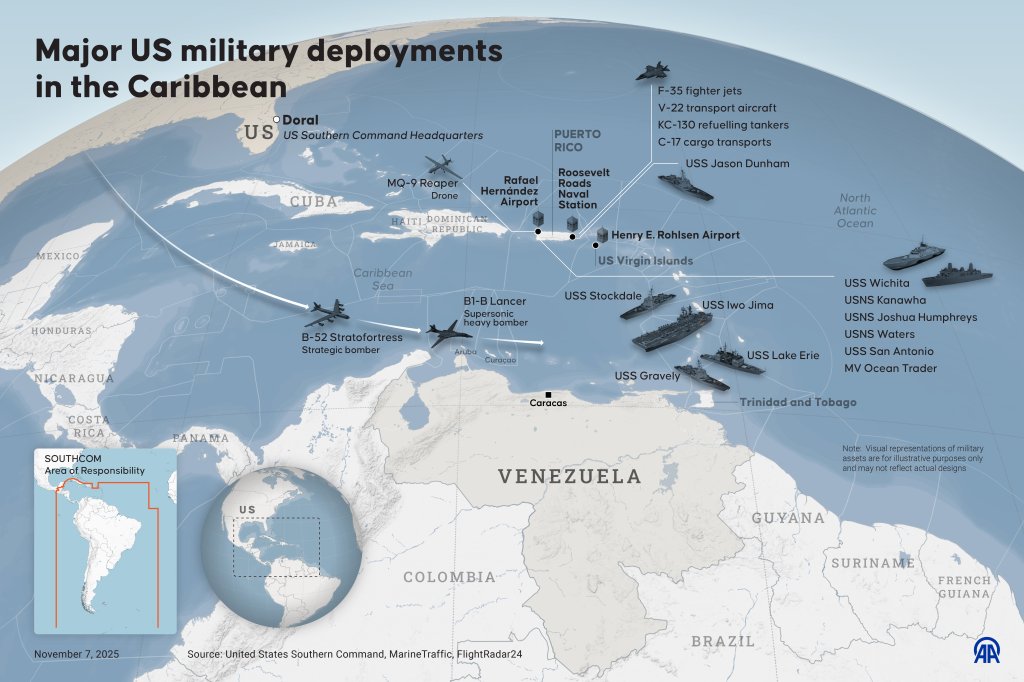
In addition to those movements, the Arleigh Burke class guided missile destroyer Jason Dunham has left the Caribbean and is now near Virginia, the official said. That leaves eight surface vessels, a nuclear fast attack submarine and a special operations mothership in the region. Adm Alvin Holsey, the commander of U.S. Southern Command (SOUTHCOM), is in the area and recently visited one of those vessels, the Wasp class amphibious assault ship, the USS Iwo Jima.
There are also F-35B stealth fighters, airlifters, MQ-9 Reaper drones, the aforementioned AC-130 gunships, among other aerial assets, and more than 10,000 troops arrayed around the Caribbean.
Amid all the U.S. military’s moves, Moscow is ready to consider providing Maduro with assistance, Russian Foreign Ministry spokesperson Maria Zakharova said on Friday during a press briefing. The two nations recently ratified a mutual aid pact.
“Russia maintains contact with the leadership of Venezuela amid rising tensions in the Caribbean Sea and is ready to respond to Caracas’ requests,” the official Russian RIA Novosti news outlet reported.
“On Friday, Moscow confirmed it would consider Caracas’s request for critical support—including repairs to Russian‑made fighter jets, upgrades to radar systems, and the delivery of missile units,” Newsweek noted. Zakharova also requested that all parties refrain from escalatory actions.
Zakharova’s comments come three days after a top Russian lawmaker said Moscow had recently sent Venezuela air defense systems and could provide ballistic and cruise missiles in the future.
“Russian Pantsir-S1 and Buk-M2E systems were just recently delivered to Caracas by Il-76 transport aircraft,” Alexei Zhuravlev, First Deputy Chairman of the State Duma Defense Committee, told Gazeta.Ru earlier this week. “I also see no obstacles to supplying a friendly country with new developments like the Oreshnik or, say, the proven Kalibr missiles; at least, no international obligations restrict Russia from doing so.” The War Zone cannot independently verify any of Zhuravlev’s claims.
Despite the increasing pressure against him, Maduro has tried to put on a brave face.
“14 weeks of threats, the gringos who have 15 ships, 2,600 missiles, who have the largest aircraft carrier called Gerald Ford,” the Venezuelan dictator recently exclaimed. “Let the gringos do whatever they want, we are unshakable.”
Saber-rattling and boasting aside, Maduro is open to leaving power in exchange for amnesty for him and his lieutenants, the lifting of the $50 million bounty on his head and a comfortable exile, according to claims in a report from The Atlantic on Thursday.
Throughout this enhanced counter-narcotics mission in the Caribbean, Trump has offered conflicting statements about his intentions. He has previously suggested strikes on ports and other facilities associated with narcotraffickers. However, he has also said he doubts there will be an attack but that Maduro must go. Regardless, there appears to be no halt in the buildup of the U.S. military presence in the region.
Contact the author: howard@thewarzone.com
Loading comments…
Comments couldn’t be loaded. Please refresh the page.