

For nearly four weeks now, a very stealthy high-altitude, long-endurance (HALE) surveillance and reconnaissance drone commonly and unofficially referred to as the RQ-180, or an evolution thereof, has been seen flying around Larissa Air Base in Greece. New, remarkably detailed videos of the uncrewed aircraft that have recently spread on social media offer insights into its sensor package and other aspects of the design. Just yesterday, TWZ also published an in-depth feature exploring the likely role of the ‘RQ-180’ in the ongoing conflict in Iran and how it ties to a secret Cold War drone program that was, in many ways, its progenitor.
The very large and very stealthy flying wing-type drone was first spotted in the skies around Larissa Air Base, also known as Larissa National Airport, in the city of the same name in Greece, back on March 18. Local spotter Efthymios Siakaras shared two new video clips offering especially good views of the uncrewed aircraft in flight, one on Sunday and another on Monday, which our friends over at The Aviationist were first to report on. Similar to the stealthy RQ-170 Sentinel being dubbed the “Beast of Kandahar” after it was first spotted in Afghanistan in the late 2000s, many are now also calling this drone the “Lady of Larissa.”
Of the features visible in the latest footage of the Lady of Larissa, the most notable are a pair of large electro-optical sensor apertures underneath its central fuselage, right behind the main landing gear bay. The two windows are noticeably angled to the left and right. Behind those transparencies would be a large multi-spectral sensor system that can look down to the ground below and out at long slant angles towards the horizon from the aircraft’s very high perch. By having one window on each side, the RQ-180 could run racetrack patterns some distance from its target while providing continuous coverage. If a sensor is housed under each window, it could collect intelligence over much larger swathes of terrain at any given time.
As TWZ has noted for years, the RQ-180 would, with near certainty, carry a powerful radar with ground moving target indicator (GMTI) and synthetic aperture radar (SAR) modes as its primary sensor, along with electronic intelligence collection capabilities. Optical camera systems were always another possibility, one that seems to have proven true now.
“At its most basic, GMTI allows battle managers to see the enemy’s ground movements in real-time and then quickly adapt their game plan to counter those enemy forces before they can ever attack, or even pose a threat to friendly forces. GMTI is also a critical capability for detecting changes in force posture, establishing patterns of enemy movements over time, and identifying new targets of interest. Modern GMTI products can also be looped into a ‘kill web’ for rapid targeting purposes.“
“Some of this is also achieved through the aforementioned SAR mode, which basically provides a satellite-like image of a target area using radar. It also has the ability to see some things optical systems cannot, and, like GMTI, it can work under nearly all atmospheric conditions, day or night. When paired with GMTI, SAR can be used to help positively identify targets, as well as gain better situational awareness about the targets being tracked.“

“Passive electronic intelligence collection that allows for radiofrequency-emitters to be quickly detected and geolocated via onboard antennas and interferometry-based computing is another part of the equation. Long-range optical sensors can also provide higher-fidelity intelligence and spot movements of infrared signatures over large areas. You can imagine how fusing all these capabilities together, combined with advanced networking, on a single platform could be incredibly potent. Basically, detecting a target or target group of interest, and then training advanced sensors on it to rapidly build up a high-quality understanding of what is going on and even to provide real-time targeting data to ‘shooters’ would be this aircraft’s bread and butter.“
The drone’s electro-optical system and radar, together with the rest of its sensor suite, could offer a secondary air-to-air surveillance capability, as well.
As an interesting aside, Scaled Composites’ Proteus high-altitude test aircraft has previously been seen flying with an extremely similar-looking sensor suite with an oddly angled aperture housing. The high-flying Proteus has a long history of being used to test and evaluate new sensors and other advanced capabilities. Scaled Composites is also a wholly-owned subsidiary of Northrop Grumman, widely understood to be the prime contractor behind the RQ-180.
In addition, the underside of the drone’s central fuselage, which is where the main array for the aforementioned radar would go, has a very pronounced bulge. This would house a rotating radar or a two-sided one so that the aircraft can scan the same area while traveling in either direction. Supplemental conformal arrays, or even load-bearing ones, could also be positioned all around the aircraft, along with communications antennas, electronic warfare gear, and electronic surveillance measures hardware.
The new views of the drone flying around Larissa underscore just how widely positioned its tricycle landing gear is, along with its very broad wingspan. As we’ve noted previously, a landing gear configuration like this allows for a large volume for payload and good stability on the ground.
It is worth pointing out that there looks to be a foreign object debris (FOD) deflector fitted around the wheel of the nose landing gear. In general, the radar absorbent coatings and the composite skins of stealthy aircraft are very sensitive. What might look to be relatively minor surface damage at a casual glance can have significant negative impacts when it comes to radar cross-section, which is critical for the aircraft’s mission effectiveness and survival. From what we can see, the drone will be sitting very low on its gear when on the ground. This only increases the potential for foreign objects to get kicked up and hit its belly during takeoff and landing. This is especially true for the low-hanging ventral bulge where sensor apertures are, right behind the nose gear. So, this debris guard makes total sense.
The nose gear strut also has what is called a trailing link or trailing arm, a feature designed to help smooth the impact of landing.
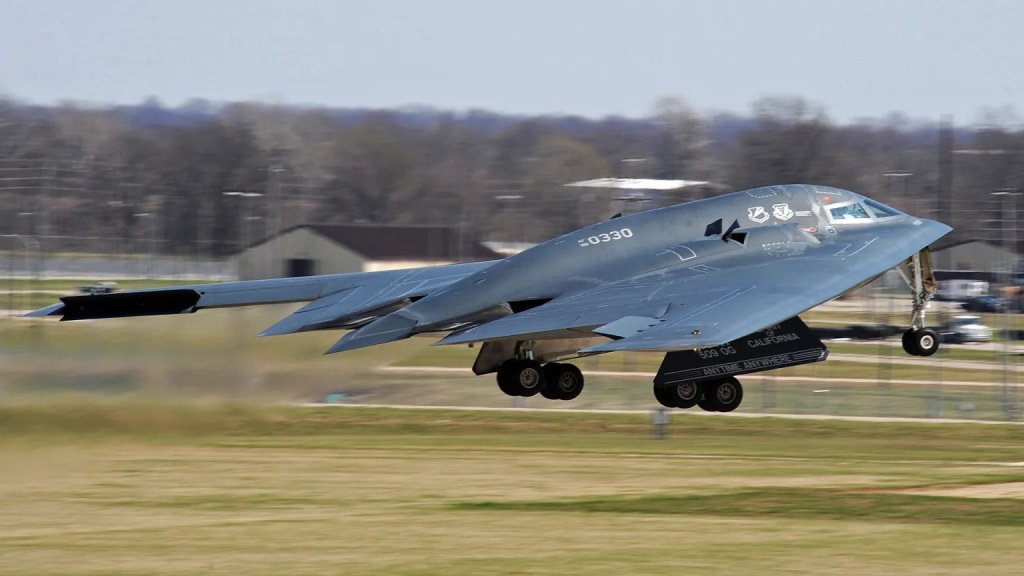
The trailing-link style nose landing gear otherwise has a two-wheel configuration very much in line with that of the B-21 Raider bomber, but in a scaled-down form. This is not all that much of a surprise, as the B-21 shares a general planform with the RQ-180. The Raider’s development was likely heavily influenced by the RQ-180, or a progenitor of the flying wing uncrewed aircraft we are seeing today.
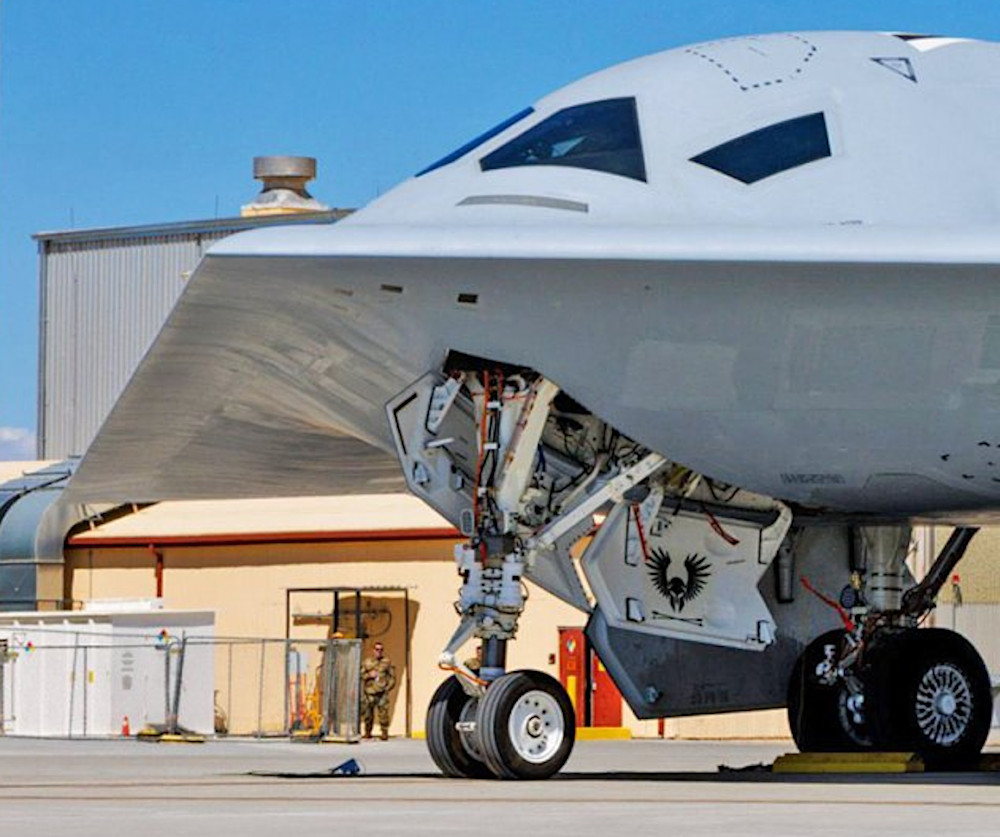
The drone’s main landing gear looks extremely similar to what is found on F-15 fighters. Borrowing existing, proven components for experimental or low-production aircraft like this is a time-honored tradition. The use of an F-15’s main landing gear points to a high gross takeoff weight. The maximum takeoff weight of the latest F-15EX variant is 81,000 pounds, according to Boeing, and the F-15 has a much smaller, single nose wheel. For comparison, the high-flying Global Hawk drone’s maximum takeoff weight is 32,250 pounds, per the U.S. Air Force, and it has distinctly less robust landing gear to match.
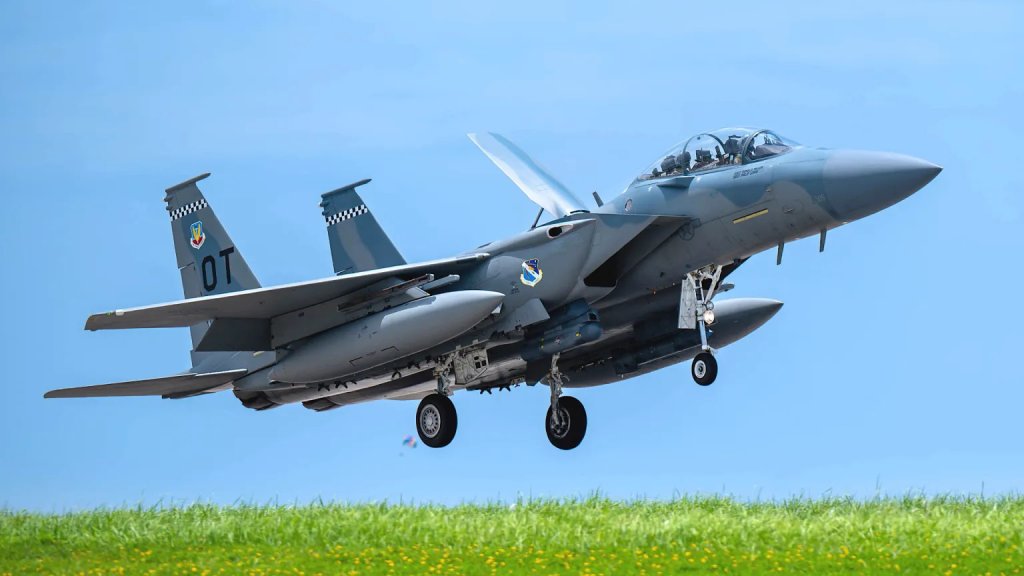
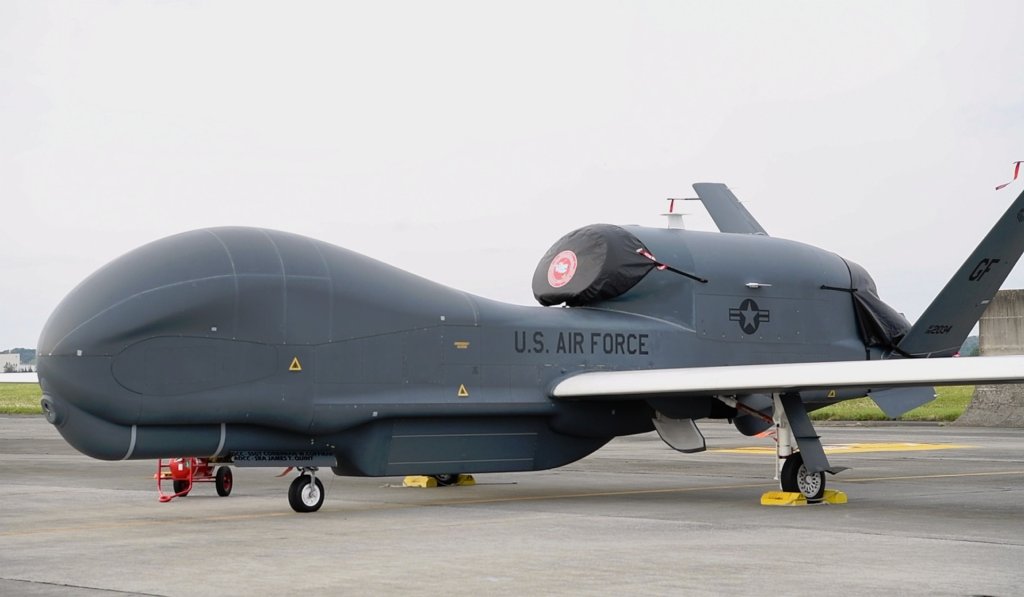
At the same time, the Lady of Larissa would not necessarily need to make use of all of that capacity, or it could even have a bit higher gross weight, and various additional factors could have influenced the choice of landing gear. The overall design is likely to be light for its overall size to maximize range, endurance, and high-altitude performance. With its reconnaissance and surveillance mission sets, there would be no need for a payload bay structure to carry heavy weapons. This, along with the lack of any need to support a crew, would allow the aircraft to be absolutely packed with fuel.
While its similarities to the B-21 are glaring, the Lady of Larissa is even more optimized for high-altitude flight than the Raider, which itself is a step beyond in altitude performance over the B-2. You can read all about this in our past feature here. The drone’s overall massive flying wing shape and its very clean, laminar flow-like sculpting, along with wings that look designed to allow the RQ-180 to loiter at relatively extreme altitudes, support its penetrating, persistent reconnaissance mission set.
Furthermore, the most recent videos of the Lady of Larissa offer new looks at the control surfaces in action. Like what is found on the B-21 and Northrop’s preceding B-2 Spirit bomber, the drone has flaperons along the trailing edges of the wings and along its diamond-like empennage. There may also be a central variable geometry ‘beaver tail’ section, something also found on the B-2, but not on the B-21, although this could just be the inboard flaps being slightly extended.
Much remains to be learned about the drone’s design and capabilities, as well as why it is operating out of Greece and how long it has used Larissa as a forward base. Why such a sensitive asset continues to be seen flying in the middle of the day is also curious. After the highly exotic uncrewed aircraft was first spotted at Larissa, reports said that it had landed there after experiencing some kind of technical issue, though this remains unconfirmed. The drone could have diverted there after taking off for a mission from another operating location, even one potentially inside the United States. All that being said, as we’ve noted in the past, Larissa does look to have unique facilities that seem very well suited for hosting an aircraft like this, and that were only built in recent years.
It may be that it simply has no place to hide any longer, and more flexibility is being exercised as to when it can and can’t depart and land from wherever it’s operating from. This could also mean the Pentagon may be more willing to acknowledge its existence in the not-so-distant future.
As mentioned at the start of this story, TWZ just yesterday laid out a detailed case for why the RQ-180 would be very relevant for helping hunt Iranian mobile missile launchers. That is a mission set that likely evolved from work on a previous secret Cold War-era stealthy drone program called the Advanced Airborne Reconnaissance System (AARS), also known by the codename Quartz. There are many other roles it could execute in relation to Operation Epic Fury, as well.
Overall, we have gotten our best look at the so-called RQ-180. We now know it is capable of radio-frequency and electro-optical sensing, and we have a bit better idea of its overall size and mass. This is a very large unmanned system that is smaller in size than the B-21, but far larger than RQ-170. A very cursory guess supports a wingspan of something on the order of 130 feet (possibly significantly larger), but again, that is just a guess. This aircraft is clearly optimized to fly at least at Global Hawk altitudes (upwards of 60,000 feet) and possibly higher, approaching that of the U-2, giving it a huge line of sight to target areas. Being such an efficient-looking design and being so large with so much internal volume, it likely measures its endurance in days, not hours.
The videos of the RQ-180 operating in the daytime also come as China is moving forward with its own very large unmanned stealth flying wing designs.
If the war with Iran continues, we will probably be seeing more of the Lady of Larissa, with its shyness appearing to be waning just a bit.
Contact the author: joe@twz.com
Loading comments…
Comments couldn’t be loaded. Please refresh the page.