
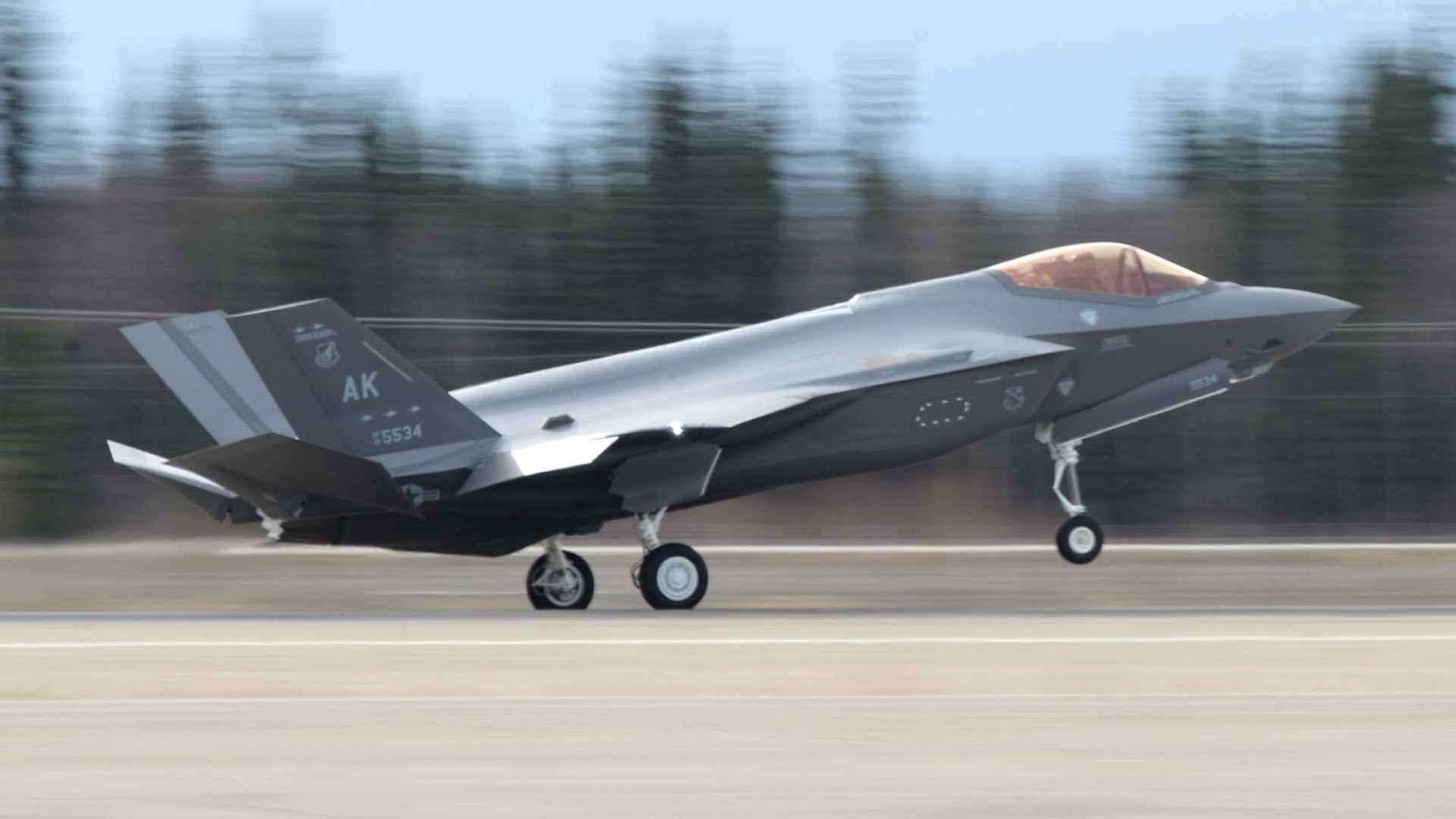
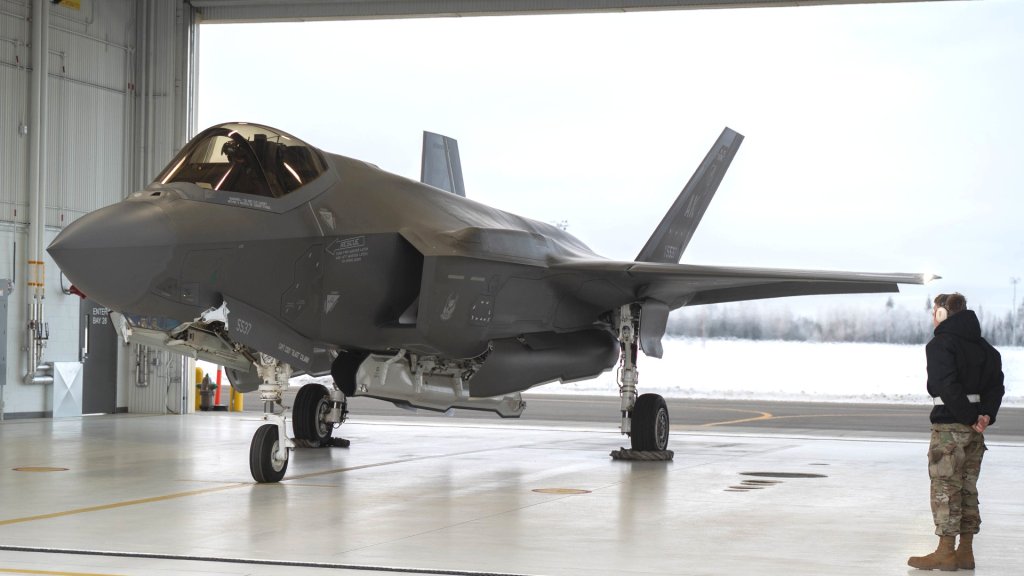
Ice buildup in the landing gear of a U.S. Air Force F-35A due to hydraulic fluid contaminated by water was the root cause of a crash at Eielson Air Force Base in Alaska in January, according to a recently released report on the mishap. The incident also highlights an automated ground-operation mode in the F-35’s avionics, which wrongly determined that the jet had landed while it was still airborne because of how the ice had impacted the landing gear struts.
Pacific Air Forces (PACAF) released an unclassified report yesterday on the mishap in question, which occurred back on Jan. 28. A video, seen below, showing the F-35A tumbling vertically into the ground and then bursting into a fireball, quickly went viral at the time. The pilot, assigned to Eielson’s 354th Fighter Wing, was able to eject and suffered minor injuries. The aircraft was a total loss, and the accident cost the Air Force approximately $196.5 million.
“After initial takeoff, the MA’s [mishap aircraft’s] nose landing gear (NLG) did not retract properly due to hydraulic fluid contaminated with water that froze, preventing full strut extension and resulting in the NLG being canted to the left. After running initial checklists, the NLG was still turned approximately 17 degrees to the left,” the report’s executive summary explains. “The MP [mishap pilot] initiated a conference call with Lockheed Martin engineers through the on-duty supervisor of flying (SOF). The MA held for approximately 50 minutes while the team developed a plan of action.”
The canted nose wheel made it unsafe to attempt an emergency barrier engagement landing using the arresting gear installed of the main runway at Eielson.
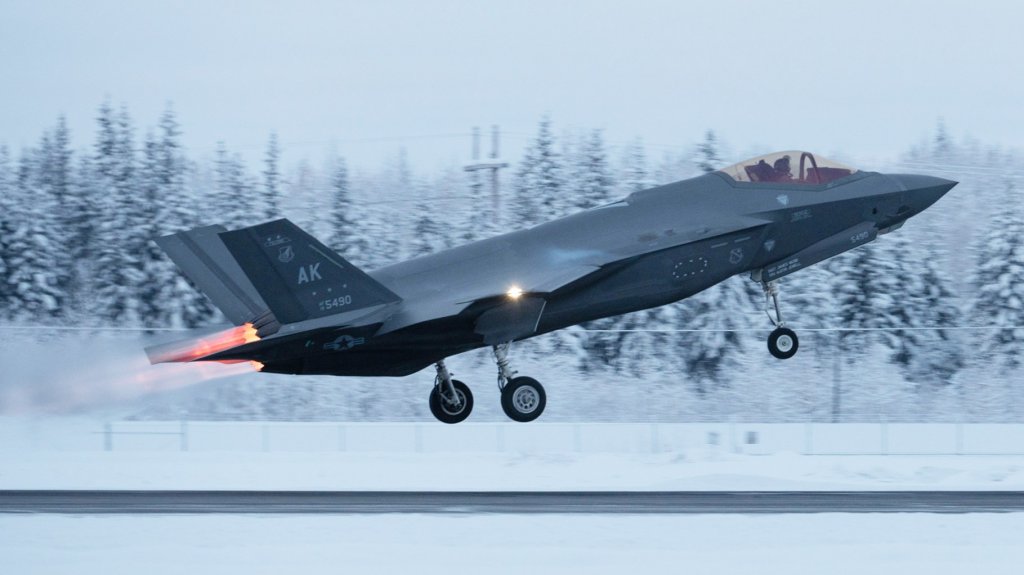
“The MP accomplished two touch-and-go landings attempting to recenter the NLG wheel. While both attempts failed to center the NLG wheel, the right main landing gear (MLG) strut and then left MLG strut did not fully extend after takeoff due to ice forming inside the strut,” it continues. “After the second touch-and-go, all valid Weight on Wheels (WoW) sensors indicated the MA was on the ground, and the MA transitioned to the ‘on ground’ flight control law (i.e., automated ground-operation mode causing the MA to operate as though it was on the ground when flying). However, because it was actually airborne, the MA was uncontrollable. The pilot successfully ejected and emergency responders were at the scene within a minute.”
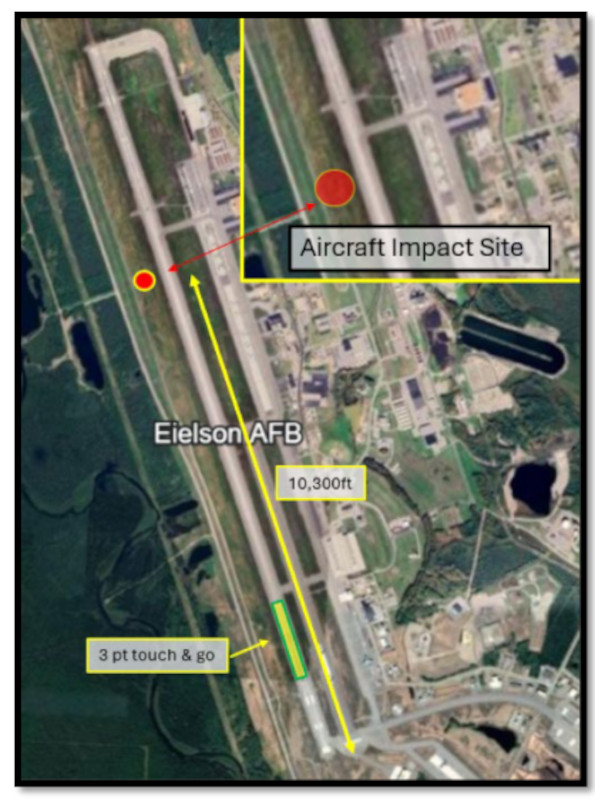
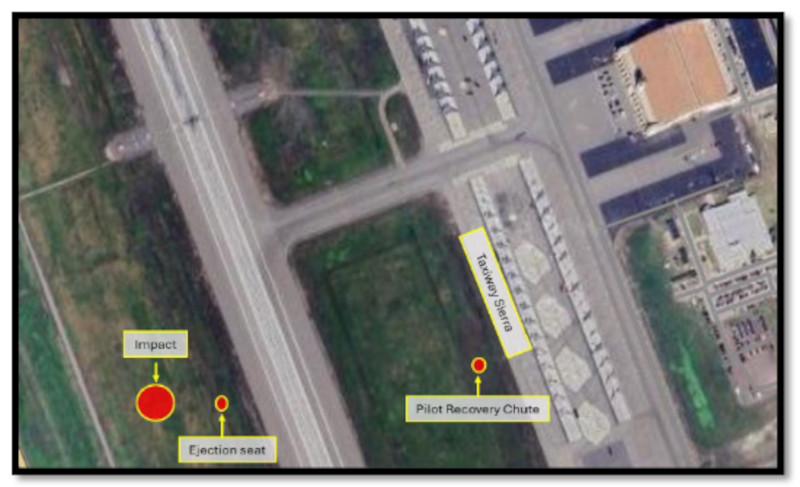
The report separately notes that the F-35 flew upward after the pilot ejected and reached an altitude of 3,205 feet mean sea
level (MSL), or 2,665 feet above ground level (AGL), before it stalled and fell back to Earth. This helps explain the vertical descent seen in the viral video. The report says the aircraft was already pitched up 30 to 40 degrees, and was in a 38-degree bank to the left, when the pilot punched out.
“The accident investigation board (AIB) president found, by a preponderance of the evidence, the cause of the mishap was hydraulic fluid contaminated by water that froze in the NLG and MLG struts. The ice prevented the struts from full extension that led the WoW sensors to declare the MA was on the ground when it was airborne,” the report adds. “Additionally, the AIB president found, by a preponderance of the evidence, that crew decision making including those on the in-flight conference call, lack of oversight for the Hazardous Materials program, and lack of adherence to maintenance procedures for hydraulic servicing were substantially contributing factors.”
The F-35A that crashed, tail number 19-5535, had initially taken off from Eielson as part of a four-ship flight tasked to act as ‘red air’ aggressors during routine training. The first indication that something was wrong with the landing gear came from an “overspeed gear” warning to the pilot as they accelerated past 275 knots calibrated airspeed (KCAS). This alert “if the predictive or current aircraft speed rises above 300 KCAS or 0.65 Mach with LG doors not indicating locked, gear handle down, or ALT GEAR EXTENSION commanded,” according to the report on the mishap, which also notes that “the clean aircraft structural limit is 300 [KCAS].”
“It is a common occurrence for the predictive OVERSPEED GEAR caution to assert on initial takeoff in the F-35A,” the report also says, but does not elaborate on. “This is especially true in a cold temperature environment such as Eielson AFB on the day of the mishap.”
This does underscore the unique challenges associated with operating F-35s, as well as many other aircraft types, in the often extreme cold weather found in Alaska. TWZ previously explored these realities in detail as the Air Force first began to build up its F-35 force at Eielson in the early 2020s. The recorded temperature in the area around the time of the mishap on Jan. 28 was 1.4 degrees Fahrenheit.
In terms of what specifically happened to the aircraft’s landing gear, “the NLG Uplock Hook is used to ensure the NLG assembly is up and locked appropriately. The uplock is mechanically ‘slaved’ to the NLG door,” the report explains. “The NLG is in the uplock so NLG door actuator will start to close the door, raising the uplock hook into the ‘LOCKED’ position. When the uplock hook is in ‘LOCKED’ position, the doors are closed and aircraft is ready for full flight envelope.”
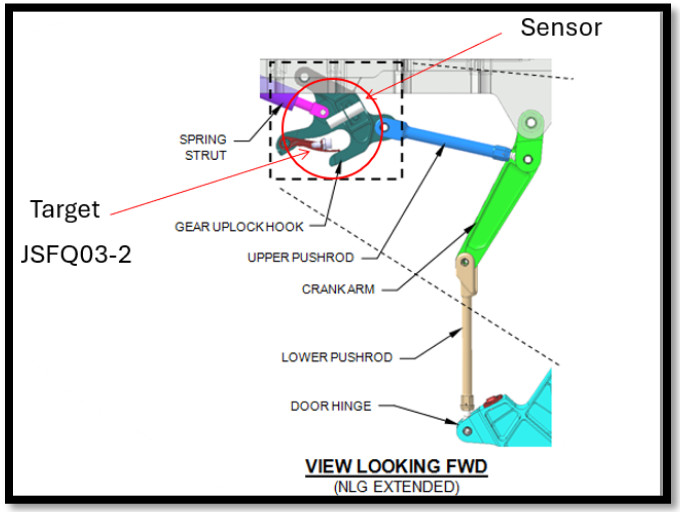
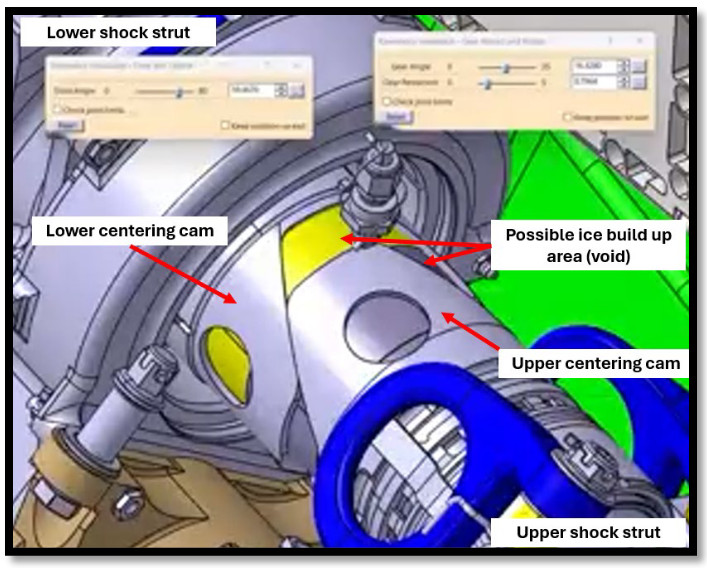
“The NLG centering cams are used to ensure proper centering of the NLG. One of the cams is mounted at the top of the landing gear strut and the other one is mounted at the bottom of the landing gear,” the report adds. “At the beginning of the mishap flight, the NLG didn’t fully extend due to ice build-up within the NLG strut. This ice buildup was the combination of significant water contamination in hydraulic fluid used to service the struts and ambient freezing temperatures around Eielson AFB (Tab J-189). The lack of full extension caused a misalignment that prevented the NLG uplock hook from catching the NLG uplock roller, causing damage to the metal adjacent to the roller.”
Water contamination in the hydraulic fluid had also caused pitting in the affected landing gear piston, but investigators determined this did not impact the functioning of the gear during the mishap.
“The inability of the strut to fully extend and retract impacted the proper function of the WoW sensors and flight control law (CLAW) on the MA. According to Lockheed Martin, if a MLG strut fails to fully extend to a pre-determined length then the WoW sensors cannot extend and will report weight ON wheels,” the report notes. “The WoW sensors are one component of the F-35A’s flight control system. Each MLG has two WoW sensors that are mounted on the shock strut. These sensors, along with a single WoW in the NLG, are part of a redundant system that is intended to function even when multiple WoW sensors fail. When the shock struts are fully extended and then
compressed by the weight of an aircraft, the WoW sensors are designed to reflect that the aircraft is on the ground.”
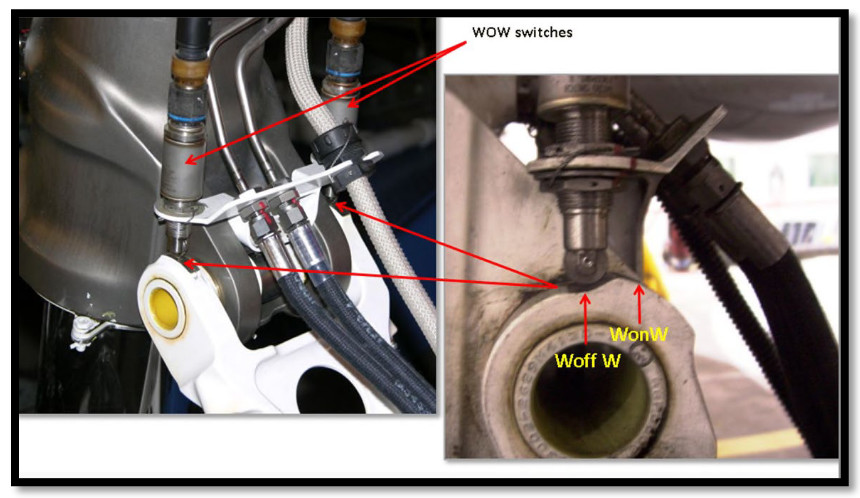
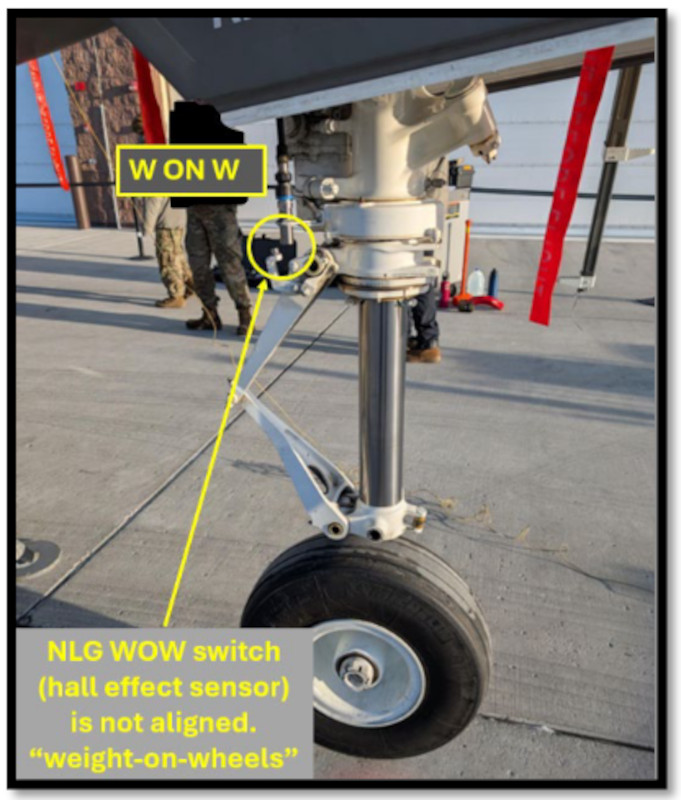
The issue, of course, was that the F-35 in this case was very much not on the ground. The cascading problems then ran into the jet’s flight control law programming.
“The F-35A is controlled by execution of a defined set of algorithms, known as CLAWs. The F-35A CLAWs include power approach (PA) for takeoff and landing, up-and-away (UA), and on-ground (OG). The PA CLAW is selected when airspeed is less than the programmed air speed or when precise control of the aircraft is required. The OG CLAW is selected when three of five WoW sensors suggest there is, in fact, weight on the wheels because the aircraft’s weight has compressed the extended strut while on the ground,” the mishap report explains. “If an aircraft is airborne but still in the ‘on-ground’ CLAW, it will experience significant degradation in flying qualities and loss of control can be expected. This is because CLAW software is designed to provide the desired aircraft response rather than direct control by the pilot.”
Lockheed Martin was apparently previously aware of the potential for problems with the WoW sensors, especially in extreme cold weather environments. The sensors themselves are understood to be relatively fragile.
“The WOW switches on the MLG are a mechanical plunger switch that are known to have a history of failure due to internal damage… These failures assert as actionable HRCs [Health Reporting Code] and become more frequent during extreme cold weather operations where aircraft are prepared for flight in a climate controlled hangar and takeoff 20-40 minutes after being exposed to outside ambient conditions,” according to an expected from April 2024 Lockheed Martin maintenance newsletter reproduced in the Air Force’s report report on the January crash. “Faults should be taken as an early indication of failure. If an actionable HRC is asserted noting a fault to a MLG WOW switch, the AFRS tied to that HRC must be followed… Not acting on a WOW switch fault HRC could result in… WOW switches faulting… on a future flight which can cause erratic flying qualities making it difficult for the pilot to maintain control of the aircraft.”
In its conclusions, the report commends the actions taken by all involved to “address a challenging situation that had not been seen in the F-35 fleet previously.” It notes that, in the absence of the cascading WoW sensor and CLAW issues, the immediate results of the second touch-and-go attempt “would have given the MP enough control authority to safely land.”
The report notes that this latter point was underscored by another F-35A landing uneventfully at Eielson just nine days later after suffering a similar landing gear issue.
However, with the HRCs in hand, the participants in the conference call on Jan. 28 “potentially could have referenced the Lockheed Martin maintenance circular from April 2024 that said these WoW sensor issues could lead to aircraft controllability issues,” the report continues. Had they “considered this potential outcome, they likely would have advised a planned full stop landing or a controlled ejection instead of a second touch-and-go.”
The report’s conclusions also underscore the problems on the ground with adherence to maintenance procedures and oversight of the storage of hazardous materials like hydraulic fluid as contributing factors in the mishap.
The unclassified report on the Jan. 28 crash does not include any detailed recommendations for any changes to policies or procedures in light of the lessons learned from the incident. The lessons learned could well have impacts outside of the Air Force, and even the rest of the U.S. military. In particular, there are other F-35 operators that have to deal with very cold weather environments. Many future operators, like Canada and Finland, are expecting to fly their jets in frigid conditions, too.
The accident at Eielson also serves as a reminder of the highly automated and otherwise computerized nature of the F-35, as well as many modern aircraft, and the additional complexities that can lead to, especially in emergency situations. This is not the first time that the jet’s flight control software has come up in a mishap investigation.
Thankfully, in this particular case, the pilot was able to eject, and the F-35A came down without causing injuries or severe damage on the ground.
Contact the author: joe@twz.com
Loading comments…
Comments couldn’t be loaded. Please refresh the page.