
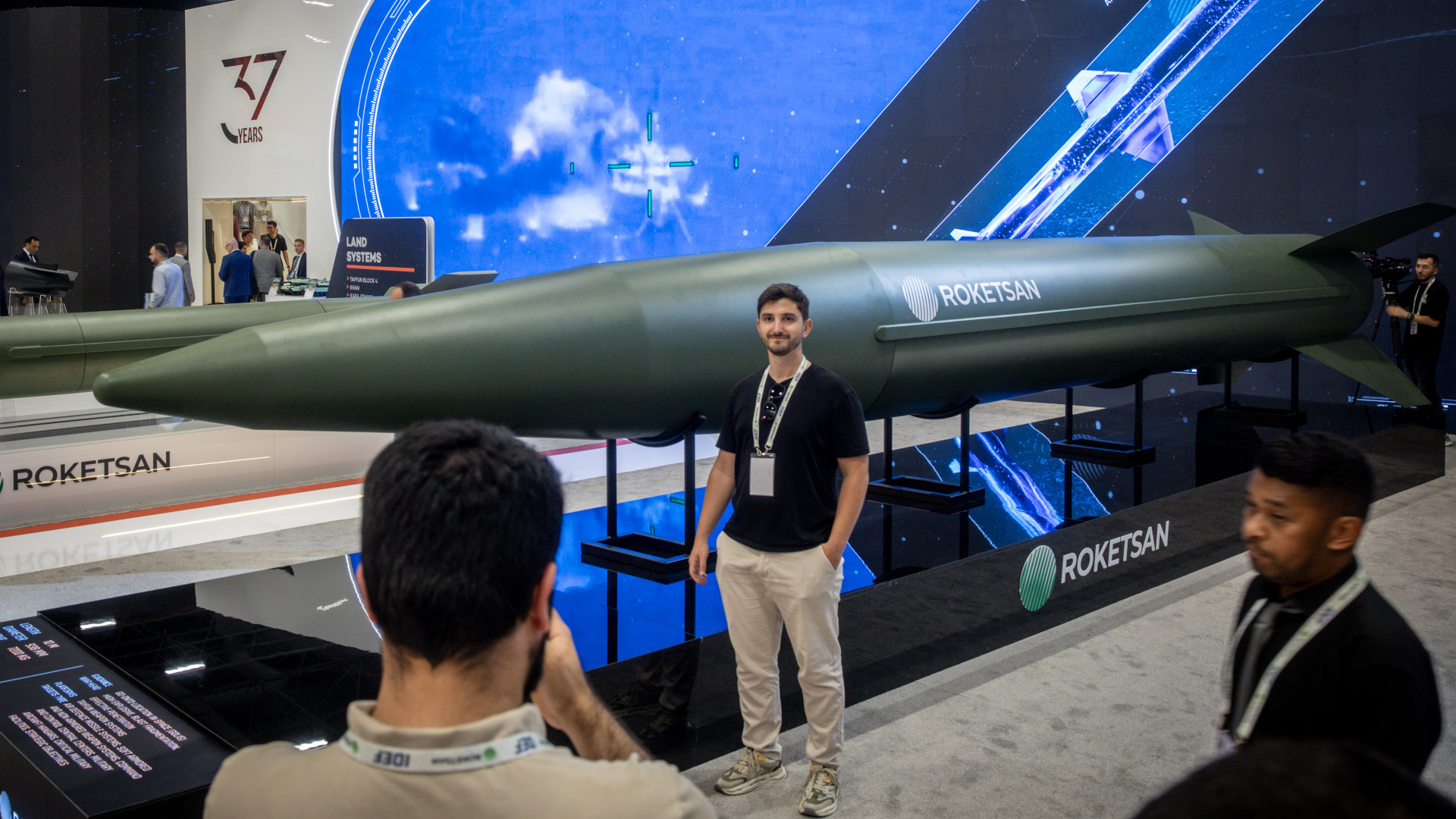
Turkish defense contractor Roketsan has rolled out a substantially larger version of its Tayfun short-range ballistic missile. In addition to the new capabilities it could offer Turkey, the Tayfun Block 4 is another indication of a broader resurgence of interest in larger and longer-ranged ballistic missiles, especially within the U.S. military.
Roketsan unveiled the Tayfun Block 4 at the 2025 International Defence Industry Fair (IDEF) in Istanbul last week. The Tayfun family first broke cover in 2022, and the weapon reportedly evolved from Rokestan’s preceding Bora short-range ballistic missile. Tayfun and Bora mean “typhoon” and “storm” in Turkish, respectively.
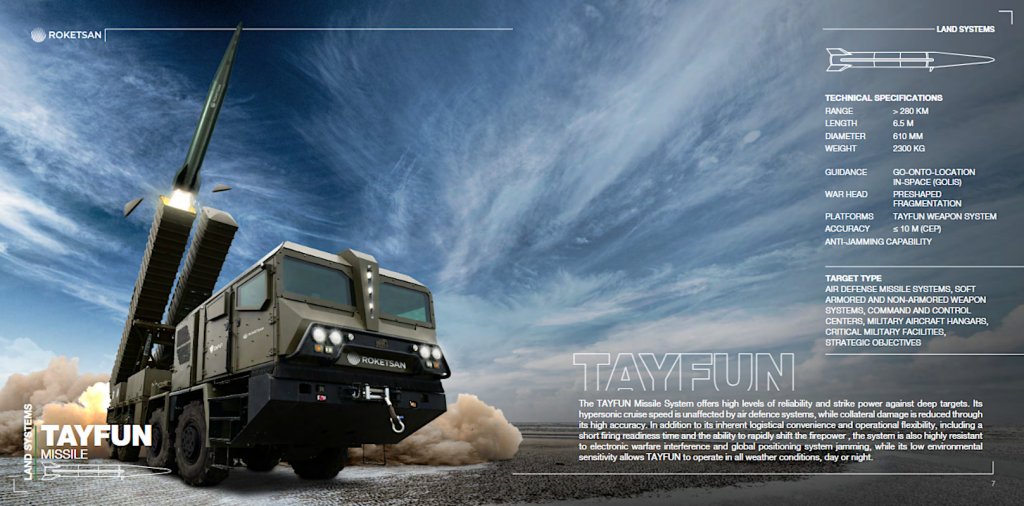
Tayfun Block 4 is close to 33 feet (10 meters) long, just over 3 feet (close to one meter) wide, and has a total weight of nearly eight tons (7,200 kilograms), according to Janes. Existing specifications for Tayfun (no block specified) on Roketsan’s website describe a missile that has an overall length of just over 21 feet (6.5 meters), a diameter of around two feet (just over 0.6 meters), and a gross weight of some two and a half tons (2,300 kilograms).
“The Tayfun Block-4 achieves long ranges, setting another record for the Turkish defense industry,” Rokestan said in a statement, according to Turkey’s state-run Anadolu Agency news outlet. It “will be capable of destroying numerous strategic targets, such as air defense systems, command and control centers, military hangars, and critical military facilities…”
Roketsan has not disclosed an official maximum range for Tayfun Block 4, but its substantially larger size has prompted speculation that it may be in the medium-range ballistic missile (MRBM) category. MRBMs are categorized as ballistic missiles with maximum ranges between 620 and 1,860 miles (1,000 and 3,000 kilometers), while short-range ballistic missiles (SRBMs) can reach out to between 190 and 620 miles (300 and 1,000 kilometers). The stated range of Tayfun provided on Roketsan’s website is greater than 174 miles (280 kilometers). Previous versions of Tayfun have reportedly demonstrated the ability to hit targets nearly 350 miles (561 kilometers) away.

It is worth noting that Tayfun Block 4 has been touted as a “hypersonic” missile, but there is nothing yet to indicate it has any characteristics associated with highly maneuverable hypersonic weapons, as you can read more about here. Ballistic missiles, especially larger, longer-ranged types, typically reach hypersonic speeds, defined as anything above Mach 5, in the latter stages of flight.
Other details about the Block 4 version of Tayfun, as well as the differences between the preceding Blocks, are limited. All versions, including the new Block 4, are understood to carry large unitary blast fragmentation warheads and use go-onto-location-in-space (GOLIS) guidance, at least in their default configurations. GOLIS weapons can operate on a number of different principles, including simply flying along a preset trajectory or leveraging inertial guidance, but are all limited to engaging fixed or near-fixed targets based on data loaded into the missile before launch. Roketsan’s website says the GOLIS guidance system used in the Tayfun family gives the missiles a circular error probable (CEP) of less than 33 feet (10 meters), meaning that the weapons can reliably hit within that distance of a specified aim point.
Whether or not Tayfun Block 4 is confirmed to be an MRBM remains to be seen. Roketsan is also known to be developing an MRBM called Cenk (meaning “war” in Turkish). Cenk was publicly disclosed two months after Turkish President Recep Tayyip Erdogan announced plans to acquire ballistic missiles with maximum ranges of at least 620 miles (1,000 kilometers). It remains unclear whether Erdogan may also have been referring to an extended-range version of Tayfun at that time.
Just last week, Minister of Industry and Technology Mehmet Fatih Kacir reportedly declared that Turkey was pursuing missiles with maximum ranges of around 1,242 miles (2,000 kilometers), but did not specify whether he was referring to ballistic or cruise missiles, or name any particular programs. Reports also emerged last year that Turkey is looking to begin testing ballistic missiles in Somalia, specifically because of the greater space available in the East African country to conduct longer-range launches.
A variant of Tayfun with MRBM range, or close to it, could offer a hedge against any issues in the development of Cenk. At the same time, a purpose-built MRBM rather than one derived from SRBM would offer the potential for increased overall performance and greater survivability, including through a greater total payload capacity that could include the addition of new decoys and other countermeasures against anti-missile interceptors, as well as improved warhead options. A missile designed from the ground up as an MRBM would be easier to further scale up, as well.
For Turkey, the development and fielding of longer-range ballistic missiles, broadly, is being driven in part by a desire to deter long-time regional competitor Greece.
“Now we have started to build our missiles. Of course, this production frightens the Greeks. When you say ‘Tayfun’ (Typhoon), the Greek is scared. They (Greece) say it will hit Athens. Of course, it will hit it,” Erdogan said in December 2022.
It would also extend Turkey’s reach against other regional opponents. Turkish forces have reportedly fired Bora short-range ballistic missiles at Kurdish militants in Iraq in the past.

Tayfun Block 4 could also be geared in part to potential export sales. Turkish defense contractors, with the support of the government in Ankara, have been steadily pushing in recent years to expand their global market share, in general. However, Turkey is a member of the Missile Technology Control Regime (MTCR) arms control bloc, an arrangement that puts severe restrictions on the export of missiles that can carry payloads of more than 1,100 pounds to distances of more than 190 miles. Bora falls within the MTCR parameters, and Roketsan offers an export-specific version called Khan, which Indonesia signed a contract to purchase in 2022.
All of this underscores the aforementioned new surge of interest globally in ballistic missiles in recent years, especially in the West. The U.S. Army may also be pursuing a two-tier conventionally-armed MRBM plan. The service has outlined a plan for a future variant or derivative of its Precision Strike Missile (PrSM) with MRBM range. There are signs it could be working toward acquiring a new purpose-built MRBM design, as well, as TWZ reported on back in April. The Army has not had an MRBM capability of any kind since it retired its nuclear-armed Pershing IIs in 1991.
PrSM is also being offered for export, at least to top-tier U.S. allies and partners. Australia is set to be the first foreign operator of the missile, and just recently test-fired one in the country for the first time as part of the biennial Talisman Saber exercise, in which the U.S. military is also participating.
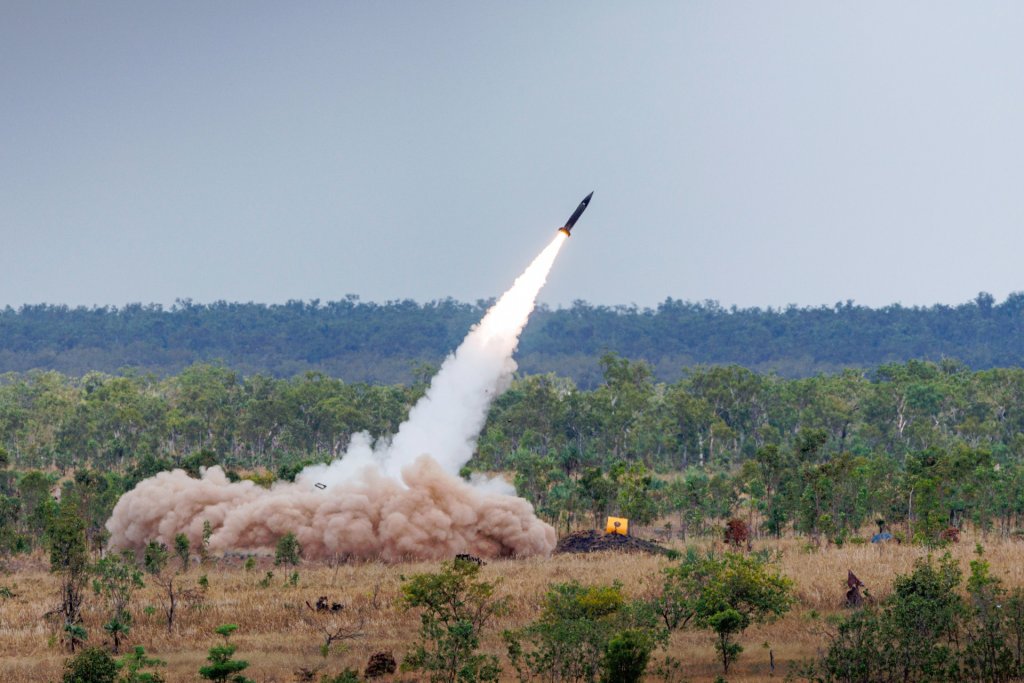
In general, the very high terminal speeds ballistic missiles reach make them especially well-suited for employment against high-value time-sensitive targets. Missiles traveling at hypersonic velocities also present additional challenges for defenders. Those speeds give the missiles an inherent ability to burrow deeper into hardened targets, as well.
The utility of ballistic missiles has been on full display on both sides of the ongoing war in Ukraine in recent years. Russia made a particular statement last year when it fired at Ukraine a previously unknown ballistic missile capable of carrying multiple warheads called Oreshnik. There are reports that Ukraine is getting close to fielding a new domestically-developed ballistic missile of its own, if it hasn’t started to do so already.
Iranian ballistic missile attacks on Israel, particularly during the 12-Day War in June, have also underscored the value of these weapons and the threats they pose, even against countries with significant missile defense capabilities. Iran has used its ballistic missile arsenal in attacks on Syria, Iraq, and Pakistan, as well.
Many countries are fielding new air and sea-launched ballistic missiles, especially China. Israel has made significant use of air-launched ballistic missiles against Iran, including during the conflict in June. Russia has also fired air-launched ballistic missiles at Ukraine.
Whether or not Tayfun Block 4 is indeed an MRBM, it is the latest example of Turkey’s push to expand and diversify its ballistic missile arsenal, which reflects worldwide trends.
Contact the author: joe@twz.com
Loading comments…
Comments couldn’t be loaded. Please refresh the page.