
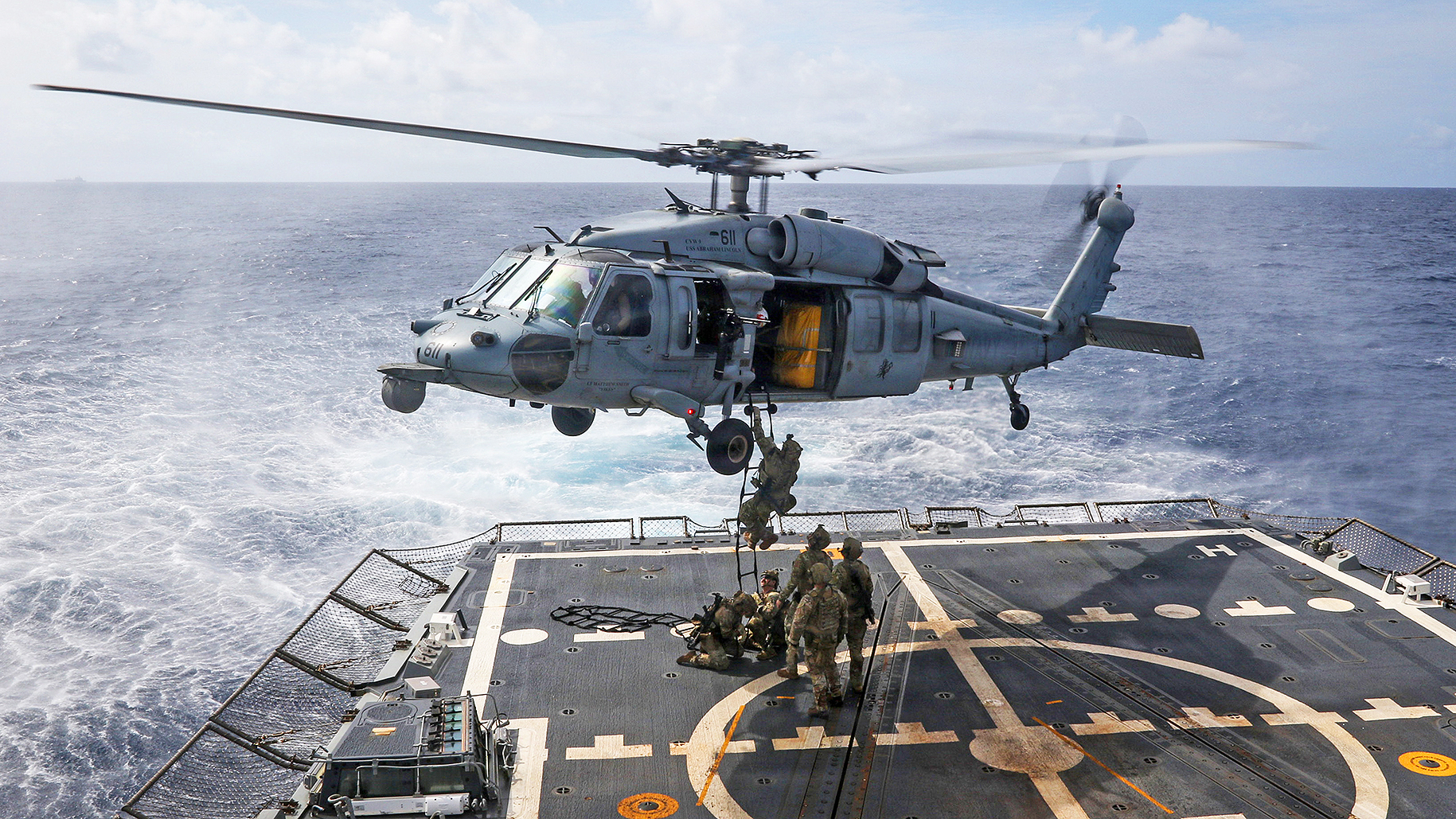
The U.S. military is not limiting its efforts to interdict Iranian vessels to the Middle East. Air Force Gen. Dan Caine, Chairman of the Joint Chiefs of Staff, told reporters today that this is a global campaign.
“Let me be clear, this blockade applies to all ships, regardless of nationality, heading into or from Iranian ports,” he said. “The U.S. action is a blockade of Iran’s ports and coastline, not a blockade of the Strait of Hormuz. Enforcement will occur inside Iran’s territorial seas and in international waters.”
“In addition to this blockade, the joint force, through operations and activities in other areas of responsibility, like the Pacific Area of Responsibility, under the command of Admiral [Samuel] Paparo, will actively pursue any Iranian-flagged vessel or any vessel attempting to provide material support to Iran,” he added. “This includes Dark Fleet vessels carrying Iranian oil. As most of you know, Dark Fleet vessels are those illicit or illegal ships evading international regulations, sanctions or insurance requirements.”
Caine added that no Iranian ships have been boarded in the CENTCOM region so far, but he did not say if any have been interdicted outside the CENTCOM region. We have reached out to his office for more details. It should be noted that early in Epic Fury, a U.S. Navy submarine sunk an Iranian frigate in the Indian Ocean.
Caine was one of three top military leaders to brief reporters this morning on the currently paused Operation Epic Fury and the ongoing blockade. Here are some highlights from the press conference, which also included War Secretary Pete Hegseth, and CENTCOM commander, Adm. Brad Cooper.
- Caine explaining how the Navy is enforcing the blockade:
“This map is a pull from our common operating picture that we use to allow commanders and key leaders to see what is happening in near real time, we just grabbed screen grabs to highlight the actions and activities,” Caine noted. “What is not shown is how incredibly congested this area is and the incredible work that our sailors are doing to ensure that they can work in and around an incredibly busy water space. What is also not depicted here is the massive, massive force of fighters, intelligence aircraft, helicopters and other embarked forces, to include aerial refueling tankers that are up overhead this blockade area. You’ll note that U.S. forces are in blue. Iranian ships are in red.”
- Caine on how the Navy communicates with ships approaching the blockade:
“At each point, the United States Navy will transmit a warning. A young sailor, normally on the bridge of one of those destroyers – a junior officer – picks up that mic and transmits, and I quote, ‘do not attempt to breach the blockade. Vessels will be boarded for interdiction and seizure, transiting to or from Iranian ports, turn around or prepare to be boarded. If you do not comply with this blockade, we will use force,'” the chairman explained. “And as this message is being transmitted…those ship masters can literally see, sense and feel the pressure around them.”
“It’s a finely tuned machine rehearsed multiple times and executed now 13 times since the blockade has begun,” he posited.
- Caine on the capabilities of U.S. Navy warships:
“When we talk about an American destroyer, it’s important that you and the American people understand their capabilities. And Arleigh Burke class destroyers are the backbone of the United States Navy surface fleet,” Caine proffered. “Over 500 feet long, they displace 9,000 tons, and it is the sports car of the United States Navy. From the keel to the mast, they stand nearly 10 stories tall, and their four gas turbine engines can drive the ship at 30 plus knots. These ships are armed to the teeth with surface-to-air missiles, land attack cruise missiles, anti ship missiles, anti submarine rockets, torpedoes, five-inch naval guns, multiple electronic warfare systems, embarked helicopters extending the reach and capability of each and every one of these destroyers. But far and away, the most important weapon on board these ships is the American sailor.”
- Caine on operating a blockade in highly congested waters:
“On that bridge, our sailors maintain a constant watch, maneuvering the ship tactically and safely through always congested water space, and there is a lot out there,” the general pointed out. “It is like driving a sports car through a supermarket parking lot on a payday weekend with thousands of kids in that parking lot as you attempt to maneuver through there to get to that ship that would attempt to run that blockade.”
- Cooper on working with allies during Epic Fury:
“I assess that our military partnerships are stronger than ever as we continue to maintain a very active defense posture across the region during this ceasefire, and that posture stretches across the entire Arabian Peninsula, and it runs from Northern Iraq all the way down into the northern Arabian Gulf,” according to the admiral. “In creating the largest air defense umbrella in the world, across the Middle East, we invited specially trained U.S. military air defenders alongside our partner nation soldiers side by side, literally side by side.”
“And to give you a sense of their contribution and impact,” he highlighted, “the king and crown prince of Bahrain both personally knew our soldiers by name.”
- Hegseth on being prepared to resume fighting if needed:
“We can make that transition again very quickly and even more powerfully than ever at the direction of President Trump,” the secretary stated. “The War Department will ensure that Iran never has a nuclear weapon, never. We prefer to do it the nice way, through a deal led by our great Vice President and negotiating team, or we can do it the hard way. We urge this new regime to choose wisely.”
- Hegseth on Iranian command and control:
“Their command and control capabilities are highly degraded,” Hegseth noted. “So their ability to talk, see and sense is the worst it’s ever been. But their motivation to want to stay in the ceasefire is very high, because they understand that a violation of that ceasefire means a commencement once again, of Admiral Cooper’s forces, which went very poorly for them. “
- Hegseth on the Houthis:
“As far as the Houthis, thus far, they have stayed out of it, which, of course, we think is a good decision by them,” Hegseth said. “And I think it is a reflection of the fact that over a year ago, in Operation Rough Rider, we had an ongoing and intense campaign that demonstrated American capabilities, which has them hesitating to want to do something on that Strait, which I think would be a poor choice.”
It is worth noting that USNI reported that the aircraft carrier USS George H.W. Bush, which is heading to the Middle East, did not transit the Strait of Gibraltar, but is instead “operating off the coast of Namibia… The path around Africa allows the carrier and its escorts to avoid transiting the Red Sea and the Bab el-Mandeb, which were both hubs of activity for the Houthis in their drone and missile attacks on U.S. and commercial shipping in 2024 and 2025.”
- Hegseth on claims China is helping to arm Iran:
“President Trump has a very strong and direct relationship with President Xi, and they’ve communicated on that, and China has assured us that that indeed is not going to happen,” Hegseth avowed.
- Hegseth on the health of Iranian Supreme Leader Mojtaba Khamenei:
He is “believed to be alive, wounded and disfigured,” Hegseth explained. His “status remains the same.”
UPDATES:
Our coverage for the day has concluded.
UPDATE: 6:19 PM EDT –
The ceasefire in Lebanon earned praise from the U.N. Secretary General and Saudi officials.
“I welcome the announcement of a ceasefire between Israel & Lebanon, and commend the role of the U.S. in facilitating it,” Antonio Guterres said on X. “I hope this will pave the way for negotiations towards a long-term solution to the conflict & contribute to ongoing efforts toward a lasting & comprehensive peace in the region. I urge everyone to fully respect the ceasefire and to comply with international law at all times.”
The Saudi Foreign Ministry “expresses the Kingdom of Saudi Arabia’s welcome of the announcement by President Donald Trump of the United States of America, regarding the ceasefire in the Republic of Lebanon,” it stated on X. “The Kingdom commends the significant and positive roles played by the President of the Republic of Lebanon General Joseph Aoun, the Lebanese Government, headed by Prime Minister Nawaf Salam, and the Speaker of Parliament, Nabih Berri.”
UPDATE: 6:09 PM EDT –
Trump took to Truth Social to blast Italy, saying: “Italy wasn’t there for us, we won’t be there for them!”
He included a link to a Guardian story from March about how “Italy has denied the use of an airbase in Sicily to U.S. military planes carrying weapons for the war in Iran after the U.S. did not follow the required authorization procedure.”
UPDATE: 5:59 PM EDT –
Pre-war planning meant Iran’s military “was able to mitigate the impact of U.S.-Israeli strikes on its weapons arsenal and leadership,” Bloomberg reported, citing Western military intelligence assessments — which also say the Islamic Republic retains the ability to respond if the ceasefire fails.
Despite the widespread damage and killings of leadership during the hostilities, operational planning undertaken in anticipation of the conflict was effective in preventing the destruction of its missile and drone capabilities as well as maximizing the impact of its military response, people familiar with the assessments told the news outlet.
UPDATE: 5:54 PM EDT –
People in the Lebanese capital of Beirut celebrated by firing flares as the 10-day ceasefire between Israel and Hezbollah went into effect.
UPDATE: 5:48 PM EDT –
Netanyahu says he rejected Hezbollah’s demands for an Israeli withdrawal from all Lebanese territory, and for a ceasefire in the form of “quiet will beget quiet.”
UPDATE 5:42 PM EDT –
CENTCOM released a video of a sailor aboard the Arleigh Burke class guided missile destroyer USS Michael Murphy communicating with a merchant vessel during a diversion in the ongoing blockade.
UPDATE 5:20 PM EDT –
Trump on Thursday claimed that Iran has agreed to give up its nuclear ambitions. He made that statement during comments to the press outside the White House on Thursday.
“We had to make sure that Iran never gets a nuclear weapon. They’ve totally agreed to that. They’ve agreed to almost everything,” he claimed, despite no deal being reached during Saturday’s U.S.-Iran talks in Pakistan, The Jerusalem Post noted.
In addition, Trump asserted that Iran is willing to do things today “that they weren’t willing to do two months ago,” before the U.S. and Israel launched Operation Epic Fury against Iran.
When asked if it would be acceptable for Iran to agree to a 20-year halt for enriching uranium, Trump said he had received “a very powerful statement” that Iran will not have nuclear weapons for “beyond 20 years.”
It is unclear how Iran has responded.
An image emerged on social media purporting to show what appears to be an anti-drone cage atop a U.S. radar system in Baghdad. Last month, a radar and a Black Hawk helicopter in the Iraqi capital were damaged during a first-person view (FPV) drone attack by an Iranian proxy militia group. As we have been reporting for years, these so-called cope cages emerged in the battlefields of Ukraine and have become ubiquitous in conflicts around the globe.
Reports are emerging of intense and sustained activity by the IRGC to restore access to Iranian underground missile sites.
“Throughout the early morning (04:15 AM – 06:00 AM local time today), a total of approximately 30 explosions were recorded as crews worked persistently to clear or unseal the blocked tunnel entrances,” according mamlekate, a network of independent journalists covering Iran.
As we have noted, these sites have been targeted multiple times since February 28, the first day of the war.
During his press conference, Hegseth noted that the U.S. is closely monitoring Iranian efforts to dig out these facilities and said they would be unsuccessful.
“While you are digging out, which is exactly what you’re doing, digging out of bombed-out and devastated facilities,” he posited. “We are only getting stronger. You are digging out your remaining launchers and missiles with no ability to replace them.”
As we noted yesterday, CNN reported that Iran appears to be using the time to reopen entrances to underground missile cities damaged during the war. The network published footage showing engineering equipment at the Tabriz South missile base and the Khomein missile base.
The network also noted that, according to U.S. intelligence estimates, about half of the Iranian missile launchers remained intact after a month of fighting, and that many of these launchers could have been buried in underground storage facilities as a result of strikes on the entrances.
U.S. and Iranian negotiators have scaled back ambitions for a comprehensive peace deal and are instead seeking a temporary memorandum to prevent a return to conflict, two Iranian sources told Reuters.
“A senior Iranian official said the two sides had started to narrow some gaps, including over how to manage the Strait of Hormuz, a vital route for about 20% of the world’s oil and gas needs that has been closed to most ships for weeks,” the news outlet reported.
Iran, which has faced crippling U.S. sanctions for years, “wants a memorandum to include Washington unfreezing some Iranian funds, in return for allowing more ships through the strait,” Reuters added.
However, no dates for a return to talks has yet been set.
The commander-in-chief of the Iranian Army boasted about how his country still has a functional Air Force, as demonstrated yesterday during the escort over its airspace by a visiting Pakistani delegation.
“They say the Iranian Air Force is gone. Yesterday we had a guest (Commander of the Pakistan Army),” proclaimed Gen. Amir Hatami. “As soon as he entered our airspace, we announced that your (Pakistan’s) planes weren’t needed. We escorted our guest with twice the number of planes they wanted to bring for escort.”
Hatami’s comments came a day after images emerged on social media purporting to show an IRIAF F-4E and Mig-29A flying over Tehran escorting the Pakistani delegation that arrived today to discuss potential future peace talks.
Despite the ongoing efforts to end the fighting, the U.S. is continuing to flow assets to the region, with transport planes regularly landing in the Middle East from the U.S.
Trump said Israel and Lebanon have agreed to a ceasefire.
“I just had excellent conversations with the Highly Respected President Joseph Aoun, of Lebanon, and Prime Minister Bibi Netanyahu, of Israel,” the president stated on his Truth Social site. “These two Leaders have agreed that in order to achieve PEACE between their Countries, they will formally begin a 10 Day CEASEFIRE at 5 P.M. EST.”
However, the statement doesn’t mention Hezbollah, which is fighting Israel, so it is unclear what effect this will have.
Trump added that he is “inviting the Prime Minister of Israel, Bibi Netanyahu, and the President of Lebanon, Joseph Aoun, to the White House for the first meaningful talks between Israel and Lebanon since 1983, a very long time ago.”
Prior to Trump’s social media post, Iran’s parliament speaker Mohammad Bagher Ghalibaf told his Lebanese counterpart Nabih Berri that Tehran is pushing for a permanent ceasefire “in all conflict zones” and that a ceasefire in Lebanon is “just as important” as in Iran, according to a statement on Telegram.
Despite Ghalibaf’s comments, Lebanon’s president will not speak to Israel’s prime minister in the near future as anticipated, Lebanese officials said on Thursday, according to Reuters. The move dealt a blow to U.S. efforts to expand contacts between the enemy states as Pakistan said peace in Lebanon was vital to ending the Iran war.
The IDF is setting up more outposts in southern Lebanon, Haaretz reported.
Soldiers serving in Lebanon told the newspaper that the army is “operating in Lebanon using methods similar to those used in the Gaza Strip and that these new outposts are likely to become focal points for friction and ongoing fighting against Hezbollah.”
Select Committee on China Chairman John Moolenaar sent a letter to Hegseth concerning the operations of Airbus Space “due to its role in likely providing satellite imagery of U.S. military assets to MizarVision, a Chinese entity, days before the commencement of Operation Epic Fury,” according a committee press release.
“While commercial satellite imagery may serve public interest purposes in some cases, unconstrained imagery provision exposing U.S. forces to heightened risk crosses a dangerous threshold,” Moolenaar wrote. “Near-real-time publication of precise, annotated imagery identifying the exact type, number, and location of specific high-value military assets at an active forward operating base—while those assets are actively engaged in combat operations—is targeting data for enemy forces.”
As we noted yesterday, VANTOR and Planet Labs, two U.S. satellite firms, have already complied with the Pentagon and have curtailed providing imagery over the Middle East.
China and the U.S. are maintaining communication on U.S. President Donald Trump’s visit to China, Chinese Foreign Ministry spokesperson Guo Jiakun said on Thursday.
Guo’s statement came in response to a question regarding remarks by President Trump in an interview aired Wednesday on Fox News, in which he said factors including Iran would not change the dynamic of his meeting with the Chinese leader.
U.S. Central Command (CENTCOM) clarified its efforts to interdict ships providing support to Iran. All Iranian vessels, those with active Office of Foreign Asset Control (OFAC) sanctions, and ships suspected of carrying contraband are subject to boarding and seizure. The contraband items include weapons, ammunition, fissile materials, equipment for nuclear enrichment, metals, oil and lubricants among others.
The ongoing reduction of oil exports from the Middle East as a result of the war is having dire economic impacts around the globe.
On Thursday, International Energy Agency Chief Fatih Birol stated that Europe has “maybe six weeks of jet fuel left,” and warned of possible flight cancellations, according to Sky News.
Contact the author: howard@thewarzone.com
Loading comments…
Comments couldn’t be loaded. Please refresh the page.