
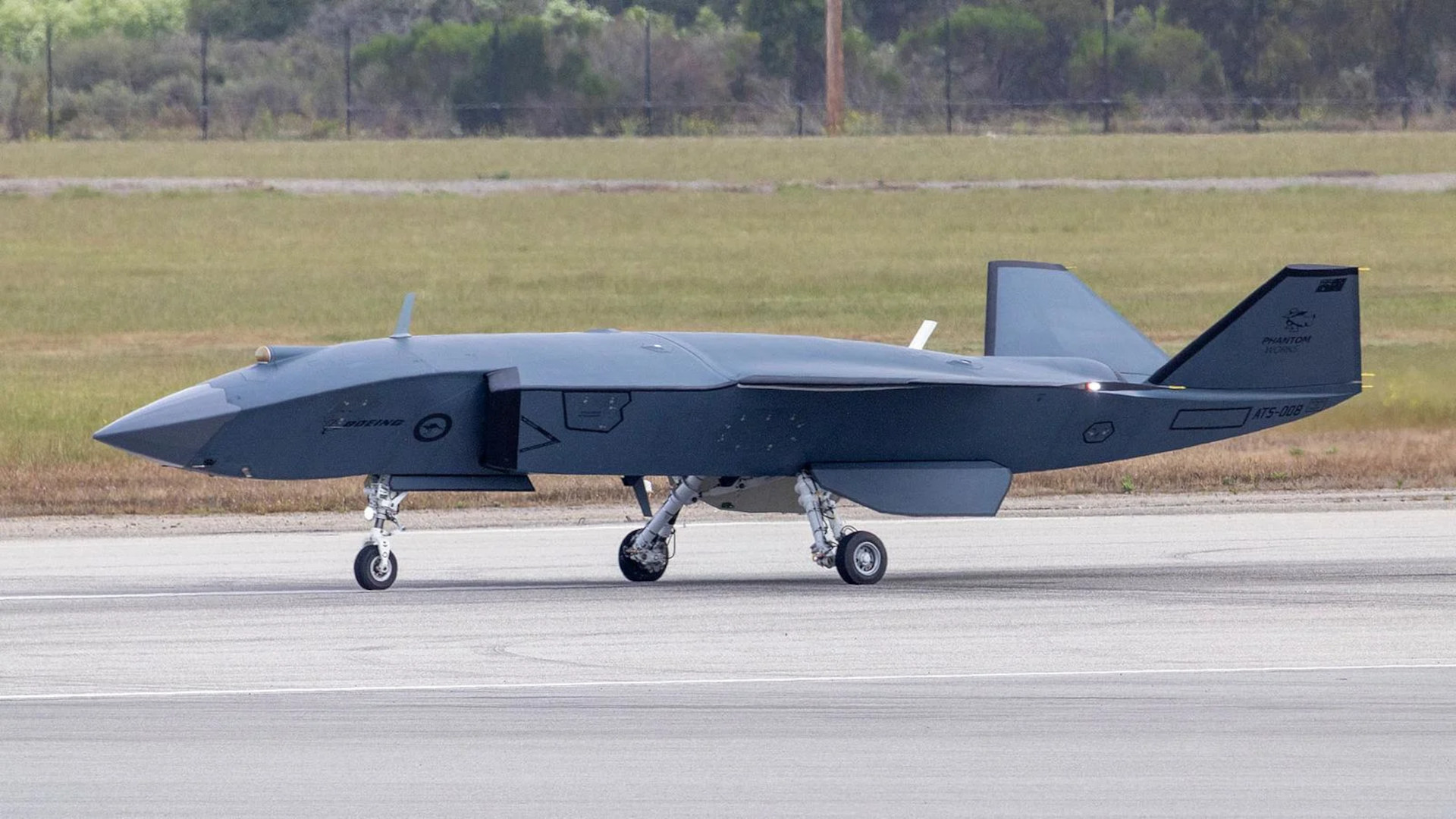
Boeing is now conducting test flights of its MQ-28 Ghost Bat drone out over the Pacific from the U.S. Navy’s base in Point Mugu, California. The company says its main goals are to demonstrate the maturity of the design, originally developed for Australia, and promote export sales. The specific choice of testing location also seems notable given Boeing’s involvement in the Navy’s still-evolving carrier-based Collaborative Combat Aircraft (CCA) plans.
The MQ-28 has now flown at least three times within the Point Mugu Sea Range off the coast of southern California, according to a Boeing press release. The expansive range is routinely used for a wide array of research and development and test and evaluation activities, as well as training. Naval Air Station Point Mugu, part of Naval Base Ventura County, sits right on the coast, surrounded by farmland, with direct access to the range and minimal risk to bystanders. Its location makes it well suited for uncrewed aircraft operations, and it already has a major role in this regard in relation to the MQ-4C Triton and managing target drones.

“This testing shows the MQ-28’s ability to operate seamlessly from allied facilities, which helps Boeing demonstrate the aircraft’s maturity and potential export opportunities to international customers outside Australia,” per the press release from Boeing. “Tests at Point Mugu validate autonomous systems while following required airspace, range safety and regulatory approvals.”
Boeing also described this as “MQ-28’s first international operation in allied airspace,” but it is unclear when the first sortie from Point Mugu occurred.
In December, the Pentagon released a video of Secretary Pete Hegseth visiting Naval Air Station Point Mugu with an MQ-28 clearly visible in the background. However, the drone seen in that footage also had an early-style paint scheme with high-visibility orange trim. Pictures and video that Boeing released along with its announcement of the Point Mugu Sea Range flight testing show a Ghost Bat with a two-tone gray livery. It also has an infrared search and track (IRST) sensor system in the nose, something not seen on the example in the Hegseth video. The MQ-28 is a highly modular design, with the nose section designed to be readily swappable.
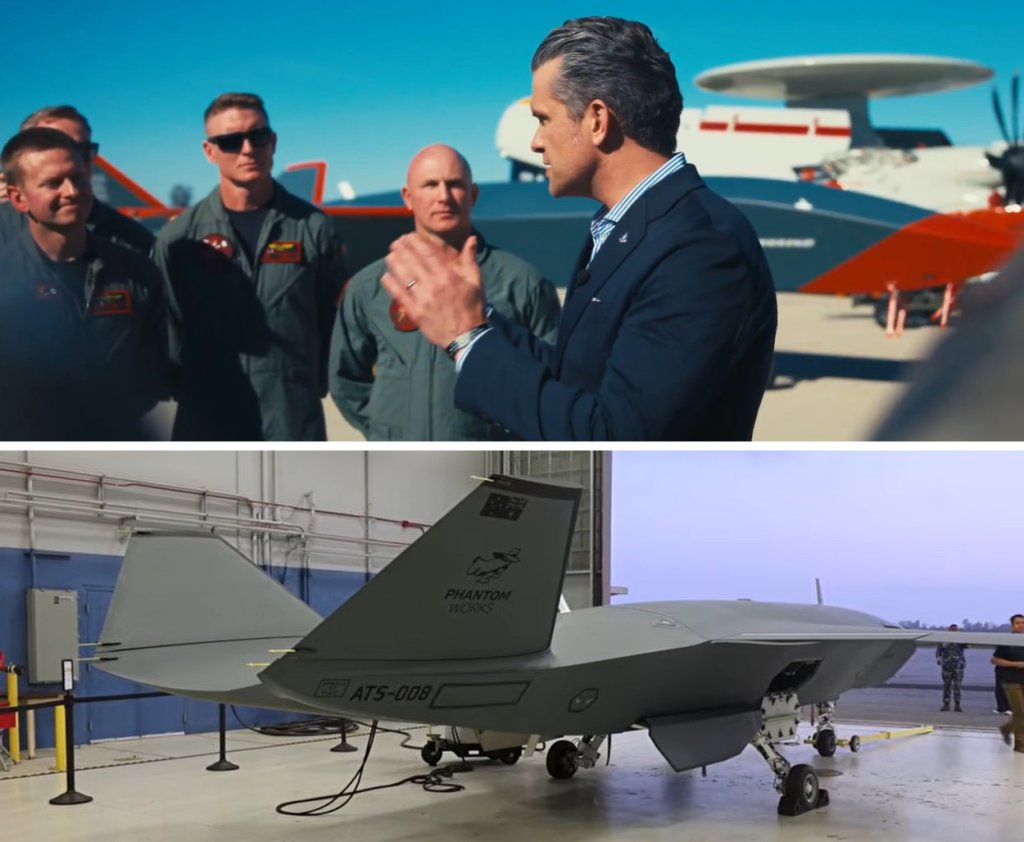
There have also at least been indications of Ghost Bat flight testing in the United States in the past. The U.S. Air Force previously said it had made use of at least one MQ-28 to support advanced uncrewed aircraft and autonomy development efforts.
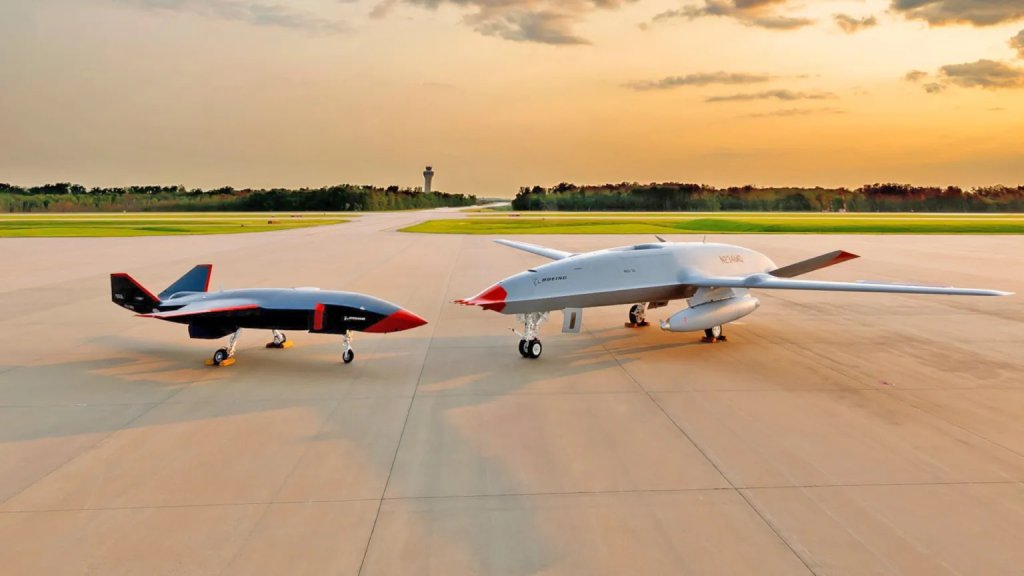
Boeing itself released a picture of an MQ-28, again with the early paint scheme and no IRST, at MidAmerica Airport outside of St. Louis, Missouri, back in 2023. In that instance, the Ghost Bat was displayed alongside the demonstrator the company had been using to support the development of the MQ-25 Stingray tanker drone for the Navy.
It is unknown how many Ghost Bats are currently in the United States. TWZ has reached out to Boeing for more information.
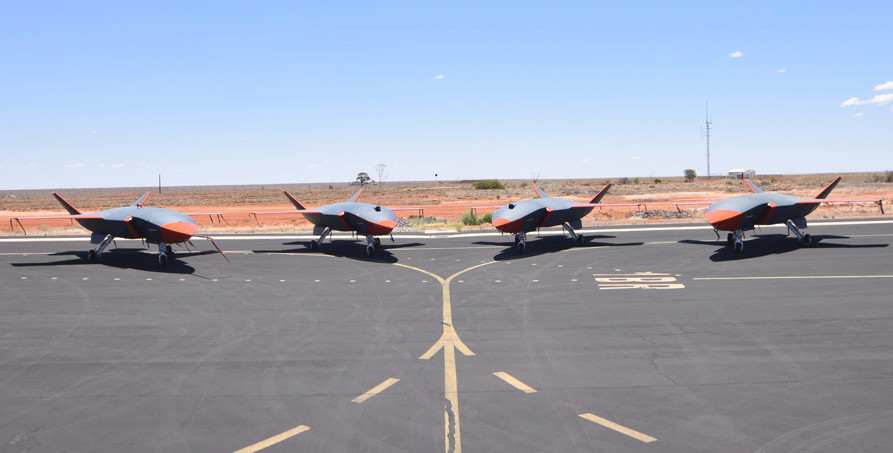
The MQ-28 has been flying in Australia since 2021, two years after the design was first shown publicly. Boeing’s subsidiary in Australia had already been working on the design before then under the Royal Australian Air Force’s (RAAF) Airpower Teaming System (ATS) program. To date, RAAF has received eight Ghost Bats in a pre-production Block 1 configuration.
Boeing is now working to build the first of a batch of nine Block 2 drones, which are seen as an intermediate stepping stone to an operational Block 3 version. The Block 3 type is expected to be substantially larger and have greater range. It will also feature an internal weapons bay that could accommodate a single AIM-120 Advanced Medium Range Air-to-Air Missile (AMRAAM), two GBU-39/B Small Diameter Bombs (SDB), or equivalently sized stores.
Boeing and the RAAF have already conducted at least one live-fire AIM-120 launch from a Block 1 Ghost Bat, with the missile having been carried aloft on an external pylon under the drone’s fuselage.

Block 1 MQ-28s have also been used to demonstrate other important capabilities in testing to date. This includes crewed-uncrewed teaming with RAAF E-7A Wedgetail airborne early warning and control aircraft and F/A-18F Super Hornet fighters. The ability to operate from allied facilities that Boeing says the Point Mugu sorties demonstrate could be valuable just for Australia for future coalition operations.

Boeing has also been open about its interest in pursuing sales of the MQ-28 outside of Australia. The company has publicly named Japan as a potential customer and has said it is exploring potential opportunities with other unnamed countries in the Indo-Pacific region. In March, Boeing Australia announced a partnership with Rheinmetall in Germany to pitch the Ghost Bat to that country’s armed forces. A carrier-capable version of the design with a tail hook has been pitched to the United Kingdom in the past, as well.
This latter point brings us to what is largely absent in Boeing’s announcement about MQ-28 flight testing from Point Mugu: the U.S. Navy.
In September 2025, the Navy confirmed that it had awarded Boeing, as well as Anduril, General Atomics, and Northrop Grumman, contracts to develop “conceptual” carrier-based CCA drone designs. At that time, the service also announced that Lockheed Martin was under contract for work on an accompanying common control architecture.
In April 2025, Navy Capt. Ron Flanders, public affairs officer at the Office of the Assistant Secretary of the Navy for Research, Development & Acquisition (RDA), had also told TWZ directly that “the U.S. has expressed strong interest in leveraging the MQ-28’s AI-driven autonomy and modular design for future air combat operations.”
As mentioned, Boeing is also developing the MQ-25, a production representative version of which just flew for the first time in April. Beyond the important aerial refueling and other capabilities the Stingray is set to bring to the Navy’s carrier air wings, the service routinely describes it as a “pathfinder” to future uncrewed aviation capabilities.

All this being said, the Navy’s CCA plans are still very much evolving. The service, by its own admission, has been trailing behind the U.S. Air Force and the U.S. Marine Corps in the development of CCA-type drones.
Flight testing now from Point Mugu is certainly an important development for the MQ-28 program as a whole, and one Boeing hopes could open the door to new opportunities for the Ghost Bat. Whether or not that includes deeper U.S. Navy involvement remains to be seen.
Contact the author: joe@twz.com
Loading comments…
Comments couldn’t be loaded. Please refresh the page.