
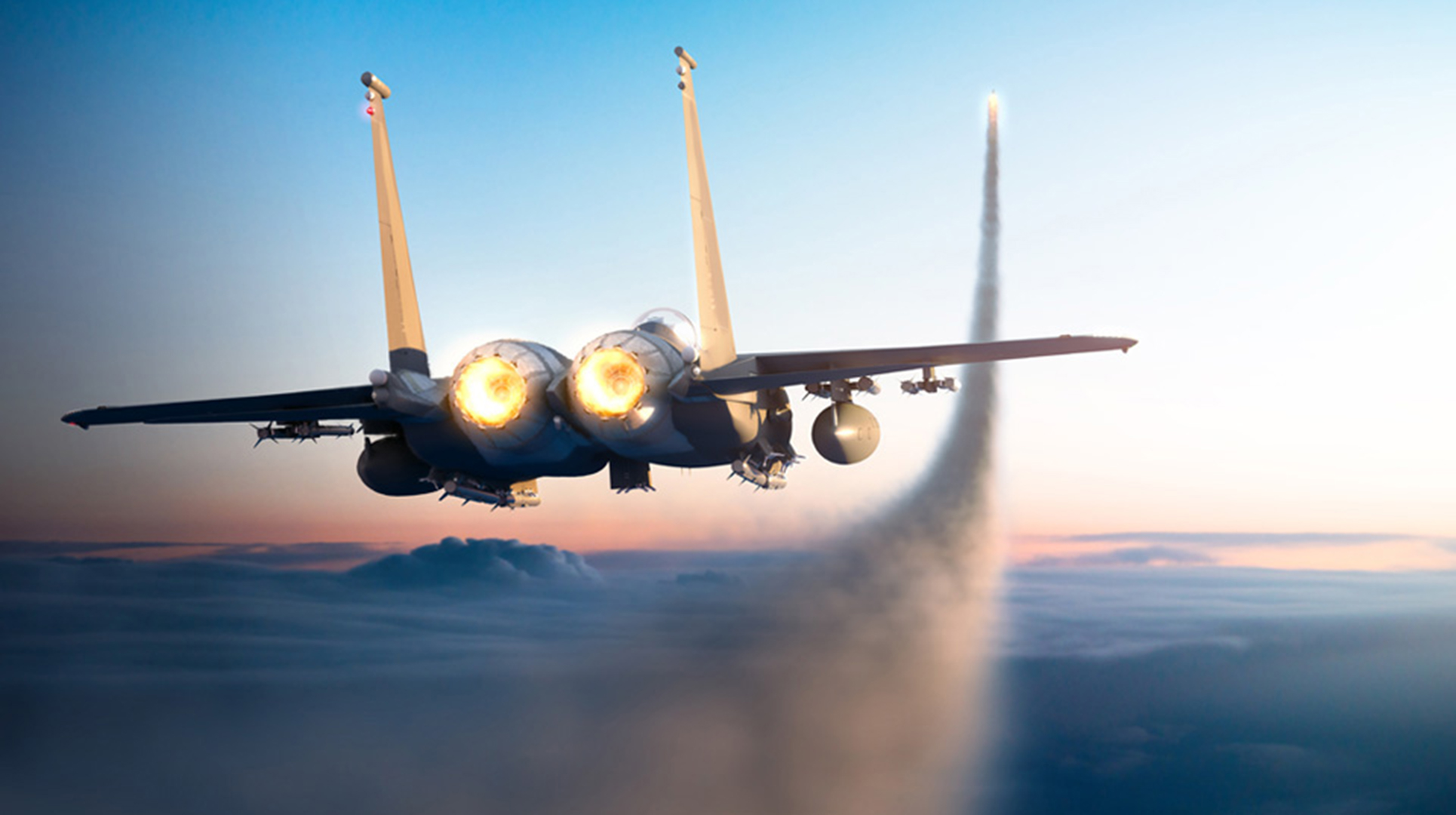
Locating a target, positively identifying it with sufficient confidence to engage it with weapons, then continuously tracking it until it’s time to target and attack. These are all fundamental elements of a modern kill chain. Completing the chain is critical, sensing the damage inflicted and deciding if further action is necessary are the final steps to close the cycle. While these may be the basic building blocks of a kill chain, it is a vast simplification of all that goes into them. So, what will future kill chains – that will grow in distance dramatically – look like? Why will they be so important? And how could they evolve over time?
Scott “Frag” Jobe, a retired major general, was director of force design, integration, and wargaming before he retired from the U.S. Air Force. Jobe is a master of the kill chain and today he heads up strategy for Boeing’s secretive Phantom Works.

These targeting cycles demand sensors, shooters, decision makers, complex communications links, and weapons, each with their own specific requirements. Insufficient speed, poor sensing, and a multitude of shortcomings, including, above all else, enemy actions, can break the cycle and ultimately lead to failure. In specific tactical engagements as well as on a strategic level, advanced adversaries are looking for vulnerabilities in key elements, such as data links and command and control nodes, to break this all-important chain.
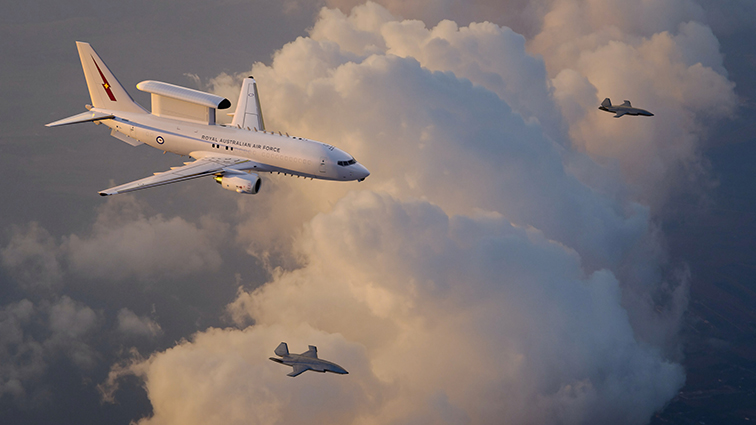
Jobe talked to TWZ about Boeing’s vision for closing kill chains before the battle begins, significantly denying the enemy the ability to break them. That involves a range of capabilities including manned/unmanned teaming and Collaborative Combat Aircraft in offensive and defensive roles. The E-7 Wedgetail as a forward command and sensor node in harmony with space and terrestrial battlespace sensor and communications layers are all part of the equation, with Phantom Works at the front end of the company’s innovations in this critical space – including advanced tech and air dominance game changers like the F-47.
TWZ: Could you explain the critical function of a kill chain?
Jobe: I’ll use some examples of recent events that will help frame the conversation. In recent conflicts, we’ve seen where the inability to close the targeting cycle has been of huge detriment to at lease one of the parties. The ability to close what I call “organic kill chains” – those that are developed from a sensor onboard a particular platform and tied to a weapon to engage targets – has been somewhat successful.
This becomes more complicated when you scale it up to the operational level, and involve intelligence, surveillance, and reconnaissance to collect information from the battlefield and incorporate that into the next series of maneuvers or with targets you want to engage. Then, it’s about understanding whether or not you were successful in getting the effect you want.
We have seen forces unable to do that at scale, resulting in a static, entrenched battlefield. This led to tactics such as sending out thousands of drones to tackle very small and discrete acts like attacking individual vehicles or individual soldiers. If they’d been able to actually close those chains at operational scale, it likely wouldn’t have worked out as it did.
The ability to maneuver and affect the enemy on both sides was degraded to the point where it became a long, protracted campaign. Thus, the ability to scale the engagement cycle is critically important.
You’re familiar with the ‘find, fix, track, target, engage, assess,’ or F2T2EA concept of the U.S. military. The ability to sense a target is your first requirement in any kill chain. That could be from satellites, imagery from unmanned platforms, a crewed platform with a radar – anything that’s collecting intelligence from the battlespace and then understanding it.
If you go back to John Boyd and the OODA loop, that concept still applies today – observe, orient, decide, act. Those are the fundamental parts of kill chains that have transferred to the find, fix, track, target and gauge/assess mantra – those are really the fundamental components.
TWZ: What’s an example of closing a kill chain before the battle?
Jobe: It comes down to understanding the operational scheme, the maneuver, and the sense-making and acting of the kill chain – before the engagement. It’s not just about the sensors and munitions.
We’ve seen it recently when combatants chose not to engage when they knew they could be at a disadvantage. They only engaged when they knew they could close the targeting cycle – and those decisions were likely made before they took off. They had in their minds how they were going to engage, their scheme of maneuver, and what targets and when they were going to take risks to optimize their side and minimize the opponent’s.
In some situations, those military forces have had formidable capabilities – the airplanes, the missiles and the radars. But that’s not what actually decided those engagements. They were decided by how they were going to engage and what risks they were going to take. Those kill chains, I think the pilots and the command and control people had already decided before they went into the battle how they were going to close them.
I’m certain they had contingencies for if things went wrong, but that’s how you actually do mission planning and your operational scheme of maneuver. The plan itself is normally fairly basic and fundamental, and it never survives first contact with the enemy. It’s all about contingencies and what happens when something fails.
I also want to mention Operation Bolo in the Vietnam War, led by [then] Col. Robin Olds. That was an incredible deception campaign and they had closed those kill chains before they engaged. They had already set up false radio calls and set up flight profiles that deceived the enemy. They mapped this in their minds and those engagements were probably decided before they even took off.
Robin Olds developed that tactic and that scheme of maneuver, they had it set up perfectly to be in their advantage, and only engaged when the opportunity was exactly what they wanted.
TWZ: Can you explain what is meant by closing the kill chain?
Jobe: A simple example is engaging an enemy vehicle, the missile hits the vehicle, the vehicle is no longer effective or is destroyed. But the assessment is just as important as finding, fixing, and engaging the target. You must come full circle. Operation Bolo was successful as a tactical engagement, but at the strategic level, the outcome of the Vietnam War was very different. That assessment of engaging tactical targets didn’t fall back around into the operational and strategic ends. Closing kill chains is the full cycle. You need to assess what happened and what’s needed to be able to capitalize on your next series of actions.
TWZ: What elements are critical in a modern-day long-range kill chain?
Jobe: Suppose you have two air assets, one friendly and one hostile, and they are both flying at 40,000 feet. If I use a simple heuristic of the curvature of the Earth they can have a direct line of sight on each other out to a range of around 350-388 nautical miles, depending on global location. Beyond that range, they’re on the other side of the curve and there’s no physical way to “see” one another, unless they maybe have an over-the-horizon radar, which no airborne assets currently possess today.
Put simply, if you’re on the other side of the curvature of the Earth, you’re in a long-range kill chain environment.
In this case, it’s not an “organic kill chain” or something you develop yourself with your own onboard sensors. Something else has to sense the target. Now we are talking about data. The information about the target; its position, altitude, heading or vector, speed, the type of target it is – all of that comes from something else. So you can’t close that kill chain of your own accord.
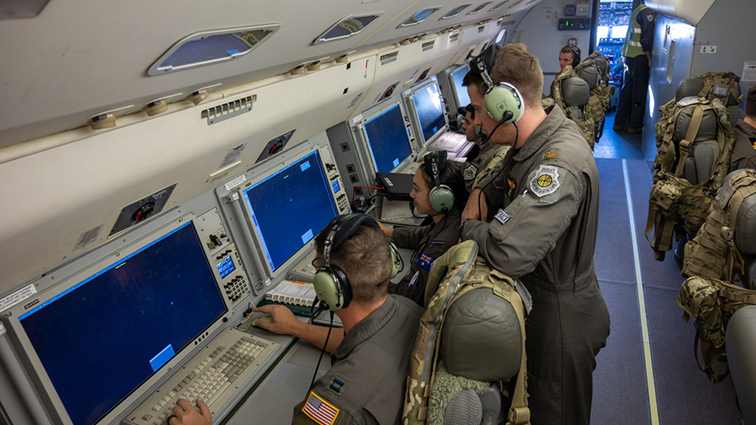
In this situation you’re probably going to be working with a space-based asset. Because that has the ability to sense the target when you can’t. It can also present the ability to gather a great amount of data, process that data on orbit and provide mission-relevant data at mission-relevant speed. So in this situation, the fundamental start of the long-range kill chain is again sensing the target, but it’s got to come from an off-board source. Then the data from that sensor has to pass to the shooter, and that is something that’s got a weapon or an effect that can engage that target. In this case, let’s say it’s an air-to-air missile. Even if the shooter has a missile that can go those ranges, it needs the target data and that adds a communication layer. Adding to that, you need someone to battle-manage this in order to pair the shooter to the target to get after the desired effects, a scheme of maneuver perspective, and also to provide the authority to engage.
When they want to engage the target, guess what? Because of those huge ranges and the time of flight associated with them, something has to update the weapon in flight with in-flight target updates because targets maneuver, they’re almost never static. That requires the same sensor that’s tracking the target to either organically or through another mechanism, send the updates to the weapon.
TWZ: Are you able to comment on what is possible via space sensing?
Jobe: We can direct sense from space or you can have an airborne asset that’s within line of sight and has a sensor to detect. There’s a sensing layer in space that can accomplish some of these things at different levels, and I think I’ll probably leave it at that due to classification levels.

TWZ: Turning to the comms side of this. I’m sure that adversaries have some very sophisticated means to counter long-range kill chains by targeting the comms. What’s being done to address that?
Jobe: Everyone knows that satellites communicate via uplink and downlink. If you jam those, you can no longer tell a space-based asset what you want it to do, nor can you get the information or mission effect that it’s trying to communicate. That’s why we continue to develop resiliency in our long-range kill chains – in addition to the elements of the engagement cycle that already have redundancy or resistance to jamming. Our latest generation of communications satellite have software-defined anti-jam and autonomous self-healing capabilities to counter enemy jamming attempts. You’ve got to have layers of redundancy in your kill chains to close them and be able to rely on them.
TWZ: You mention airborne assets able to sense targets, and of course that leads us to talk about the E-7A Wedgetail and its capabilities.
Jobe: The E-7 is a critical capability for helping to close the kill chain. Wedgetail provides flexibility for the unknown. It commands the fight. Multi-band advanced sensing command and control turn the battle in your favor. It allows you to engage more targets, evade more threats, and integrate the joint force.
The E-7’s advanced capabilities – from sensing to multi-domain data integration to real-time analysis for a comprehensive view of the battlespace – provides powerful multi-domain surveillance, communications, and networked battle management capabilities and interoperability that multiply the effectiveness of joint forces.
It can detect and track a wide array of airborne and maritime targets, providing comprehensive situational awareness across vast operational theaters. The integrated sensor system allows the aircraft to simultaneously monitor multiple targets, making it an invaluable asset for both defensive and offensive operations.
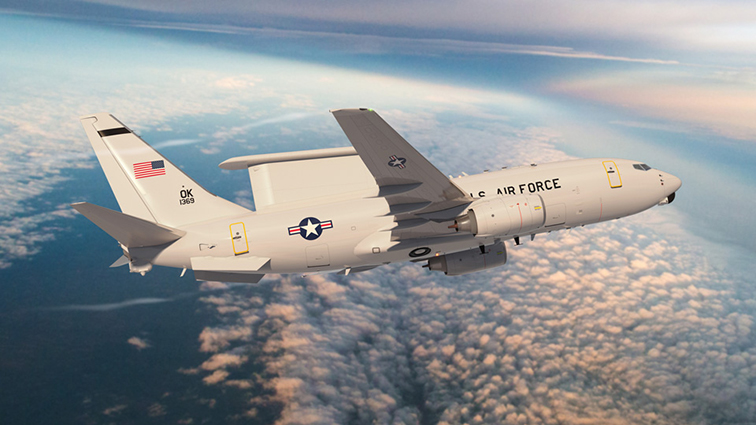
Its capabilities extend beyond detection. It features sophisticated communication systems that facilitate real-time data sharing with air, space and ground forces, enhancing collaborative decision-making. The E-7’s unmatched command and control capability is just as crucial, and will become even more important as all-domain data integration and manned-unmanned teaming becomes [an] increasing part of operations.
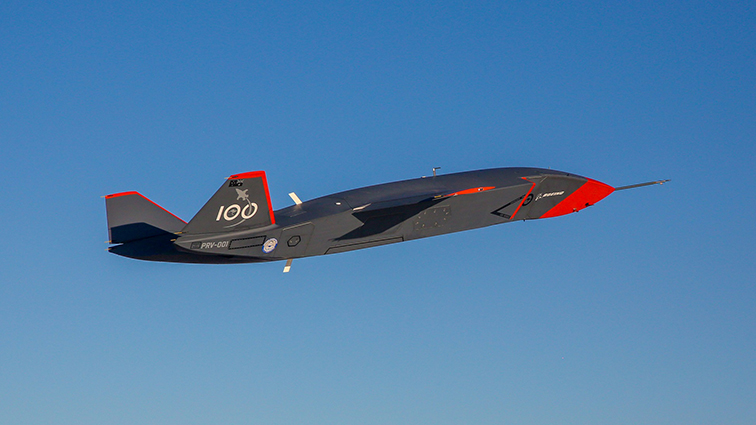
The E-7 has also recently had a first-of-kind demonstration using two in-flight MQ-28 Ghost Bat Collaborative Combat Aircraft [CCA] and a third digital aircraft, all controlled from an airborne E-7. The MQ-28 brings affordable combat mass to complement and enhance long-range kill chains.
There’s been a lot of discussion about CCAs and about manned-unmanned teaming in general. We’ve been flying remotely piloted aircraft for a very long time, but CCAs operate with some level of autonomy that’s organic to the platform itself. Looking at the E-7 and MQ-28 Ghost Bats together as an example, they have the ability to communicate and coordinate with those assets as a huge force multiplier.
Now you can put those CCAs out front where the risk is, more towards where the enemy is without incurring risk to a high value asset like the E-7 or to the human operators on board. Additionally, you have a level of autonomy and artificial intelligence embedded in the Ghost Bats that means they are able to learn the same skills as a wingman CCA that may have just been attrited. The next one off the airfield can have the exact same skillsets, and you can iterate that much faster than you can train a human operator.
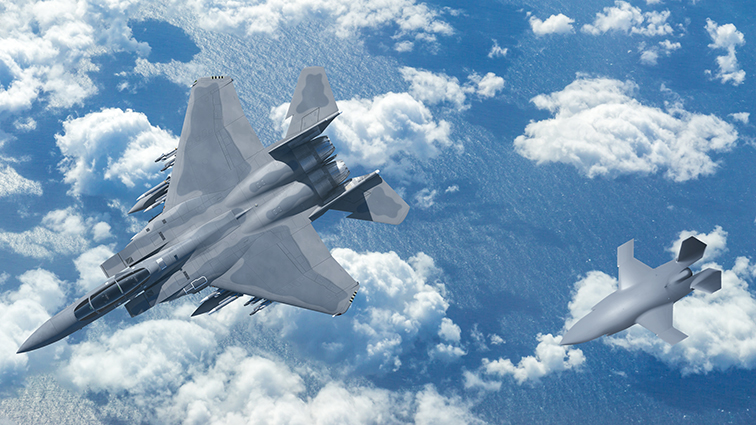
CCAs also change your risk calculus. You can afford to lose the asset to achieve the effect, but without the risk of losing a human operator.
A CCA has the ability to act as a forward shooter and forward sensor. If you get a CCA into a forward position, they can sense and send that information back, either through an E-7 or directly. You can almost think of daisy-chaining the data back to the shooter.
TWZ: How does Phantom Works play a role in all of this?
Jobe: Phantom Works is Boeing’s advanced research and development and rapid prototyping division, with a mission to push the boundaries of innovation and technology. Our ultimate goal is to transform the future of defense – and that includes mission planning, capabilities and solutions that help our warfighters close kill chains before the battle begins.
In Boeing’s defense business, which includes Phantom Works, we’re very focused on bringing a family of systems approach and an open systems architecture. A lot of that work starts in our Virtual Warfare Center [VWC], our leading modeling and simulation environment that we use to collaboratively develop the best solutions for our customers’ toughest problems. Phantom Works has numerous projects currently in development from sea, to air and space – the majority of which are classified.
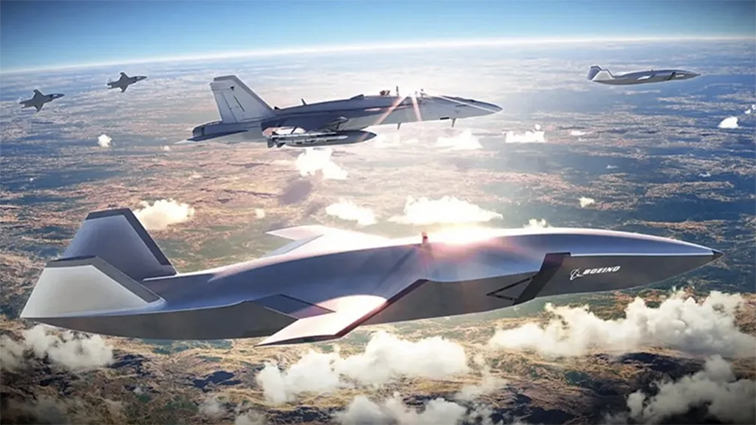
We do a lot of operational analysis in the Virtual Warfare Center to make sure we deeply understand behaviors and iterate on the technology to get reliable effects and to build trust on what CCAs are going to do when they’re no longer “talking to humans.” At the end of the day you’ve got to give the CCA some mission type orders. So that if they don’t have humans there to tell them what to do, they still can go execute some element of the mission.
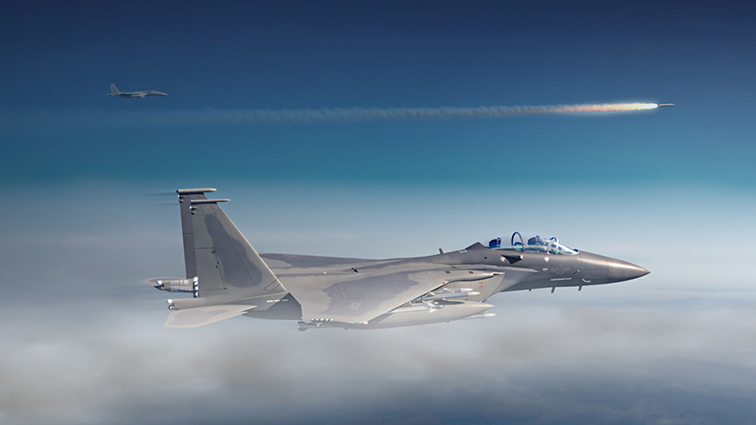
That family of systems includes E-7 with Ghost Bat. That is how we’re building resiliency in our data links and survivability of our platforms and how we communicate both in and through space, but also equally to other warfighting domains, be that surface vessels – cruisers, carriers, and so on. That family of systems approach means we can understand all those elements that have to act together. It could be that E-7 that’s controlling CCAs or Ghost Bat out front. Then I’ve maybe got an F-15EX doing long-range kill chain work to take out high value targets.
How do we integrate those family systems together? It’s been a huge part of our focus, and we’re doing that across all of our different product segments from the Apache and Chinook to our advanced fighters the F-15EXs and F/A-18s and advanced future programs.

Our mobility, surveillance, and bomber portfolio is part of the family too. For example, with the KC-46A Pegasus, we are looking at how we make that a partial battle management node, because you don’t go anywhere without a tanker. If you fly fighters, tankers are your lifeline because they’ve got your gas. You can top up with gas and at the same time top off with data. The KC-46A tanker can relay battlespace information among fighters, carriers, and the rest of the fleet. So we’re very oriented on the family assistance approach, and understanding how all these fit together.
It comes back to what we talked about before. You need to have resiliency in your kill chains, that makes them reliable. We’re very focused on making sure we understand all potential vulnerabilities and that we’re mitigating those and building trust in the whole family of systems ecosystem.
We continually wargame to understand the changing environment from a threat perspective. From a technology perspective, we’re very focused on digital engineering and design concepts that enable us to rapidly introduce new technologies, both hardware, but a lot of software. You can get a lot of capability with new software to mitigate new threats. Things like new algorithms that can do auto target recognition if the adversary changes their electronic signature or what they look like to a sensor. You can quickly spiral software to counter that capability when it emerges.
TWZ: We talked about closing kill chains before the battle begins. What is the vision for that within Phantom Works and how are you evolving kill chains?
Jobe: We’re actively working on the U.S. side with battle management, command and control, communications, or BMC-3. A lot of that is about advanced software that’s able to operate at a speed and scale that is difficult for humans to do, in order to know where all the different assets are, what different sensors they can bring to bear, and then how can you integrate them together. That way you enable the humans that are making decisions and present a greater understanding of the battle at machine-to-machine speeds.
There’s also a lot of mission planning that helps characterize the threat environment and the physical environment. That’s things like terrain and weather – all of that is still a factor in real operations that often is overlooked. So we do a lot of software development and mission planning and then battle management in that area.
Ultimately, a connected, adaptable, and ready family of systems to deter and win the joint fight is our focus. That’s E-7, MQ-28, satellites, F-15EX, F-47, mission systems and core technology capabilities that are a few important elements of our family of systems.
Boeing brings data, platform knowledge, integration and an open systems architecture to the customer, and potential partners, as we continue to iterate, prototype and design for the future. We’re helping customers out-innovate the threat when it comes to the long-range kill chain today, and we will continue to evolve that capability into the future.
Contact the editor: Tyler@twz.com