
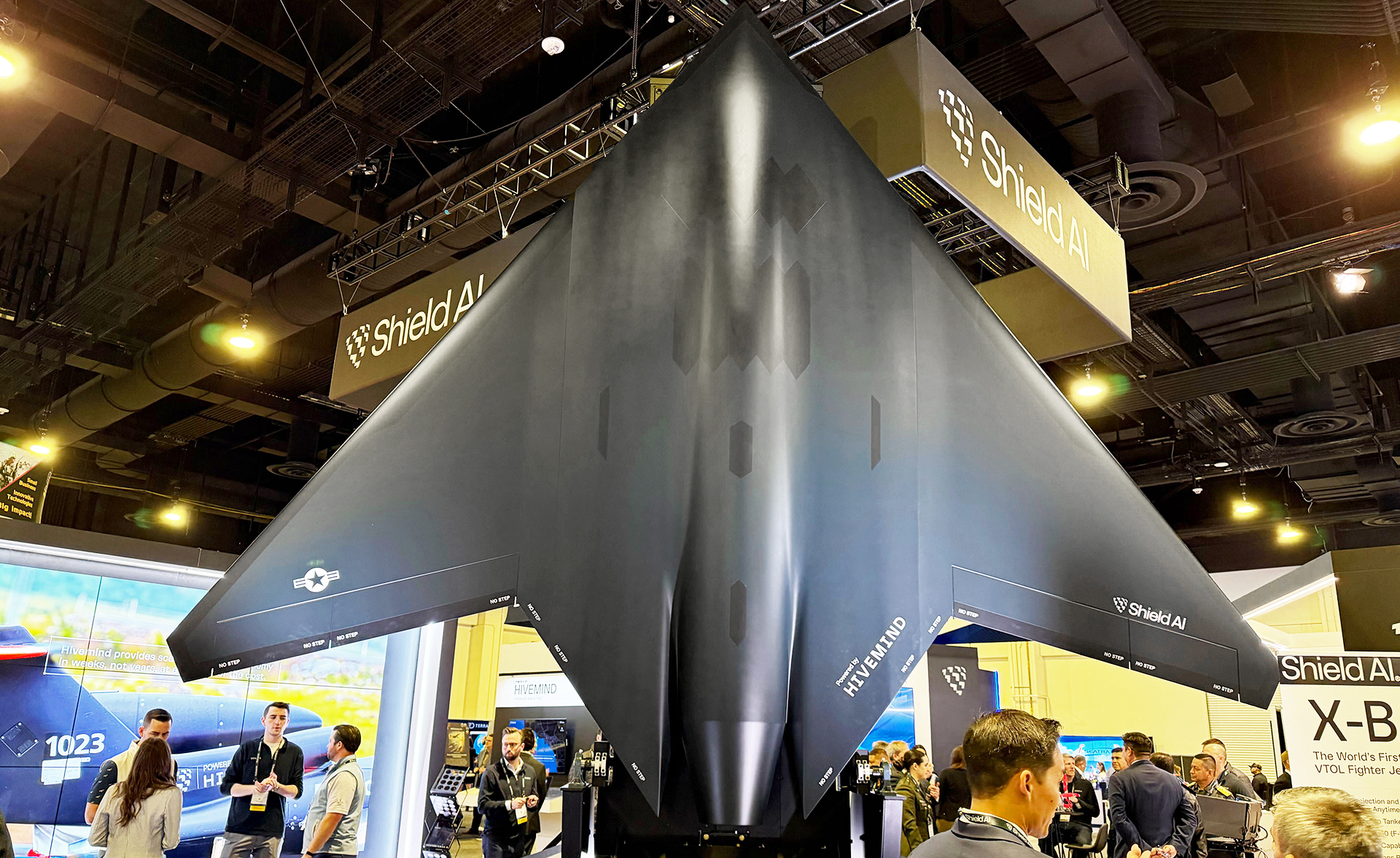
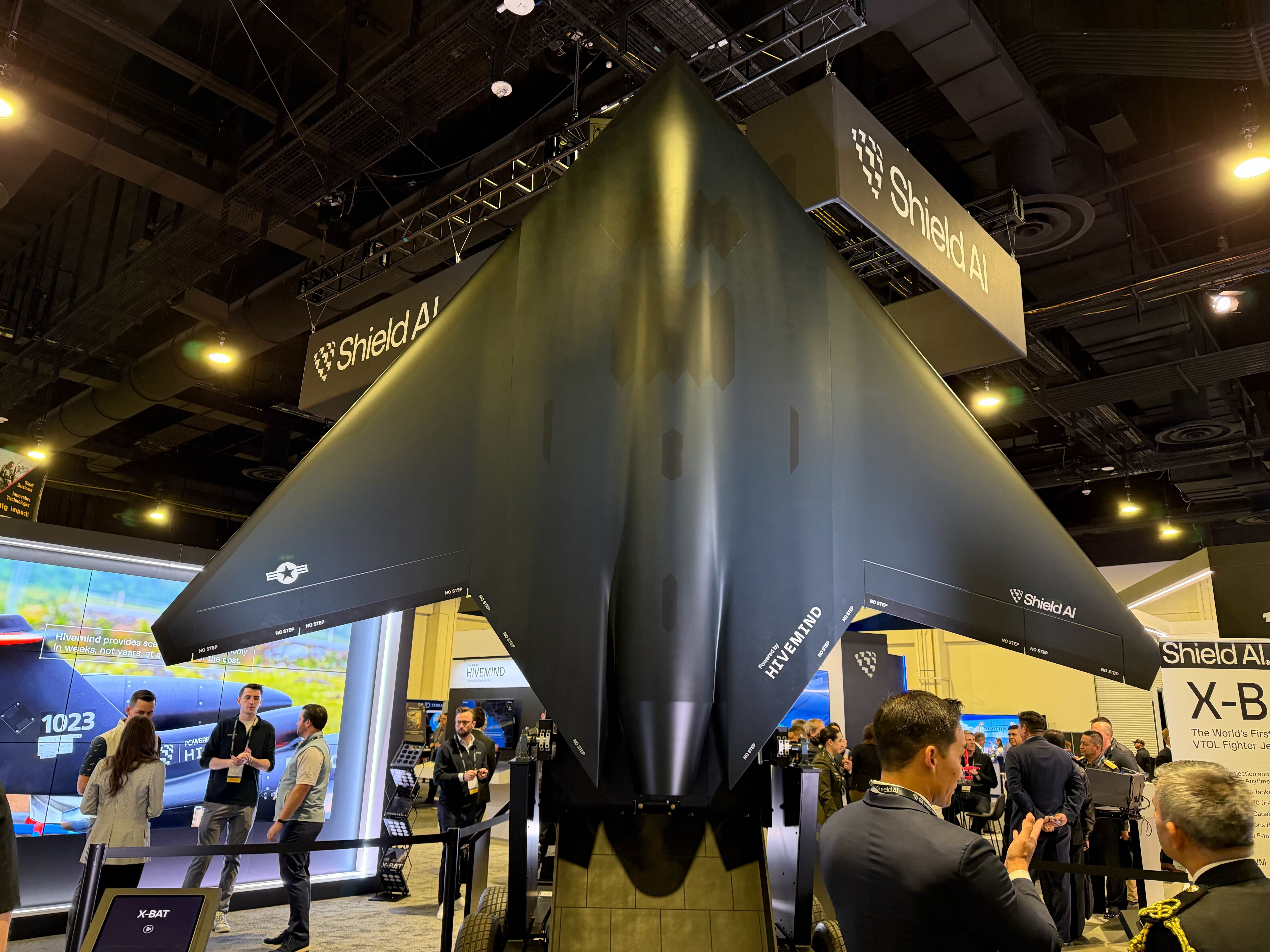
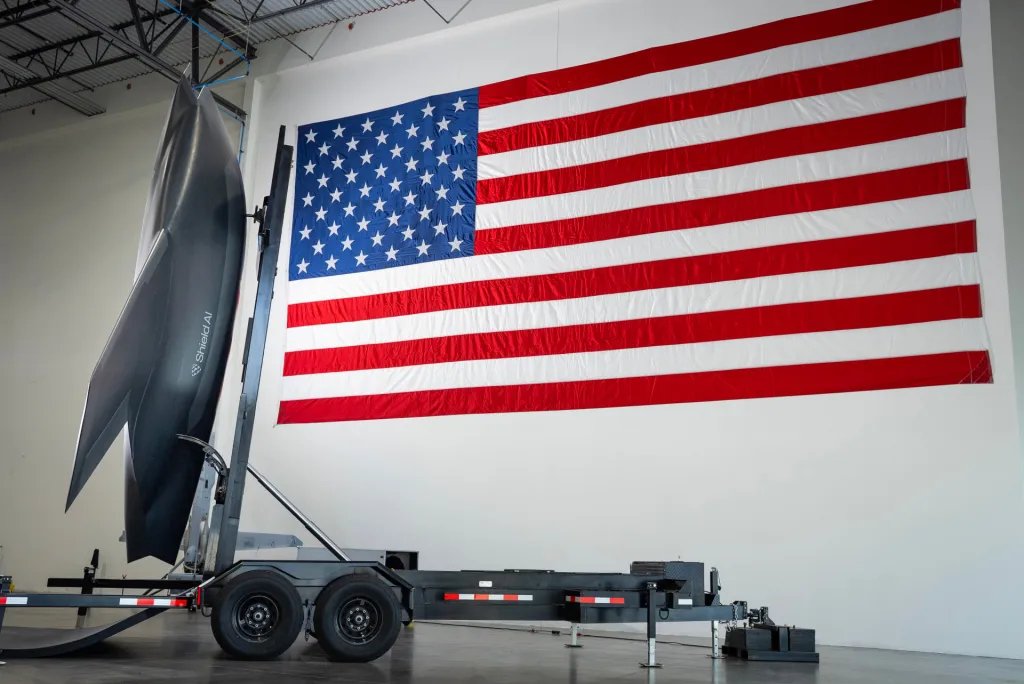
Shield AI and GE Aerospace have revealed more details about X-BAT, the jet-powered autonomous stealth ‘fighter’ drone designed to take off vertically and land the same way, tail first, after completing its mission. With the extremely ambitious aircraft concept planned to start vertical takeoff and landing (VTOL) testing before the end of this year, the companies have also shown off a roughly half-size model that includes significant design changes.
The new details came when officials — J.J. Cummings and Armor Harris from Shield AI, and Steve Russell from GE Aerospace’s Edison Works — spoke with reporters, including The War Zone, at the Sea-Air-Space 2026 exposition near Washington, D.C.
Make sure to get up to speed on everything we previously knew about X-BAT in our exclusive feature from when the aircraft was unveiled, linked here, as well as its forthcoming flight testing here.
A major redesign
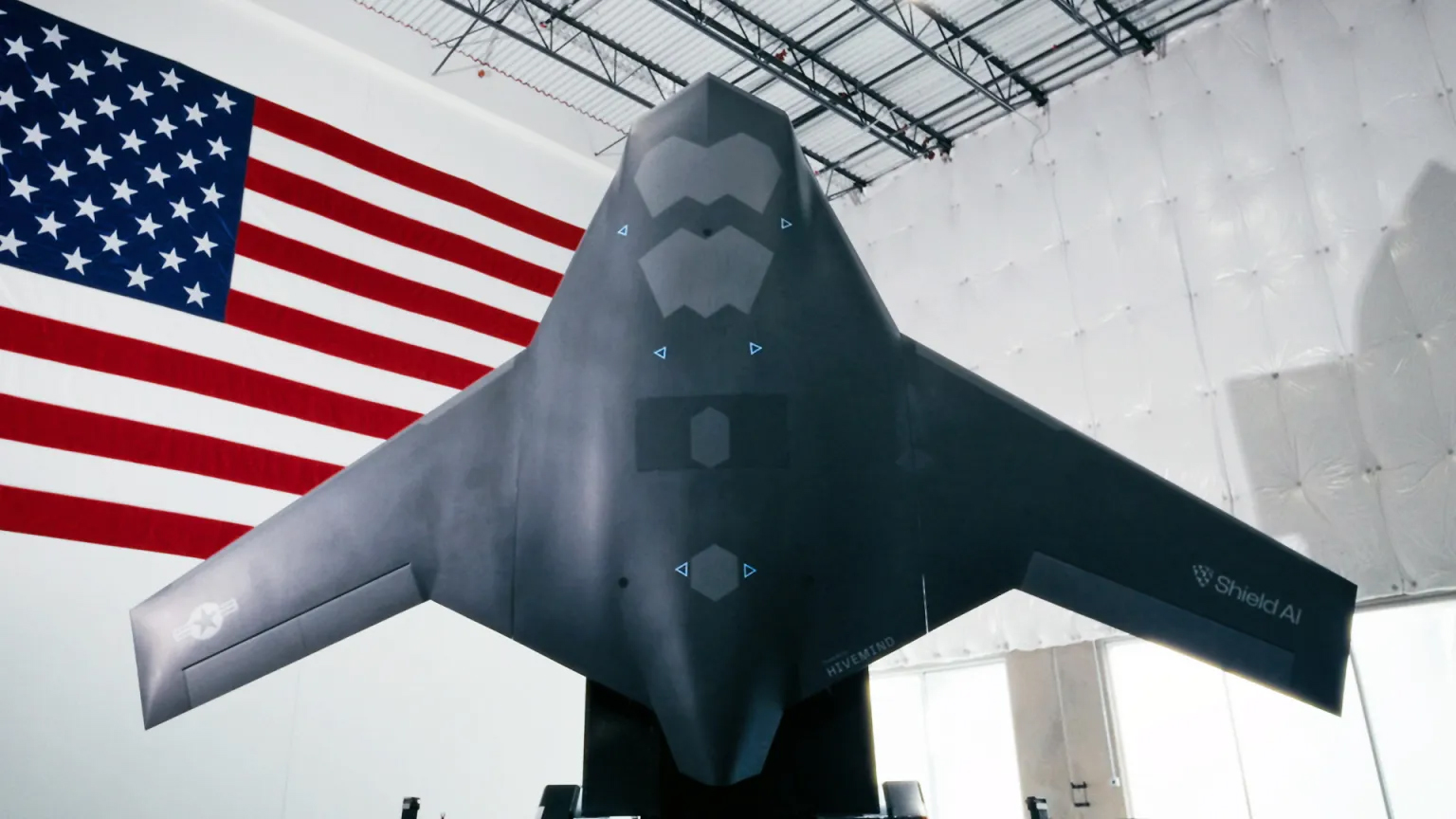
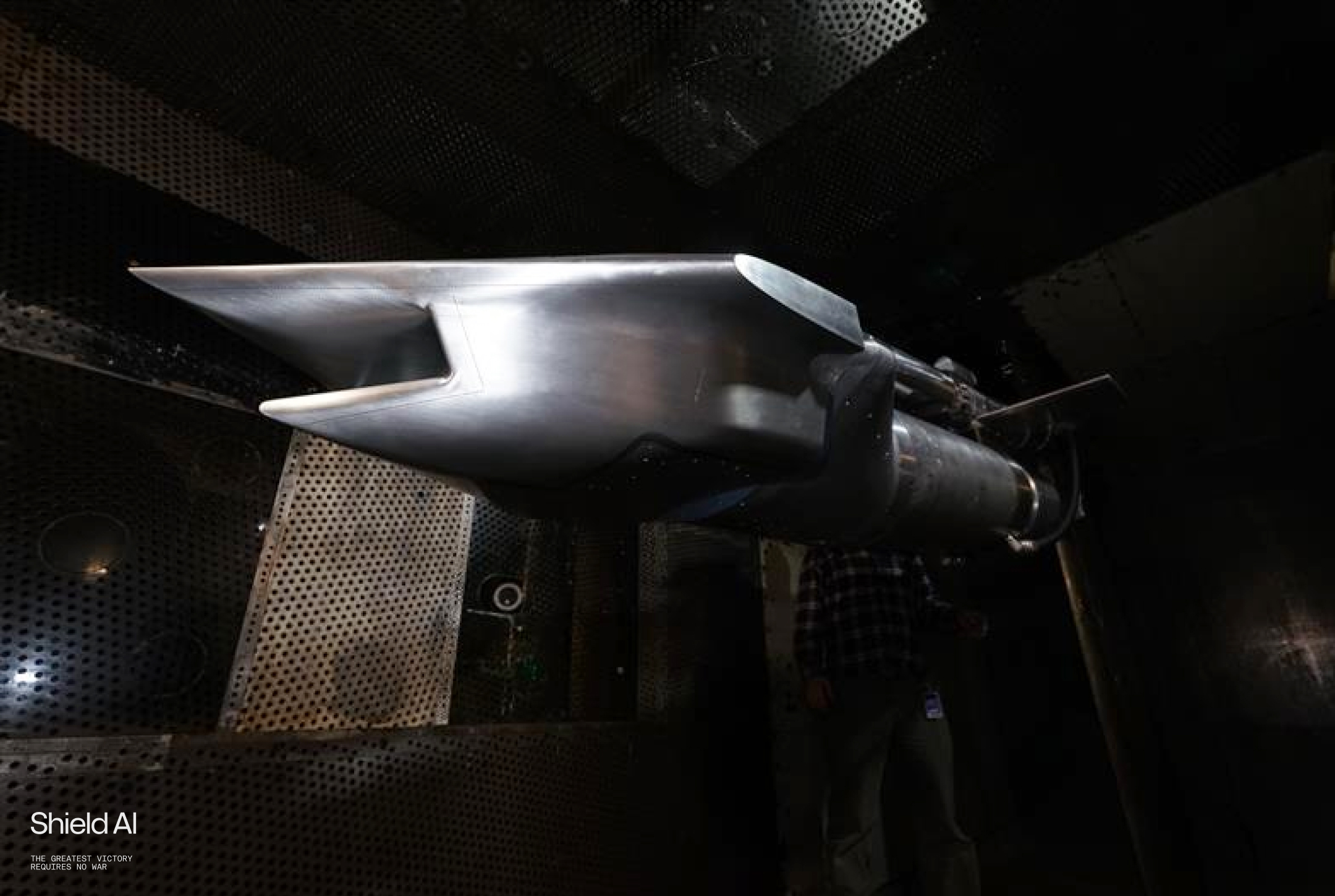
When we discussed the X-BAT in our in-depth coverage of the program in the past, the drone had a ‘cranked kite’ planform, which has now given way to a straight leading edge with a more dramatic sweep as part of a distinctive arrowhead-shaped profile. We saw the same on the Boeing X-45C Phantom Ray UCAV prototype, and it has since been adopted by the Chinese GJ-11 Sharp Sword, among others. This new configuration looks better optimized for higher-speed flight.
According to X-BAT’s chief designer, Armor Harris, “We’ve taken an iterative approach to development and made improvements to the design based on test data.”
Raiding the past to realize the future
Of all the new details we received about X-BAT, where the jet’s critical thrust vectoring capability will come from is perhaps the most intriguing. GE Aerospace says that the engine nozzle is the Axisymmetric Vectoring Exhaust Nozzle (AVEN), which comes from a specialized thrust-vectoring F-16 that was tested out of Edwards Air Force Base, California, back in the 1990s. The AVEN nozzle — taken direct from the warehouse, “Indiana Jones-style,” according to the officials — will be used for the initial testing.

Multirole platform: including tanker
Officials confirmed that the X-BAT can be operated as a tanker, making use of its two external hardpoints. Both of these are plumbed to the internal fuel tanks, so they can support ‘buddy’ refueling pods, which trail a hose and drogue.
The companies stress that aerial refueling tanker is “definitely not a primary mission,” but this option does reflect the multirole nature of the platform. Meanwhile, drone tankers are a growing area of interest for different U.S. military services, with efforts currently spearheaded by Boeing’s MQ-25 Stingray, although, since it is larger than the X-BAT, this would also offer much greater internal capacity.
For expeditionary operations, in particular, drone tankers are seen as a viable solution, although by no means the only one. X-BAT acting as a launch tanker could be especially of interest for tactical jets that require long runways. This would allow them to takeoff in short distances with heavy weapons loads and get fuel immediately from the X-BAT tanker before heading on their missions. X-BAT tankers could also act as unpredictable refueling platforms that are forward deployed for enroute combat aircraft, launching from virtually anywhere to refuel jets making their way from longer distances to their target areas. These are just some of the less traditional theoretical ways a tanker-configured X-BAT could be used.
Interestingly, based on the current concept of operations, Shield AI sees less interest in having the X-BAT take on fuel while airborne itself, although there is a “holding place” for a refueling probe in the nose, if required.
Overall, and beyond tanking, the X-BAT’s multirole capability implies “significant air-to-ground capability, maritime strike capability, and electronic warfare capability,” Shield AI says.
GE Aerospace F110 engine
Last year, TWZ broke the news that GE Aerospace was working with Shield AI on the powerplant side of the X-BAT, specifically its F110 turbofan, the same as used in many F-16s and F-15s. The choice of the F110 was driven by size and thrust requirements, including the demanding VTOL cycle that’s at the heart of the X-BAT concept.
Significant thrust is also a prerequisite of the X-BAT’s multirole capability, which Shield AI says sets it apart from other Collaborative Combat Aircraft (CCA) and uncrewed combat air vehicle (UCAV) type drones now flying or in development.

As well as offering what Shield AI describes as the best power-to-weight ratio in its class, the F110 was selected for its fuel economy. The engine is also widely available. With roughly 3,400 in the world, several “certified pre-owned engines” have been obtained for the program, as well as new-build ones.
While the partnership between Shield AI and General Electric was announced relatively recently, they have been working together for longer, with “tremendous progress on adapting the F110 engine” made in the last six to 12 months, according to officials.
Payload and range
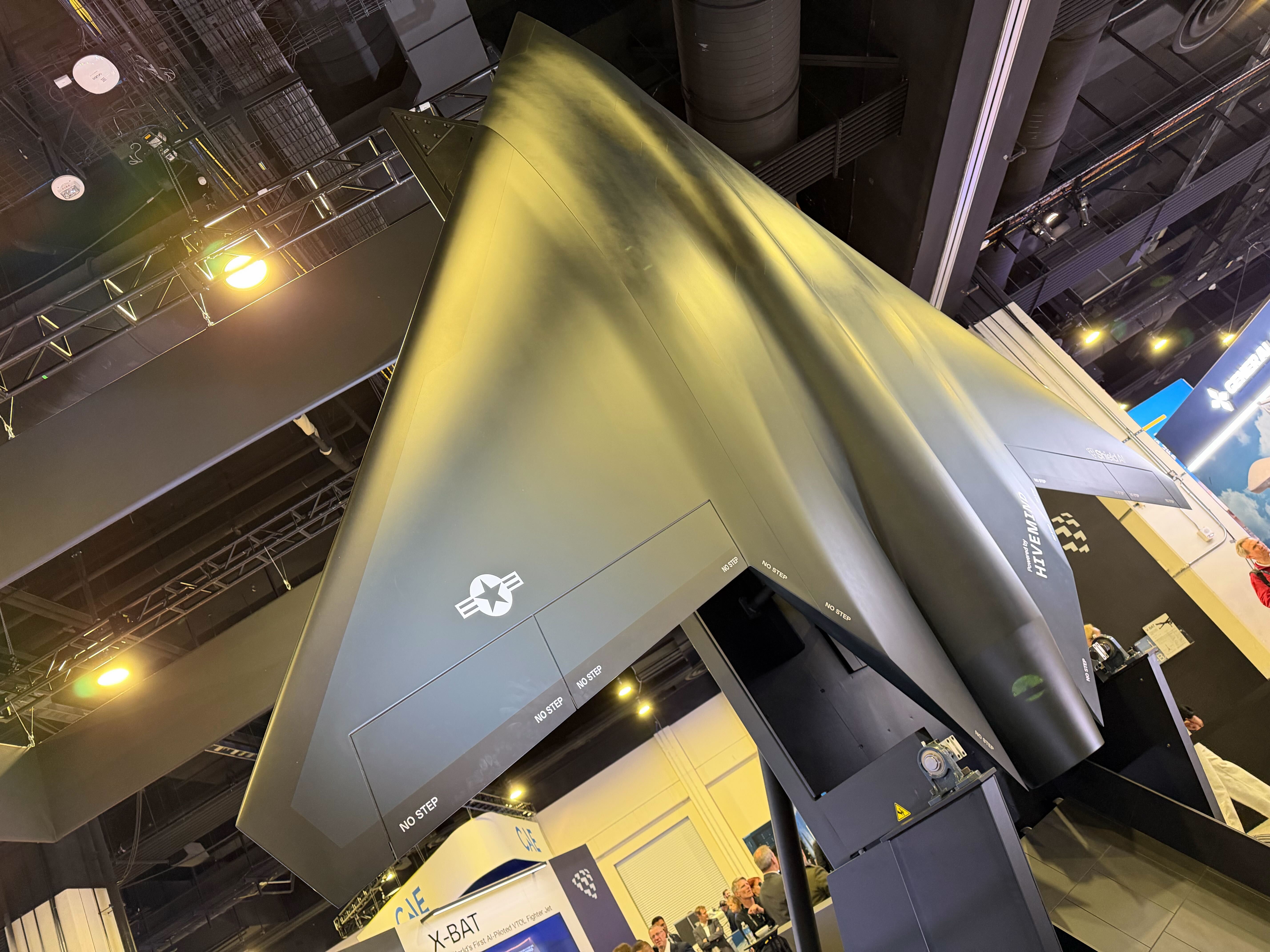
According to Shield AI, X-BAT is around twice the size of all the other CCAs that are on the market today, which allows it to have a pair of payload bays that are roughly the same size as those found on the F-35. This means that any store that fits in an F-35 can theoretically also be accommodated internally in an X-BAT. These presently include 2,000-pound-class weapons.
At the same time, the X-BAT “goes twice as far” as an F-35, meaning double the combat radius. The drone’s manufacturers give a combat radius figure of 1,000 nautical miles. In the past, Shield AI told TWZ that the drone would also have a maximum range of 2,000 nautical miles and a service ceiling of around 50,000 feet.
Of course, the aircraft’s weight is a major factor in providing range. Company officials say they are “not really doing anything super-novel on the design of the air vehicle” in terms of weight reduction. However, with no landing gear and no auxiliary power unit (X-BAT uses an external lithium-ion battery pack to start the engine), and with other items moved from the air vehicle to the trailer-based launch recovery vehicle, all of this helps make the drone lighter.
VTOL flight profile
For vertical takeoff, the F110 engine is put into afterburner to get the required thrust-to-weight ratio needed for takeoff, although the aircraft returns to land on military power (without afterburner).
Various modifications are needed to the F110 for use in a vertical takeoff application: as a tail-sitting aircraft, the X-BAT spends a lot of its time in this attitude. As such, the engine has been exposed to significant subscale and full-scale testing at GE Aerospace facilities. Shield AI says it plans to build the prototype aircraft at a facility in Frisco, Texas, this summer.
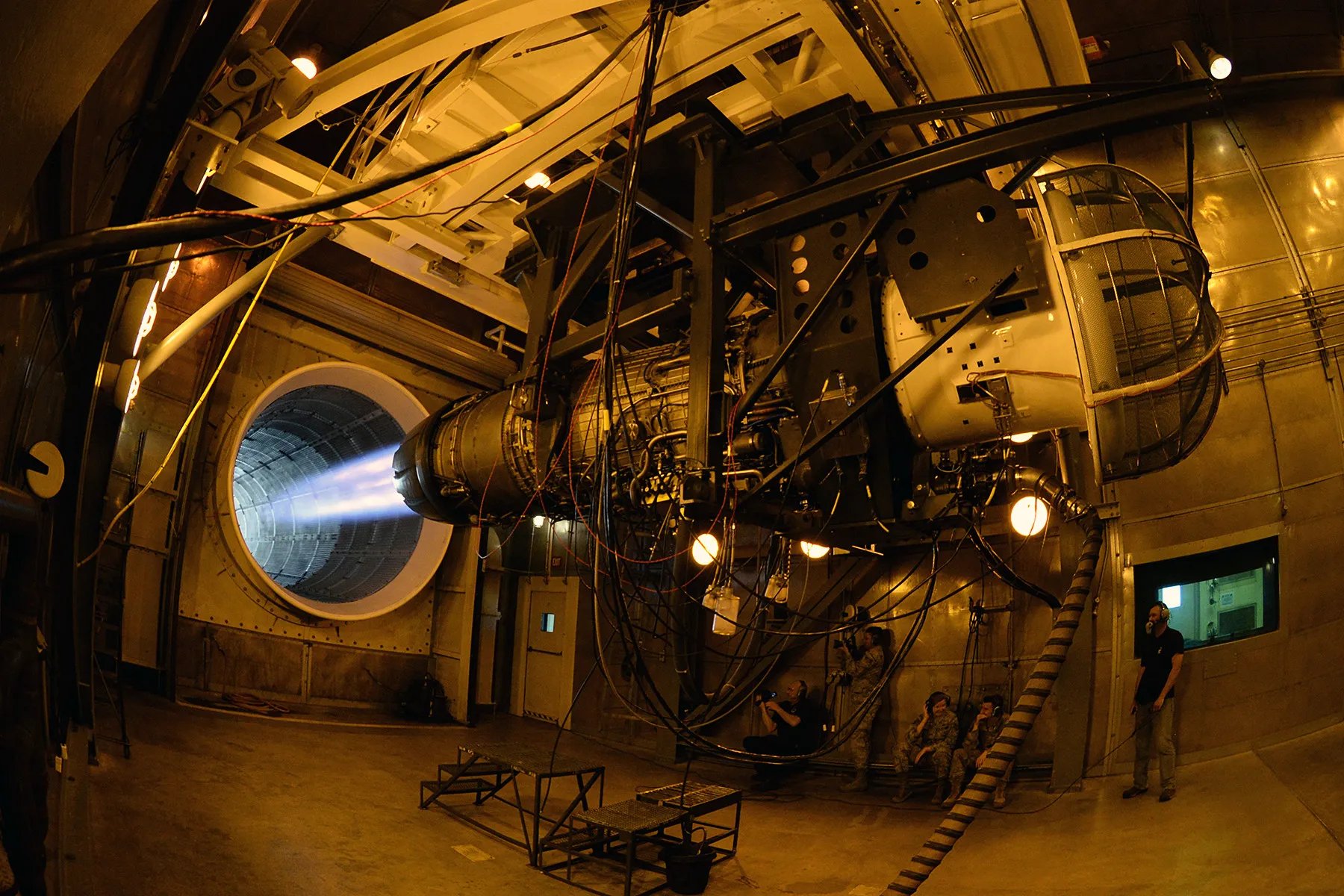
Interestingly, one important part of the tests so far has been to explore just how far the F110 can be throttled back for the delicate VTOL and transition phases. Previously, the limits were set by the cabin pressurization requirements of crewed aircraft: essentially, how much fan speed was needed to generate enough bleed air to pressurize the cabin for the pilot. Since the X-BAT is uncrewed, the F110 can be throttled back farther and operate in different regimes.
Thrust-vectoring nozzle
While the aforementioned AVEN nozzle will be used for the initial testing, the companies are meanwhile working on redesigning and updating the design and building more nozzles. The control system and software are also completely different from those used on the original AVEN and are tweaked to work with today’s F110.
“It actually has worked really well,” Steve Russell says of the nozzle. “We’ve done testing where we’ve reversed it, we’ve integrated it, we’ve run the control system … you put all those things together and put it into such a cool platform that’s really going to present a unique dilemma for our potential adversaries.”
So far, testing has shown that the rigors of VTOL actually result in less fatigue and vibration compared to a typical F-16 profile.
The current nozzle doesn’t have low-observable (LO) attributes, but that is something that will be introduced after prototype testing. There is also the possibility of the X-BAT vectoring its nozzle in forward flight to increase its agility. The companies stress that this capability will depend on customer requirements, but the nozzle will be fully vectorable across the flight regime.
The focus for now is more about actuation and integration of the F110 with the Shield AI airframe and flight control system. A key factor is mitigating against exhaust gas ingestion and ensuring the engine is fed with clean air during the transition phases of flight. However, this is not something the developers are overly concerned about, and the F110 is also judged particularly stall-resistant.
Air intakes and blast deflector
Shield AI’s air intake system is specifically engineered to handle these demanding phases of flight and includes an auxiliary inlet on the back of the aircraft. This is concealed beneath a panel when the aircraft is not in VTOL mode.
Just as important is the engine exhaust, especially when it comes to mitigating the risk of foreign object damage (FOD) and kicking up debris that could damage other assets on the ground during VTOL operations. This would be especially critical on the tight confines of a ship’s flight deck.
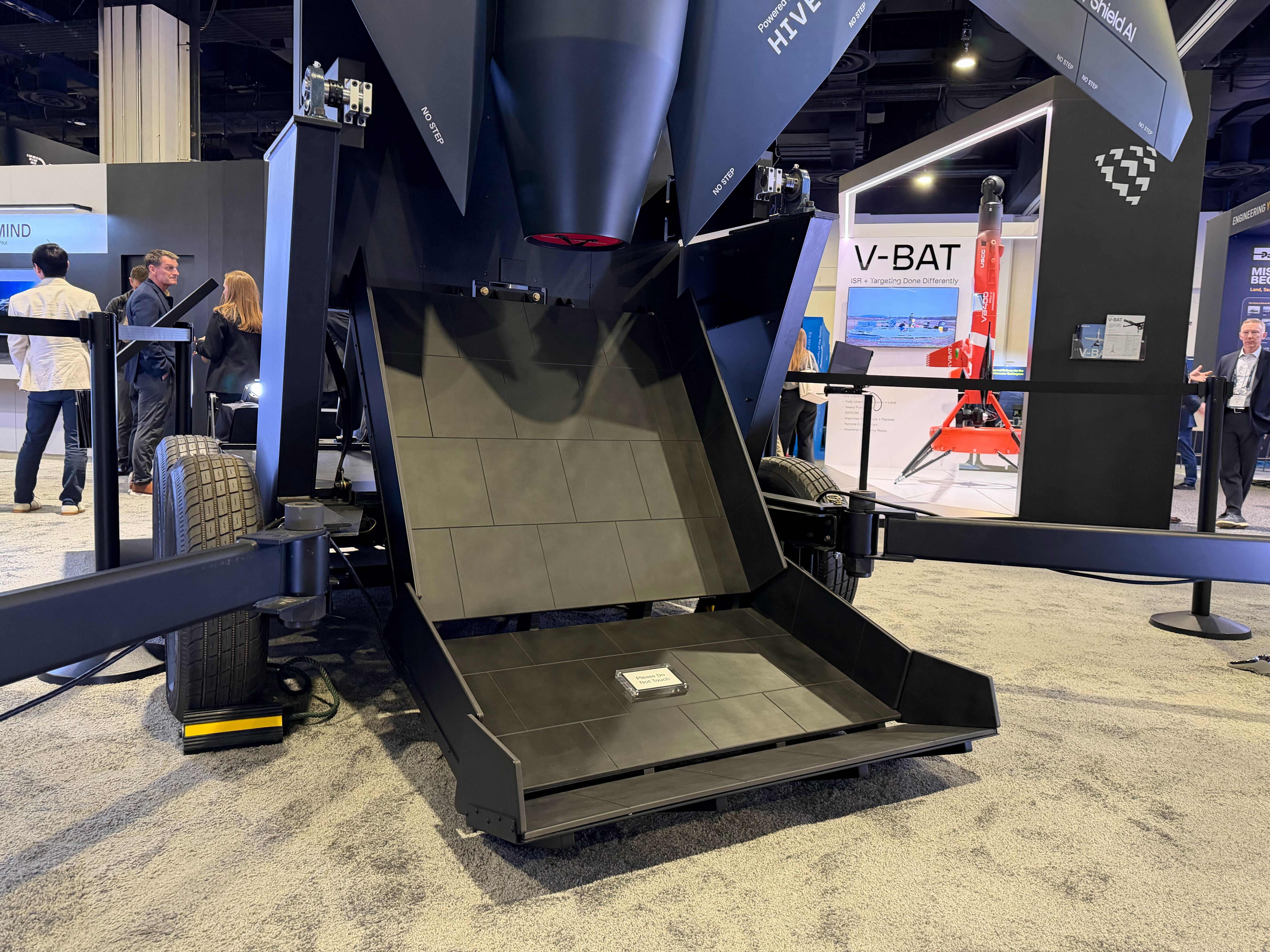
For the launch, a blast deflector built into the X-BAT’s custom trailer is designed to direct the exhaust plume away rather than recirculating it back to the engine. The fact that the aircraft is suspended relatively high in the air for takeoff means that the issue of rocks and other debris being kicked-up at the aircraft is reduced. The deflector also channels the blast in a known direction.
For the landing phase, the aircraft’s approach profile helps avoid FOD and exhaust gas ingestion. Instead of coming straight down to land, the X-BAT approaches the launch-recovery trailer from the side, makes contact with it, and then powers up into a latch that secures it. The aircraft also leans slightly into the incoming airstream to help ensure the intake is always being fed with cleaner air.
Open system architectures
With open system architectures baked into the design, it should also be easier to upgrade the X-BAT than previous aircraft, meaning it is getting “a lot closer to plug and play.” Shield AI talks about swapping in and swapping out different radiofrequency and infrared sensors for upgrades or potentially for different missions.
The companies remain generally tight-lipped about the electronic warfare (EW) packages that will be installed in the X-BAT. They did say that the EW gear will be unique to this aircraft and that they were able to leverage a lot of the sixth-generation systems that have been developed for the NGAD programs, in both their Air Force and Navy iterations.
Testing pathway
Looking in more detail at what comes next for the program, Shield AI and General Electric confirm that the first stage of testing is already underway, using the adapted F110 on GE Aerospace test stands. Step two will see the propulsion system integrated into the prototype aircraft. It will then be run horizontally and then vertically, while still attached to the launch-recovery trailer.
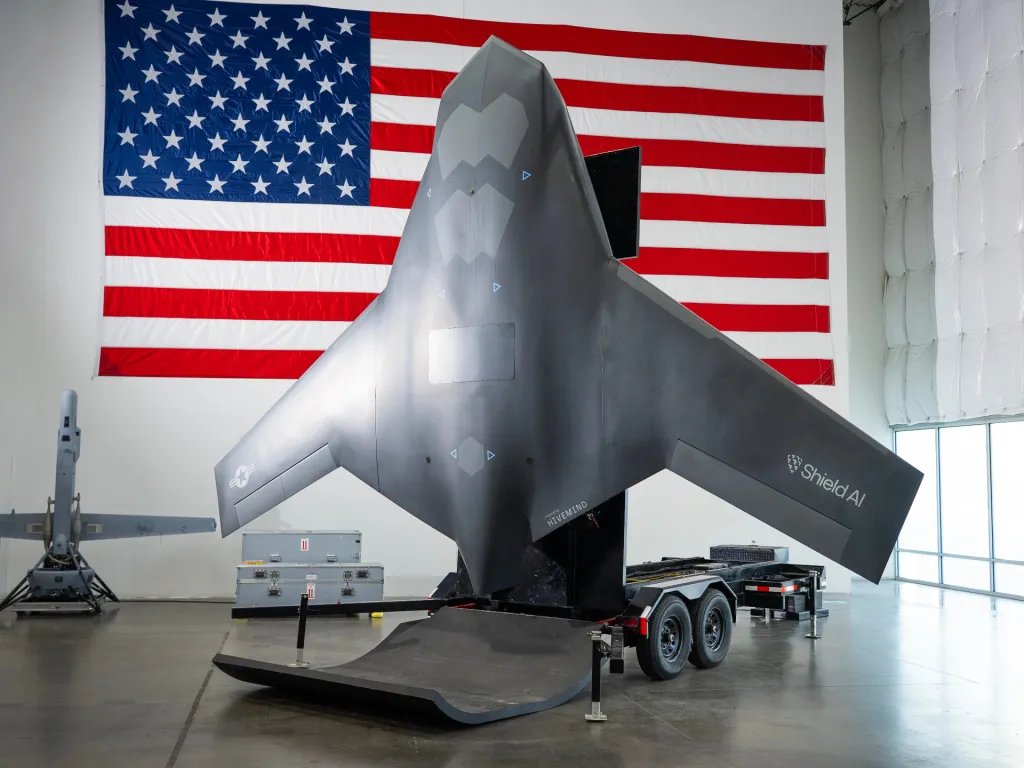
The next step will involve a very large crane, which will hold the aircraft vertically, with engine tests being run while the X-BAT is tethered for safety. This phase will see the propulsion system tested in proximity to the ground, in proximity to the launch and recovery trailer, and under different inlet conditions.
The final step will see the tether taken off, allowing the X-BAT to perform free flights. The aircraft will take off from the launch and recovery trailer, go up, come around, and reattach to it, all in vertical mode. If things go well, company officials say, this milestone will be targeted before the end of 2026.
In the process, Shield AI and General Electric are realistic about the possibility of mishaps in what is really groundbreaking technology. Company officials describe a “hardware-rich approach to test,” which means building several prototype test aircraft that will be pushed to the limit. They “fully expect to lose one in testing,” since the program is stressing the delivery of capability to the operators as quickly as possible. In this respect, zero failures mean the program is going too slow, the officials say.
Market prognosis
Shield AI and General Electric confirm that there is “tremendous interest internationally” in the X-BAT, across all regions.
Their business case rests on the X-BAT providing “fifth and sixth-gen type capabilities” at a price point much cheaper than an equivalent crewed combat jet. Part of the cost equation also relates to the VTOL flight mode, which means operators can “delete a lot of the lifecycle cost associated with having a conventional air force.” With no conventional airbase required, there is no need for expensive airbase defenses or hardened aircraft shelters. The concept of operations involves a much-reduced need for tanker support, since the X-BAT can be forward stationed and has a large combat radius. Of course, there is also no conventional pilot-training pipeline. Shield AI and General Electric officials describe the resulting air power employment, in life-cycle terms, as costing around a tenth that of an equivalent fifth or sixth-gen type.
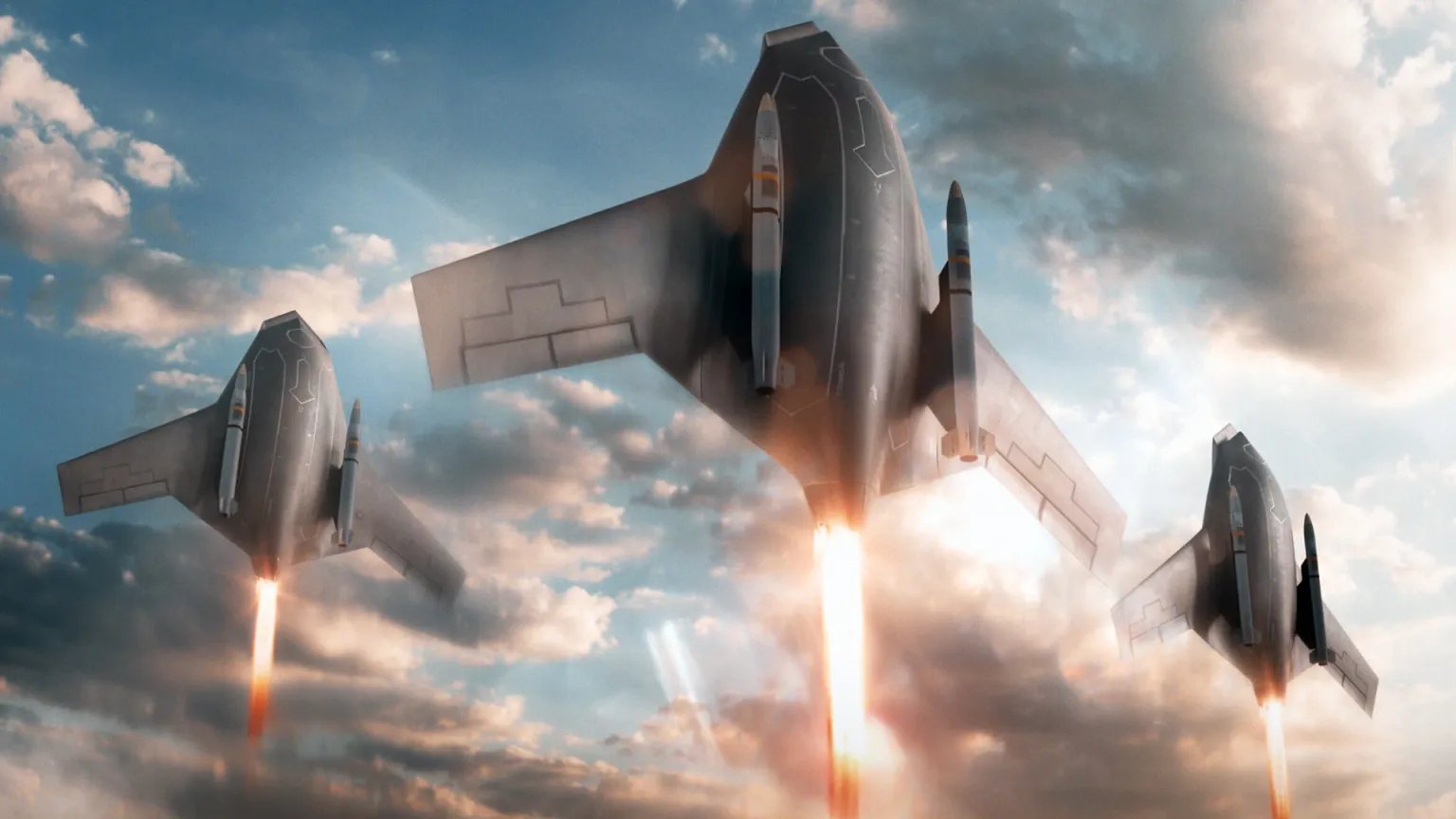
Compared to those fifth/sixth-gen platforms, the lower cost of the X-BAT means that it doesn’t have to be as survivable. Shield AI and General Electric talk about the aim of having an aircraft that is “just survivable enough that you can do the mission.” Meanwhile, it should avoid the “exponential costs for incremental return” that are inevitable in other, more exquisite platforms. Instead, the companies are looking at the possibility of an operator buying 10 to 20 X-BATs for the price of something like a B-21. The Air Force previously specified an average unit cost of roughly $550 million for the B-21.
With this in mind, Shield AI is sizing a factory that will be able to produce 150 X-BATs annually, with employees working single shifts.
Clearly, the ambition of creating a vertical takeoff and landing ‘autonomous fighter’ that is capable of countering an adversary’s air defenses at a fraction of the price of a crewed platform is incredibly bold. Some would even call it outright far-fetched. Yet the comparisons to Space-X and how they disrupted the space access market by doing something many thought would not work — also a VTOL solution — also can’t be denied.
With testing of the X-BAT and its F110-based propulsion system now well underway, and first flights planned before the end of the year, we are getting closer to seeing whether this radical vision can actually be realized.
Contact the author: thomas@thewarzone.com
Loading comments…
Comments couldn’t be loaded. Please refresh the page.