
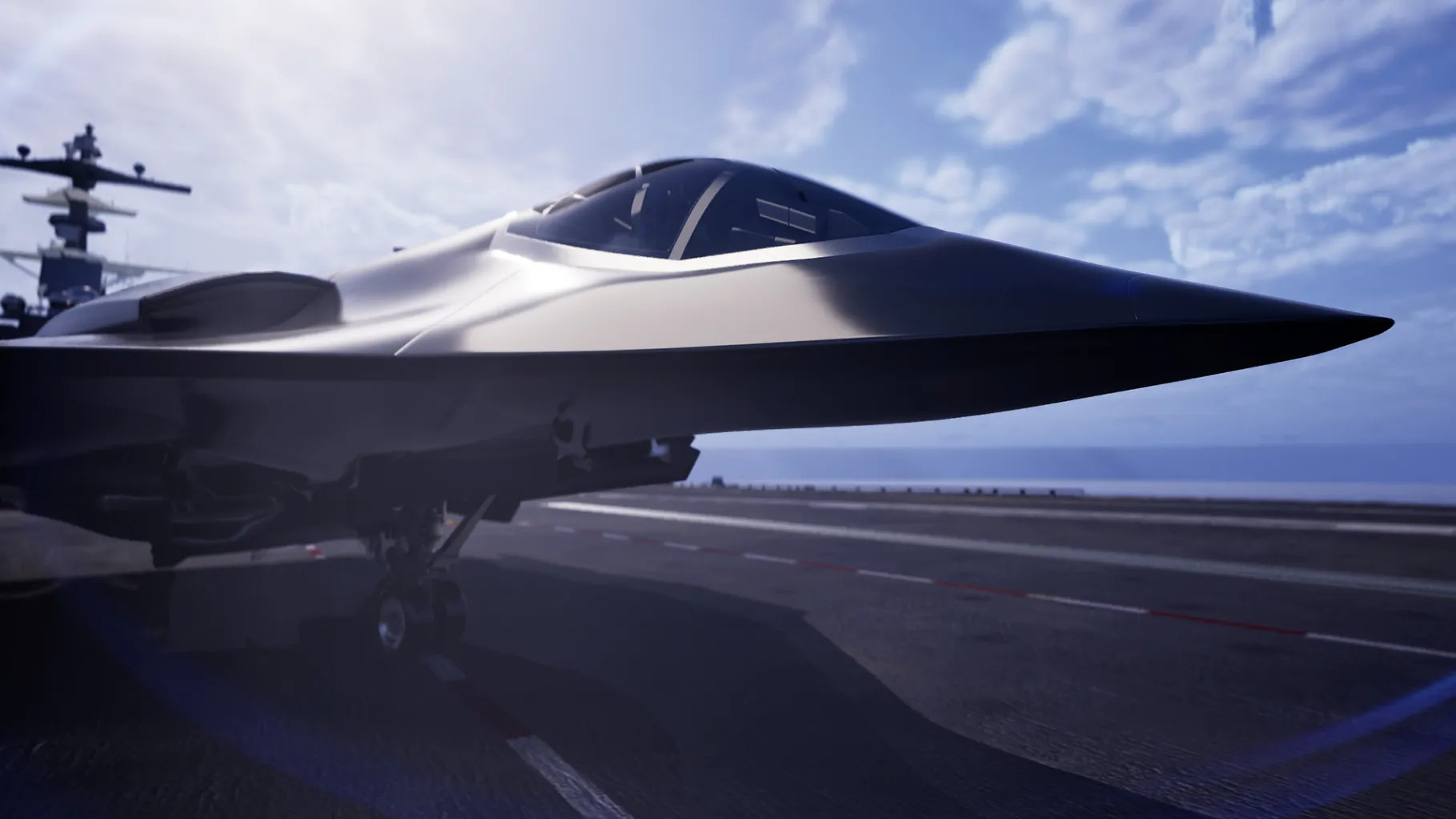
The House and Senate Appropriations Committees have negotiated a draft defense spending bill that includes nearly $900 million for the U.S. Navy’s F/A-XX next-generation carrier-based combat jet program. The proposed legislation and an accompanying report also aim to finally force the selection of a winner in the stalled F/A-XX competition. All of this comes after Congress did not reverse the Pentagon’s previously announced plan to effectively freeze the F/A-XX effort in the most recent annual defense policy bill, despite framing the program as fully funded therein.
The Senate Appropriations Committee released the text of the draft Defense Appropriations Act for the 2026 Fiscal Year, which is currently consolidated with spending bills for a swath of other government agencies, earlier today. The committee also released a Joint Explanatory Statement report with additional information and Congressional guidance. The House Appropriations Committee had put out more truncated information about the proposed legislation yesterday, which only included a brief note about “enhancing investments” in F/A-XX.
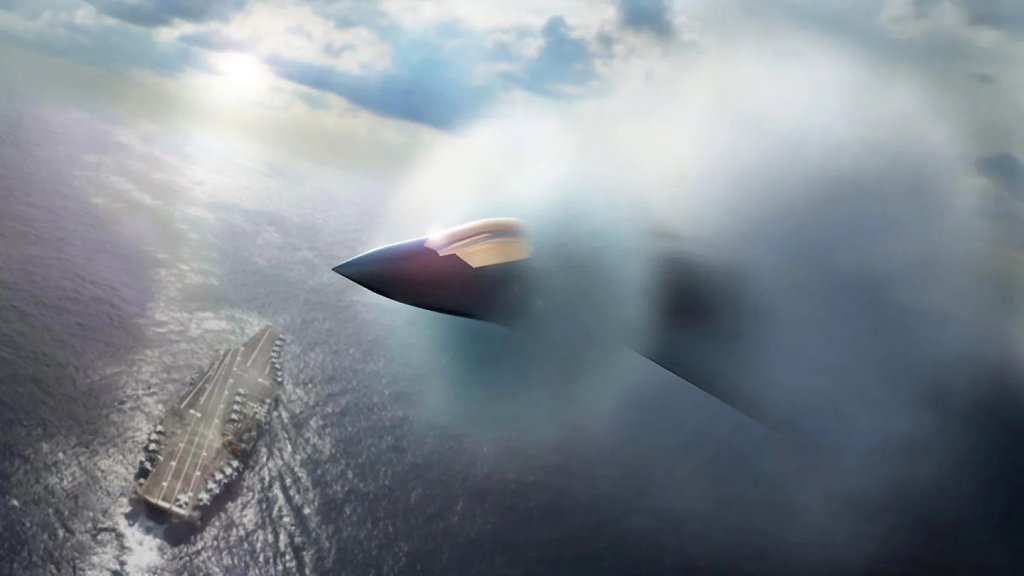
Last month, the House Armed Services Committee announced that “full funding for the Air Force’s F-47 and Navy’s F/A-XX 6th Generation Aircraft programs” was included in the separate defense policy bill, or National Defense Authorization Act (NDAA), for Fiscal Year 2026. However, it subsequently turned out that the legislation, which was signed into law on December 18, only authorized the “full” $74 million the Pentagon had previously requested.
The Pentagon had revealed its intention to shelve F/A-XX, formally known as the Next Generation Fighter program, indefinitely when it rolled out its proposed Fiscal Year 2026 budget last June. At that time, U.S. military officials said concerns about competition for resources with the U.S. Air Force’s F-47 sixth-generation fighter program had been the primary factor in that decision. Boeing is the prime contractor for the F-47, and has been competing head-to-head with Northrop Grumman for F/A-XX following the reported elimination of Lockheed Martin.
F/A-XX is intended as a very stealthy replacement for the F/A-18E/F Super Hornets and E/A-18 Growlers currently in Navy service that will offer increased range and an array of other advancements. On top of its expected kinetic capabilities, Navy officials have talked in the past about the sixth-generation jet’s improved ability to perform intelligence, surveillance, and reconnaissance (ISR) missions and to contribute to battle space management. Serving as a flying ‘quarterback’ from uncrewed aircraft, including future carrier-based Collaborative Combat Aircraft (CCA), is also expected to be a key role for F/A-XX. You can read more about what the Navy has shared about its requirements for its Next Generation Fighter here.
“The agreement provides $897,260,000 above the fiscal year 2026 President’s budget request to continue F/A-XX development and directs the Secretary of Defense to obligate these and any prior funds for the purposes of awarding the EMD contract limited to one performer in accordance with the acquisition strategy to achieve an accelerated Initial Operational Capability (IOC),” per the Joint Explanatory Statement report released today. “The agreement supports the Navy’s efforts to develop the F/A-XX sixth generation fighter and understands the program’s unique capability in delivering air superiority to the fleet, including greater operational range, speed, stealth, and enhanced survivability.”

It is worth noting that the Senate Appropriations Committee had previously moved to add $1.4 billion to the Fiscal Year 2026 defense budget for F/A-XX. That figure aligned directly with a call for additional funding for the program that the Navy had reportedly included in its annual Unfunded Priority List (UPL) sent to Congress last year.
“The agreement notes the Full-Year Continuing Appropriations and Extensions Act, 2025 provided $453,828,000 to align to the program’s acquisition schedule which assumed a March 2025 award for engineering and manufacturing development (EMD),” the statement adds. “However, rather than proceeding with a Milestone B award, the Department expended nearly all fiscal year 2025 funding on contract extensions with minimal demonstrated value to the program.”
“Further, the Secretary of the Navy is directed, not later than 45 days after the enactment of this Act, to submit a report to the congressional defense committees that details: (1) the current acquisition strategy and updated schedule for awarding the EMD contract; (2) a revised development and fielding, imeline for the F/A-XX program to meet IOC; (3) any programmatic, budgetary, or policy barriers that have delayed execution of prior-year funds; and (4) a spend plan for the active year additional funds that have been appropriated to the Department of Defense for this program,” it continues.
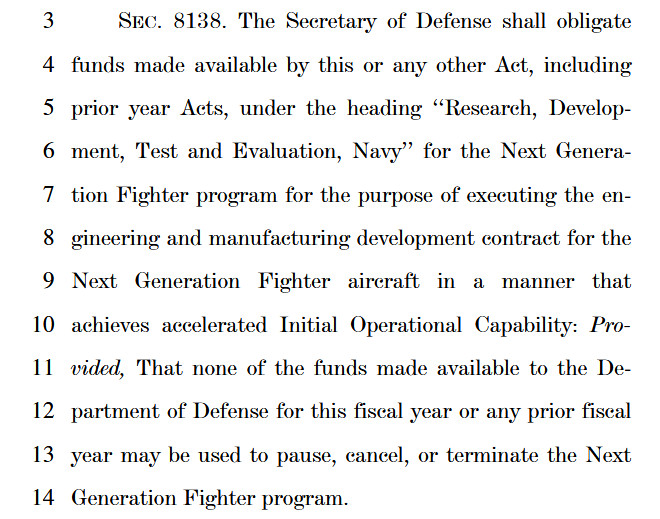
In addition, the text of the draft legislation includes an explicit provision that compels the Secretary of Defense to obligate funding “for the purpose of executing the engineering and manufacturing development contract for the Next Generation Fighter aircraft in a manner that achieves accelerated Initial Operational Capability.” It blocks the use of any funding appropriated for F/A-XX to “pause, cancel, or terminate” the program, as well.
House and Senate appropriators had already expressed their displeasure over the Pentagon’s decision regarding F/A-XX last year.
“The [House Appropriations] Committee is deeply concerned by the Navy’s declining investment in strike fighter aircraft, particularly at a time when carrier air wings are sustaining high operational tempo across global theaters,” lawmakers wrote in another report last June. “This shortfall comes as the People’s Republic of China is rapidly out-producing the United States in advanced fighters and threatens to surpass U.S. air superiority in the Indo-Pacific, as the Commander of U.S. Indo-Pacific Command recently testified. China’s continued advancements in carrier aviation underscores the urgent need to modernize and enhance the Navy’s carrier air wing.”
It is worth remembering that the U.S. Air Force considered cancelling the program that led to the F-47. The service ultimately decided not to after assessing that the next-generation fighter would be essential for ensuring U.S. air superiority in future conflicts, especially high-end fights like one against China in the Pacific.
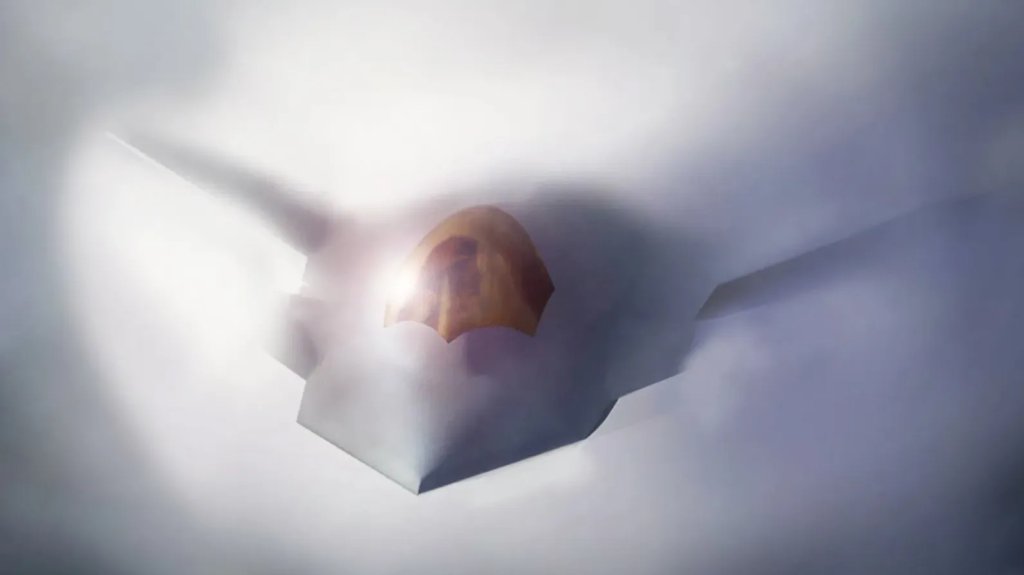
Despite the Pentagon’s desire to put F/A-XX on hold, the Navy has continued to argue very publicly in favor of moving ahead with the program as planned, too.
“It’s my job to inform the secretary of war’s team about that imperative,” Chief of Naval Operations Adm. Daryl Caudle, the Navy’s top uniformed officer, told members of the press at the annual Reagan National Defense Forum in December, according to Breaking Defense. “I’m part of those discussions, but my job is to pressurize that decision because the warfighting imperative, I think, is there, and I’m trying to build a compelling case to get that decision made quickly.”
“Does it need to be done at [sic] a cost-effective way? Does it need [to] be done [in a way] that doesn’t clobber our other efforts? Does it need to be done so it actually delivers in the relevant time frame? Yes,” Caudle had also said at the forum, according to Aviation Week. “So hopefully some of this acquisition reform and production improvement can help us get those decisions.”
“I do think there’s a commitment for us to deliver this capability,” Michael Duffey, Under Secretary of Defense for Acquisition and Sustainment, said separately at the Reagan National Defense Forum, per Aviation Week. “There’s an interest to make sure that we can, from our standpoint, [ensure] that the industrial base is able to support it, and I think we’ll be working through that question as quickly as we can.”
Executives from both Boeing and Northrop Grumman have publicly said they are ready to move ahead with F/A-XX if chosen. Boeing has more explicitly pushed back on the idea that the U.S. industrial base cannot simultaneously support work on F/A-XX and the F-47.
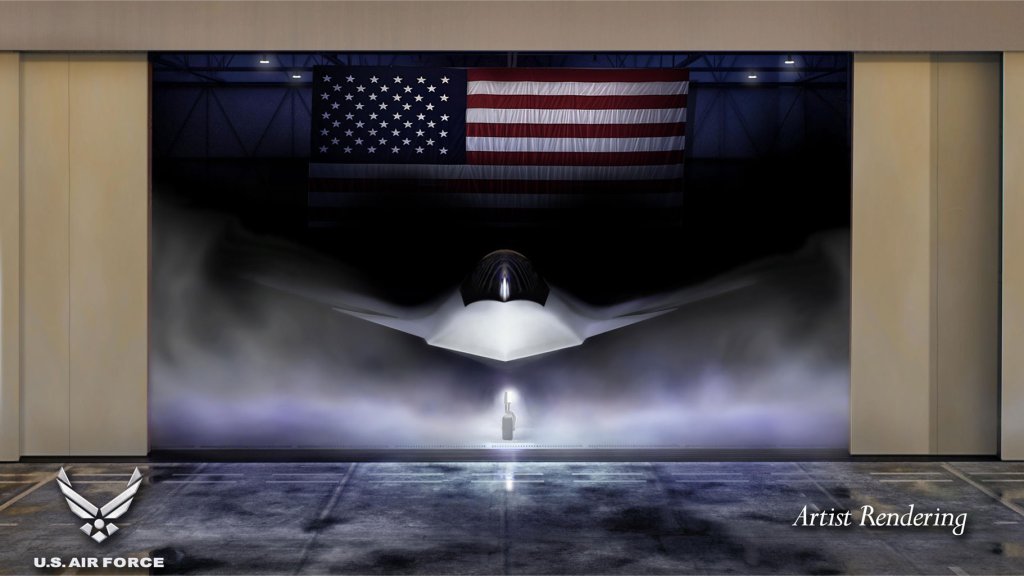
Navy Vice Adm. Daniel Cheever, commander of Naval Air Forces, and more commonly referred to as the service’s “Air Boss,” also told TWZ he was still “eagerly awaiting” F/A-XX back in August.
In the meantime, the Trump administration has made major calls recently regarding major Navy programs, some of them controversial, while FA-XX, seen by some as essential to winning a fight in the Pacific and making the best use of America’s very costly carrier force, has remained in purgatory. These have included cancelling the Constellation class frigate in favor of a design with a similar armament package to the service’s current Littoral Combat Ships (LCS) and embarking on what could be a gargantuan investment in building huge new ‘battleships.’ These decisions will have their own impacts on the Navy’s budget priorities going forward that could impact other efforts.
The House and Senate do still have to pass the consolidated spending bills, and there is always the possibility of last-minute changes. Afterward, President Donald Trump would then have to sign the final version of the legislation into law, as well.
Still, and despite not having done so with the NDAA in December, Congress now looks very much poised to save F/A-XX from being gutted and to compel officials to finally pick a winning design to be the Navy’s next-generation carrier-based fighter.
Contact the author: joe@twz.com
Loading comments…
Comments couldn’t be loaded. Please refresh the page.