

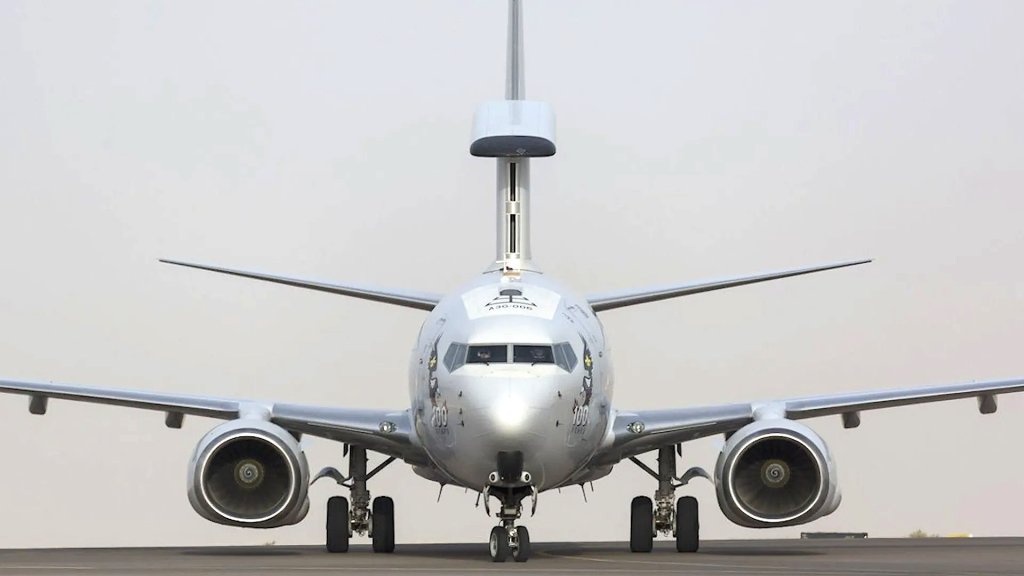
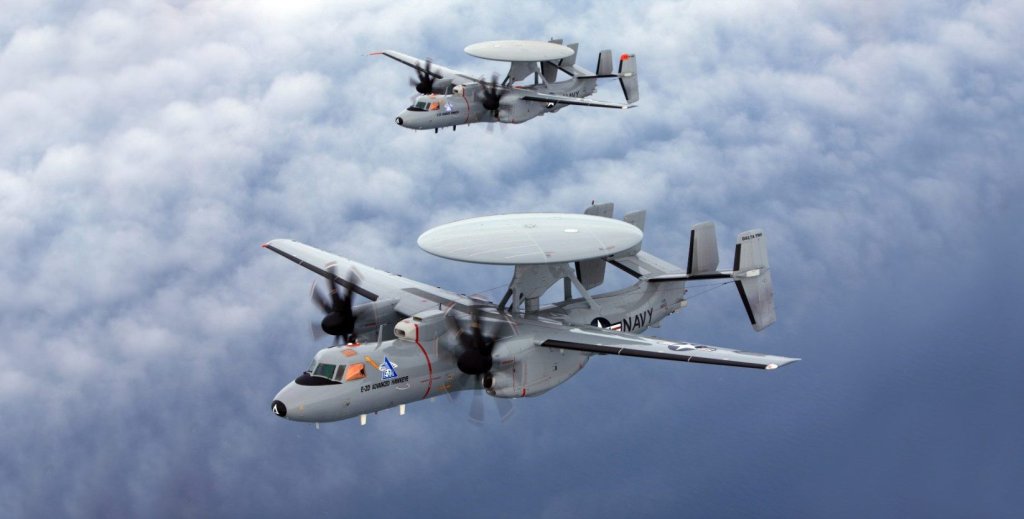
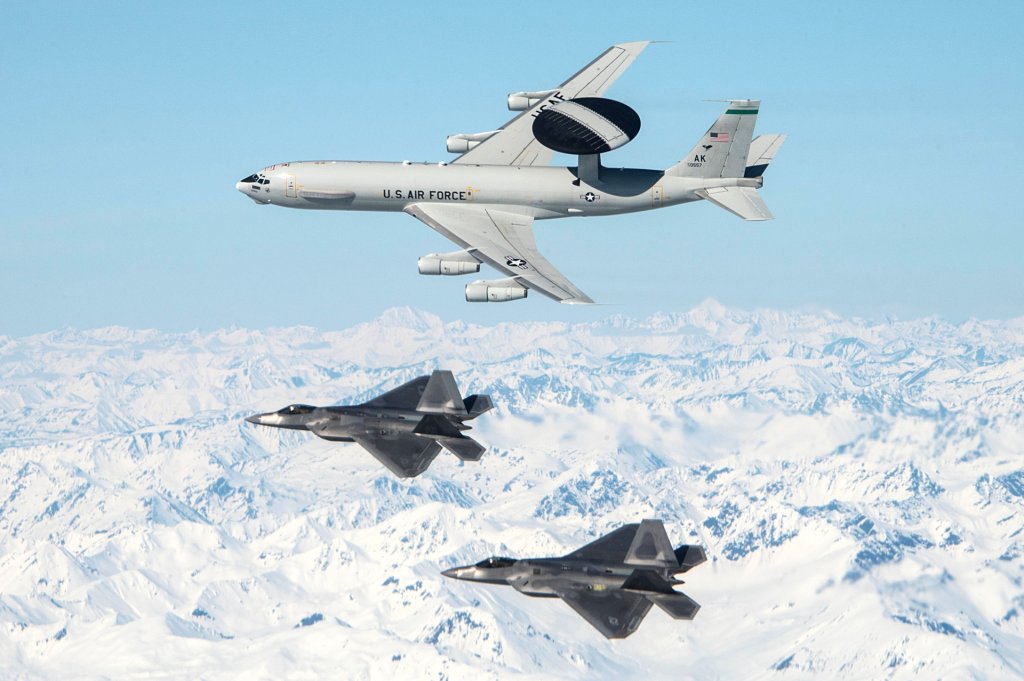
The House Armed Services Committee has made an initial move toward reversing the Pentagon’s plan to axe the acquisition of E-7 Wedgetail airborne early warning and control aircraft for the U.S. Air Force. The E-7s had previously been working to replace a portion of the Air Force’s increasingly unsupportable E-3 Sentry Airborne Warning and Control System (AWACS) fleet ahead of plans to eventually push most, if not all of its airborne target warning sensor layer into space. The Pentagon has also now laid out plans to buy more of the Navy’s E-2D Hawkeye airborne early warning and control planes to mitigate capability gaps in the interim.
An addition of $600 million for the “continuation of rapid prototyping” of the Air Force-specific version of the E-7 is included in a draft of the annual defense policy bill, or National Defense Authorization Act (NDAA), for the 2026 Fiscal Year, which the House Armed Services Committee released today. The Air Force first announced its intention to buy Wedgetails in 2022. The service had been working to acquire two production representative prototypes for test and evaluation purposes as a lead-in to a finalized production configuration, examples of which were expected to begin entering operational service in 2027. The program had already suffered notable delays and cost growth, which the Pentagon has said were major factors in the cancellation decision.
Versions of the Wedgetail are currently in service in Australia, South Korea, and Turkey, and the United Kingdom and NATO are in the process of acquiring E-7s.
For years now, the Air Force has said its ultimate goal is to eventually push more of the airborne early warning and control aircraft’s function to radar satellite constellations. Space-based assets capable of taking on these missions could be operational by the early 2030s, but airborne early warning and control aircraft are expected to continue playing a role, at least for the time being.
It first emerged publicly at a Senate Appropriations Committee hearing in June that the E-7 plans had radically changed.
“I would file this entire discussion under difficult choices that we have to make,” Secretary of Defense Pete Hegseth had said at the time in the course of an exchange with Sen. Lisa Murkowski, a Republican from Alaska. “But you know, the E-7, in particular, is sort of late, more expensive and ‘gold plated,’ and so filling the gap, and then shifting to space-based ISR [intelligence, surveillance, and reconnaissance] is a portion of how we think we can do it best, considering all the challenges.”
Bryn Woollacott MacDonnell, the special assistant to the secretary of defense who is currently performing the duties of the under secretary of defense (comptroller) and the Pentagon’s chief financial officer, also testified at that hearing and disclosed plans to fill the resulting capability gap with E-2D Hawkeye airborne early warning and control aircraft assigned to a joint unit. In America’s armed forces, the E-2D, which is designed primarily for aircraft carrier-based operations, is currently only in service with the U.S. Navy.
The day before, Hegseth had also told members of the House Appropriations Committee that the E-7 was an example of a platform that was “not survivable in the modern battlefield” and mentioned plans “to fund existing platforms that are there more robustly and make sure they’re modernized.”
At the Senate Appropriations Committee hearing last month, Murkowski had openly questioned the Pentagon’s overall plans to meet airborne early warning and control demands, especially in and around her state.
“I have been concerned. We have E-3 capability up north, of course, but we were all counting on the E-7 Wedgetail coming our way. We’re kind of limping along up north right now, which is unfortunate. And the budget proposes terminating the program,” she said. “Again, the E-3 fleet [is] barely operational now, and I understand the intent to shift towards the space-based – you call it the ‘air moving target indicators’ – but my concern is that you’ve got a situation where you’re not going to be able to use more duct tape to hold things together until you put this system in place. And, so, how we maintain that level of operational readiness and coverage, I’m not sure how you make it.”
Murkowski’s remarks had, in turn, already pointed to the potential for a battle between the Pentagon and Congress over the E-7’s final fate.
Other major advocates have also now stepped forward in support of continuing with the E-7 program. Earlier this week, the Air & Space Forces Association sent an open letter to Congress signed by 19 retired Air Force generals, including six former Air Force chiefs of staff, “to express our alarm” at the Wedgetail decision, as well as planned cuts to the procurement of new F-35 Joint Strike Fighters.
The draft NDAA that the House Armed Services Committee released today does not include any additional funding for F-35 purchases, though it does add money to buy more spare parts for those aircraft across the U.S. Air Force, Navy, and Marine Corps. The Pentagon has said cuts to F-35 procurement are intended to help free up resources to support work on major upgrades for those aircraft and to aid in sustaining existing fleets.
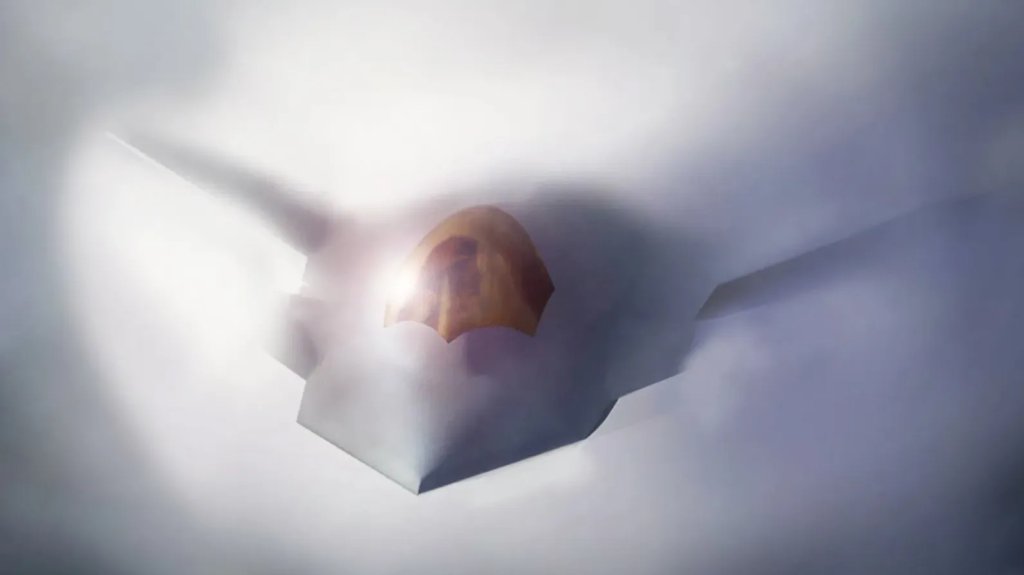
The proposed legislation also notably makes no changes to plans to gut the U.S. Navy’s F/A-XX next-generation carrier-based fighter program, which is set to be effectively shelved to prioritize work on the Air Force’s new F-47. The future of F/A-XX remains its own hot-button topic, with the Navy putting out a call for more funding for that program in an annual wishlist to Congress.
In a report accompanying the draft NDAA, the House Armed Services Committee has also highlighted concerns about the Air Force’s fielding timetables for new F-15EX Eagle II fighters. The Air Force is moving to acquire additional F-15EXs, but legislators fear there could be issues in actually getting those aircraft to units, especially Air National Guard squadrons tasked with critical homeland defense missions. This has all been compounded by the surprise announcement in April of a decision to stand up an additional F-15EX squadron within the Michigan Air National Guard to replace A-10 Warthog ground attack jets that are being retired. You can read more about the Air Force’s current stated plans for the F-15EX fleet here.
The draft NDAA also slows the Air Force’s final retirement of the A-10, with a requirement to keep at least 103 Warthogs in service through 2026. The Air Force is now pushing to send the last of these aircraft to the boneyard by the end of the 2026 Fiscal Year.
When it comes to the Air Force’s E-7 program, its fate is still very much an open question. The House Armed Services Committee is set to consider further changes to the draft NDAA next week, and this is just one step in an often drawn-out process of finalizing the bill. The Senate will be working through its own version of the NDAA, and both pieces of legislation will eventually have to be brought into line before a vote can happen. After the NDAA is passed, the president still has to option to veto it. At any step along the way, proposed additional funding for the E-7 could be stripped out.
In the meantime, the House Armed Services Committee has made clear that a final decision on E-7s for the Air Force has yet to be made.
Contact the author: joe@twz.com
Loading comments…
Comments couldn’t be loaded. Please refresh the page.