
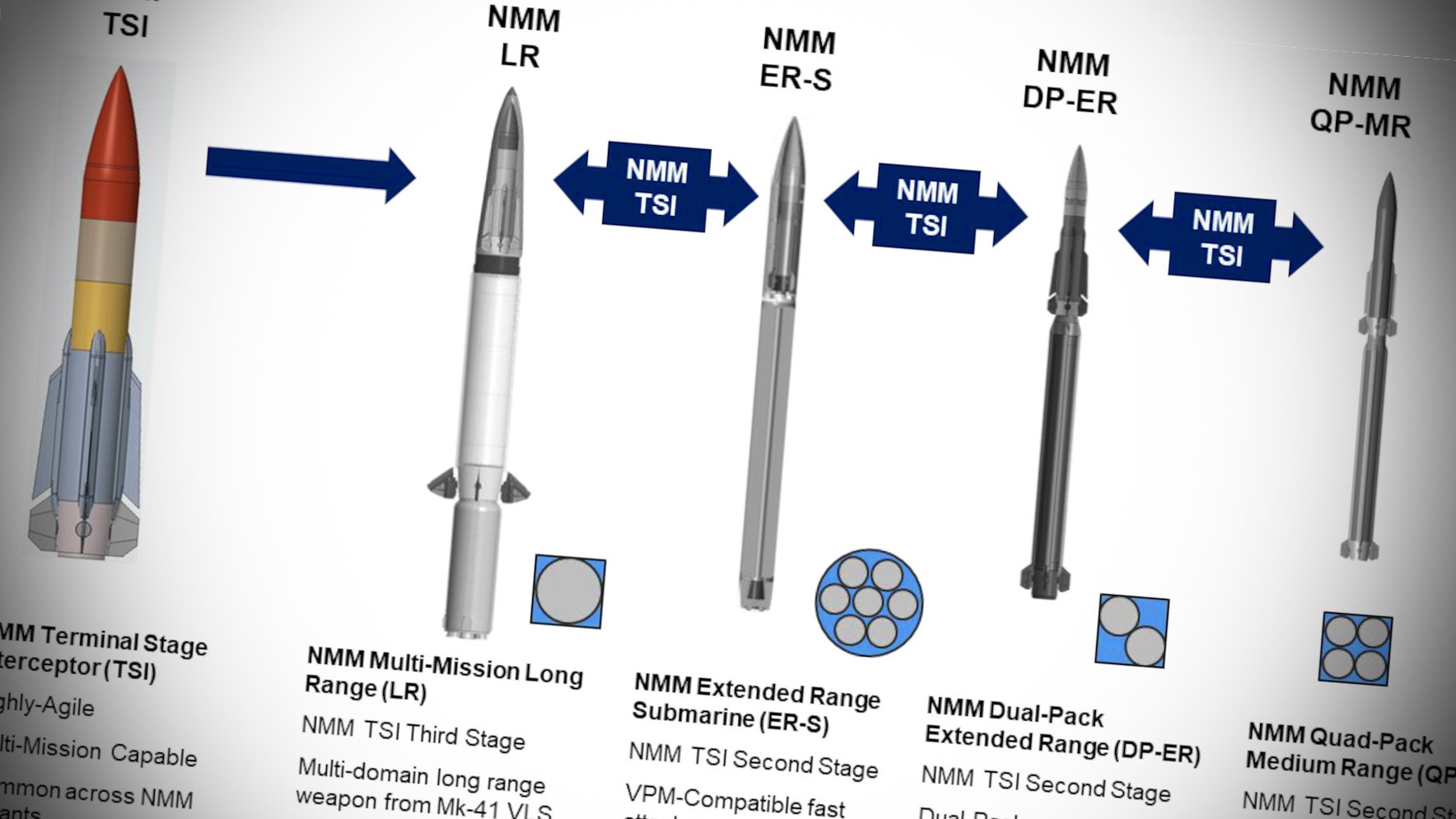
The U.S. Navy has shared details about its vision for a new family of modular surface-to-air missiles that is expected to include a version that will arm future variants of the Virginia class submarine. This would be an all-new capability for the service, at least as far as we know. All of the members of the Naval Modular Missile (NMM) are set to be based around a common Terminal Stage Interceptor (TSI), creating a range of capabilities in very different form factors. This, in turn, opens a door to new options for larger and/or mixed loadouts in vertical launch systems on surface warships and submarines.
New information about the Navy’s NMM concept is contained in a draft request for solutions contracting notice recently posted online, which Aviation Week was first to report on. Naval Sea Systems Command (NAVSEA) hosted an NMM Industry Day event earlier this year to get feedback from prospective vendors. The NMM effort traces its roots back to at least 2021, but the Navy has only released limited details about its plans for these new missiles in the past.
“The United States Navy (USN) is seeking a new, modular interceptor to serve as the basis for the Naval Modular Missile (NMM) program, a next-generation initiative designed to revolutionize surface naval capabilities through multi-mission utility, enhanced capacity, and a modular open architecture,” according to the recent draft request for solutions notice. “The NMM TSI is a modular, highly capable multi-mission interceptor that leverages state-of-the-art technology to provide effectiveness across the entire mission space.”
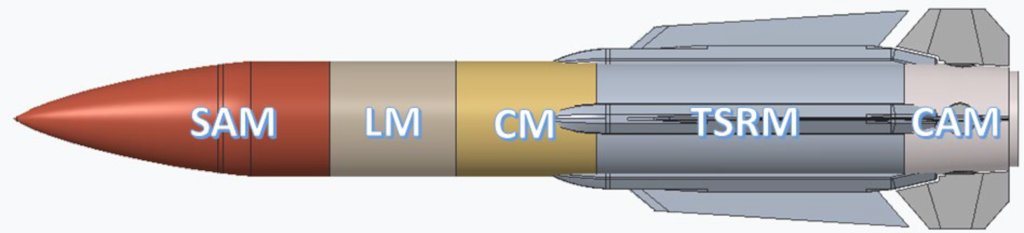
“The TSI is ten inches in diameter and consists of five modules,” which are “the Seeker Assembly Module (SAM), Lethality Module (LM), Command Module (CM), Terminal-Stage Rocket Motor (TSRM), and Control Actuation Module (CAM),” the notice adds. “This TSI will be integrated with multiple booster stacks and canisters to achieve a robust family of multi-mission and multi-platform variants.”
To start with, the contracting document describes the desired TSI as “highly agile” and “multi-mission capable,” but does not lay out any hard performance or capability requirements.
When it comes to the TSI’s seeker, there are certainly multiple options for prosecuting an aerial intercept, including active radars, imaging infrared sensors, and passive radiofrequency (RF) capabilities. Though we do not know yet what the Navy’s requirements here might be, a multi-mode seeker system could also be extremely valuable as the countermeasure ecosystem continues to expand.
An interceptor with a high degree of agility would also be required for any NMM variants intended to address high-supersonic and/or hypersonic targets, especially ones with their own ability to maneuver significantly during mid-course and/or terminal phases of flight. The Navy has made clear in the past that addressing the threats posed by ever more advanced supersonic and hypersonic anti-ship missiles, including air-breathing types, as well as ballistic and hypersonic designs, is a top priority. This has only been underscored by lessons learned from recent conflicts in and around the Middle East, as well as observations from the war in Ukraine. Those threats are only expected to be magnified in any future high-end fight against an adversary like China or Russia. Both of those countries have been investing heavily in the development and fielding of new high-speed anti-ship missile capabilities.
All this being said, the TSI element is perhaps the least interesting part of the overall NMM concept the Navy has now outlined. The service envisions at least four distinct NMM “All-Up-Rounds,” or AURs, topped with the common interceptor. As described now, the missiles are very different in form and function.
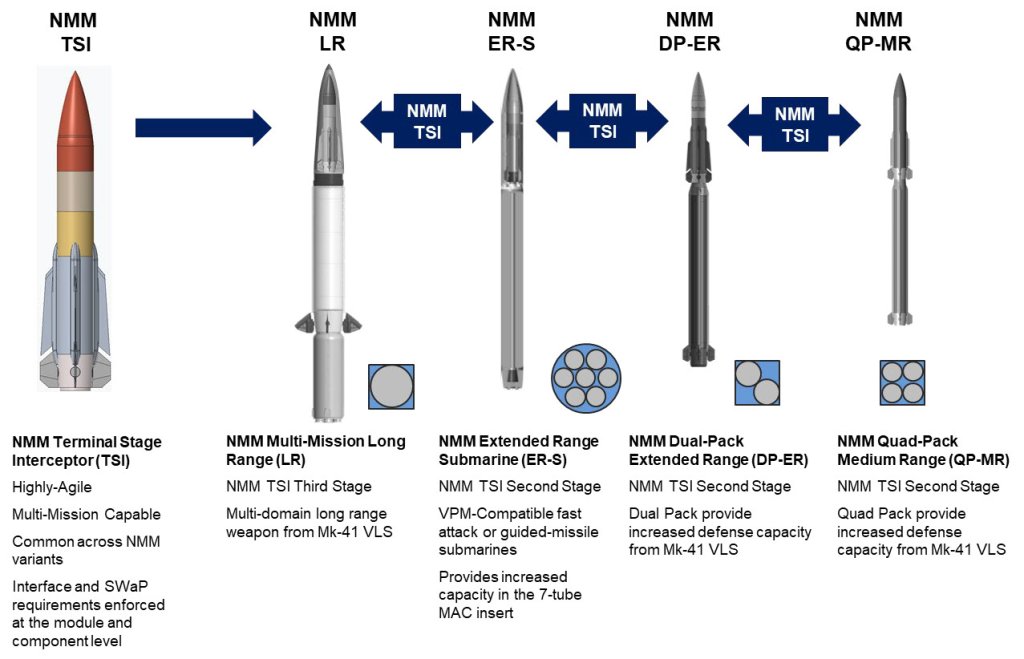
There is a Long-Range (LR) version that “brings multi-mission, hypersonic capability to the Mk 41 Vertical Launching System (VLS),
leveraging existing USN investments in a 21” rocket motor and fully integrating with future Long-Range Fires kill chains,” according to the recent notice. A single LR NMM will be able to fit inside a Mk 41 Vertical Launch System (VLS) cell.
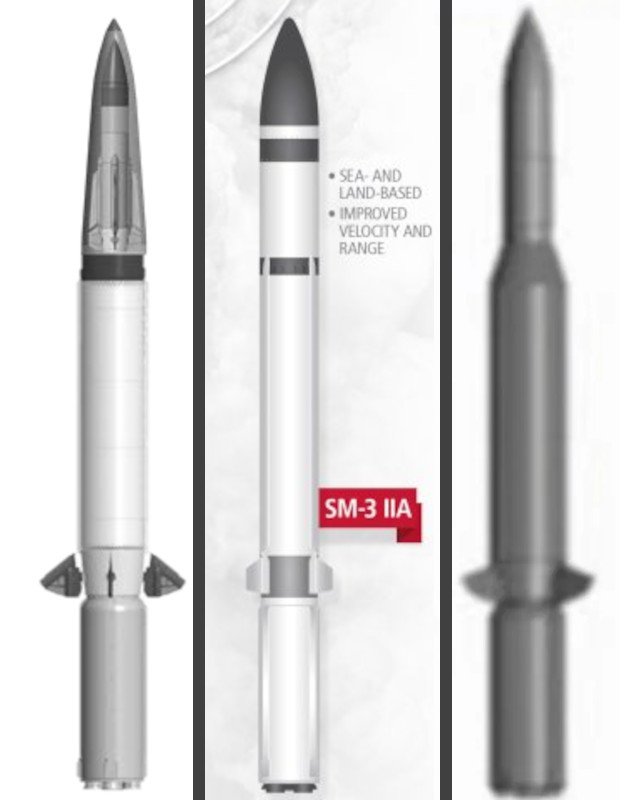
A 21-inch rocket motor is a key component of the Standard Missile-3 Block IIA anti-ballistic missile interceptors in Navy inventory today. A similarly sized rocket motor is also a central feature of the still-in-development supersized Block IB version of the Standard Missile-6 (SM-6). Existing variants of the SM-6 are multi-purpose missiles that can be employed as anti-interceptors, including against certain hypersonic threats, as well as surface targets. The rendering the Navy has shown now of the LR version of the NMM is very much in line with the overall designs of the SM-3 Block IIA and SM-6 Block IB.
In addition, the Navy wants slimmer extended and medium-range NMMs that can be dual- and quad-packed into a single Mk 41 VLS cell, respectively. These are called the DP-ER and QP-MR versions. It’s worth noting here that the service uses similar extended and medium-range terminology today to describe different variants of the Standard Missile-2 (SM-2). Those missiles are primarily employed as surface-to-air interceptors, but have a limited secondary surface-to-surface capability, as well. However, SM-2s can only be loaded singly in Mk 41 VLS cells. The Navy is now in the process of integrating the Patriot PAC-3 Missile Segment Enhancement (MSE) interceptor into the Mk 41, offering another alternative to SM-2, but those missiles will also be loaded one per cell, at least initially.
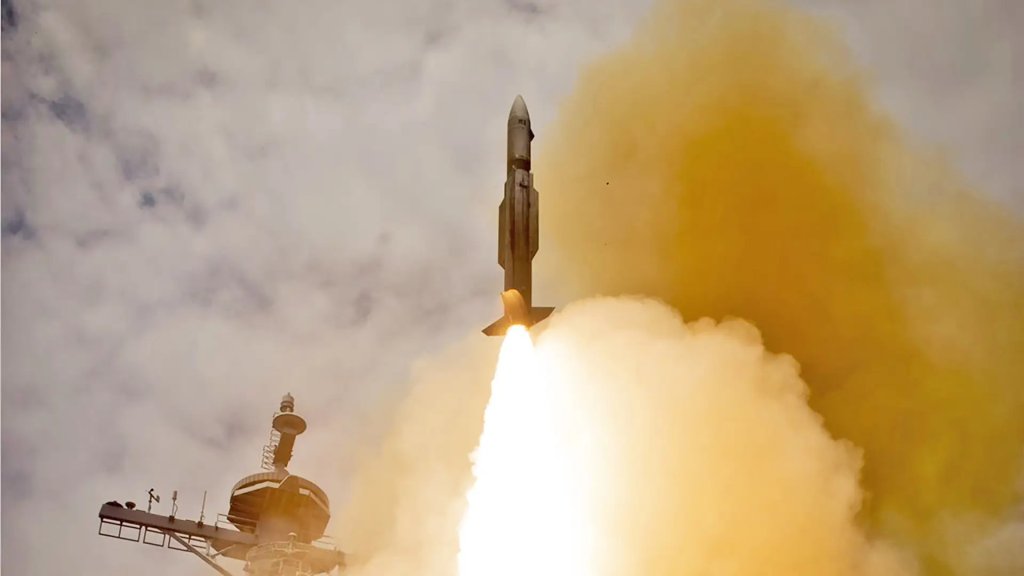
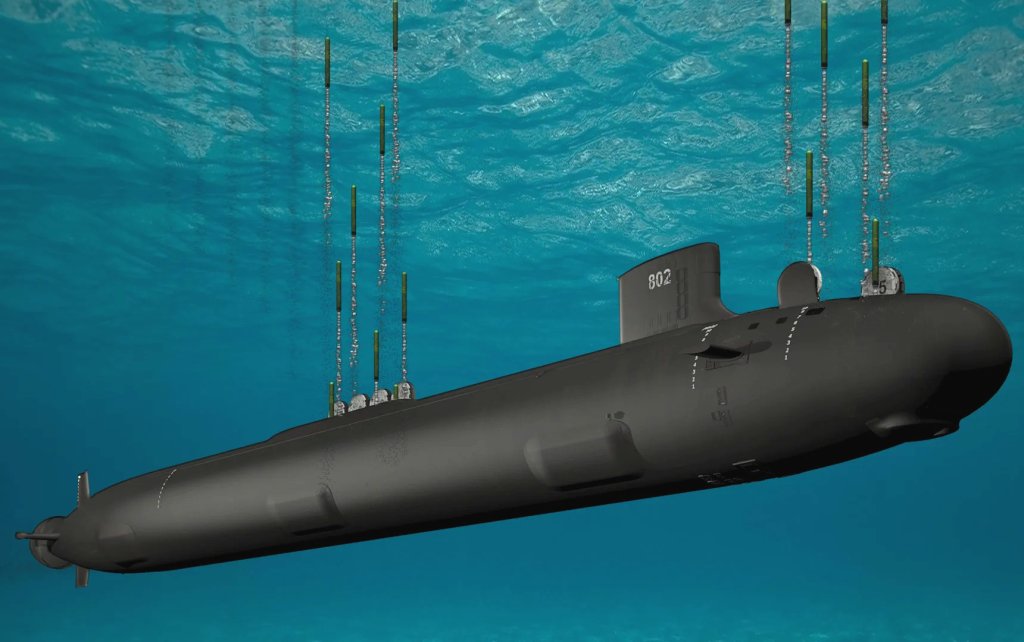
The last and most notable version of the NMM that the Navy has outlined now is an extended-range version intended to be launched from future subvariants of the Virginia class nuclear-powered attack submarine equipped with the Virginia Payload Module (VPM). The VPM consists of four large vertical launch tubes and is set to be integrated first on Block V Virginia class boats. The so-called ER-S member of the NMM family would be loaded into those tubes via a seven-cell Multiple All-Up-Round Canister (MAC) adapter, first used on Ohio class guided missile systems.
The Navy does not currently have an operational submarine-launched surface-to-air capability at all, at least that we know about. This is something that has been explored by navies globally to varying degrees for decades, as you can read about more in this past TWZ feature. We will come back to this later on.
The NMM concept presents clear potential benefits operationally. The Navy’s 2027 Fiscal Year budget request indicates the service is aiming to eventually supplant all of its existing Standard missiles with NMM types. The new modular missile family could conceivably replace other munitions. With a new common TSI interceptor, even shorter-range NMM versions could offer expanded capability against an array of aerial threats in different envelopes. The Navy’s description of the LR type, at least, as a multi-mission weapon, also points to new capability against surface targets.
It’s also important to point out that the Navy says the LR and ER-S versions will be capable themselves of traveling at hypersonic speeds, helping to close any kill chain faster, even at extended ranges. This would be especially important for engaging incoming hypersonic threats, something the Navy can only currently do with versions of SM-6, to at least some degree. Depending on the full scope of capabilities the Navy has planned for NMM, this could open the door to new options for strikes on time-sensitive or otherwise fleeting surface targets.
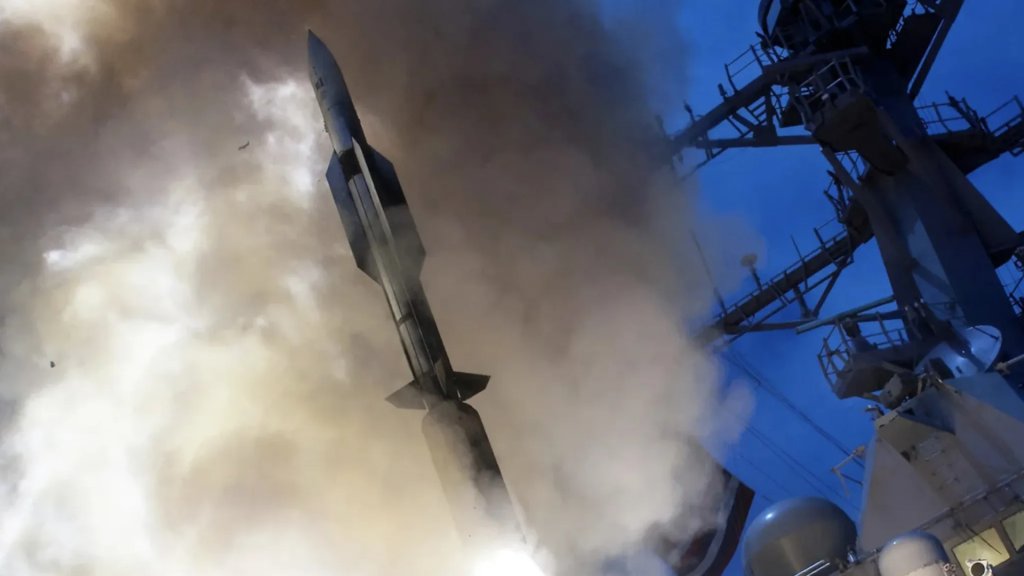
The DP-ER and QP-MR versions would bring valuable additional magazine depth. Currently, the lower-end Evolved Sea Sparrow Missile (ESSM) is the only surface-to-air interceptor in Navy inventory that can be multi-packed into VLS cells on its surface ships. Greater magazine depth means more engagement opportunities before having to reload, a process that currently requires Navy warships to leave their stations and head to a friendly port. During those transits, they may also be more vulnerable due to limited remaining ordnance. Especially in the face of growing threats to established port facilities, the Navy is also pursuing new at-sea reloading capabilities to create additional operational flexibility and reduce vulnerability. These issues have also been highlighted by recent U.S. operations in and around the Middle East.

The NMM plan would present benefits logistically and when it comes to production, too. Multiple contractors could be brought on to produce TSIs and the different rocket motors, creating opportunities for competition and cost savings, as a result. It could also help with ramping up production at scale. The recent NMM contracting notice says the Navy could leverage multiple vendors just to produce the modular components of the TSIs, and that the service is aiming for a production rate of 1,000 interceptors per year within five years of a contract award.
These are all considerations that are top of mind for the U.S. military at present when it comes to anti-air interceptors, as well as other munitions. Higher-end surface-to-air missiles have historically been very long-lead-time items with the delivery timelines measured in months, if not years. This has already created serious issues for sustaining stockpiles that have been exacerbated by a succession of crises in the Middle East, as well as the need to support allies and partners, especially Ukraine.
Overall, NMM “will provide the US Navy, Joint Force, Allies and Partners with advanced defensive and offensive capability to out-pace the threat. As the effective range, capability and capacity of adversary anti-access/area denial (A2/AD) systems have increased, the US Navy and Joint and Allied forces are at increased risk,” the Navy’s budget documents explain. “Additionally, adversary capacity and expected large raid engagement tactics will demand US and Allied forces increase their platforms’ defensive capacity (depth of magazine) or be forced to resupply frequently in the midst of combat operations. The adversary’s increased capacity comes with increased capability in the form of highly-maneuverable, complex threats that will stress the current U.S. weapon systems capabilities.”
Then there is the additional matter of the submarine-launched capability. As stressed from the start, the explicit inclusion of the ER-S version in the NMM plan is especially significant since this is not something the Navy is known to have access to at all right now. TWZ has previously explored in detail the potential benefits, as well as drawbacks, of arming submarines with anti-air interceptors.
Historically, the most immediate use case for a submarine-launched anti-air missile capability has been localized defense against anti-submarine aircraft and helicopters, as seen in the video below. The threat of a submarine shooting back could have a deterrent effect, too. Still, a submarine could have to get close to the surface and otherwise expose its position to prosecute such an engagement. A submarine launching anti-air interceptors is not automatically guaranteed to achieve a kill, either. This all raises a question of the value proposition compared to simply trying to evade detection and escape pursuers. There are rules of engagement and other questions to be answered, as well, as you can read more about here.

However, the extended-range nature of the ER-S NMM variant raises the possibility of a different concept of operations involving a deep integrated and fully networked kill web, which is an area the Navy has already been investing in heavily. In this context, submarines might offer broader additional anti-air engagement capacity as part of a larger defensive posture around carrier strike groups, other surface action groups, and even potentially friendly assets on island outposts or along other coastlines, although this is unlikely to be the primary use of this capability set.
Submarines offer inherent survivability benefits and can operate discreetly across broad areas for extended periods of time. This, in turn, could create additional challenges for opponents who would have to account for the potential of additional surface-to-air capabilities to be hiding underneath the waves. Similarly, ER-S-armed submarines could be used proactively to take out enemy aircraft in areas far forward of any other friendly forces, and without opponents knowing they are there to begin with. This could be an especially valuable tool for targeting airborne early warning and control planes and other prized strategic force multiplying platforms. Targeting data could come from many sources, including future air moving target indicator space sensing layers, but also from warships equipped with the Aegis combat system or aircraft, including future sixth-generation F/A-XX fighters operating beyond the reach of their weapons capabilities. Acting as forward remote ‘shooter’ nodes, submarines would be very unpredictable and dangerous counter-air assets. Ukraine, for instance, has leveraged remote forward ‘shooter’ concepts in a similar manner, albeit on land, to great success.
Tied in with offboard sensor networks, submarines loaded with ER-S missiles might be able to conduct more general anti-missile defense missions, as well. For instance, a submarine would offer a new and different way to position such a capability closer to enemy territory, and potentially without their knowledge, from where boost-phase intercepts might be attempted. Missiles, especially larger ballistic types, are particularly vulnerable in the boost phase after launch. However, taking advantage of that has historically been complicated by the fact that the launch points are generally expected to be in more heavily defended areas.
If ER-S can also be employed as a hypersonic surface-to-air missile, it would give submarines armed with them additional operational flexibility. A VPM-equipped Virginia class submarine could also carry ER-Ss as just one part of a mixed ordnance load. VPM tubes are designed to accommodate a variety of munitions, including Tomahawk land-attack cruise missiles and Intermediate-Range Conventional Prompt Strike (IRCPS) hypersonic missiles.
In the missile defense context, the submarine with mid-course ballistic missile and/or hypersonic missile interceptors onboard could provide a more forward launch point for midcourse interception of these weapons. This would provide another layer of defense, especially in anti-access combat scenarios, allowing for the traditional missile defense layer, farther to the rear, to deal with whatever breaks through.
This all sounds great, but there is one problem with actually using this kind of capability in a sustained operational context. Firing off a larger interceptor from a submarine gives off a huge signature — infrared, radar, and acoustic. This is exactly what submarines operating forward try to avoid at nearly all costs. So how exactly this would be mitigated is unclear at this time. Clearly, there is a risk-reward calculus to all operations, but having a hugely valuable asset loaded with sensitive technologies and lives give away its position deep in enemy territory to shoot down a plane or missile would be a choice that would have to be made very carefully. The submarine could have a long way to run to safer territory if its presence were detected.
If nothing else, ER-S would create a submarine-based anti-air capability, and its very presence would impact adversary anti-submarine warfare playbooks. When it comes to chasing down U.S. submarines from the air, the hunted could now shoot back.
The Navy does still appear to be relatively early on in the process of outlining the NMM concept, let alone moving down a path that could lead to an operational capability. The requirements for NMM, including the submarine-launched capability, could well evolve further down the line, or even be truncated to focus first on a lower-risk spiral. As it stands now, the Navy is asking for $311 million to support NMM development in Fiscal Year 2027, which it says is a “new start” effort.
“The Department [of the Navy] is implementing diverse procurement strategies to enable rapid acquisition,” the service’s budget documents also note. “These will include the use of Other Transaction Authorities, ‘Marketplace’ acquisition platforms, and alternative concepts to increase supply and suppliers in addition to traditional FAR-based procurement strategies.”
Still, the NMM plan that the Navy has outlined now shows that it is pursuing a significant leap in anti-air capability that will be employed across its fleets, including on certain Virginia class submarines.
Contact the author: joe@twz.com
Loading comments…
Comments couldn’t be loaded. Please refresh the page.