
Last week, the U.S. Navy announced that future stretched Virginia class nuclear-powered attack submarines (SSN) fitted with Virginia Payload Modules (VPM) will be recategorized as guided missile types (SSGN). In doing so, the service disclosed that two Block V Virginia class boats will lack a VPM, and the four large vertical launch tubes contained therein, rather than just one as had been previously understood. Now, the Navy has confirmed to TWZ directly that the second VPM-less Block V will have a one-of-a-kind seabed warfare configuration. This will allow it to conduct espionage missions on the seafloor, a role currently filled by the USS Jimmy Carter, a one-off subvariant of the Seawolf class attack submarine.
In its August 3 press release, the Navy said it planned to acquire 19 VPM-equipped Virginia class SSGNs across the Block V and Block VI subclasses. As TWZ noted at the time, this created a discrepancy of one submarine based on publicly stated procurement plans. It was already known that the first of the 12 Block Vs, the future USS Oklahoma, would lack a VPM, but the expectation had been that the other 11 would have this feature. The Block VI production run is currently set to consist of nine more submarines, all with VPMs. We correctly posited last week that the outlier could be the seabed warfare submarine, the basic plans for which emerged some years ago now.
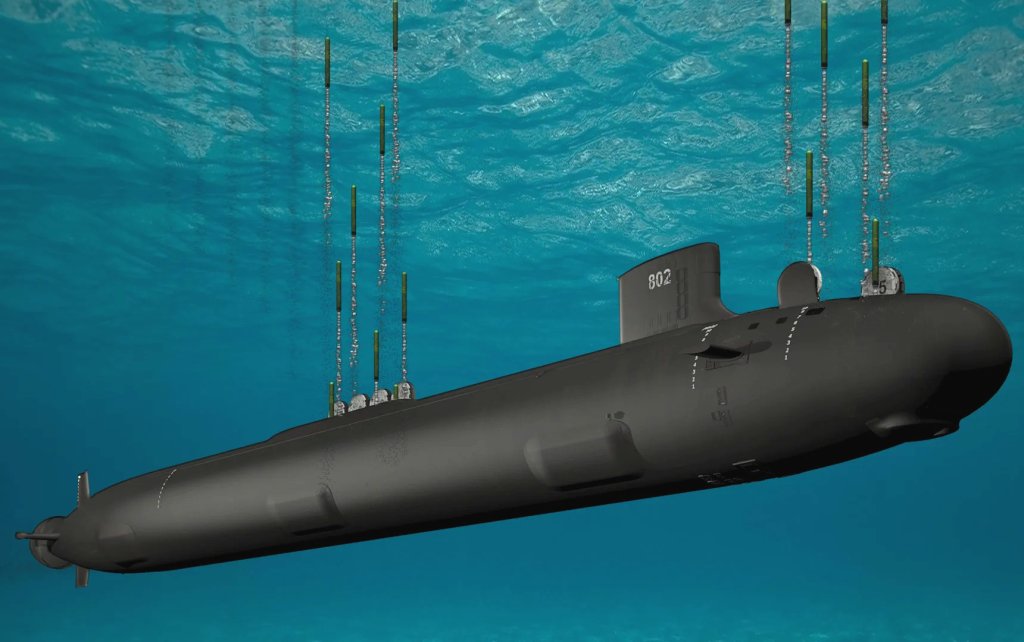
“19 of the VPMs will be re-classified as SSGNs with two of the Block V SSNs to be built in non-VPM configurations,” a Navy spokesperson told TWZ when asked for clarification.
“A later Block V submarine will not have VPM and will be a Subsea and Seabed Warfare (SSW) focused platform,” the same Navy spokesperson subsequently confirmed to TWZ in response to our follow-up questions.
The Navy has declined to name the specific Block V Virginia class submarine that will be configured for the seabed warfare role. We know from the statement above that it will not be the future USS Oklahoma (also known by the hull number SSN-802). We also know that the second Block V Virginia, the future USS Arizona (SSGN-803), will be the first to feature the VPM.
So the seabed warfare version will be one of the other 10 planned Block V Virginia class submarines. All of those future boats (hulls 804 through 813) have already been assigned official names, which are, in order: USS Barb, USS Tang, USS Wahoo, USS Silversides, USS John H. Dalton, USS Long Island, USS San Francisco, USS Miami, USS Baltimore, and USS Atlanta. As an aside, Barb, Tang, Wahoo, and Silversides will be the first Navy submarines in decades to be named after ‘denizens of the deep.’ Since the 1970s, the service has largely been naming new attack submarines after cities and states, a decision you can read more about in detail here.
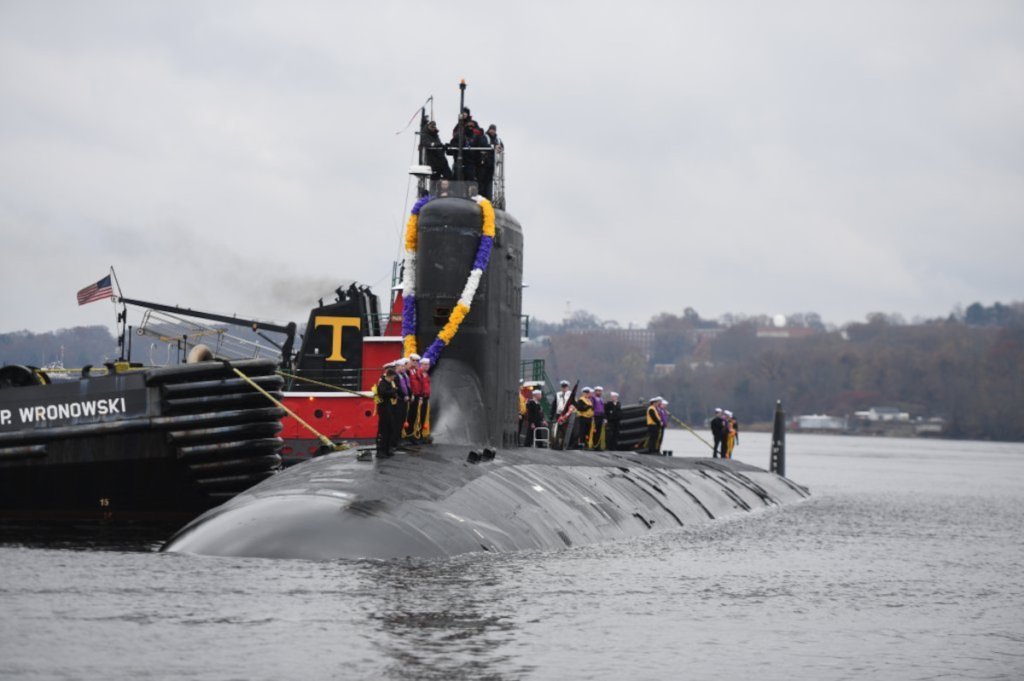
As noted, the Navy has previously disclosed plans to acquire a one-off Virginia class submarine in a seabed warfare configuration, but has offered little in the way of specifics to date. General Dynamics Electric Boat has shared some additional information in the past. This company is one of two prime contractors involved in producing Virginia class boats, with the other being the Newport News Shipbuilding division of Huntington Ingalls Industries (HII).
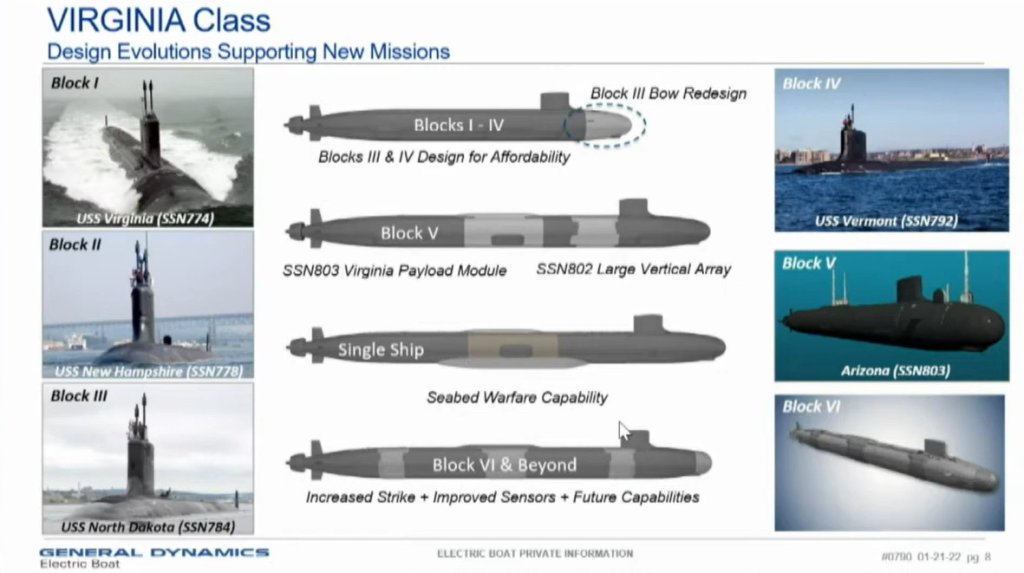
“Our Virginia class submarine program is evolving … over time to accomplish new missions, and we’re taking the existing hull form and modifying that to incorporate new weapons, sensors, and improved stealth features,” Kevin Graney, then President of General Dynamics Electric Boat, said during a presentation as part of a summit hosted by the Connecticut Business and Industry Association (CBIA) in 2022. “One of the most significant design changes we’ve implemented in recent times and currently ongoing is the Virginia Payload Module, which will carry an enhanced strike capability. …basically an 84-foot hull section that includes four additional missile tubes.”
You can watch Graney’s 2022 presentation in full below. His overview of the Virginia class program at that time starts at approximately 21:52 in the runtime, if the video does not advance to that point automatically.

General Dynamics Electric Boat’s main shipyard, as well as other facilities, are in Connecticut. The company also has a major hull-fabrication and outfitting facility in neighboring Rhode Island. Graney retired in 2024.
“We’re developing … a seabed warfare variant, and this ship is designed to interact with the seafloor,” Graney also said during his 2022 presentation. “This design will repurpose some of those missile tubes that I referred to in the VPM design to perform those missions.”
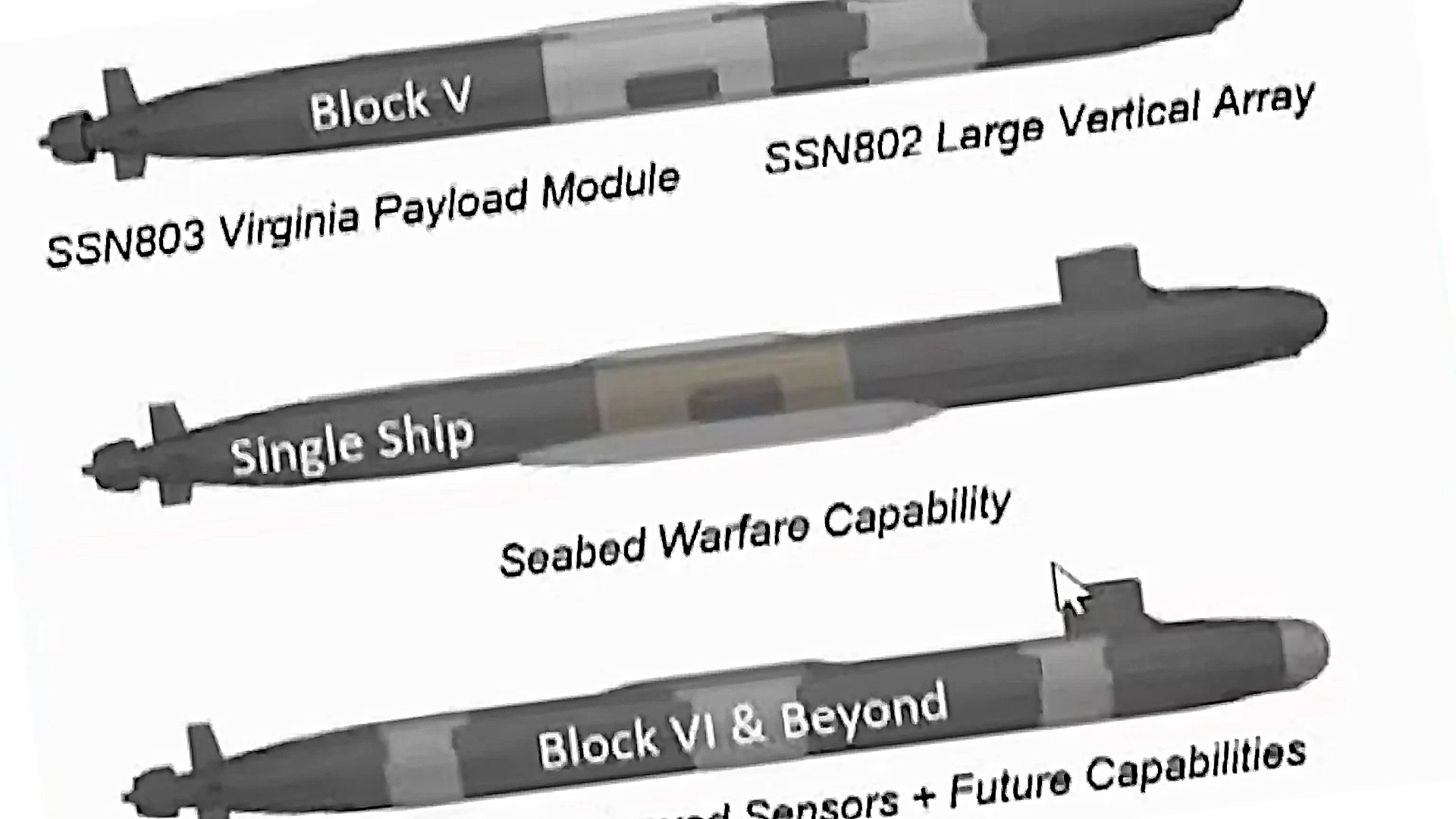
An accompanying slide in Graney’s presentation – seen in part at the top of this story and below – showed a rendering of the seabed warfare variant. As depicted, the design features a pronounced additional bulge under the center of the hull in the same general area where VPM will be fitted on other Block V boats.
This is fully in line with how Jimmy Carter is known to be modified. The main difference between that submarine and the other two Seawolf class boats is the addition of a 100-foot hull extension known as the Multi-Mission Platform (MMP). From what has been publicly released in the past, the MMP is capable of launching and recovering remotely operated vehicles (ROV), uncrewed underwater vehicles (UUV), and other specialized payloads. There is also a reconfigurable command and control room, storage spaces, and other special missionized equipment. The submarine also has auxiliary thrusters and other unique features to help it land on the seafloor or otherwise keep its position underwater. Altogether, Jimmy Carter‘s unique features are understood to be optimized for covert and clandestine underwater espionage missions, including inspecting, manipulating, and even collecting objects of interest from deep on the ocean floor.
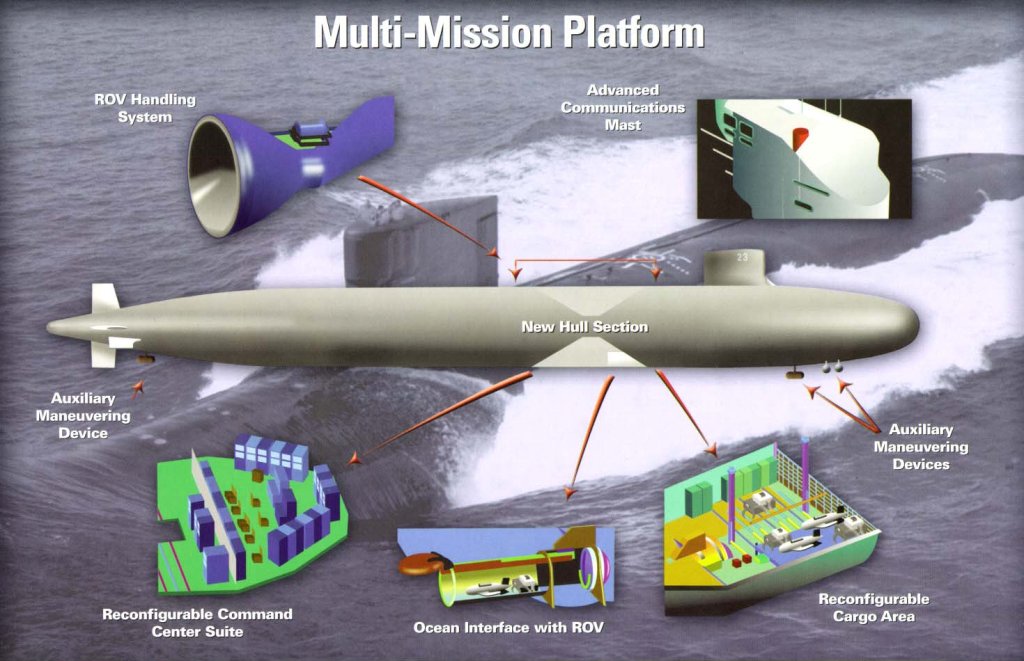
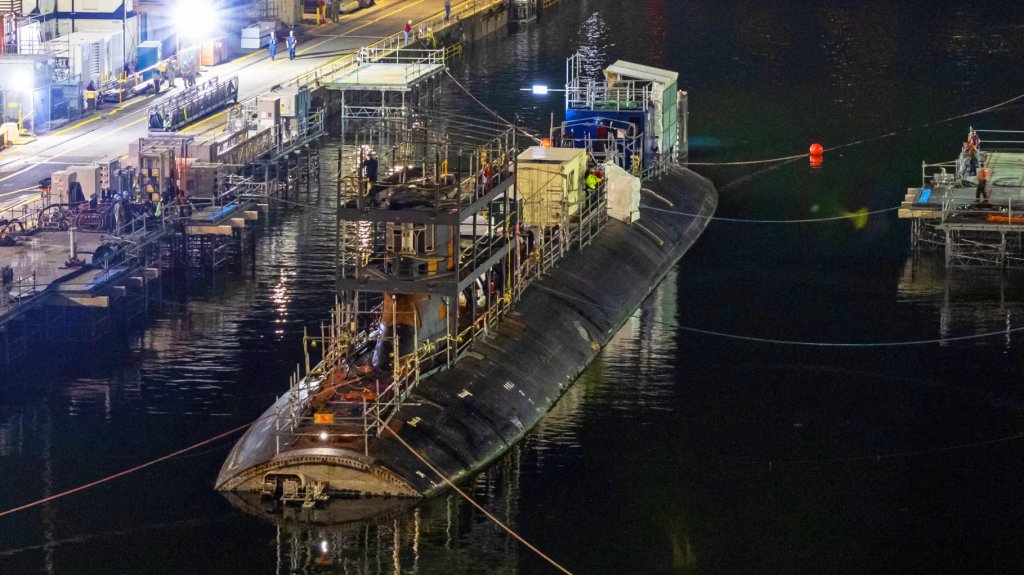
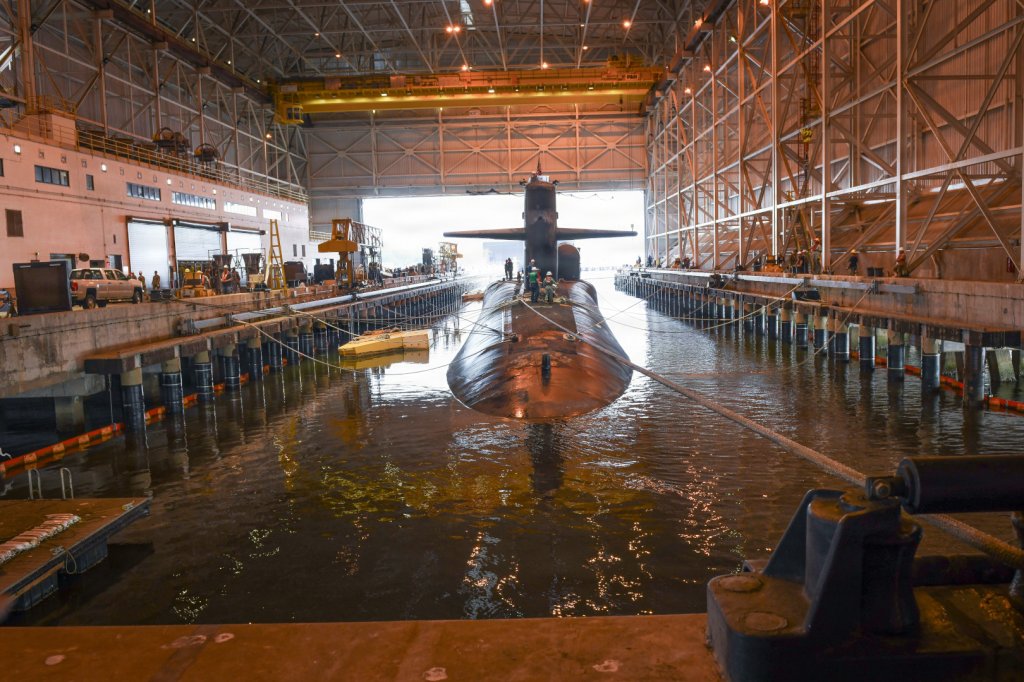
Beyond repurposing the space set aside for the VPM, what other modifications the seabed warfare version of the Virginia might receive are unknown. The Seawolf class, in general, is understood to have particularly good deep-diving capabilities, among other attributes, even compared to the Virginia class that came afterward. All three Seawolf class submarines – the other two being the USS Seawolf and the USS Connecticut – continue to be in high demand because of the advanced capabilities the design offers at its core. The continued importance of these submarines is underscored by the Navy’s ongoing work to return Connecticut to service after it suffered major damage, particularly to its bow, from a collision with an underwater seamount in the South China Sea back in 2021.
The floor of the ocean has long been an important, but challenging domain for underwater operations, including when it comes to cutting or tapping into critical fiber optic communications cables and destroying pipelines. Being able to examine, or even recover, objects of interest from the seabed has been and continues to be a critical element of so-called foreign materiel exploitation (FME) operations, as TWZ has explored in great detail in the past.
The importance of the seabed is only set to grow going forward. China, Russia, and others are working to expand their undersea infrastructure, often in support of nominally civilian activities that could have obvious dual-use applications. The Russian Navy, in particular, and the Soviet Navy before it, has its own particularly long history of covert and clandestine seabed warfare operations utilizing special mission submarines and submersibles, specialized surface ships, and uncrewed platforms.
Overall, including a new highly specialized version of the Virginia class design to supplement, or even eventually supplant, Jimmy Carter makes good sense. The Navy currently expects the Block V Virginia class submarines to be delivered between 2028 and 2034. Jimmy Carter was commissioned in 2005 and will be 29 years old when the last Block V boat arrives, at least according to the present schedule. This one-of-a-kind subvariant of the Seawolf class itself replaced the equally uniquely modified Sturgeon class attack submarine USS Parche, which was inactivated in 2004 after three decades of service.
As TWZ discussed in detail last week, the decision to recategorize VPM-equipped Block V submarines as SSGNs is meant to underscore the Navy’s separate commitment to filling separate looming capability gaps. The Navy is now starting the process of retiring its four Ohio class SSGNs, all of which were originally built as nuclear ballistic missile submarines (SSBNs). Those boats are also among the most heavily in-demand submarines the Navy has in service today. They are really more multi-mission platforms able to provide a wide range of special operation support, underwater command and control, and intelligence fusion functions, on top of their long-range strike capabilities, as you can read more about in this past feature of ours.
It has also been pointed out that the Navy is now unlikely to acquire a new SSN class, at least technically, for many years. The Navy has plans to acquire a new class of attack submarines, currently referred to as SSN(X), which has been discussed in the past as more of a true successor to the Seawolf class. However, the service does not now expect the first of those boats to enter service until the mid-2040s. At the same time, it is also worth noting that the decision to change the hull classification of VPM-equipped Virginia class from SSN to SSGN is largely administrative from what has been disclosed so far. Block V versions, at least, are expected to have the same capability mix as before.
SSN(X) “will complement the Virginia class to create a mixed attack submarine force built to penetrate and dominate heavily defended adversary areas,” according to the long-term shipbuilding plan the Navy released back in May. “With a larger payload volume, superior survivability, and organic hosting of unmanned robotic and autonomous systems (RAS), SSN(X) will assure continued persistent access to denied zones and eliminate enemy safe havens.”
“Block VI, really, that will become the jumping-off point, we think, for the SSN(X) program, and we expect to continue to incorporate even more advanced stealth and performance features,” General Dynamics Electric Boat’s Graney had also said back in 2022.
Whether the new SSGN nomenclature for Virginia class submarines equipped with the VPM results in any significant changes to how the submarines are employed remains to be seen.
What we do know now for sure is that two of the Navy’s future Block V Virginia class submarines will lack the VPM, and the second one will be a highly specialized seabed warfare version completely unlike any other.
Contact the author: joe@twz.com
Loading comments…
Comments couldn’t be loaded. Please refresh the page.