
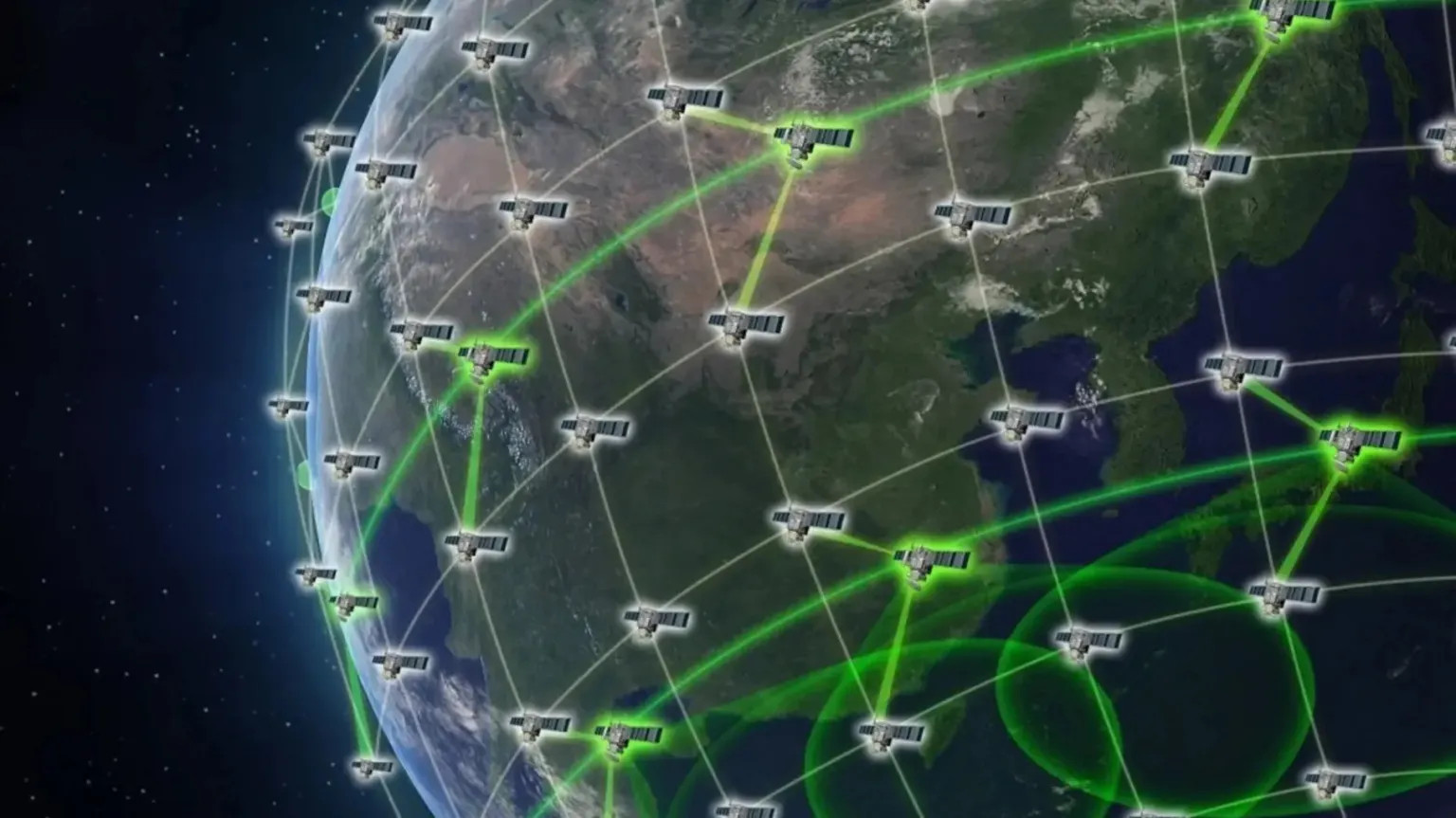
The U.S. Space Force has awarded SpaceX a $4.16B deal to help accelerate work on what could be a game-changing, space-based air moving-target indicator (AMTI) sensor network. The service says it now hopes to have an “early capability” in orbit by 2028, years ahead of the timelines officials have put forward in the past.
Plans for an AMTI satellite constellation were directly tied to an attempt in the past year to axe purchases of E-7 Wedgetail airborne early warning and control aircraft, something the Pentagon has now fully abandoned after Congress intervened. Though the Air Force is moving ahead again with the E-7, which will succeed its aging E-3 Sentry Airborne Warning and Control System (AWACS) jets, the end goal remains to eventually push most, if not all, AMTI tasks into space.

“The long-standing method of military airborne platforms to track moving targets faces continued challenges as adversaries develop increasingly sophisticated anti-access/area-denial (A2/AD) systems,” the Space Force said in its press release about the new deal with SpaceX today. “To compliment [sic; complement] traditional airborne sensing, the requirement for a layered, highly resilient tracking architecture is evident. SB-AMTI aims to enhance the Space Force’s capabilities to the Joint Force through the establishment of a persistent, global capability to sense and track airborne targets from space.”
The Space Force has described the $4.16 billion deal with SpaceX for the Space-Based Airborne Moving Target Indicator (SB-AMTI) program as a “competitive Other Transaction Authority (OTA) agreement,” rather than a traditional contract. The agreement came via the office of the Portfolio Acquisition Executive for Space-Based Sensing & Targeting (PAE SBST).
“This initial award is projected to field a constellation of satellites by 2028, providing the Joint Force with an early capability to eliminate operational blind spots,” according to the Space Force release.

In the past, U.S. officials have generally talked about space-based AMTI becoming a reality sometime in the 2030s. Work is underway to push ground moving-target indicator (GMTI) tasks into orbit, as well.
Some degree of on-orbit prototype AMTI sensor testing has already been ongoing for at least a year, if not much longer, but this work has been heavily classified. In addition to the U.S. Air Force and Space Force, both of which fall under the Department of the Air Force, the National Reconnaissance Office (NRO) has been involved in this work. The NRO, the activities of which are shrouded in heavy secrecy, is a U.S. military organization that serves as America’s main remote sensing intelligence arm.
“The capabilities that are happening in space are far exceeding our expectations,” then-Air Force Maj. Gen. Christopher Niemi said at a hearing earlier this year as part of a response to a question about plans for the E-7. He declined to offer more details publicly. Niemi, who has since been promoted to lieutenant general, is currently Deputy Chief of Staff of the Air Force for Force Modernization, and the service’s Chief Modernization Officer.
SpaceX has already reportedly been deeply involved in this work, too, as you can read about more in this past TWZ feature. This underscores the company’s ever-growing dominance globally in all aspects of the space industry, which we will come back to later on.
As mentioned, a functional, persistent, and distributed AMTI (and GMTI) sensor network in orbit has the potential to be game-changing. As TWZ wrote back in 2024, talking primarily about the future of space-based GMTI capabilities:
“A larger, distributed constellation would have the ability to monitor huge swathes of the Earth simultaneously, and depending on the size of the constellation, at least far more persistently to seamlessly. This could make it difficult, if not impossible, for an opponent to hide activities of interest. A very low revisit rate, or even eliminating revisit rate altogether, could even open up the possibility of continuous ‘streaming’ coverage of a location from low Earth orbit. This would also be essential for persistent GMTI coverage that tracks ground movements in real time that will actually be high enough in fidelity to guide weapons onto those tracks. It’s possible that aerial tracking could also be a function, as well, even to a more limited degree. The E-3 Sentry Airborne Warning and Control System (AWACS) will also be replaced at least partially by space-based capabilities, along with the E-7 Wedgetail.”

“There is also a fair chance that this is another type of system, perhaps to execute broad area optical/infrared imaging with some exotic capabilities to provide tracking. We just don’t know.”
“Regardless, yes, we are talking about the possibility of panoptic or near panoptic targeting and surveillance from space.”
“Greater collaborative capabilities, especially ones enabled by the use of machine learning and artificial intelligence (AI) technologies, could help to find targets of interest and anomalies far faster than ever before. This could also open a door to more autonomous collection, tasking/retasking, and other capabilities, as well. Areas of interest that need seamless coverage could have extra satellites retasked to the necessary orbit in order to do so automatically, without the need for human deconfliction and even direct operator direction.”
It is not hard to imagine how the satellite constellation being described here would fundamentally change the U.S. military’s ability to not just spot and track targets globally, but also close the kill chains to engage them, even at very long ranges. This has massive implications for future net-centric warfare where all sorts of tangential capabilities will increasingly be networked together. It might impact how tactical aircraft are equipped in the future, including the need for their own radars. There could at least be a reduced need for them to use their own radars to guide missiles, even when no supporting sensor network within the Earth’s atmosphere has relevant data to provide.
Unlike having to rely on a single plane in a single surveillance place, a space-based sensor network made up of a very large number of individual satellites would also be highly resilient to attacks, as well as other attrition just due to technical breakdowns or other factors.
All this being said, U.S. officials have been open about potential challenges when it comes to making space-based AMTI capabilities a reality, even just compared to establishing GMTI networks in orbit.

“So GMTI [ground moving-target indicator capability] and AMTI [air moving-target indicator capability] sound like they’re really close, just because one little letter that is all you changed, [but it] turns out they’re pretty different,” Chief of Space Operations Gen. Chance Saltzman, U.S. Space Force’s top officer, said during a press briefing on the sidelines of a conference in December 2025, according to Breaking Defense. “What it takes to accomplish AMTI is different than what it takes to accomplish GMTI.”
“Things on the ground move slower than things on [sic] the air, so [they] require different levels of fidelity tracks,” he added.
“The [AMTI] data the Intelligence Community and warfighter need presents a multi-phenomenology challenge that requires automated orchestration of the NRO’s collectors, low-latency data transport, and rapid data fusion by the NRO’s unmatched space communications and ground architecture capabilities,” a spokesperson for NRO also told Breaking Defense earlier this year.
It’s worth noting here that satellites with sensors are only one component of the total equation. Robust, resilient, and secure communications networks will be vital to getting the data collected where it needs to go. This is a separate area where SpaceX is already playing an increasingly central role with its Starlink and Starshield networks, as you can read more about here. Laser-based communications relays are set to be another key supporting capability.

In its announcement today, the Space Force did explicitly stress that SpaceX will not be the only company supporting the SB-AMTI effort going forward, and that it has established a larger “vendor pool.”
“By utilizing this multi-vendor framework, we are capitalizing on established industry capacity and continuously evaluating and onboarding the best tech to field this essential capability at speed and scale,” Space Force Col. Ryan Frazier, the acting PAE SBST, said in a statement. “We will not leverage any one single provider; instead, we are partnering with a highly diversified pool of traditional and non-traditional vendors, each bringing various capabilities to support the SB-AMTI architecture, ensuring the Joint Force has access to a strong, competitive industrial base well into the future.”
At the same time, as TWZ has noted in the past, SpaceX’s dominance in the market gives the company a clear advantage for securing further deals. This extends to the additional demands to put all this architecture in space. At least currently, no other company has the same capacity to provide the U.S. military with the kind of reliable access to space at the required cadence, and within budget constraints. SB-AMTI is already a major budget priority, with the Space Force asking for more than $7 billion in additional funds to procure additional elements of the system in its 2027 Fiscal Year budget request.
These are all factors that are also notably set to play into how the Golden Dome missile defense initiative evolves. There has already been talk about Golden Dome leveraging existing work, including programs under the umbrella of PAE SBST, to help accelerate the fielding of at least an initial layer of capability.
It should also be reiterated that the Air Force is now moving ahead again with the E-7 program, and traditional aerial AMTI capabilities look set to remain an important element of U.S. military operations for the foreseeable future.
That being said, the new $4.16 billion agreement with SpaceX makes clear that the Space Force is pressing ahead with its plans for a space-based AMTI sensor network with hopes that at least an early operational capability could be in place within the next two years.
Contact the author: joe@twz.com
Loading comments…
Comments couldn’t be loaded. Please refresh the page.