
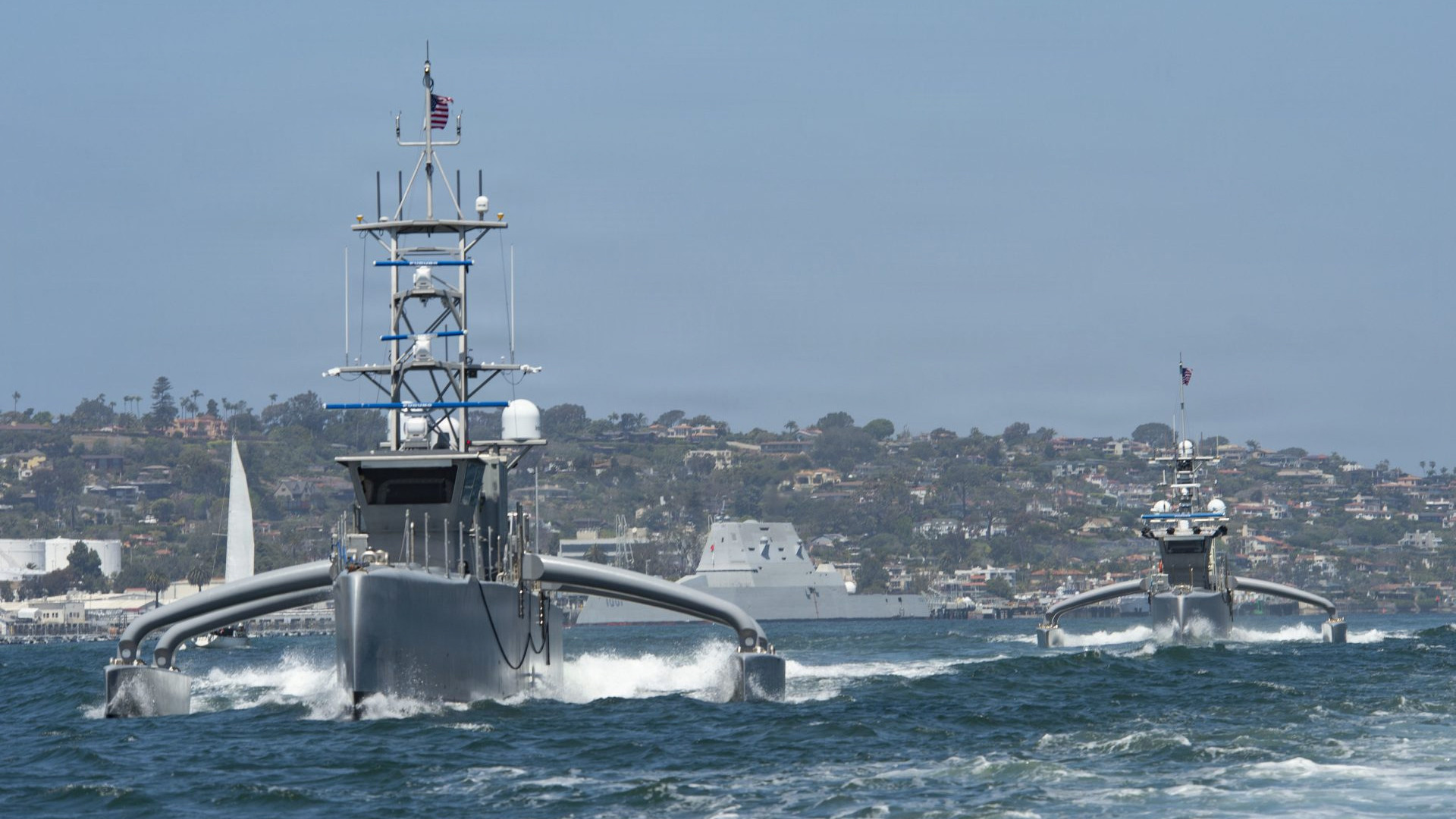
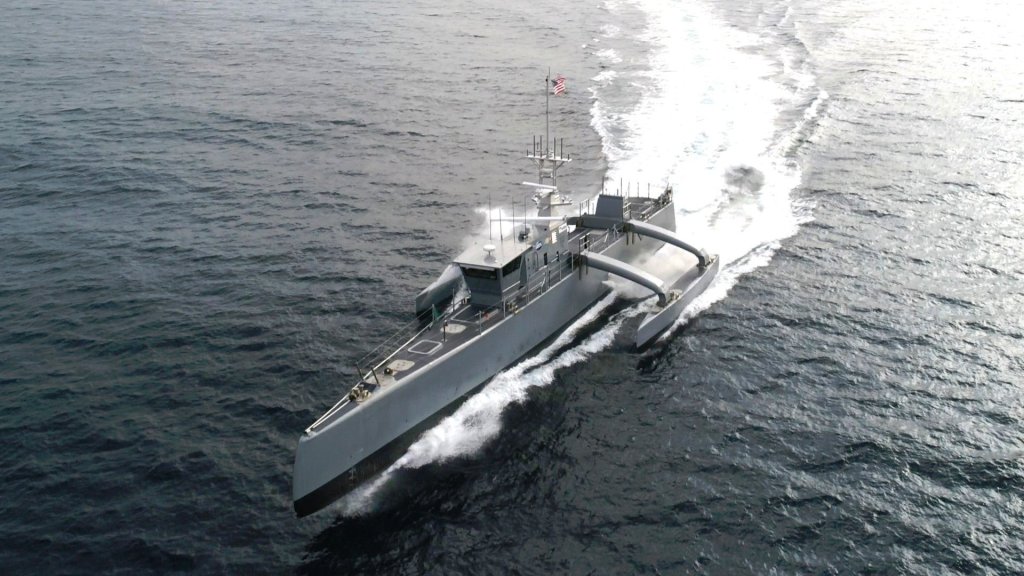
The U.S. Navy has unveiled a “marketplace” model for acquiring future fleets of uncrewed surface vessels (USV), which could be owned and/or operated by the service or contractors. The Navy is applying this approach first to the procurement of medium-sized designs, or MUSVs, which could be configured for a variety of missions with the help of containerized payloads. The new strategy, which supplants the Modular Surface Attack Craft (MASC) plan laid out just last year, and aims to cut down on lengthy prototyping requirements, is the latest in a series of Navy efforts to try to speed up the fielding of new USV capabilities at scale.
“The character of warfare is changing rapidly. The Department of the Navy is adapting its acquisition system to deliver capability to our warfighters faster,” Secretary of the Navy John Phelan wrote in a post on X this morning, marking the official roll-out of the new USV acquisition plan. “We are harnessing the talent and ingenuity of the American tech sector by launching a market competition for the Medium Unmanned Surface Vessel (MUSV) Family of Systems. This new approach will leverage private investment and accelerate the delivery of real capabilities to the Fleet. We will reward the companies who are able to deliver capability at the speed of relevance.”
“Our goal is to create a regular, recurring marketplace, not just for the MUSV, but for other classes of vessels, as well, over time, designed to match the growing demand for unmanned systems across a range of missions,” Rebecca Gassler, the Navy’s first-ever Portfolio Acquisition Executive for Robotic and Autonomous Systems (PAE RAS), also told TWZ and other outlets during a press call today. “This model that we’ve posted rewards demonstrated performance at sea, not just development, and is not another prototyping award. And it creates a direct path from what’s demonstrated on the water to putting those vessels into the fleet.”
The use of “marketplace” here should not be confused with how the U.S. Army is also now using that term to describe an actual online storefront-style system for ordering small uncrewed aerial systems. “I don’t know how many customers other than PAE RAS there are right now that actually have the funding to go buy or lease an MUSV,” Gassler said in response to a question about whether any kind of comparison between the two might be appropriate.
The Navy also posted a contracting notice regarding what it is now calling the Medium Unmanned Surface Vessel (MUSV) Family of Systems (FoS) program, specifically, online today. Potential offers only have another three weeks or so to submit proposals that involve designs that can be ‘on the water’ by the end of September, underscoring the service’s interest in already highly mature capabilities.
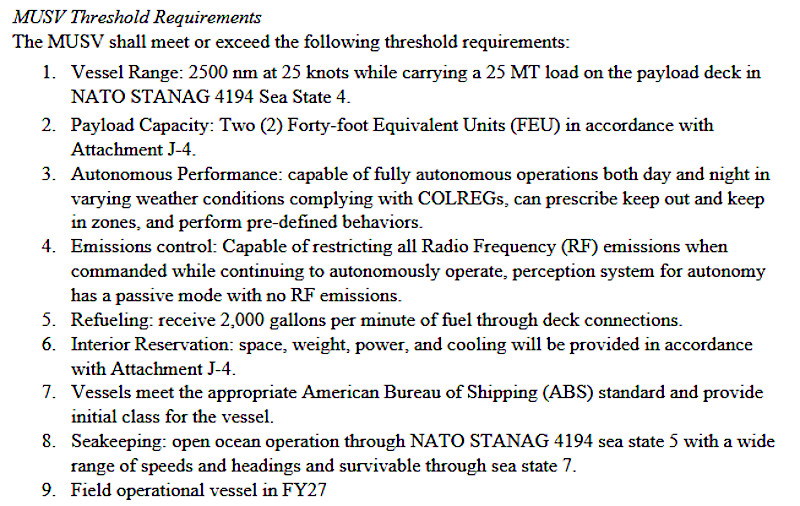
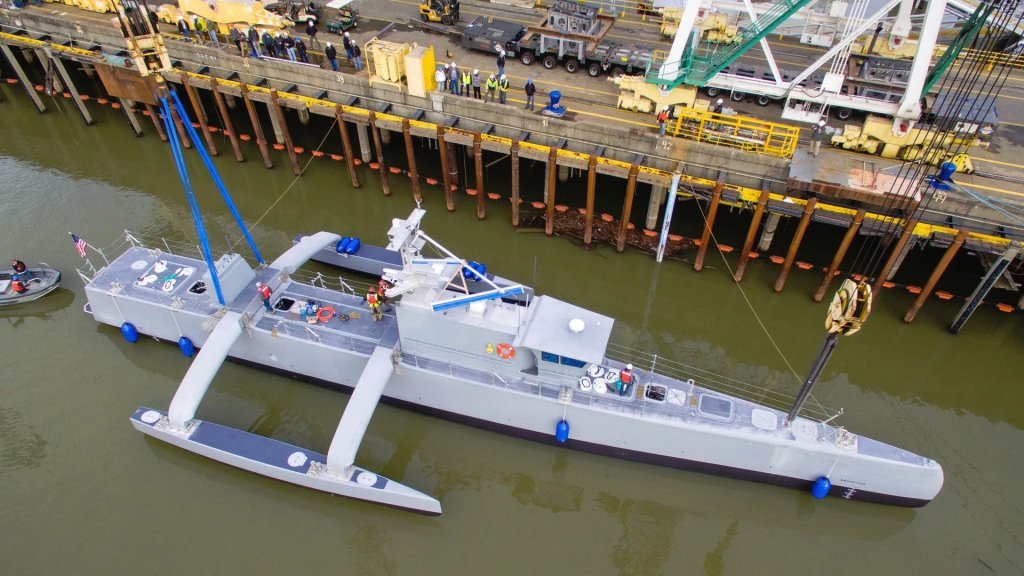
In terms of the actual uncrewed vessels the Navy is seeking through this effort, threshold requirements include a range of at least “2500 nm [nautical miles] at 25 knots while carrying a 25 MT [metric ton] load on the payload deck in NATO STANAG 4194 Sea State 4.” Per this NATO standard, Sea State 4 is characterized by wind speeds of 17 to 21 knots and wave heights between four and eight feet.
The MUSVs also need to be able to carry forty-foot equivalent units (FEU) containerized payloads and to refuel at sea at a rate of “2,000 gallons per minute of fuel through deck connections,” according to the contracting notice. We’ll come back to what might be in those payloads later on.
The Navy also wants designs that are “capable of fully autonomous operations both day and night in varying weather conditions complying with COLREGs [Convention on the International Regulations for Preventing Collisions at Sea], can prescribe keep out and keep in zones, and perform pre-defined behaviors,” per the notice. They also have to be “capable of restricting all Radio Frequency (RF) emissions when commanded while continuing to autonomously operate, perception system for autonomy has a passive mode with no RF emissions.”
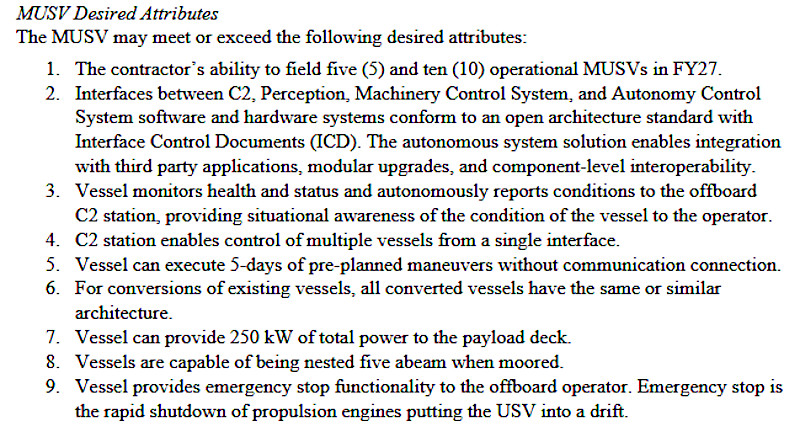
In addition, the Navy has outlined a number of desired attributes, including “interfaces between C2, Perception, Machinery Control System, and Autonomy Control System software and hardware systems [that] conform to an open architecture standard with
Interface Control Documents (ICD)” and an overall “autonomous system solution [that] enables integration with third party applications, modular upgrades, and component-level interoperability.” The service is also interested in the ability of the MUSV to monitor “health and status and autonomously reports conditions to the offboard C2 station, providing situational awareness of the condition of the vessel to the operator.”
“Vessel can execute 5 days of pre-planned maneuvers without communication connection” and “vessel provides emergency stop functionality to the offboard operator,” defined as “the rapid shutdown of propulsion engines putting the USV into a drift,” are also on the desired attributes list. There are production and operational aspects the Navy is also interested in, such as the ability of a selected contractor to supply between five and 10 operational MUSVs by the end of Fiscal Year 2027 and designs that can be “nested five abeam when moored.”
“We believe a number of them [potential offers] will test on production representative, but not full production[-ready designs,] or they’ll test in [sic] surrogate boats, so that we can see the autonomy that they’re bringing, even if it’s not the full production vessel,” Gassler noted today. So, acceptance of a finalized design will include a requirement “to do the full endurance test again, and any additional mission profiles that we have gotten from the Fleet, we will test at the time. And then we will do a full regression test on the autonomy now that it has been connected into the production boat controls.”
Overall, many of the stated threshold requirements for the MUSV FoS are similar, if not identical, to what the Navy had previously outlined for the initial baseline MASC design. The MASC plan was a three-tier approach that also included larger and smaller types, all of which would be configurable for different missions using containerized systems.
At the same time, the new strategy laid out today “is a replacement for MASC, absolutely,” PAE RAS Gassler stressed. MASC “was tailored towards a very specific mission and a very specific ask from the Fleet, [and a] very specific quantity. And we have a much wider variety of requirements for these vessels and missions that they need to accomplish as part of the Golden fleet. And so this is a replacement for that.”
“So, I won’t talk about specifically what mission we’re going after now that kind of gets out of the unclassified realm, but know that we are looking at specific mission profiles,” Gassler added. “For example, some require more complexity in their autonomy features than others, and so when we put these vessels through their tests, those tests will be a superset of those requirements such that we understand they will meet each of those missions.”
“Honestly, inside you could have a sensor, you could have repair equipment for ships,” she also said, speaking more generally about containerized payloads. “You could have any number of payloads inside those, and you basically are able to just swap them on.”
It should be noted here that the Navy did say its initial focus for MASC was on Intelligence, Surveillance, Reconnaissance, and Targeting (IRS&T), Counter-ISR&T, and Information Operations missions. At the same time, the three-tier approach and focus on containerized systems had certainly pointed to additional missions, including surface-to-surface strike and electronic warfare, down the line. The Navy already has a containerized launcher capable of firing SM-6 multi-purpose missiles and Tomahawk land-attack cruise missiles that it has been working to field on crewed ships, as well as in a ground-based configuration. The Navy has test-fired that launcher from an optionally crewed ship in the past.
“As we look across how the Golden Fleet capability, or the Golden Fleet concept, has matured, and we look across where we could use these vessels as part of CNO’s [Chief of Naval Operations Adm. Daryl Caudle] tailored offsets and tailored forces, we bring ourselves to realize there’s a number of missions that we could immediately use these vessels for,” Gassler said. “That is, that is part of the strategy now, is that we will now have a scalable way to procure vessels that meet specific mission profiles.”
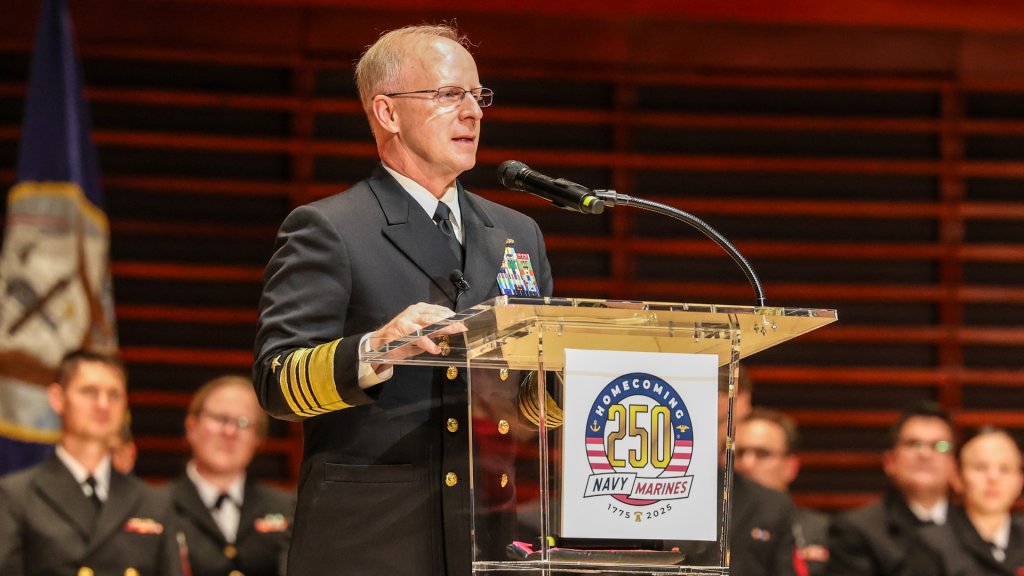
Adm. Caudle publicly announced that the Navy would be moving toward a more flexible deployment model using tailored force packages at the Surface Navy Association’s (SNA) annual conference in January. At that same event, he also laid out a new “Hedge Strategy” to try to better maximize Navy resources through a major overhaul of how existing forces are utilized and how new capabilities are acquired and fielded. You can read more about all of this here.
Last week, Caudle also rolled out another new initiative, the Containerized Capability Campaign Plan, which puts new emphasis on containerized weapons and other capabilities, specifically, as a means to help the Navy achieve these broader goals.
Perhaps the biggest change the Navy is hoping to see with its USV marketplace strategy is in the processes through which it acquires and fields USVs. This reflects a broader push by the service to shake up how it buys vessels, crewed and uncrewed, to try to avoid the kinds of serious setbacks that have plagued Navy shipbuilding programs in recent years.
From what Gassler said today, the MASC program had been progressing along largely traditional lines, with plans to issue contracts to multiple vendors for a prototyping phase ahead of choosing one or more designs for production. She made clear that the new strategy aims to skip the prototyping phase to the fullest extent possible.
“Industry has leaned forward and has built boats or has built the technology already,” leading to the assessment that “we no longer needed to go through the prototyping phase,” she said. “So this will allow us to test the capability on water and go straight into production. And that will save us approximately on the order of a year, and we will get capability to the fleets faster.”
“What we want to do is capitalize on that investment. So the marketplace will look for several things,” she added. Beyond the “technical design that meets the specifications,” the Navy is also “looking for a variety of business models. So in this case, the [MUSV FoS] solicitation asks for what does a government-owned, government-operated model look like, types of data, rights, things like that, as well as a contractor-owned, contractor-operated model.”
Then there’s “manufacturing readiness. When we go through a normal development program, you don’t consider that until much further into the life cycle of development. Here we’re considering it up front,” she continued. “So we’ll be looking at your staffing, the supply chain, and whether you’ve got any fragility in the supply chain. We’ll be looking at facilities and capacity. So if you say you can produce X number of boats per year, can we really see that in the laydown of your facility, or that of those who you’ve partnered with.”
Gassler says that vendors that successfully complete the on-water test requirements will receive a fixed-price payment as a “reward” to help foster competition. The Navy will then have the option of entering into a production or leasing agreement for the design in question.
With all this being said, as mentioned, this is not the first time the Navy has attempted to accelerate the acquisition and fielding of USV capabilities, especially when it comes to larger types. The service already has a number of smaller USVs with speed boat and jet ski-type designs in service today.
When it was rolled out last year, MASC was presented as finally offering a path forward after more than a decade of prototyping and experimentation efforts that have yet to lead to meaningful operational capabilities. As a prime example of how things have progressed previously, in January, the Navy triumphantly declared its intention to employ two MUSV-type vessels it has in inventory now – Sea Hunter and Seahawk – operationally. Sea Hunter has been sailing since 2016. The Navy acquired Seahawk in 2021.

With MASC, the Navy had also hoped to leverage those prior investments, including work that had been led by the Defense Advanced Research Projects Agency (DARPA) and the Defense Innovation Unit (DIU). DARPA’s ongoing No Manning Required Ship (NOMARS) program, which the Navy is also involved in, continues to be particularly relevant in terms of the new operational and production concepts it is seeking to prove out. The NOMARS test ship, the USX-1 Defiant, was designed to be a lower-cost and readily producible design capable of operating without humans ever being on board, as you can read more about here.

Overall, as TWZ wrote back in July 2025 when the MASC plan broke cover:
“All of this comes as USVs have now long been seen as a key way for the Navy to bolster its surface fleets. Distributed fleets of USVs configured for strike and ISR missions, and capable of operating independently or in groups, as well as together with crewed warships, open a door to significant new operational possibilities. Members of the MASC family could also help reduce risks to crewed assets. Modular designs that can be readily configured and reconfigured for different missions using containerized payloads also present targeting challenges for opponents.“
…
“The United States’ worrisome and still-widening gap in shipbuilding capacity with chief global competitor China has also been putting new emphasis on USVs. The U.S. government has been trying to take steps to reverse this trend, including exploring the potential of leveraging foreign shipyards to produce more crewed warships, in recent years. In the meantime, the Navy’s traditional shipbuilding programs continue to be beset by delays and cost growth, on top of being expensive long-lead-time efforts, in general.“
The Navy is clearly hoping that it has found the right formula with its new marketplace strategy to finally get larger and more capable USVs into service.
Contact the author: joe@twz.com
Loading comments…
Comments couldn’t be loaded. Please refresh the page.