
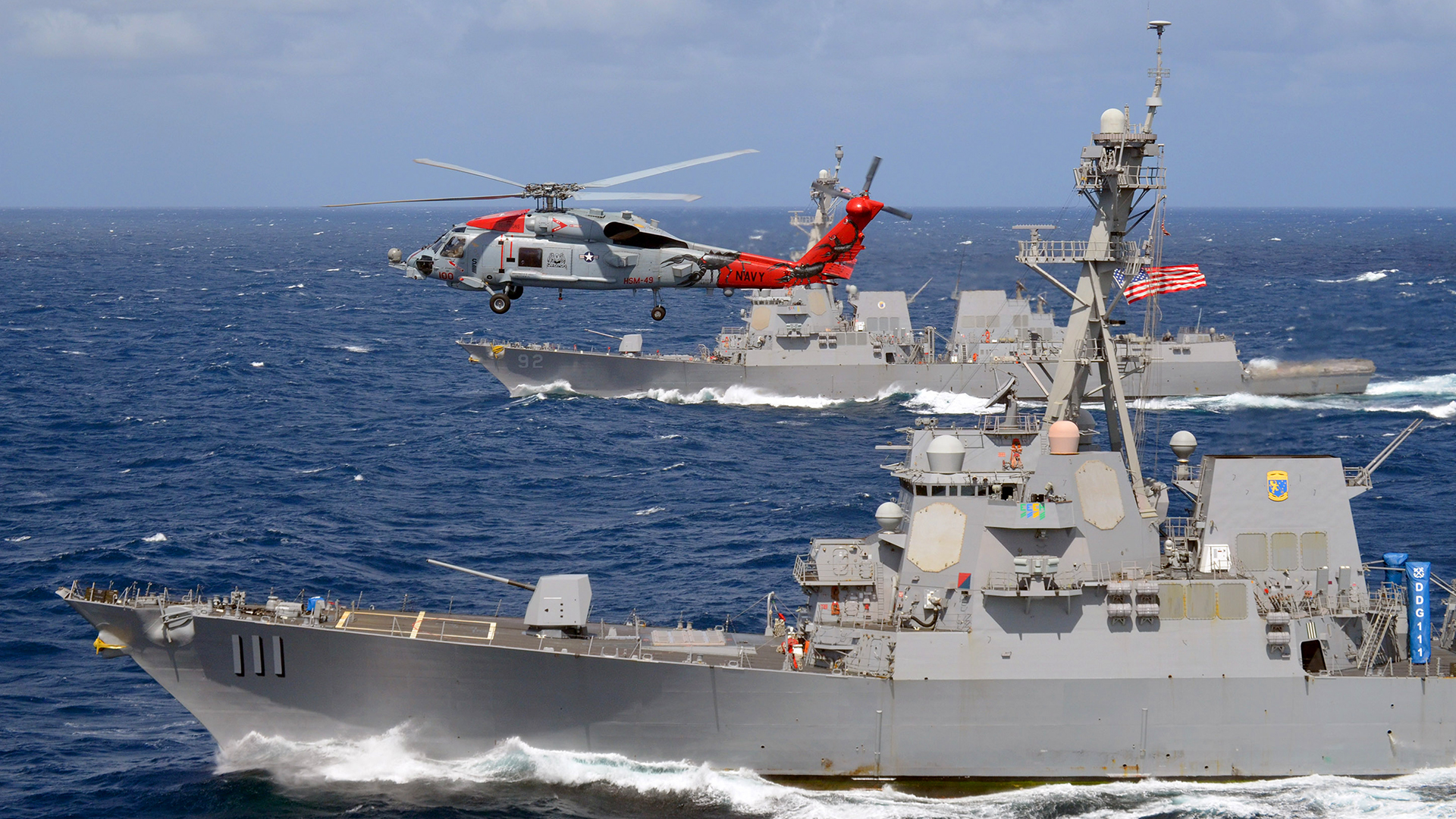
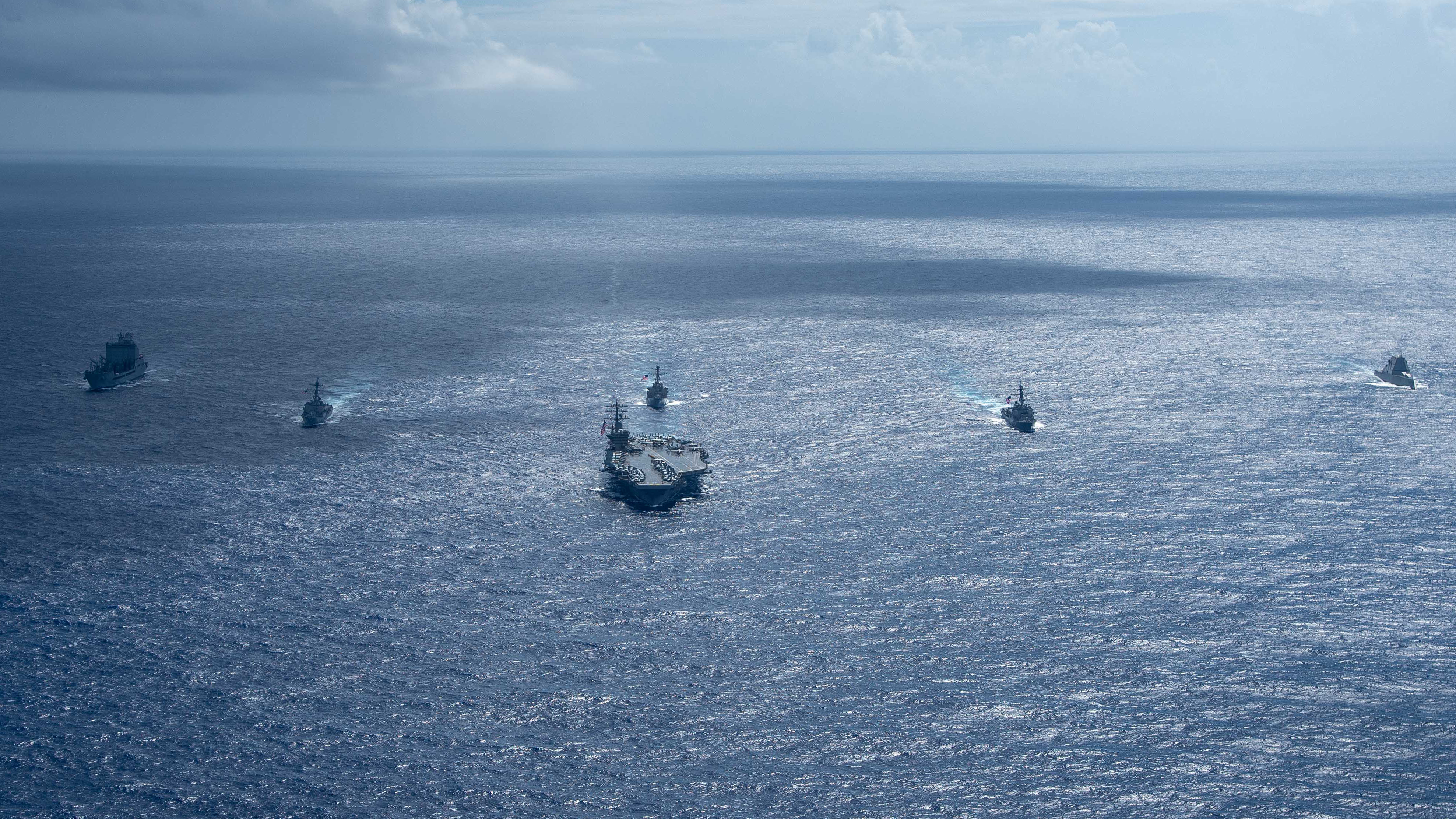
While today’s surface Navy puts major emphasis on carrier strike group and expeditionary strike group deployments, driven by the resource realities and the global threat environment, the current Chief of Naval Operations (CNO) wants to take a far more flexible and tailored approach to sending his vessels on cruise.
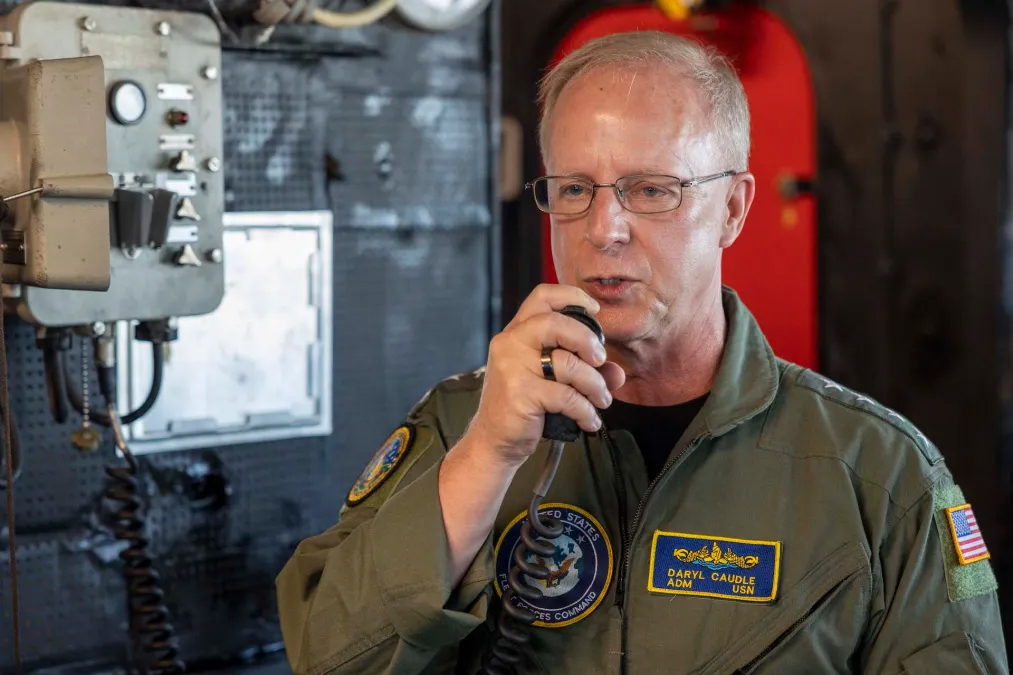
Speaking to reporters at the Surface Navy Association’s (SNA) annual conference near Washington, D.C., CNO Adm. Daryl Caudle said global mission demands made delivery of the full carrier strike group package to all the parts of globe where combatant commanders signaled a need “just not possible.”
“So the idea is, what’s necessary and sufficient to actually handle the thing that you need some within your [area of responsibility] as a combatant commander and as a Navy component commander,” he said. “That’s what drives you into a tailored force package.”
While independent deployments and those of smaller groups of ships aren’t by any means new, a greater emphasis on them in the future aims to give the Navy better resource management of its most prized assets and more presence where it is needed around the globe.
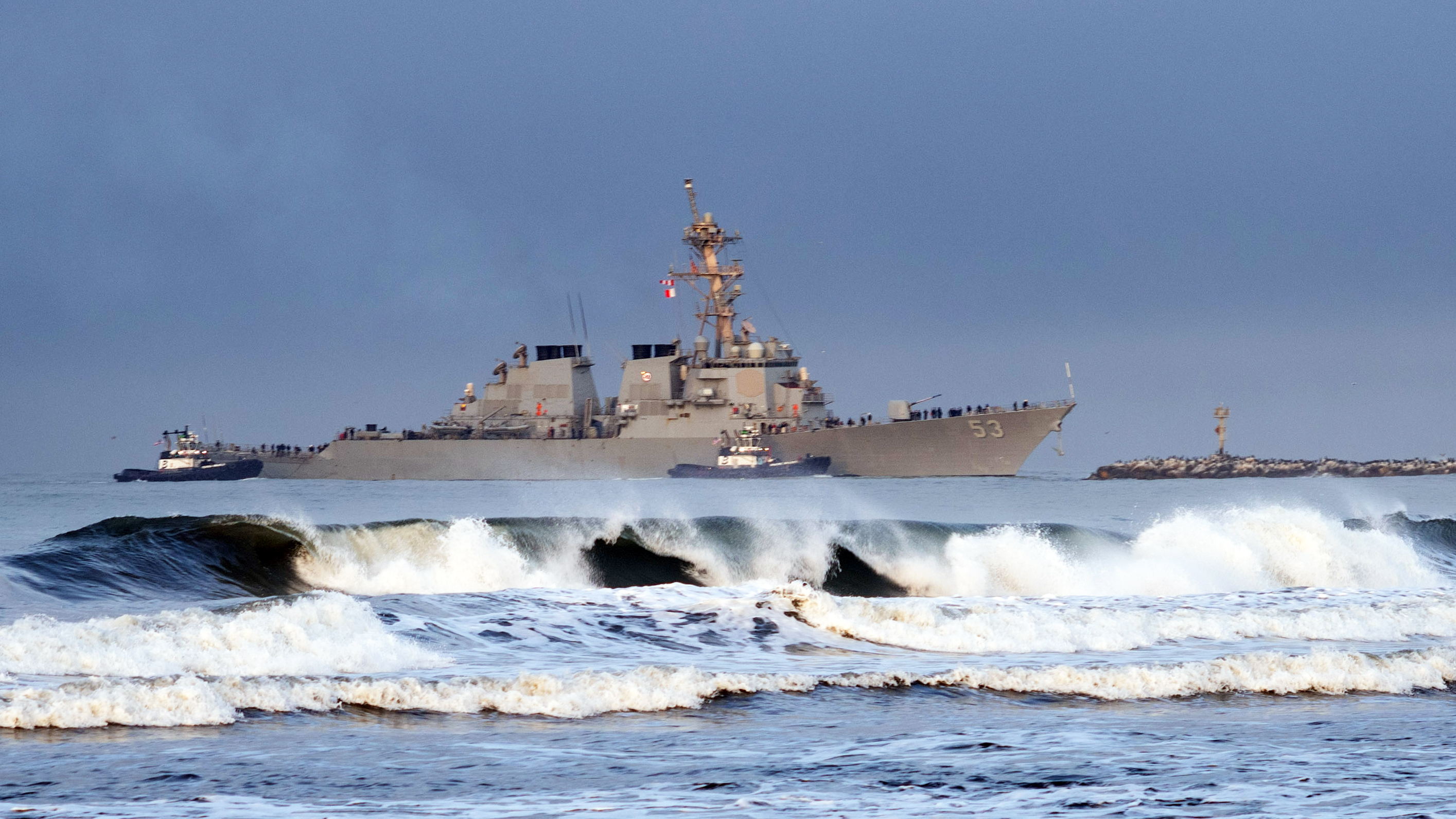
Caudle noted that there was some recent history of tailoring deploying forces based on specific mission needs, citing the two-year campaign defending Israel from the Red Sea in the aftermath of the Oct. 7, 2023, Hamas attacks on Israel. The Arleigh Burke class destroyers USS Mason and USS Carney, for example, spent months in the Red Sea operating largely independently prior to joining other naval assets in the region. Mason had deployed to the region as part of the Dwight D. Eisenhower Carrier Strike Group. Carney is one of several Navy destroyers forward-deployed in Spain.
“If I want to go put a force package to bolster the [Rota, Spain-based guided-missile destroyers] for defense of Israel, I don’t need a carrier strike group to do that,” Caudle said. “I need more ballistic missile defense. So ballistic missile defense would be a tailored force package.”
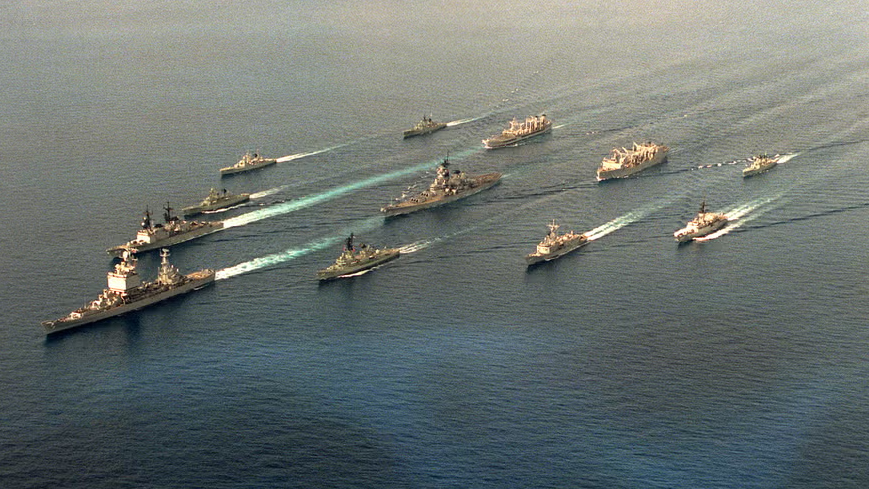
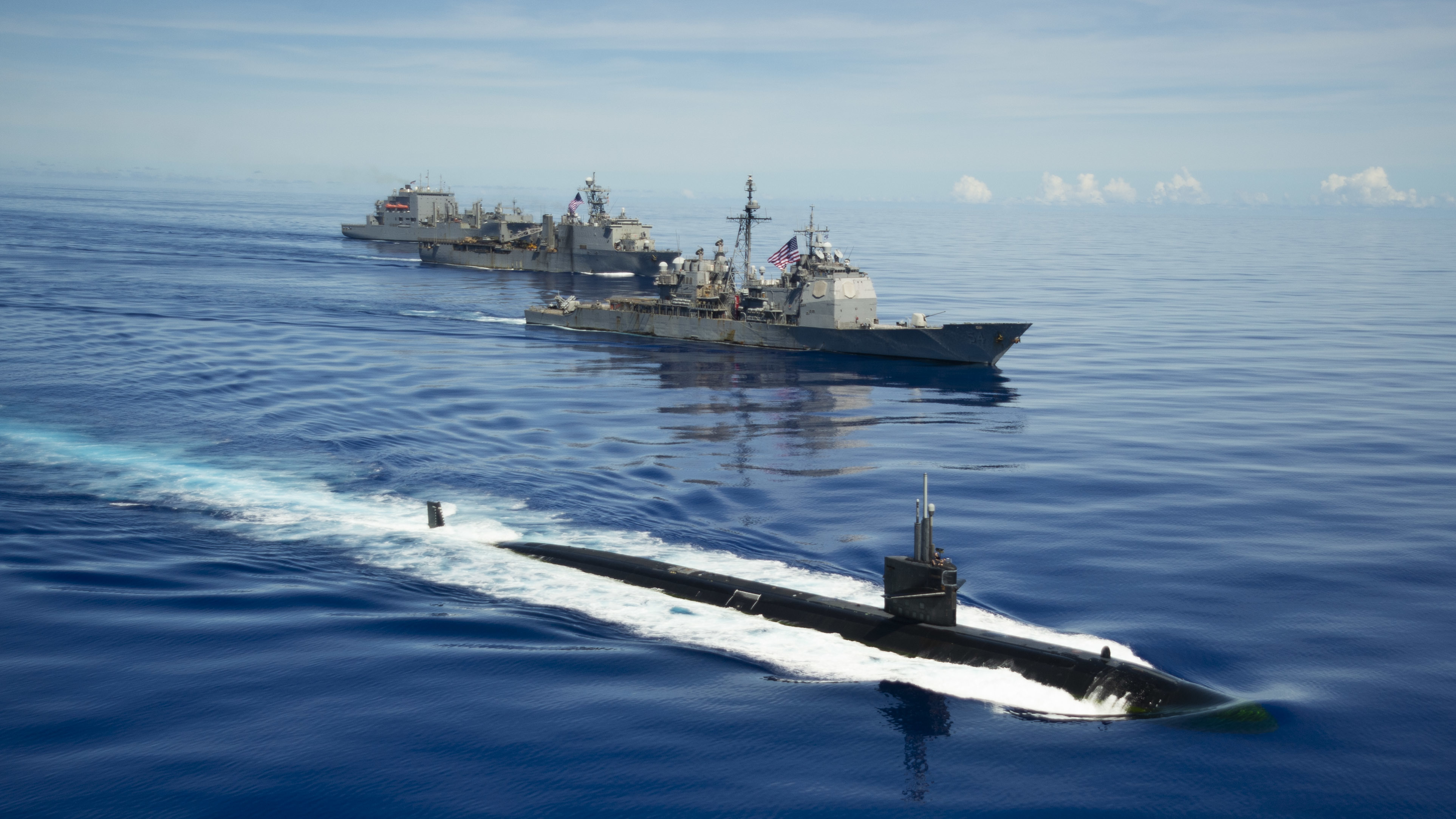
Non-amphibious ship deployment packages that don’t include a carrier are known as surface action groups (SAG) and have been relatively rare and inherently temporary in their organization. In July 2021, the Navy announced the formation of a surface action group in the South China Sea from elements of three U.S. 7th Fleet task forces. Officials noted it was the first time an Arleigh Burke class destroyer and a member of either class of Littoral Combat Ship (LCS) had come together to form a SAG – underscoring still-unexplored opportunities to combine surface assets in different ways for specific operational impacts.
The concept Caudle is advancing would take the setup a step further in developing parameters around how specific force packages can be employed, thus protecting deployers from being worked beyond their limits and managing the expectations of commanders.
“We’d organize, train, equip, certify that force, flow it into the theater,” the CNO said. “That certification would come with caveats that it’s been certified to go do this. And, so, if you do it that way and you delimit that, and you have a negotiation with the receiving commander that it’s not a full major combat operational certified unit, but it’s going to satisfy this limited objective, everybody’s on the same page … and when you bring in force sharing between the combatant commanders, which is allowed by our [Global Force Management Instruction and Guidance] process, then that even adds additional fungibility to that concept.”
With the addition of a tailored force package framework, “I think what we have in SOUTHCOM [U.S. Southern Command] today would look much different,” Caudle added.
The remark was significant as Caudle had previously addressed stresses on the supercarrier USS Gerald R. Ford at SNA. The Navy’s newest flattop, Ford has been deployed from its Norfolk, Virginia, homeport since last June and was a critical part of Operation Absolute Resolve to extract Venezuelan dictator Nicolas Maduro and his wife from Caracas to bring them to the U.S. for criminal prosecution.
“If [the Ford] requires an extension, it’s going to get some pushback from the CNO,” Caudle had said. “And I will see if there is something else I can do.”
According to the CNO, there are still formal steps ahead to codify force packages available to the combatant commanders and determine not only what platforms are included in each package but also what they carry, down to specific technological capabilities.
“In this journey to being able to present tailored force packages to the Joint Force for consideration, I’ve gotta be able to define what those look like, how I certify and do that more effectively,” Caudle said, describing what he called “tailored offsets” in a December C-Note message to the fleet. “Type commanders roll in on this, fleet commanders run on this.”
“It’s the way to have force multiplication, to punch bigger than yourself, and that’s done through tailored offsets,” he said. “That’s the concept. So that whole thing builds a way to present forces to allow me to do more with less.”
In a separate keynote address at SNA last Wednesday, Caudle promoted his new “Hedge Strategy” for maximizing Navy agility and capability, saying more details on how it works would be forthcoming with the upcoming release of “U.S. Navy Fighting Instructions.”
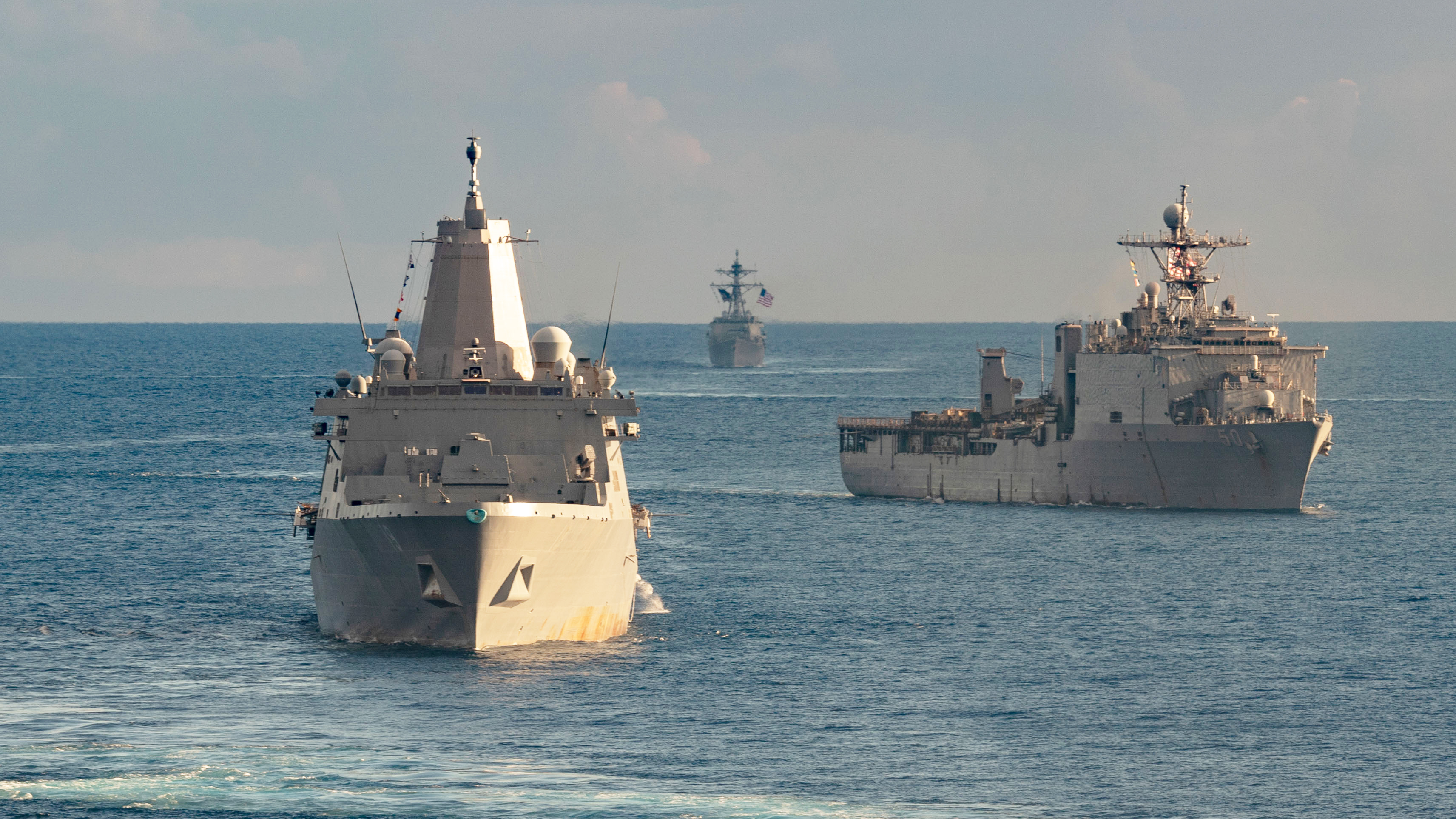
The concept also has implications for how ships and their attached units conduct pre-deployment training. Carrier strike groups and amphibious ready groups form up months ahead of time to train in a rigorous battery of exercises at sea, culminating in what is known as the Composite Training Unit Exercise, or COMPTUEX, which lasts two to three weeks and is essentially a miniature deployment. Caudle did not specify how a wider array of deployment packages might affect pre-deployment workups, but if the force package is designed for a more limited set of missions in a particular threat area, pre-deployment training would likely be truncated significantly.
While the Hedge Strategy purports to overhaul acquisition and fielding as well as how forces are postured and employed, it underscores above all using resources efficiently and in a way tailored to the current fight.
“What Hedge avoids is a brittle, single-purpose force that is either over-built for the high-end fight and under-used day-to-day or optimized for low-end crisis and overmatched when it counts,” the CNO said in prepared remarks provided to The War Zone. “Building a Fleet to cover every specific scenario is not only cost- and risk-prohibitive, it is a disservice to the taxpayer and less effective optionally.”
Caudle’s interest in taking a building-block approach to the Navy is also influencing shipbuilding reforms: during the brief, he said the Navy’s heralded and pricey “Golden Fleet” vision would be made more affordable by building greater modularity into shipbuilding.
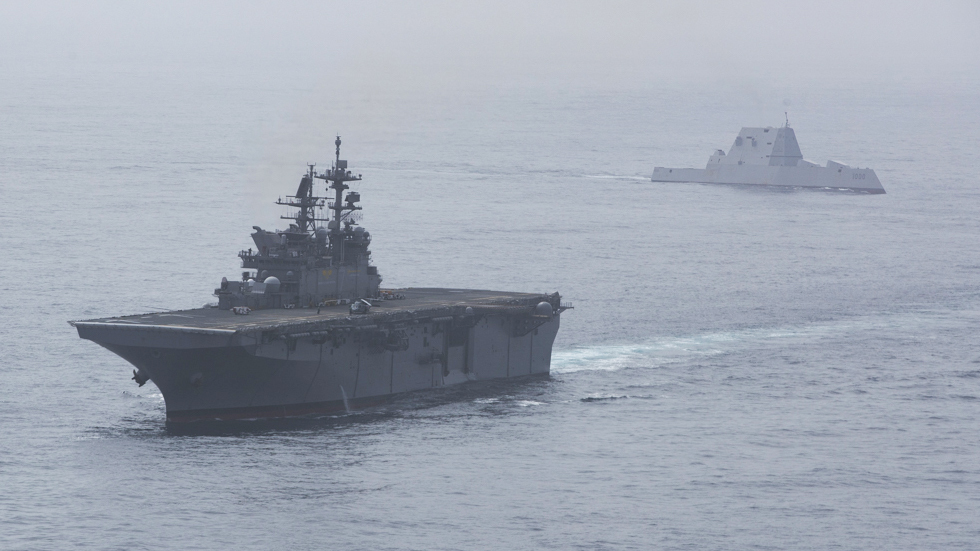
Meanwhile, the Navy’s newly revamped FF(X) frigate program is being designed to further this idea of flexible and programmable deployers. It’s envisioned as a mothership for surface groups of uncrewed vessels and intended to accommodate containerized weapons and customizable modular payloads.
Still, there will be limitations to executing tailored deployments. Caudle wants to be clear about what smaller and more finite deployment groups could and could not do.
“That’s the thing; I don’t like being limited on how I present a force,” he said. “I want my forces to be trained, and there has to be some level of certainty to buy down the acceptable level of risk before I put them in harm’s way. We do that through a certification, and then I have a conversation with the receiver of that force, that they understand what they’re getting and the level of that certification.”
“So they have a license, okay? If you get a hunting license, you can’t shoot every animal out there. Your license to do certain things. So this is a license to go do a specific mission under a specific time frame.”
Contact the editor: Tyler@twz.com
Loading comments…
Comments couldn’t be loaded. Please refresh the page.