
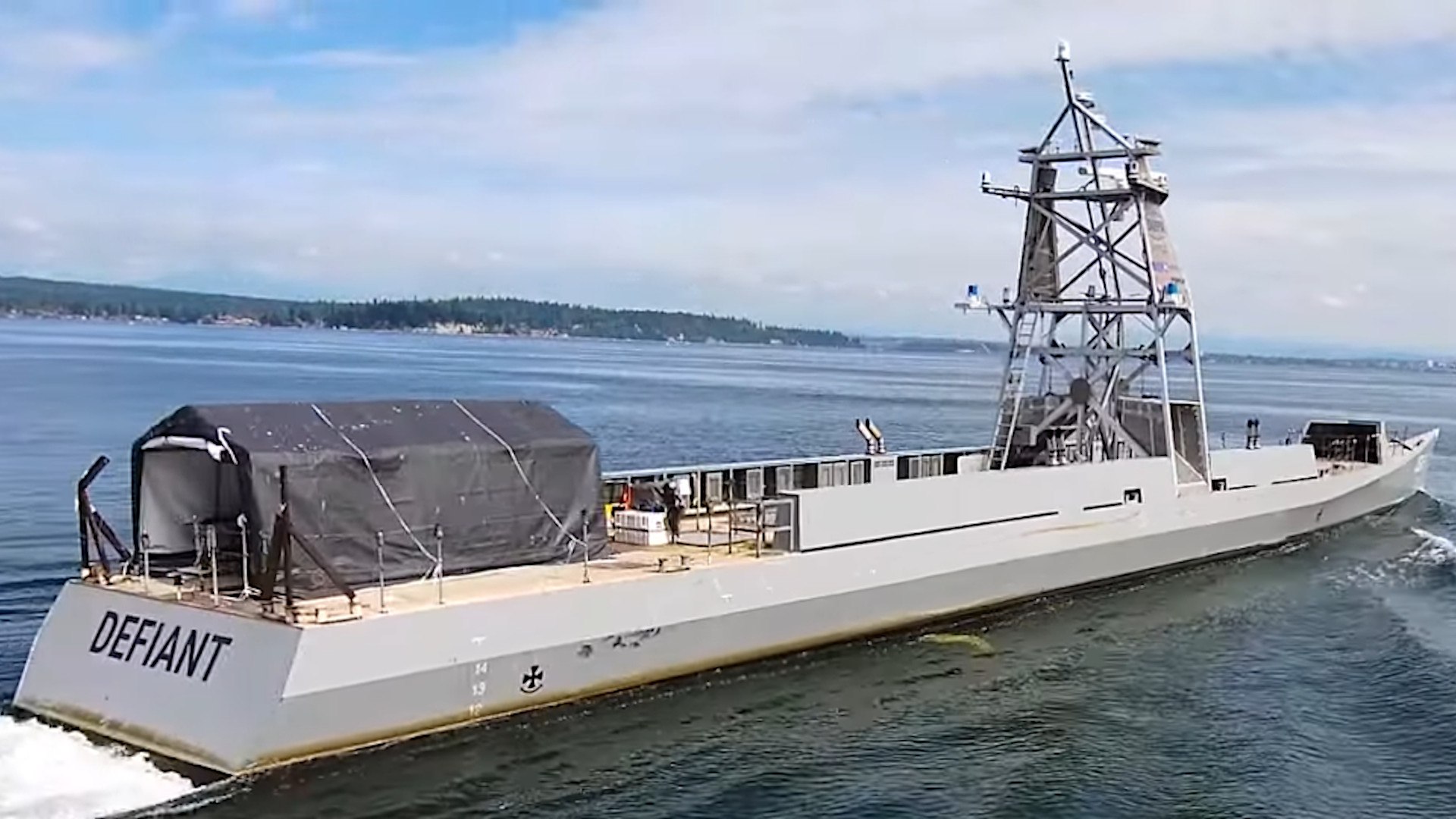
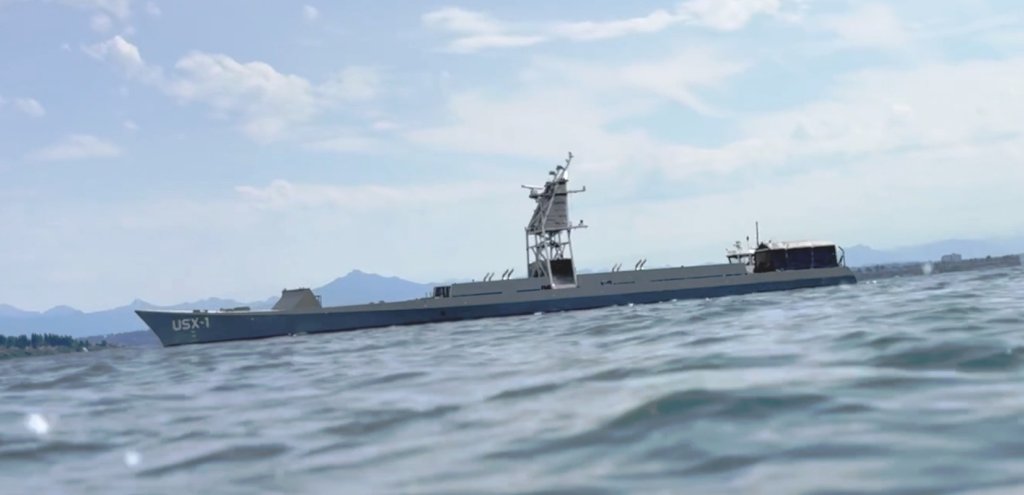
We now have a full look at the U.S. military’s USX-1 Defiant medium-sized drone ship as it gets closer to heading off on a months-long open-water demonstration cruise. Defiant was designed from the outset to operate without any humans ever onboard, as well as for efficient mass production, and is set to help lay the groundwork for the U.S. Navy’s vision of a future family of uncrewed surface vessels (USV).
The U.S. Defense Advanced Research Projects Agency (DARPA) recently released new videos and pictures of Defiant from ongoing initial in-water testing. The ship was developed and built specifically for DARPA’s No Manning Required Ship (NOMARS) program. It was formally christened at a ceremony in Everett, Washington, where it is currently homeported, on August 11. Serco Inc. is the primary contractor for the USV.

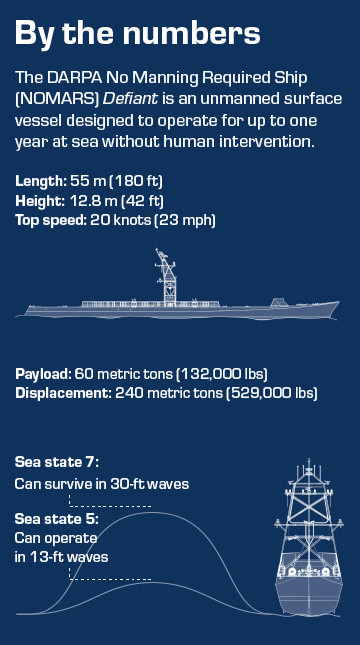
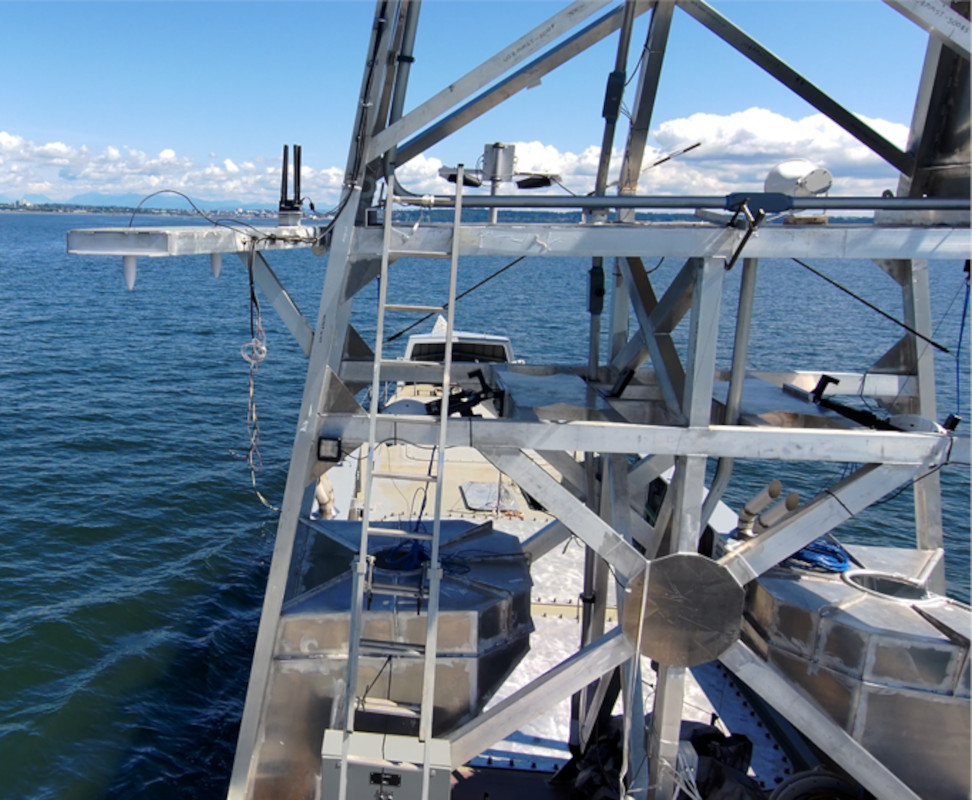
The 180-foot (55-meter) long, 240-metric-ton displacement Defiant has been mostly under wraps since it was launched earlier this year, something TWZ was first to confirm. What we can see now of the uncrewed ship, especially its central mast adorned with various commercial navigation radars and other antennas, as well as its largely flat and open deck, aligns well with previously shown models and renderings of the design. The vessel’s open deck architecture is intended to allow for the relatively rapid loading and unloading of containerized and otherwise modular payloads, something we will come back to later on.
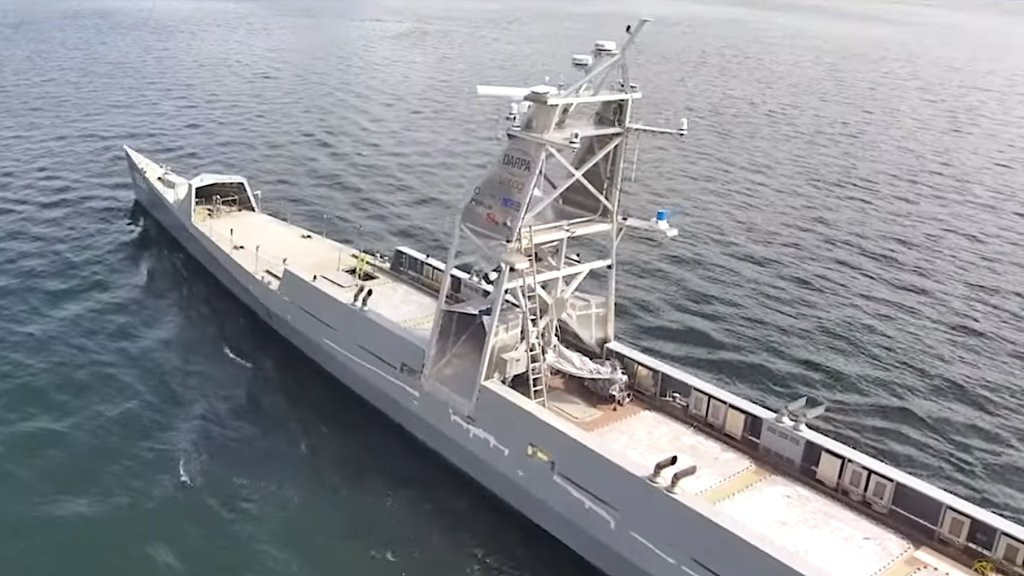
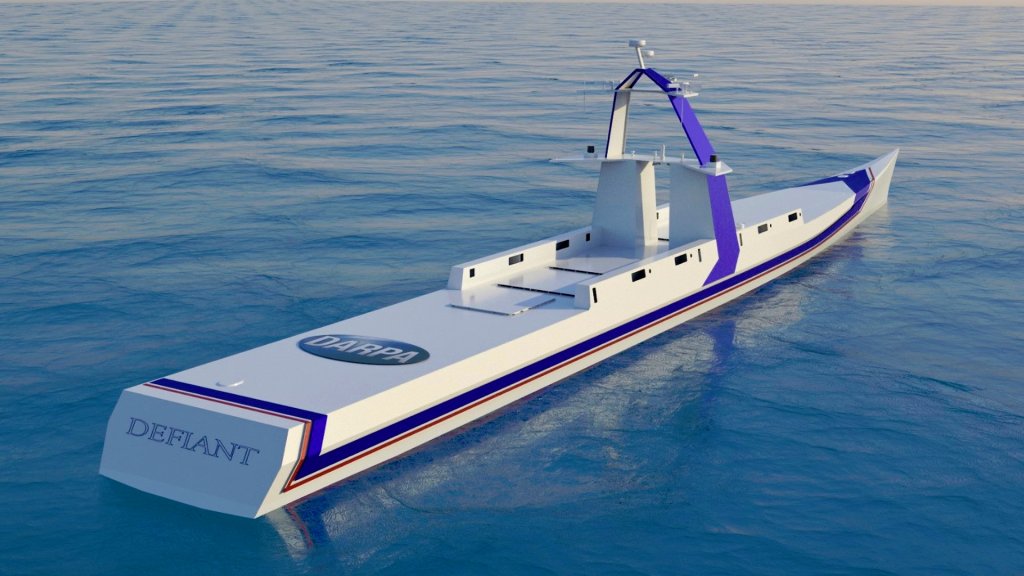
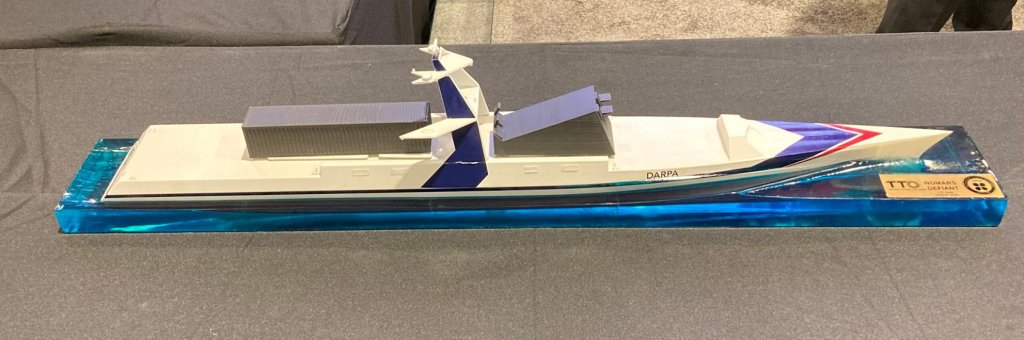
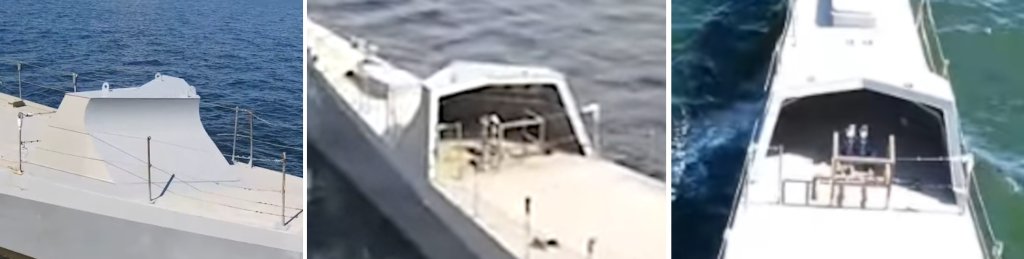
We also now see that there is an angled structure on top of the bow, which appears to be designed in part to help shield an access point to spaces below deck. It might also help break waves in heavier sea states. Defiant is designed to be able to sail safely in waters where waves are cresting at up to 13 feet, and at least survive conditions where waves might get up to 30 feet tall.
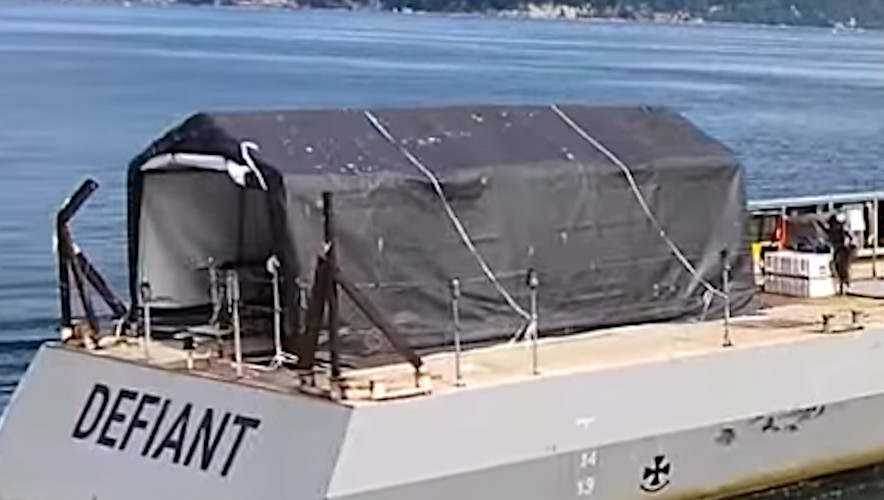
As noted, Defiant was built to operate without human personnel onboard, even just to monitor systems or provide an extra margin of safety, and so it does not have any accommodations for them. However, Defiant is seen in the recent DARPA imagery with a tent set up at the stern, which would provide some basic shelter for individuals working onboard as part of the initial testing.
“Defiant is a tough little ship and defies the idea that we cannot make a ship that can operate in the challenging environment of the open ocean without people to operate her,” Greg Avicola, the NOMARS program manager, said during the recent christening ceremony, according to a press release. “While relatively small, Defiant is designed for extended voyages in the open ocean, can handle operations in sea state 5 with no degradation, and survive much higher seas, continuing operations once the storm passes. She’s no wider than she must be to fit the largest piece of hardware, and we have no human passageways to worry about.”
“By removing the human element from all ship design considerations, the program intends to demonstrate significant advantages, to include: Size, cost, at-sea reliability, greater hydrodynamic efficiency, survivability to sea-state, and survivability to adversary actions through stealth considerations and tampering resistance,” according to DARPA. “With scaled production, NOMARS has the potential to efficiently and cost-effectively deliver a distributed USV fleet.”
“One of the challenges that we were really trying to tackle in NOMARS is, how do we take on building a ship that can go to sea for a long period of time with autonomy? There’s really two pieces of an autonomy problem. There’s the actual autonomy, but then there’s the platform the autonomy is operating on,” Avicola, the program manager, also said in a recent official video about the program, seen below. “A lot of times, the requirements that were designed into it [a platform] for humans, make it sub-optimal for the autonomy problem. What can you do with a ship design where you don’t have the constraints of the people? The other side of the coin, though, is, how do you make it reliable? It’s hard enough if there are people there to fix it.”

“Really, the only way you can prove that is by giving it a hard test, giving it a test that requires resilience and endurance,” he continued. “The at-sea demonstration that Defiant will undertake is designed for a long period of time in a real-world environment, in real sea states, proving that the ship can operate untouched for a very long period of time.”
After the demonstration, the plan is for DARPA to turn Defiant over to the U.S. Navy. The service, in turn, expects to incorporate it into an experimental fleet it is already using to lay the foundation of its future uncrewed surface fleets. Just earlier this year, the Navy rolled out a new USV vision, now dubbed the Modular Surface Attack Craft (MASC) program.
Defiant is very well suited to being a building block for MASC, which is focused heavily on modular, containerized payloads rather than specific hull designs. The Navy currently envisions a family of at least three MASC designs all capable of being readily configured for a wide range of mission sets, which could include intelligence, surveillance, and reconnaissance (ISR), as well as launching long-range kinetic strikes and electronic warfare attacks. You can learn more about what is known about MASC here.
For the Navy, Defiant, or a further evolution of the design, something that manufacturer Serco has already been working on, could be even more attractive because of what it offers when it comes to cost and producibility. The service has been struggling with major delays and cost growth on many of its traditional shipbuilding programs in recent years. At the same time, China, America’s chief global competitor, has taken a massive lead in building naval vessels and expanding the shipyard capacity needed to sustain that production tempo. The U.S. government has been taking steps to try to reverse this trend, including exploring leveraging foreign shipyards. However, USVs that could operate alongside screwed warships and/or independent groups are also seen as a key way to help bolster Navy surface fleets and do so cost-effectively.

“We have delivered a vessel in a reasonable time frame, at a reasonable cost, which is somewhat rare in today’s industry. We did that by being the designer and the prime [contractor] of the vessel, and procuring almost all the material from the industrial base, and integrating it ourselves,” Ryan Maatta, marine engineering manager at Serco, told TWZ earlier this year. “Rather than it being a shipyard-led prime, it was the government and their system integrator working together to procure all the materials and to pivot when things got tough and get the ship delivered, which is more how we used to do ships in the [19]80s than how we do ships nowadays.”
“I say 14 months with 14 men welded our hull together. The hull is allowed to be very simplistic thanks to the fact that there’s no personnel on board. So there’s no heads [toilets], there’s no galleys, there’s no passageways, there’s very few penetrations through the bulkheads. So it’s very modular in its construction, and it allows for a very quick by-hand construction,” he continued. “So tier three shipyards [that could produce Defiant], there’s more than 35 tier three shipyards in the United States. The size engine we’re using are produced by the tens of thousands across three manufacturers.”
How Defiant performs on the upcoming open-ocean cruise remains to be seen, but lessons learned from the demonstration could have important impacts on the Navy’s broader USV plans.
In the meantime, Defiant now emerged fully out into the open as DARPA works toward the NOMARS program’s capstone event.
Contact the author: joe@twz.com
Loading comments…
Comments couldn’t be loaded. Please refresh the page.