
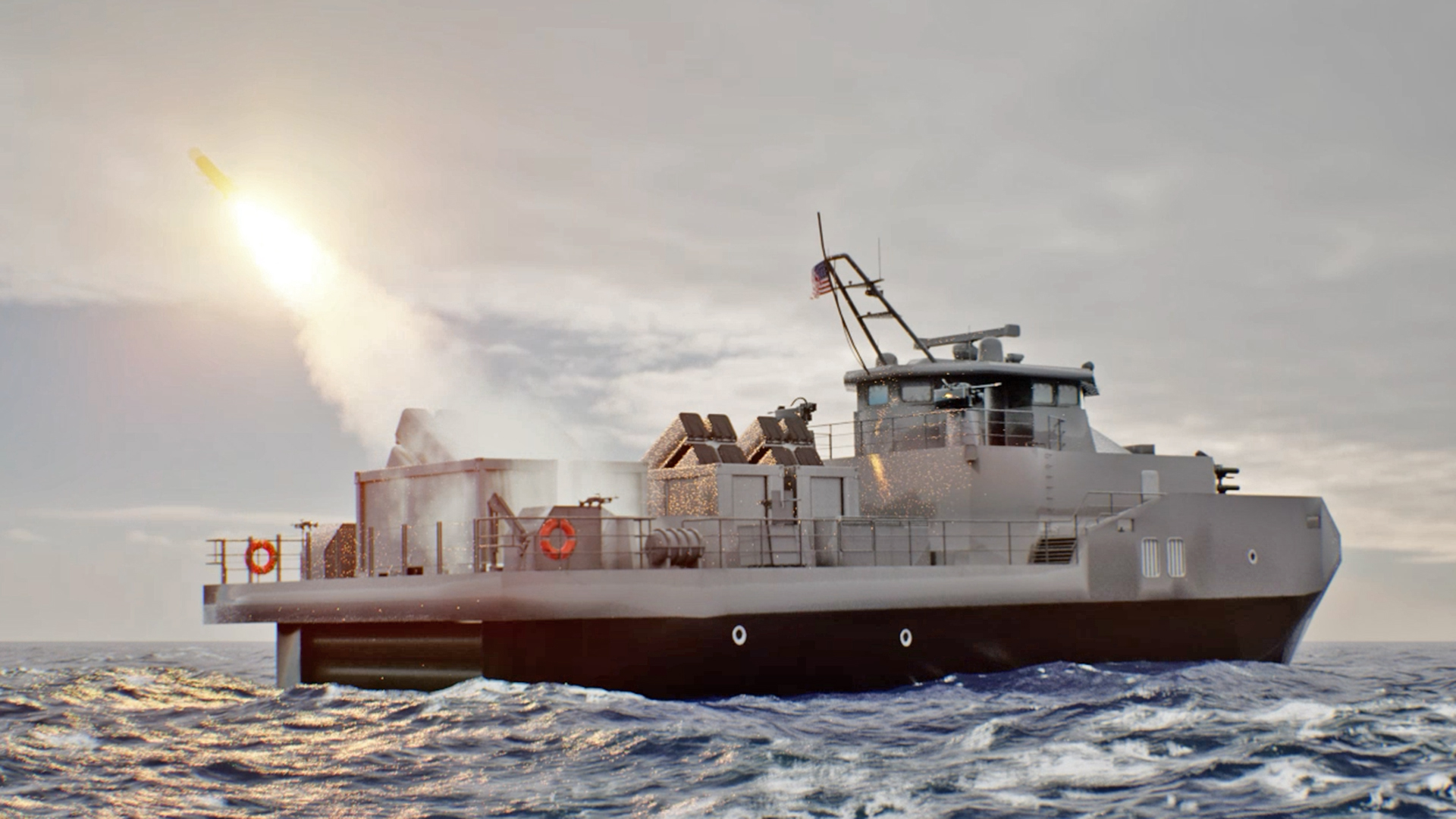
The U.S. Navy has ambitious plans for a new breed of smaller fast combatant vessels that can swiftly expand the surface fleet’s capacity, and that possess some critical features of modern warship acquisition: affordability, adaptability, and the option of operating with or without a crew. CEO Bo Jardine thinks his company, Eureka Naval Craft, has the solution to satisfy the Navy’s needs.

The Unmanned and Small Combatants Program Executive Office of the Navy is mandated to curate a new family of platforms to equip its future surface combatant force, which is aimed to include unmanned surface vessels (USVs) and ‘no manning required’ ships. One of the initial entrants into this emerging family is the optionally-manned Modular Attack Surface Craft, or MASC.
The MASC program aims to produce up to three different-sized USVs for the Navy, all of which make use of modular containerized payloads. The first MASC vessel will address the urgent need for a fast platform that can carry a pair of 40-foot ISO containers of payload. The second will carry four 40-foot ISO containers to couple high payload capacity with long endurance, while the ‘Single Payload MASC’ is expected to accommodate just a single 20-foot ISO container.
MASC has resided in the Defense Advanced Research Projects Agency (DARPA) world but is now moving forward into the Unmanned Maritime Systems Program Office, known in Navy parlance as PMS 406, thus becoming a formal unmanned surface vessel program of record. You can read more about the MASC program here.

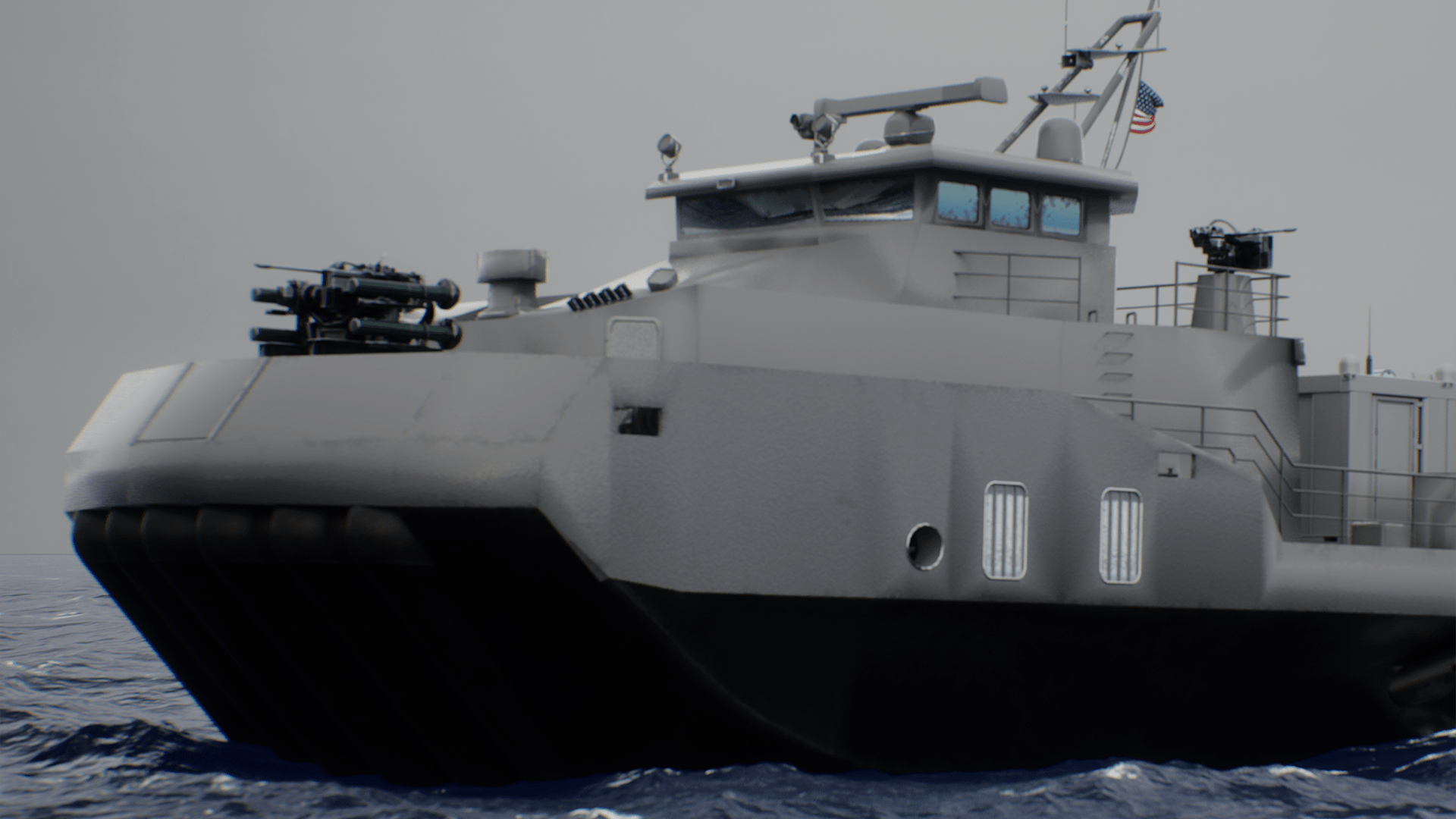
Eureka Naval Craft is developing a vessel that it considers to be extremely well suited to MASC in the form of its Bengal-Module Carrier, or Bengal-MC for short. Eureka says the vessel is designed to host a diverse array of modular armaments, with a pathway to rapid autonomy integration and suitability for contested maritime operations. In June 2025, the company responded to the U.S. Navy’s request for information for MASC with a detailed proposition built around the vessel.
The Bengal-MC hybrid air cushion catamaran has been purpose-engineered to carry a 40-tonne payload, achieve a top speed of over 50 knots, and cover a range of 1,000 nautical miles at 38 knots cruising in Sea State 3 conditions, all while operating seamlessly in both crewed and uncrewed configurations.
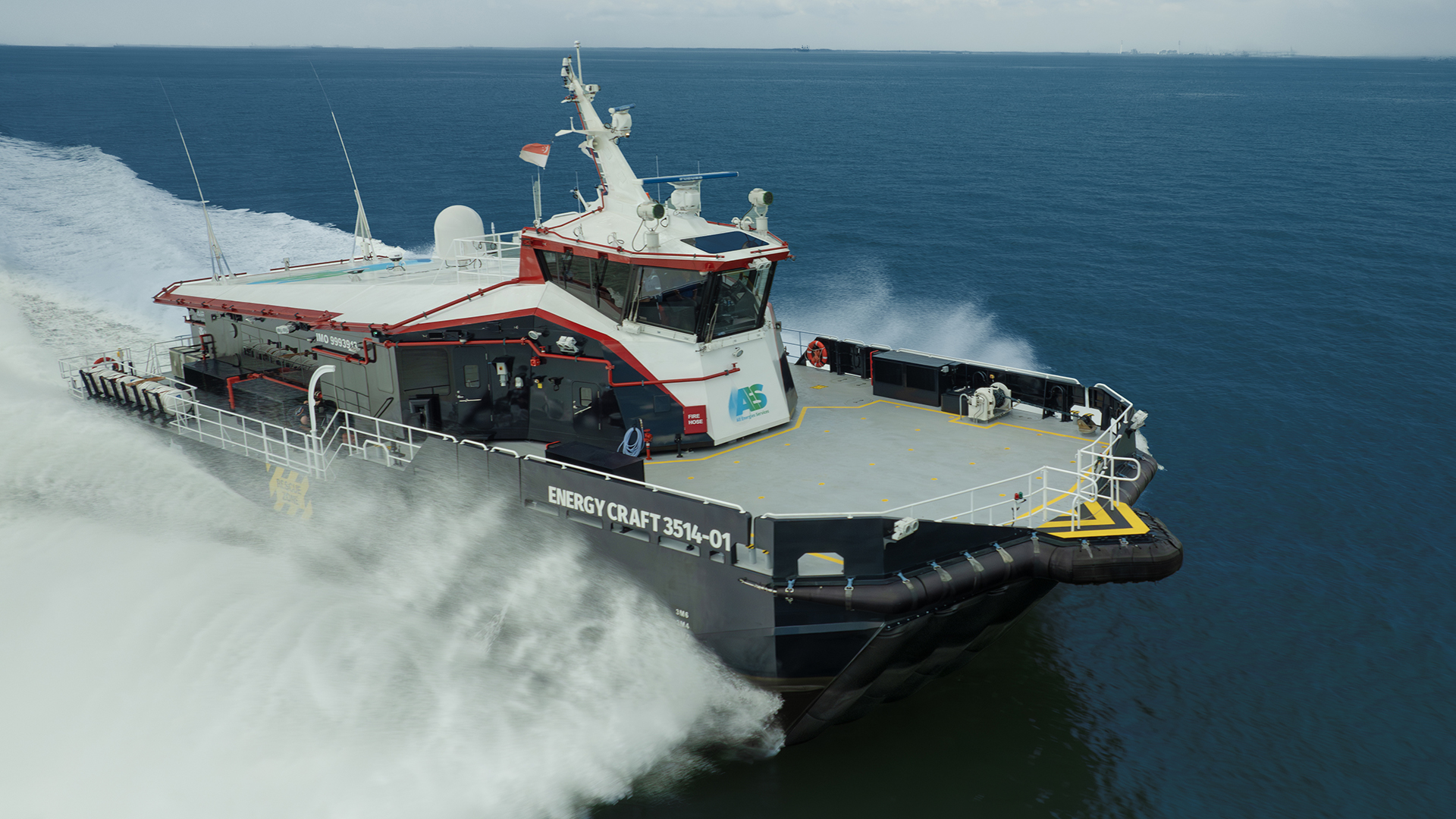
It is based on the AIRCAT Crewliner 35 Surface Effect Ship (SES), a Class-approved commercial vessel that’s already in service in the oil and gas industry. Eureka plans to blend proven technologies from both the commercial offshore energy industry and defense industries into its offering for the Navy’s next-generation USVs, starting with MASC.
Eureka believes that legacy programs, such as the Constellation-class of frigates, have been too slow, too expensive, and lack modularity, and that many new entrants in the sector lack the design operational history, production-readiness, and/or autonomy compatibility needed to deliver real working solutions to the Navy. As such, it sees the Navy’s transition to MASC as marking a groundbreaking advancement in naval operations.
MASC aims to embody the next generation of naval platforms, blending modularity, adaptability, and the unique capacity to function in both manned and unmanned configurations. This strategic approach acknowledges that the future of naval warfare hinges on the seamless integration of these capabilities, empowering the fleet to swiftly adapt to emerging threats and diverse mission demands.
To meet the modularity requirement, Eureka, in collaboration with SH Defence, has incorporated a flexible modular payload system aboard Bengal MC that’s capable of accommodating a wide range of modular mission payloads. These include those for sea and land attack, air defense, intelligence, surveillance, and reconnaissance (ISR) suites, a wide array of weapons, plus a clear pathway to autonomous operations with the injection of artificial intelligence (AI).
The Bengal-MC is designed to be “AI Autonomy-Ready” and it will use Greenroom Robotics’ Unmanned Maritime Autonomy Architecture (UMAA)-compliant GAMA (Greenroom Advanced Maritime Autonomy) system for capabilities such as mission planning and vessel control. In high-threat or restricted environments, GAMA will permit the Bengal MC to be managed remotely or function as an unmanned platform.
Bo Jardine explained the genesis of the Bengal-MC, its specific attributes, Eureka’s approach to MASC, and how navies could make huge capability strides with modular surface craft as a springboard to the future.
TWZ: How did your concept for using a commercial Surface Effect Ship for a military requirement come about?
Jardine: About three years ago, I started talking with one of my friends and now business partner Mike Jankowski about our experiences related to security vessels and the challenges facing the oil and gas industry. Mike has a military background and similar to me has advised on maritime security for the oil and gas industry, namely in counter-piracy.
One of the big concerns we saw was that the security vessels available in the market, mostly fast support vessels that were converted for security, didn’t possess the right qualities to deal with the security threats being encountered. They were either too slow, limited in range, or they had poor stability, which made firing guns off of them really hard. I can tell you personally from my days doing security in East Africa, we had boats that had to run circles to shoot, because they weren’t stable enough. They also had issues with speed. They could cruise at a sustained 12-14 knots, but they couldn’t maintain higher speeds up to around 25-30 knots for long periods for fear of running out of fuel. They were great for the oil and gas support role, but not really suited for security.
I had an idea based around a vessel called the AIRCAT Crewliner 35, which is designed in collaboration between AIRCAT Vessels of France and ESNA Naval Architects of Norway, which I had worked on while I was at Shell. I knew it was a vessel that has really great characteristics; high speed, long range at high speed, and shallow draft capabilities that allow it to operate in littoral areas where most vessels can’t venture. The AIRCAT also has a lot of efficiency measures in terms of the way it’s built and its suitability to working in austere locations. It also has a really great payload of around 40 tons and is super stable. Knowing it can do all these things, Mike and I talked about turning the AIRCAT “gray” – using it for military roles – and this served as the foundation for Eureka Naval Craft and our collaboration with AIRCAT and ESNA.
We talked to AIRCAT CEO Jerome Arnold, who I’d worked with when we did that oil and gas evaluation of the ship. We also engaged with ESNA, the naval architect for the vessel, and ultimately in September 2024 we formed Eureka in order to co-develop the AIRCAT vessel into a solution for the defense market.

TWZ: The AIRCAT is called a ‘Surface Effect Ship,’ or SES vessel. Can you explain a bit about the design and why you think it’s so well suited to the military, particularly the Modular Attack Surface Craft program?
Jardine: The interesting thing about the surface effect ship is the history, because the U.S. Navy tested these in the late 1960s and early 1970s, and the U.S. Coast Guard employed the technology quite successfully in the mid-1980s into the 1990s in counter-narcotics. Other nations like Norway employ this technology today as a key part of their small combatant and mine countermeasure vessel fleet. In essence, it’s long-proven technology. We are in the latest generation of its application, incorporating all the learnings of decades of development and use in the commercial and defense space into our designs.
The Surface Effect Ship, or sidewall hovercraft, is a vessel that has both an air cushion like a hovercraft and twin hulls like a catamaran, and it shares all the great attributes of both types of vessels. Think of it as the offspring of a hovercraft and a catamaran, possessing the best qualities of both designs. It essentially lifts up on a cushion of air with only the stern in the water, so we can carve through the water like a catamaran and also use the air cushion effect to reduce the friction, bringing the smooth ride of a hovercraft.
We have these things we call fingers on the bow, and the fingers enclose the air at the front. On the stern we have a big bag, just like a hovercraft. Lift fans push air into the gap in the hull and that’s what creates the surface effect, then the water jets at the stern push it along.
SES enables us to beach and self-recover much like a landing craft; however, at much greater speed like a hovercraft. It doesn’t take much pressure to keep the skirt inflated, which means it can take significant damage, just like a hovercraft. If it does take a big hit to the skirt, or blow the whole thing out, it’s still a catamaran and will operate like a regular boat. So it has that redundancy, and that’s a critical feature that’s derived from oil and gas industry safety standards.
We call our initial version the AIRCAT Bengal-Module Carrier (MC) Modular Attack Surface Craft – with the name AIRCAT retained to associate its lineage with the proven and in-use AIRCAT Crewliner 35 from which it is derived – essentially the same exact hull as we are proposing for defense. Currently, there are three of the commercial vessels in service with TotalEnergies supporting their oil and gas production activities offshore of Angola. Eureka’s Bengal-MC is a Class-approved design and employs the same proven key systems as found in these vessels including main engines supplied by Rolls-Royce MTU and water jets supplied by Kongsberg. The three vessels have been in operation for seven months and all three of them are regularly running trips of 250 nautical miles each way, going in excess of 25-40 knots on a daily basis. That’s a pedigree that frankly you’re not going to see anywhere else.
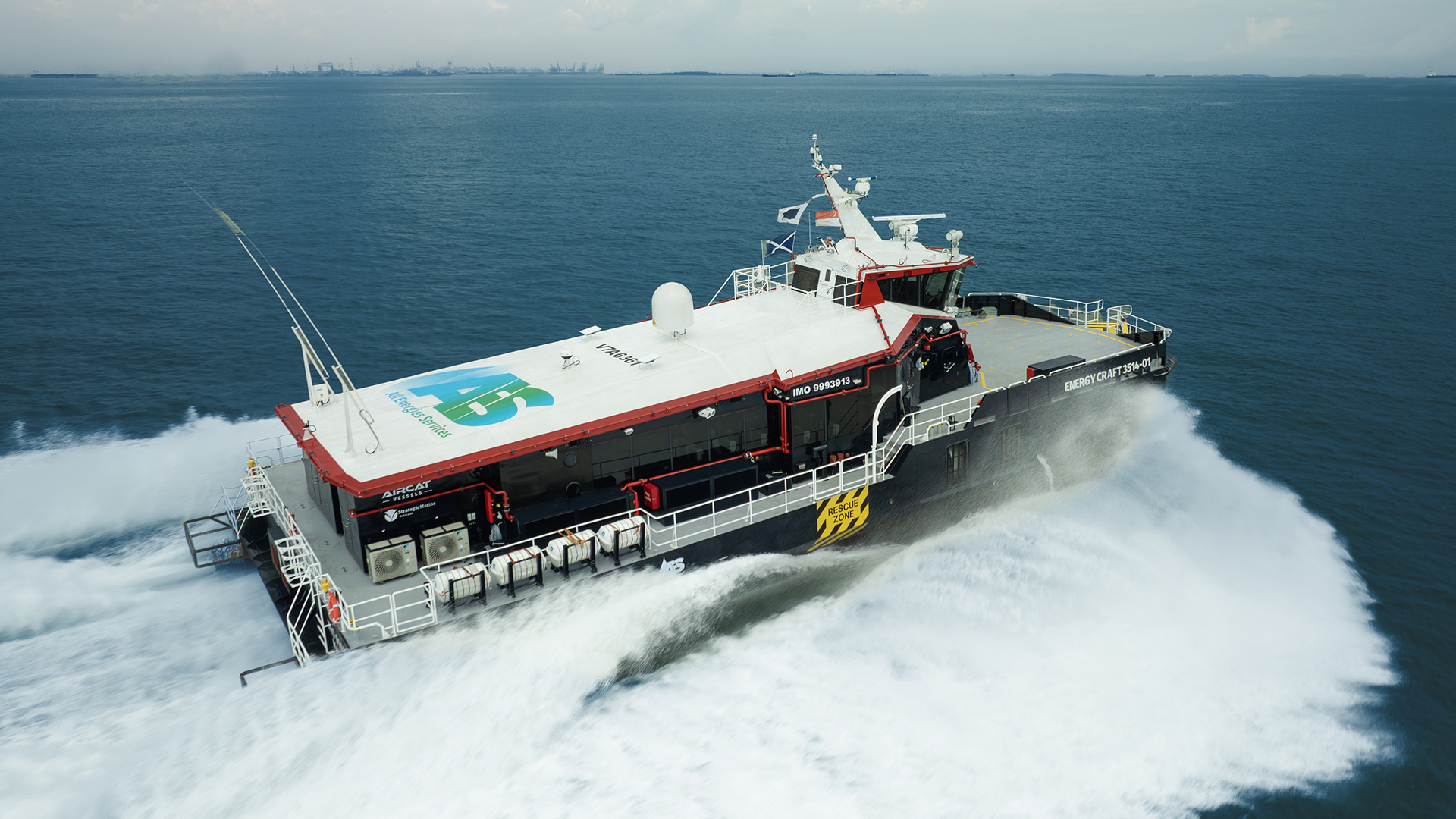
The fact that these ships come from the commercial world of the oil and gas industry holds a number of significant benefits for the military world. For a start, there’s already an established supply chain. Also, the safety of people is absolutely paramount in the oil and gas industry. The liability associated with carrying 80 passengers on these vessels is a big deal to the industry, and in the case of the Bengal-MC, this directly drives the vessel to be designed with between two to four times redundancy for all key systems.
Another critical consideration for that industry is efficiency. Saving fuel is saving money. Burning less fuel also means lower greenhouse gas emissions. With AIRCAT and the Bengal-MC there’s a 30-40% reduction in fuel burn compared to a similar fast crew vessel, because you’re racing through the water with very low friction.
The other nice thing about that SES is that you see very low instances of seasickness. In oil and gas, there are big drivers to use helicopters to move people offshore, and that’s all about how they feel when they get to the site. Traveling by boat typically means they need some time to get back on their feet. That’s not the case with the AIRCAT and Bengal-MC. This vessel dramatically reduces seasickness motions because it’s so stable in the water and so smooth even at very high speeds.
This in turn directly translates to weapon systems accuracy and performance – lethality – because it means when we put missiles or remote weapons stations on the Bengal-MC, we’re dealing with a very stable platform. We can take land systems that aren’t marinized and put them on the back deck and operate them without the risk of damage. There’s a real issue with fast attack craft and how beat up the weapons can get on deck. Then there’s a real risk that they don’t fire. We see that risk greatly reduced with the Bengal-MC.
TWZ: What’s your understanding of the requirement for MASC and how Eureka is suited for it?
Jardine: The big thing here is speed to field. The Navy needs MASC quickly – not “Hopium,” and for good reason – many people expect we’re going to have a conflict, and we need time to be ready. The U.S. Navy wants vessels that can be delivered in 16 months from the date of order, and if I’m being brutally honest, most companies and shipyards offering manned and unmanned vessels today in the MASC category either do not have the proven designs and/or the capabilities to deliver the solutions the United States military needs today. Vessel designs backed with futuristic AI imagery, fancy software solutions, and/or vaporware shipyards won’t get the U.S. Navy what it needs.
What I can tell you is that we can build our real-world proven designs in both our partner U.S. shipyards and overseas in our foreign partner shipyards and deliver them to the U.S. Navy in between 16 and 24 months, depending upon volume of orders.
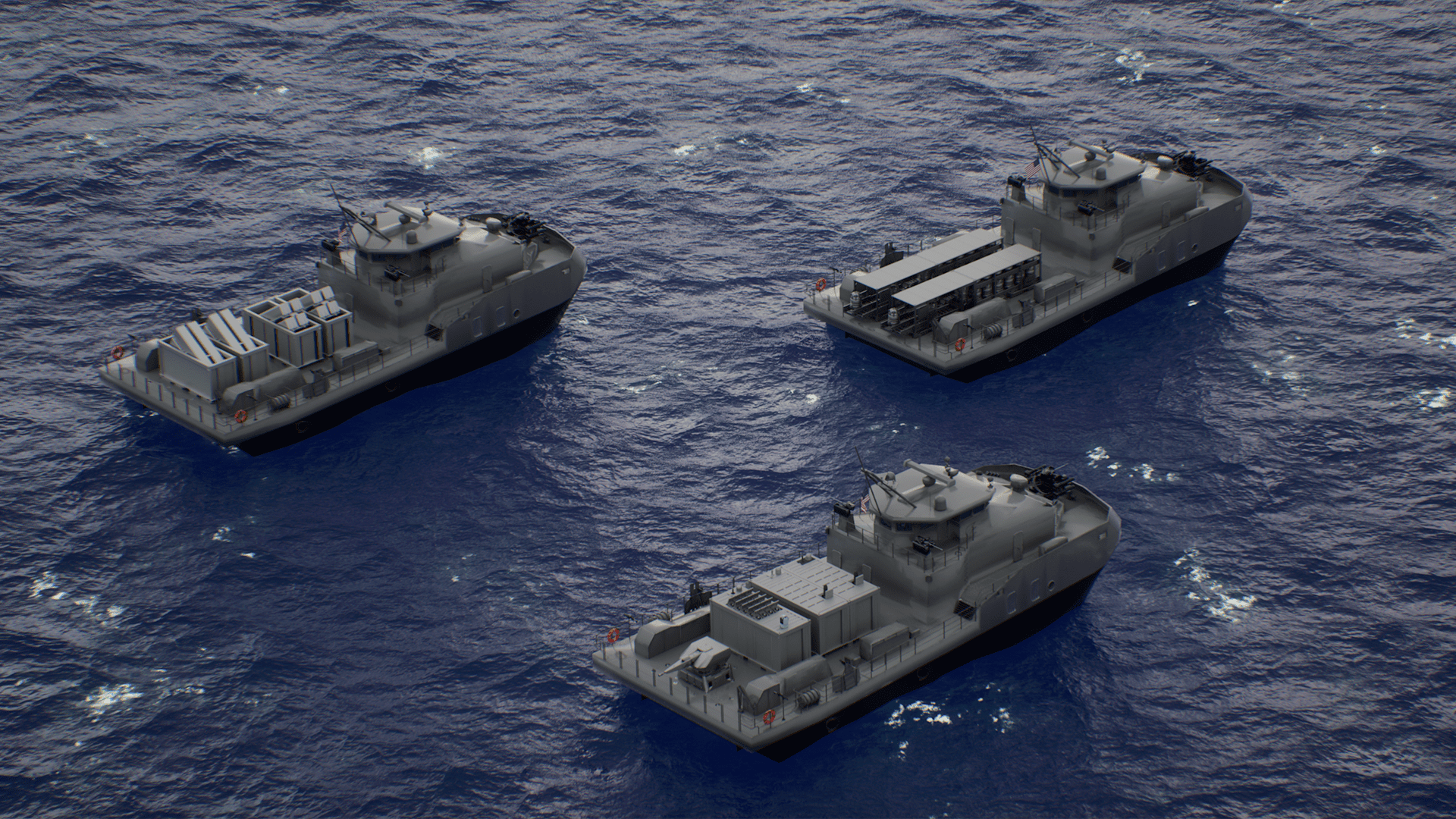
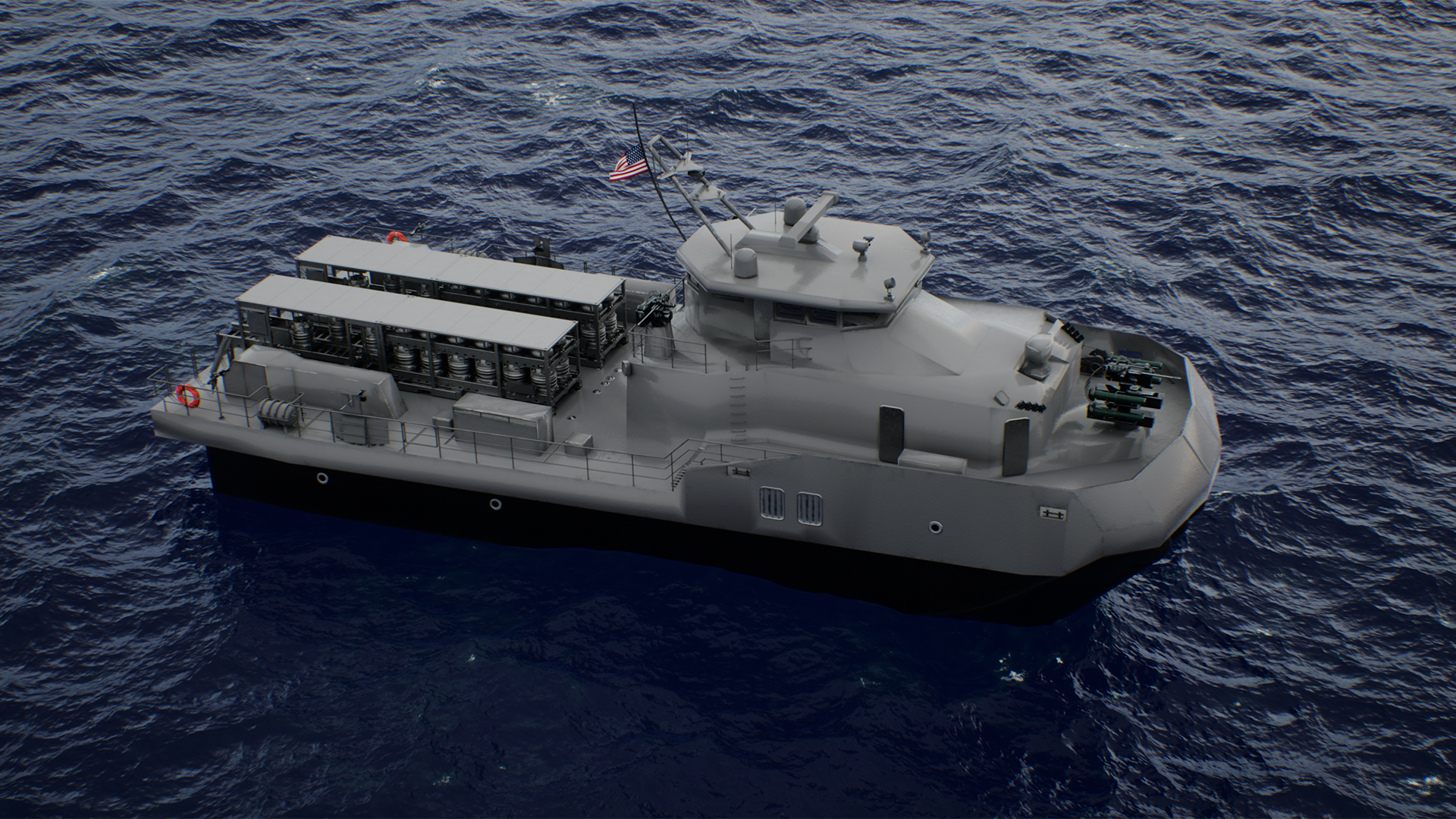
Cost efficiency is another massive factor. The Navy wants 30-40% more cost efficiency out of the designs. We can do that, it’s a big thing for us. Then there’s the big word, modularity. Our focus is modular, and it has been from the very get-go. What Eureka is offering is reality, not a pipe dream and not a promise that can’t be delivered. We’re offering 40 tons of payload on one variant of the vessel, which is basically two 40-foot containers or four 20-foot containers, or a combination of 40-footers, 20-footers, 10-footers, and so on.
With that payload, they also want to ideally see a minimum cruising speed of 25-knots. For the life of me, I can’t find another vessel besides ours that can maintain a high speed like that. Typically, running a vessel at 25 knots for any extended periods means you kill your range. I’m going to speculate here, but I think the reason for this speed requirement is that I think the Navy has realized that in a high-end conflict, anything under 25 knots will die. In combat, you need to be maneuverable and you need to be fast. Warfare at sea in the future is going to be a street fight, especially in the littorals of the Indo-Pacific, where frankly, it’s about fighting among close knit islands and in shallow areas.
So, for our Bengal-MC, it’s about the ability to maintain high speeds, cruising optimally at 38-42 knots, far exceeding the MASC program’s 25-knot cruising speed requirement. The Bengal-MC in its base configuration boasts a range of 1,000 nautical miles at 38 knots in Sea State 3, and it can survive in Sea State 6 – indeed we easily meet the stated Sea State 4 operability requirements and this is not just a statement – in our case it’s model tested and proven. With a 40-foot container load – like a four-pack of Tomahawk cruise missiles and additional fuel – we’re a 3,100 nautical mile threat to any target if unmanned and on a one-way suicide mission. That’s a significant threat capability.
The autonomy side is another big factor. The Navy wants to see proven autonomy systems, which is why we’ve teamed up with Greenroom Robotics. They have the best maritime autonomy system out there. They’ve actually put vessels to sea with their UMAA-compliant GAMA solution, which has been proven with the Royal Australian Navy onboard a full-size Austal high-speed patrol vessel, so we’re meeting the government’s requirements there too.
Furthermore, we are working with NODA AI to incorporate their vendor-agnostic autonomy stack into the Bengal‑MC, transforming the vessel into a networked, mission-adaptive node. NODA’s orchestrator enables coordinated teaming of companion craft, ISR sensors, and multiple comms layers such as SATCOM, MANET, proprietary RF and cellular mesh, opening up mission sets such as contested resupply, dynamic escorting, and rapid re-tasking with human‑on‑the‑loop oversight.
By using open adapters rather than bespoke interfaces, the integration reduces program risk and will help accelerate sea trials, enabling operators to field complex manned/unmanned teams faster and iterate combatant tactics more rapidly. The result is greater operational resilience in degraded environments, more efficient use of shipboard and offboard assets, and scalable mission capability. This is a force multiplier for naval programs seeking affordable, flexible autonomy at sea.

TWZ: Can you elaborate on the optionally-crewed element of MASC?
Jardine: While unmanned surface vessels represent a significant advancement for maintaining continuous operations and enhancing safety, they cannot replace the invaluable qualities that sailors bring to the table. In complex and contested environments, human adaptability, judgment, and resilience are essential. Depending too much on unmanned systems could jeopardize our security, leaving us exposed to electronic warfare or cyberattacks from capable adversaries. It’s crucial, therefore, to ensure that we maintain a balance, leveraging technology without sacrificing the human element that is vital for mission success.
That’s why the future lies in modular, optionally-manned vessels like the Bengal-MC.
Eureka’s Bengal‑MC is optimized for autonomous and remote operation – think of unmanned engine spaces, remotely operated control systems, secure communications, and robust autonomous mission systems – while retaining the ability to accept a small crew when required. With a full mission suite, the platform can be configured for between five and eight personnel, but is intended to operate unmanned or with reduced crewing for most missions.
Habitability features such as accommodation, potable water, food storage/galley, sewage/greywater handling, and lifesaving equipment are integrated from the outset and add minimal cost thanks to the AIRCAT 35 Crewliner’s dual‑use origin design. One key consideration carried over from the commercial sector is that our vessels comply with the International Code of Safety for High‑Speed Craft [HSC Code], addressing critical safety requirements when carrying persons aboard at the speeds planned for MASC, so the platform can be crewed without major retrofit when missions or regulations require it.
As an absolute minimum to operate our vessels, we essentially need only two deck officers and a seaman to operate the Bengal-MC, plus the mission crew. The seaman and the second deck officer can also pivot into other roles, maybe operating a remote weapons station, for example. This said, operational minimum manning will depend greatly upon how the Navy chooses to operate the vessels and the watch-standing standards applied. With this consideration, the vessel has been designed with the flexibility to meet the operational requirements of the Navy, whether for manned or unmanned missions.
When we look towards fully uncrewed in the future, I envision we will take the same vessel and trim down the wheelhouse to the point where we eventually get rid of all the manning when the time is right, but you can’t go the other direction, unmanned to manned. That’s one thing that I see with a lot of autonomy companies with maritime autonomy in these big vessels.
Uncrewed combat vessels may be possible in between eight and 10 years for all missions, but we’re not there yet. Building trust in these systems requires developing expertise through optionally-crewed platforms.
What I can absolutely see is that we can leverage uncrewed mission packages. Right now, you can launch a cruise missile off a vessel without anybody there, if you have it in the container and the container is linked to a satellite. You can have a small crew aboard operating the physical vessel, with a mission system operator working the weapons system from anywhere in the world.
I don’t see a completely uncrewed operation in all missions, as I’ve already stated. But, if we use artificial intelligence smartly, it can really reduce the workload with a manned crew in the loop, but with weapons that are triggered autonomously from somewhere else. That’s exactly what we’re thinking with our vessels.
We are already looking at that reduced workload on the bridge and how we design that area. We are looking at a bridge chair system that has controls like multi-function displays, so that when you’re controlling the vessel onboard it’s pretty much the same as it would be if you were at a console driving it remotely. We want to make the bridge more intuitive, where it is designed to operate with minimal crewing. If we apply these principles in our vessels, what’s to stop you from applying the same principles when running a frigate or a destroyer?
Ultimately, we can use our platform to inform even larger platforms of how to evolve in future. Having been on the bridges of various vessels from across the world, everything spanning small tugs to oil tankers, drilling rigs to destroyers, if we can make the bridge load come down, then we’re already preparing for the future. It may take more time to get it hooked into all the systems, but ultimately such solutions could be scaled up.
TWZ: The Bengal-MC is based upon a commercial ship design. Can you explain how it is also so well suited to a military role.
Jardine: We’re seeing more commercial designs coming into the military, especially when it comes to certain auxiliary and patrol ships. Naval ships have gone through the roof with cost, and delivery times are constantly slipping to the right. We’re saying no, let’s build something that we know works, that’s proven in another sector. We’re not building battleships any more. Every ship is vulnerable, and so what we are doing is focusing on mitigating the vulnerabilities, while keeping costs in mind.
Eureka’s vessels utilize standard, commercially available components already employed by militaries, such as Rolls-Royce MTU engines and Kongsberg water jets. This approach leverages established supply chains, ensuring reliability and accessibility of parts globally.
The modular design of the vessel facilitates easy integration of modern, often tablet-based, defense solutions. When it comes to weapons systems, there’s generally a central rack into which these modular systems are integrated. We’re not talking about warships of the past with big integration challenges. Most of the systems now are modular, which fit very well with our vessel. That modularity is critical and how we ensure those modular payloads get integrated and installed quickly. How they connect into the mission system and how they stay secure on deck is so important. We feature an ISO footprint deck layout to accommodate standard shipping containers of various sizes, enabling rapid installation and secure connection of diverse payloads.

So we have a 10-footer, a 20-footer, or a 40-footer, and we can carry different payloads on that deck in those footprints. We’re really focused on things that are either non-deck penetrating or modular, just clip on, clip off, because at the end of the day, this is still that same oil and gas boat – albeit hardened slightly for defense – it’s cost effective.
For example, Rheinmetall has the Millennium gun. It actually comes in a 10-foot ISO footprint and it has ISO locks on it. So why not make a 10-footer at the back of the boat that we can drop that on? Eureka partnered with SH Defense to integrate a positive locking system, which for the Bengal-MC means 58 such hydraulic locks on the deck, capable of securely holding multi-million dollar payloads.
SH Defense and Kongsberg are working on the Naval Strike Missile [NSM] that’s in a container. We can put four of those containers on the back deck, so that’s 16 NSMs on one boat. We also have three pedestal areas on the vessel for larger 30 millimeter autocannons for peripheral defensive and offensive roles – this is not a sitting duck.
The vessel also features short cable runs and a dedicated e-house area for weapon system integration, simplifying connectivity and a small Combat Information Center (CIC) on board.
We’re focused on putting armor where it needs to have armor, for instance around the generator sets, engines, fuel tanks, and bridge deck. We also have a lot of horsepower with our four engines. We also have the ability to upsize our gensets [generators], so it means that we can vary the genset depending on the payload. So, if you want to power up a huge energy directed weapon or a big electronic warfare suite or something like that, we can put more power into that than probably any other boat in our category.
TWZ: Being as your plan is modular, can we assume you are looking at other options beyond the baseline MASC requirements, and opportunities elsewhere?
Jardine: For MASC, the U.S. Navy asked for the vessel to have a substantial amount of power on board. So you can easily assume something like an electronic warfare package will be desirable. Right now, we have sufficient power on the Bengal-MC to power a system like the Epirus counter-drone system, for example.
We can also offer accommodation modules for additional personnel, say if they wanted to embark a team of special operators. We’ve also been talking to a company about the option to add a removable helicopter landing deck complete with related fueling and safety systems. That would mean we can easily accommodate an MH-6 Little Bird or we could also operate cargo logistics drones off the back, which is of big interest to the U.S. Marine Corps. We’re also looking at air defense systems. There’s a lot of cool things we can do with this when you think of defending port activity or escorting landing craft into contested beach landing areas.
We are also doing some work right now around how we could potentially operate unmanned combat aerial vehicles from our back deck, for example aircraft like the Kratos XQ-58 Valkyrie. We’ve worked the measurements and weights, and we’re fairly certain we can operate such UCAVs off the back deck if employing their launching rail and rocket-assisted take-off. Things like Collaborative Combat Aircraft could exactly operate this way. Think about distributed warfare where you’ve got little friends down below that can carry air defense systems or CCAs.
Take it a step further, the jets overhead could be cueing missile strikes from the ship, and the enemy would really struggle to work out where that came from. The Bengal-MC could be moving around in secluded areas and firing off missiles, launching counter-drone interceptor drones like Anduril’s Roadrunner, or launching a CCA close to the target. If Anduril, for example, tells us they want to shoot their Fury CCA off a rail on the vessel, we’ll carry it. Remember, 40 tons of payload and a gigantic footprint on the back deck and without all the rolling motion – we’re a stable platform that’s moving at speed. The idea is that these work in wolf packs, rather we call them ‘tiger packs.’
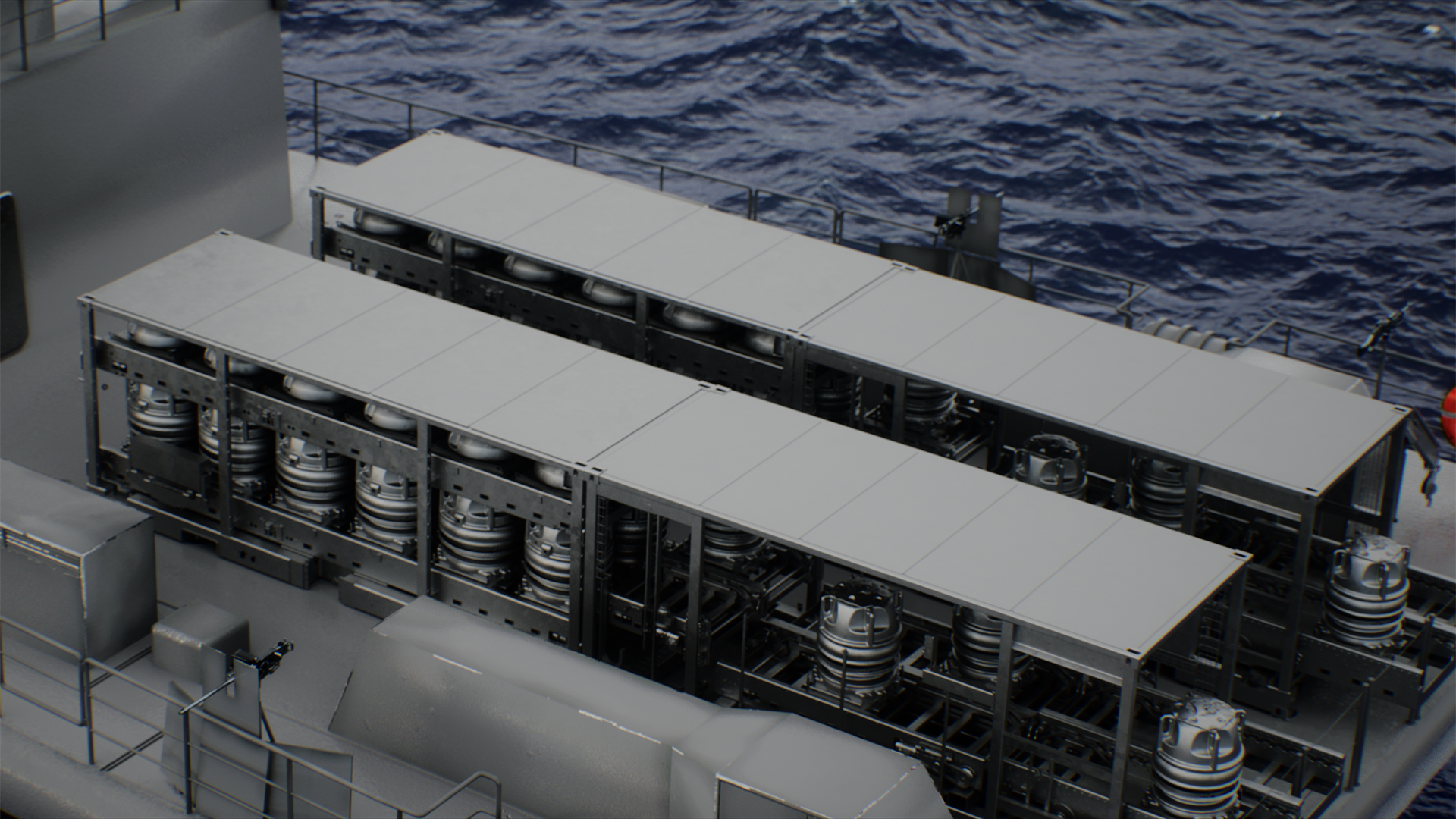
It’s important to stress that right now, we are offering tried and tested modular systems on the Bengal-MC, we’re not looking for something that hasn’t been done before. We are talking about the clip on, clip off systems where the command and control is modular. As long as we meet the power requirements and the space requirements, that’s all we need to prove, the connectivity and the space. I think that’s the best way to accelerate systems integration on vessels – have proven systems in use.
So, we’re working with a team of OEMs [original equipment manufacturers], and we tell them that we have a production ready platform that’s proven. This is intended to be an attritionable, reduced cost platform. Something the Navy can buy in volume.
We’re offering the vessels and we’re offering the training for how to operate the vessels, both deck and engine. We’re offering the maintenance, the depot spares, capability, and we’re also going to offer leasing of the vessels to navies. Imagine you lease a boat on a five or seven-year basis. You could have a boat work for five years, come back to the shipyard, get a complete refit and be ready for the next threat level. We are mirroring the aircraft industry in this sense. If a navy were to say, lease a series of vessels or buy more than one, we could put them through rotation. In other words, if you need five for operation and we constantly have one coming through the cycle like a rental car almost, and come in and get your fresh refreshed boat and the new one comes out, it means that you’re not going to have the issues with tempo and operations because of maintenance. We have seen this in other parts of the defense industry, but in marine it’s never happened because nobody’s selling a commodity type like this.
We didn’t want to come to market until we knew we had a product that worked. We promise to deliver what we say we will do, and we didn’t want to put our necks on the line unless we knew that we had a product that worked.
Right now, the acquisition team can ride on an AIRCAT 35 Crewliner to see how it works. It’s the same hull from the main deck down. We just add a meter of deck to the stern and add those modular weapons containers. If we take all that off, it’s a vessel that can be sold to the oil and gas industry tomorrow.

TWZ also also talked to some of Eureka’s industry partners about their part in making the AIRCAT vision a reality.
Harry Hubbert, co-founder and COO of Greenroom Robotics:
“We’re really excited to be working with vessel designers like Eureka on larger, modular surface craft and bringing our proven Australian advanced marine autonomy to the U.S. Navy.
Our AI-driven autonomy stack can transform any vessel into a fully autonomous, intelligent maritime system. To put it simply, Greenroom’s software acts like “the brain” of a vessel, emulating what a helmsman or navigator would do by talking to the rudder, engine and radar systems on board. It can easily be adopted on existing boats or coded into new vessels.
Our advanced marine autonomy is existing, proven and ready to go. Where Greenroom Robotics stands out is our speed to deployment and our agility. We’ve deployed autonomous systems onto vessels in days and weeks, not months and years. Crucially, we have a proven track record with large vessels.
Australia’s largest autonomous vessel was operated by Greenroom Robotics’ GAMA software. We’ve deployed our AI-driven autonomy stack on boats up to 187 feet, successfully demonstrating a human machine teaming and hardware agnostic approach.”
Nere Skomedal, naval architect and co-founder of ESNA:
“ESNA is the world leading expert on Surface Effect Ship technologies. Vessels designed by us are already equipped with fully automated and electrically-driven lift and bag fans and cushion pressure control actuators, providing a sound technological basis for completely unmanned operations of a SES under sustained offshore operations.
The SES offers unrivalled low fuel consumption during high speed [35-40 knots] and provides damped motions at both high speed and zero/low speed operations. These unique features offer a very stable weapon platform well suited for accurate sensor and targeting operations with minimal vertical accelerations and low pitch and roll motions.”
Rene Bertelsen, CEO SH Defence:
“SH Defence’s Cube™ System offers a highly flexible, secure, and efficient solution for modern naval operations. The modules can be configured for a range of uses including anti-submarine warfare, mine countermeasures, missile defense, anti-surface warfare, mine laying, and launch and recovery of UAVs and mini-subs.
The Cube™ System is a modular mission handling ecosystem that transforms naval platforms into multi-role assets. With plug-and-play modules for air, surface, and subsea operations, it enables rapid mission changes, seamless integration of partner technologies, and full interoperability across NATO fleets. Designed for both new builds and retrofits, the Cube™ System delivers unmatched flexibility, readiness, and strategic advantage in today’s dynamic defense landscape.”
Contact the editor: Tyler@twz.com
Loading comments…
Comments couldn’t be loaded. Please refresh the page.