
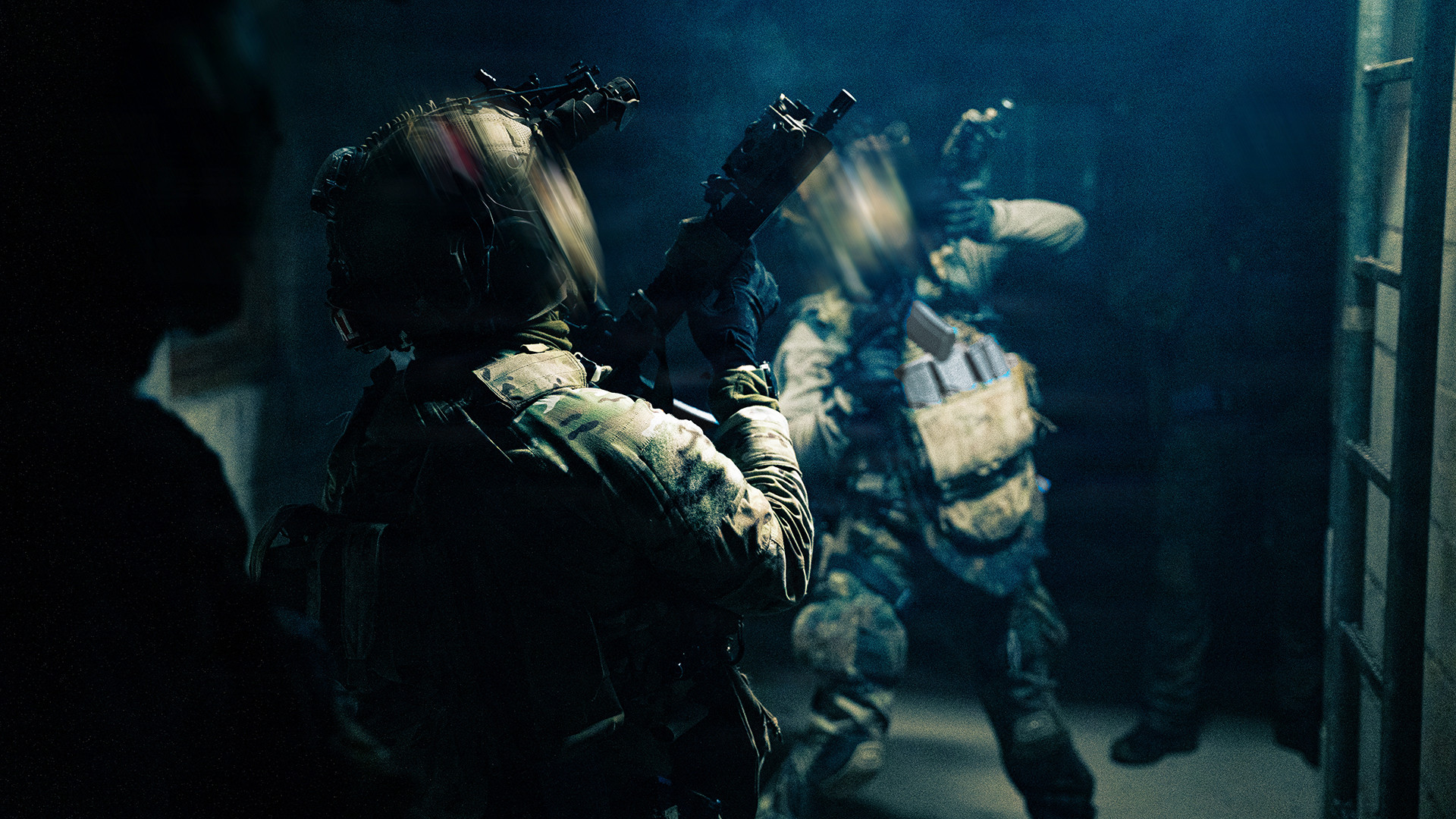
A viral and as-yet totally unsubstantiated claim that U.S. forces used a mysterious “sonic weapon” that left security forces bleeding and stunned during the recent operation to capture Venezuelan dictator Nicolas Maduro has been getting a ton of attention. The allegation – amplified, but not expressly confirmed by the White House – does add to years now of persistent rumors of weapons very loosely similar to this description being in use globally, with separate news on that front having broken just today. When it comes to the United States, this has been further fueled by decades of known work on directed energy weapons, including ones intended to produce novel auditory and less-than-lethal effects.
The sonic weapon claim looks to originate with a video posted on TikTok on January 9 by an individual who goes by Varela News (and who uses the handle @franklinvarela09). The Spanish-language clip is a purported interview with a member of the Venezuelan security forces who was involved in the response to the U.S. operation in Caracas just over a week ago. The contents of the clip gained wider traction online after Mike Netter shared an English transcription in a post on X that same day. Netter is a political commentator and advocate who describes himself as the “main proponent” of the failed 2021 effort to recall California Governor Gavin Newsom. He is now Vice Chair of an organization called Rebuild California and hosts a radio show on KABC, a Cumulus Media station that broadcasts in the Greater Los Angeles area.
The relevant parts of the exchange, as shared in English by Netter, are reproduced below:
Interviewer: And your own weapons? Didn’t they help?
Security Guard: No help at all. Because it wasn’t just the weapons. At one point, they launched something—I don’t know how to describe it… it was like a very intense sound wave. Suddenly I felt like my head was exploding from the inside. We all started bleeding from the nose. Some were vomiting blood. We fell to the ground, unable to move.
Interviewer: And your comrades? Did they manage to resist?
Security Guard: No, not at all. Those twenty men, without a single casualty, killed hundreds of us. We had no way to compete with their technology, with their weapons. I swear, I’ve never seen anything like it. We couldn’t even stand up after that sonic weapon or whatever it was.
Interviewer: So do you think the rest of the region should think twice before confronting the Americans?
Security Guard: Without a doubt. I’m sending a warning to anyone who thinks they can fight the United States. They have no idea what they’re capable of. After what I saw, I never want to be on the other side of that again. They’re not to be messed with.
TWZ cannot independently confirm any of the details above.
However, White House Press Secretary Karoline Leavitt did subsequently reshare Netter’s post on X, urging followers to “stop what you are doing and read this.”
TWZ has reached out to the White House for more information.
“To protect operations security, we don’t have any information to provide beyond the Chairman’s [Chairman of the Joint Chiefs of Staff U.S. Air Force Gen. Dan “Razin” Caine] remarks at the Jan. 3 briefing,” a Pentagon spokesperson told us in response to further queries about the purported “sonic weapon.”
We also reached out to U.S. Southern Command (SOUTHCOM), which declined to offer any comment.
Directed Energy And ‘Sonic Weapons’
For years now, the U.S. military has been very open about at least some of its work on novel directed energy capabilities. This includes ostensibly less-than-lethal systems designed to produce high-pitched sounds and other effects explicitly intended to temporarily deafen, blind, or even more fully incapacitate individuals.
One of the best-known of these programs was called the Active Denial System (ADS). It centered on the development of a large vehicle-mounted system designed to project a millimeter-wave energy beam that would make individuals feel as though their skin was burning, but without any lasting effects. ADS has been primarily presented as a crowd control tool and as a means for warding off certain types of terrorist attacks, including suicide bombings.

Quickly dubbed a “pain ray” in the press, ADS proved to be extremely controversial over concerns, justified or not, about whether the system could do real, potentially lethal harm if someone turned the power up high enough or tuned the system to the wrong frequency. A prototype was deployed briefly to Afghanistan in 2010, but was never actually employed.
To try to allay public concerns about ADS, the U.S. military had held public demonstrations for members of the media, which included opportunities for journalists to directly experience its effects. Fox News’ Peter Doocy was among those journalists, and an old video of him being hit with the beam back in 2013 began circulating on social media after the new “sonic weapon” claim emerged this weekend.
“I’ve been waiting 13 years to have an excuse to play this video again,” Doocy himself wrote on X yesterday. The clip notably does not include any audible sound.
The video below shows another demonstration of the ADS for members of the media in 2012.

The current status of work on ADS capabilities, and whether they are available for operational use, even on a limited level, is unclear. At least two different prototype configurations had been developed by 2020, and were said to be at least available for “testing and evaluation.” At that time, there were plans for a third-generation design leveraging solid-state gallium nitride (GaN) technology. GaN has been a key contributor to broader developments in electronically scanned array technologies, which have come a very long way since the ADS effort began more than a decade ago.
Less-than-lethal capabilities like ADS have also often been discussed, including by the U.S. military, in the same breath as what are commonly referred to as “acoustic halting devices” or “long-range acoustic devices” (LRAD). These are systems designed to broadcast alerts and warning sounds, but that are also capable of pumping out blasts of disorienting or even painful noise, again largely for use in crowd control and force protection scenarios.
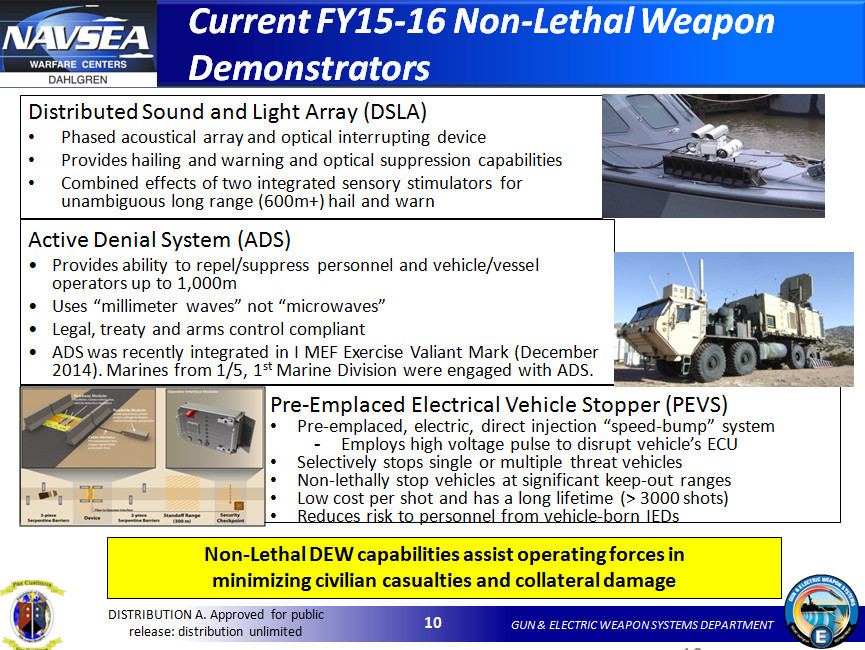
LRADs and similar systems are themselves controversial because of the potential to cause lasting impacts on affected individuals. Depending on the exact context, extremely loud noise can have physical impacts beyond just temporary or permanent hearing loss. The official U.S. Occupational Safety and Health Administration (OSHA) webpage on “Occupational Noise Exposure” explicitly highlights “non-auditory effects” that can include “potential cardiovascular effects.”

LRADs can be paired with less-than-lethal laser dazzlers that can temporarily blind individuals, as well as be used to issue visual warnings. The U.S. Navy has also been working to field more capable dazzlers on its ships to disrupt electro-optical and infrared optics, including seekers in incoming munitions.
In addition, the U.S. military has been publicly conducting research into less-than-lethal systems that can produce a mixture of ADS, LRAD, and dazzler-type effects in the past decade or so. Much of this work has centered on novel applications of laser-induced plasma. TWZ has previously highlighted the additional potential for psychological warfare applications of a system that can project strange and confusing sounds at enemy forces, and possibly do so covertly or clandestinely. Groups of enemy personnel, or even specific individuals, could be bombarded with disconcerting sounds, odd flashes of light, or even bizarre messages seemingly out of thin air.

The original claim does not provide information that might point to a highly directional system, like a ‘pain ray,’ versus one intended to have a wider area effect, such as one that could be employed by an aerial asset.
Still, if a directed energy weapon with “sonic” capabilities does exist operationally, even on a limited level, in the U.S. military’s inventory, its use during Operation Absolute Resolve would have made sense on a number of levels. The operational plan, as it is known now, involved Night Stalker MH-60 and MH-47 helicopters dropping a 200-operator assault force right on top of a fortress-like military facility at a sprawling military base in the capital Caracas, housing the country’s leader, long expected to be a key target during any potential U.S. intervention. U.S. President Donald Trump had been threatening direct military action against Venezuela for weeks beforehand, and had authorized at least one covert strike on a target in the country as of December.
Though no U.S. personnel were killed, it is well established at this point that a major firefight unsurprisingly erupted on the ground after American personnel arrived at the objective to capture Maduro and his wife. A portion of the MH-60s were configured as gunships, also known as Direct Action Penetrators, and provided key close air support. At least seven American service members were wounded in the course of the mission, including the pilot of a Night Stalker MH-47 Chinook helicopter that sustained significant damage. U.S. forces are assessed to have killed between 75 and 100 people during Operation Absolute Resolve, a plurality of whom are understood to have been personnel guarding Maduro. Cuban authorities have acknowledged the deaths of 32 officers from their military during the operation.
If it were available and functioned as described, the “sonic weapon” could have offered another valuable way to halt defenders in their tracks as they rushed to Maduro’s aid, or at least disorient them and keep them from effectively coordinating a response. As already noted, there has been work on systems that blend acoustic and ADS-like capabilities, and separate systems could also be paired together. Doing so could create even more severe and confusing effects, as well as mask the individual nature of the weapons used.
A mission as risky and high-profile as Operation Absolute Resolve would have prompted the use of more specialized assets and capabilities, and even ones that may still have been largely experimental and highly classified. The use of the stealthy Black Hawk helicopters during the raid that led to the death of Al Qaeda founder Osama Bin Laden at his compound in Pakistan in 2011 is a prime example of this in the past. TWZ has previously explained why any stealthy helicopters in U.S. inventory today were likely absent from the Venezuela operation.
Evidence has already been growing that new capabilities were used as part of the suppression and destruction of enemy air defenses (SEAD/DEAD) mission to get the heliborne special operations force safely to its objective in Caracas, in the first place. This includes signs of what could potentially be the first real-world use of new U.S. long-range one-way attack drones and/or launched effects loitering munitions, something TWZ has also explored in detail. It has also been widely reported that cyber attacks helped clear the way. All of this was on top of the extensive use of electronic warfare and conventional munitions.
On top of all of this, the U.S. special operations community is well known for fielding highly specialized and often very low-density weapon systems and other equipment. American special operations units also often get more general-use capabilities, or early variations thereof, well before their conventional counterparts.
The U.S. Army’s Delta Force, a particularly elite and secretive element in America’s special operations world, had the leading role in Operation Absolute Resolve. Assets available to Delta Force and its so-called Tier One companions across the services can take years to emerge into the light, if they ever do. Those units are often directly involved in the development of those capabilities, which can remain highly-classified, too. So, if any unit would have an exotic directed energy weapon used to disable adversaries during an assault, it would be Delta Force.
The R9X variant of the AGM-114 Hellfire missile, which contains an array of pop-out knife-like blades rather than an explosive warhead, is a prime example of an exotic, almost science fiction-sounding capability developed specifically for the highest levels of the U.S. special operations community (and the CIA) and that took years to emerge publicly to any degree. Back in 2017, TWZ had been the first to call attention to what are now recognized as the telltale signs of a strike involving an R9X, also known as the “Flying Ginsu” and “Ninja Bomb.” Though not explicitly said, the video below, which U.S. Central Command (CENTCOM) released last year, shows one of these Hellfires in action.
U.S. Special Operations Forces are also now working to field another specialized, but far less secretive version of the Hellfire, the AGM-114S, which has an articulating warhead that you can read more about here.
As another example, back in 2020, TWZ reported on a pair of Army Chinooks, one a Night Stalker MH-47 and another a standard CH-47, with curious modifications that remain unexplained to this day.
Years Of Claims
It should be reiterated that there is currently no evidence to substantiate the claim that the U.S. military used a “sonic weapon” during Operation Absolute Resolve. At the same time, this is hardly the first time American forces are alleged to have employed mysterious, less-than-lethal, and/or non-kinetic capabilities.
In November 2011, the AFP wire service published a story describing U.S.-supported efforts to safeguard weapons of mass destruction and precursor materials in Libya following the ouster and assassination of long-time dictator Muammar Gaddafi.
“A team of American[s] and Libyans, including Safi ad-Din, is based in Waddan to deal with the problems. The Americans, pistol on hips, scowled when journalists approached them, refusing any comment,” per that story. “‘It’s the CIA (Central Intelligence Agency),’ said a senior military officer from Misrata who had met them.”

“‘Three weeks ago, the car of two fighters was destroyed by an air strike as they got too near the bunkers containing the gas’ at Waddan, without anybody even being hurt, laughed Ahmed Misrati, a fighter,” that report added. “Stun bombs had also already been used against other fighters roaming on the site some days earlier, recalled Safi ad-Din who said that all the curious ones risk an air strike if they get closer than 50 meters (yards) [sic] to the chemical bunkers.”
It is unclear whether the “stun bombs” mentioned here were air-launched munitions of some kind or a more mundane weapon like a flashbang or stun-ball hand grenade, if they existed at all. However, it is put in direct context here with the threat of airstrikes.
Nearly six years later, Jenna Moussa, then working as a “roving reporter Arabic Al Aan TV,” talked about the use of a purported “electricity bomb” by U.S. forces against ISIS in Syria.
Members of the U.S.-supported Syrian Democratic Forces (SDF) “call it [an] electricity bomb here bcz [because] they don’t know real name,” Moussa wrote in a thread of posts on the social media network then known as Twitter. “When [a] plane wants to drop electricity bomb, we are told to drop anything metal that we carry. Otherwise we also burn like ISIS fighters.”
At that time, TWZ explored in detail the possible explanations for this report of an “electricity bomb,” including many of the directed energy capabilities described earlier in this piece, as you can read here. For the better part of three decades, at least, the U.S. has also been working to increase its options for disrupting electronics and power sources, from those inside vehicles to entire power grids.
Similar claims in recent years are not limited to purported U.S. capabilities, either. The prospect of weapons more explicitly intended to do varying degrees of harm using infrasound and/or ultrasound, which are not audible to the human ear, has also been a hotly disputed topic of debate in recent years around reports of so-called Havana Syndrome. The term Havana Syndrome is a reference to the first reports in 2019 of cases of American diplomatic staff at the U.S. Embassy in Havana being victims of what have been described in the past as “sonic” attacks. A swath of other alleged incidents elsewhere globally, as well as in the United States, now termed Anomalous Health Incidents (AHI), subsequently emerged. There have been claims in the past that Cuban, Russian, and/or Chinese operatives may have been responsible.

“In line with the 2023 Intelligence Community Assessment (ICA), most of the IC continues to assess that it is ‘very unlikely’ a foreign adversary is responsible for the events reported as possible anomalous health incidents (AHIs),” according to the most recent unclassified assessment from the U.S. Intelligence Community (IC), published in January 2025, which incorporated various new information. “All IC components agree that most of the new intelligence was consistent with the judgments reached in the 2023 ICA, but new reporting led two components to shift their assessments about whether a foreign actor has a capability that could cause biological effects consistent with some of the symptoms reported as possible AHIs.”
“No IC component calls into question the experiences or suffering of USG personnel and dependents. All components recognize that USG personnel and dependents experienced genuine, sometimes painful and traumatic, physical symptoms and sensory phenomena and honestly and sincerely reported those events as possible AHIs,” that assessment also notes. “All IC components continue to acknowledge that it cannot rule out the possibility that a small number of events reported as possible AHIs were caused by a foreign actor because the IC could not examine every location where an AHI was reported. Consistent with their judgments in 2023, five IC components assess such a scenario would be most likely if a foreign actor used a mechanism based on well-established scientific principles designed for harassment, such as an acoustic device or an incapacitating but nonlethal chemical agent, rather than a novel weapon.”
By its own admission, the Intelligence Community’s assessments have not settled the debate, and there continues to be much dispute over the official conclusions. Just today, CNN reported that the U.S. government spent “eight figures” to acquire a device small enough to fit in a backpack through an “undercover operation,” which might explain at least a portion of the Havana Syndrome cases, citing unnamed sources.
CNN’s story says the device “produces pulsed radio waves” and that it “is not entirely Russian in origin, it contains Russian components.” It also says there continues to be significant internal skepticism about its capabilities after more than a year of testing, but that it has still prompted concerns about the possibility of proliferation. The report does lend some new credence to past assertions and has added to the existing pushback to prior U.S. assessments. Mark S. Zaid, a prominent Washington, D.C.-based lawyer who has represented individuals in cases relating to Havana Syndrome, as well as a host of other national security matters, has issued a new call for transparency in light of today’s news.
Foreign claims go beyond Havana Syndrome and AHIs, too.
In November 2020, The Times newspaper in the United Kingdom published a story claiming that China’s People’s Liberation Army (PLA) had employed microwave directed energy weapons to drive off Indian forces during an altercation along the disputed border between those two countries earlier in the year. As described in that piece, the Chinese weapons sound very much like the U.S. ADS.
Jin Canrong, a professor of international relations at Beijing-based Renmin University, told The Times that the weapons “turned the mountain tops into a microwave oven.”
“We didn’t publicise it because we solved the problem beautifully,” Jin added. “They [India] didn’t publicise it, either, because they lost so miserably.”
The Indian Army subsequently decried the story, which was widely re-reported, as “Fake News.”
However, the claims resurfaced just last September when U.S. Senator Bill Hagerty, a Tennessee Republican, asserted that “Barely five years ago, … China used an electromagnetic weapon to literally melt Indian soldiers.” Hagerty does not appear to have elaborated on or otherwise explained the basis for his comments since then.
Other Explanations
If the underlying claims behind the purported use of a “sonic weapon” in Venezuela during Operation Absolute Resolve are true, there could still be other explanations for how those security forces ended up stunned and bleeding. It has been pointed out that the injuries described are consistent with being hit by a shockwave from an explosion, of which there were many during the operation. Flashbangs or other kinds of less-than-lethal distraction devices, including new types with more severe effects, could have been another part of the equation. If multiple capabilities were used to create different effects simultaneously, it could further add to the confusion. Being subjected to an explosion could also just impact how the individual might remember the general sequence of events.
There also remains a distinct probability that the claims in question are fabricated, in whole or in part, for any number of reasons. Claiming U.S. forces used some kind of ‘super weapon’ that could not be defended against could be an effort by Venezuelan forces to save face after the country’s leader was captured.
A similar decision-making process could have led White House Press Secretary Leavitt to highlight the claims, which certainly tout the technological and operational prowess of the U.S. military. There is also a deterrent angle in drawing attention to a supposed enemy combatant who says that it is futile to stand and fight against American forces and their superior capabilities.
The claims being made could also be intended to serve as some form of active misinformation or disinformation purpose, or just be a tall tale. It is not uncommon across the history of warfare for a side suffering a massive loss to focus blame for poor performance on inferior technology, sometimes to a point where the lines between real and magical become blurry.
This is something that has continued in various forms into the modern era, as we wrote in our previous piece on the claims of an ‘electricity bomb’ use in Syria:
There is always a certain fear of the unknown in warfare and this would be especially true for irregular groups fighting against larger, more technologically superior foreign opponents. Maybe rumors of almost absurdly advanced weaponry is how fighters are inclined to frame their disadvantages. However it happens, we’ve seen these sorts of stories develop organically many times before.
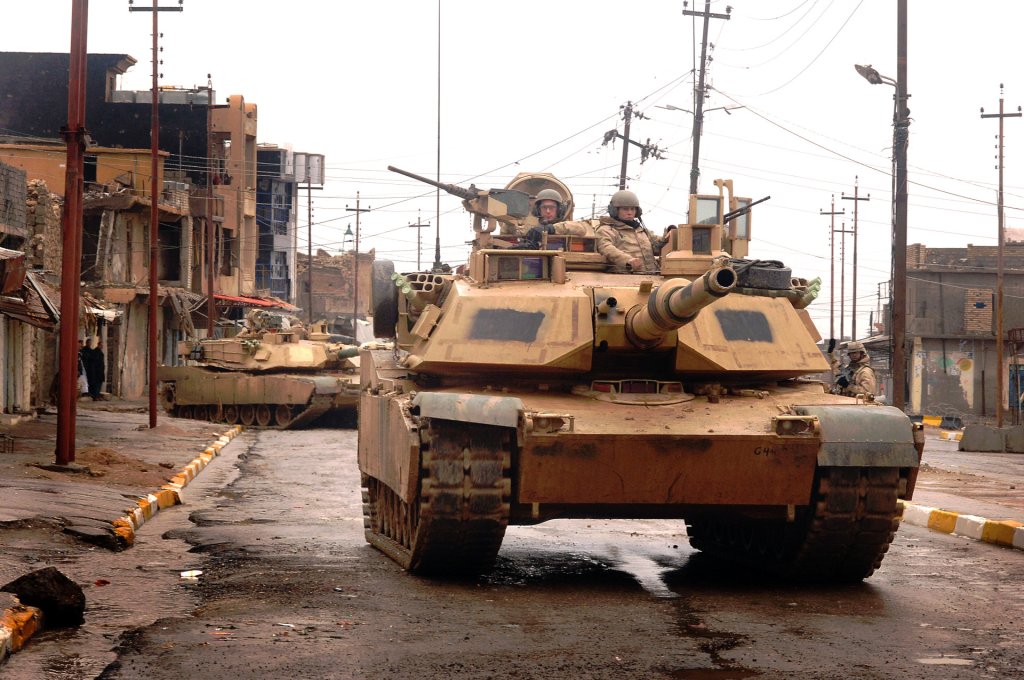
Notably, after the 2003 invasion of Iraq, the U.S. military found that insurgents had somehow come to the conclusion that the orange air identification panels on M1 Abrams tanks and other armored vehicles, there to help prevent friendly fire incidents, were actually force field generators. As a result, American forces began to find RPG warheads covered in electrical tape or with plastic bags, which militants also thought was enough to break through this barrier.
Another popular example is of Liberian rebels in the 1990s and 2000s who wore orange life jackets and other mismatched clothing items imbued with magic to make them impervious to bullets. There are countless similar stories from conflicts the world over, often with few obvious explanations as to how the specific battlefield superstition came about.
Whether or not more information emerges to substantiate the claims of some kind of ‘sonic weapon’ during Operation Absolute Resolve, or definitively refute them, remains to be seen. If nothing else, as was the case with the purported employment of ‘electricity bombs’ in Syria nearly a decade ago, this does call attention to real directed energy weapon programs and other efforts, and that’s just what we know about — you can be assured there are many that we don’t.
Howard Altman and Tyler Rogoway contributed to this story.
Contact the author: joe@twz.com
Loading comments…
Comments couldn’t be loaded. Please refresh the page.