
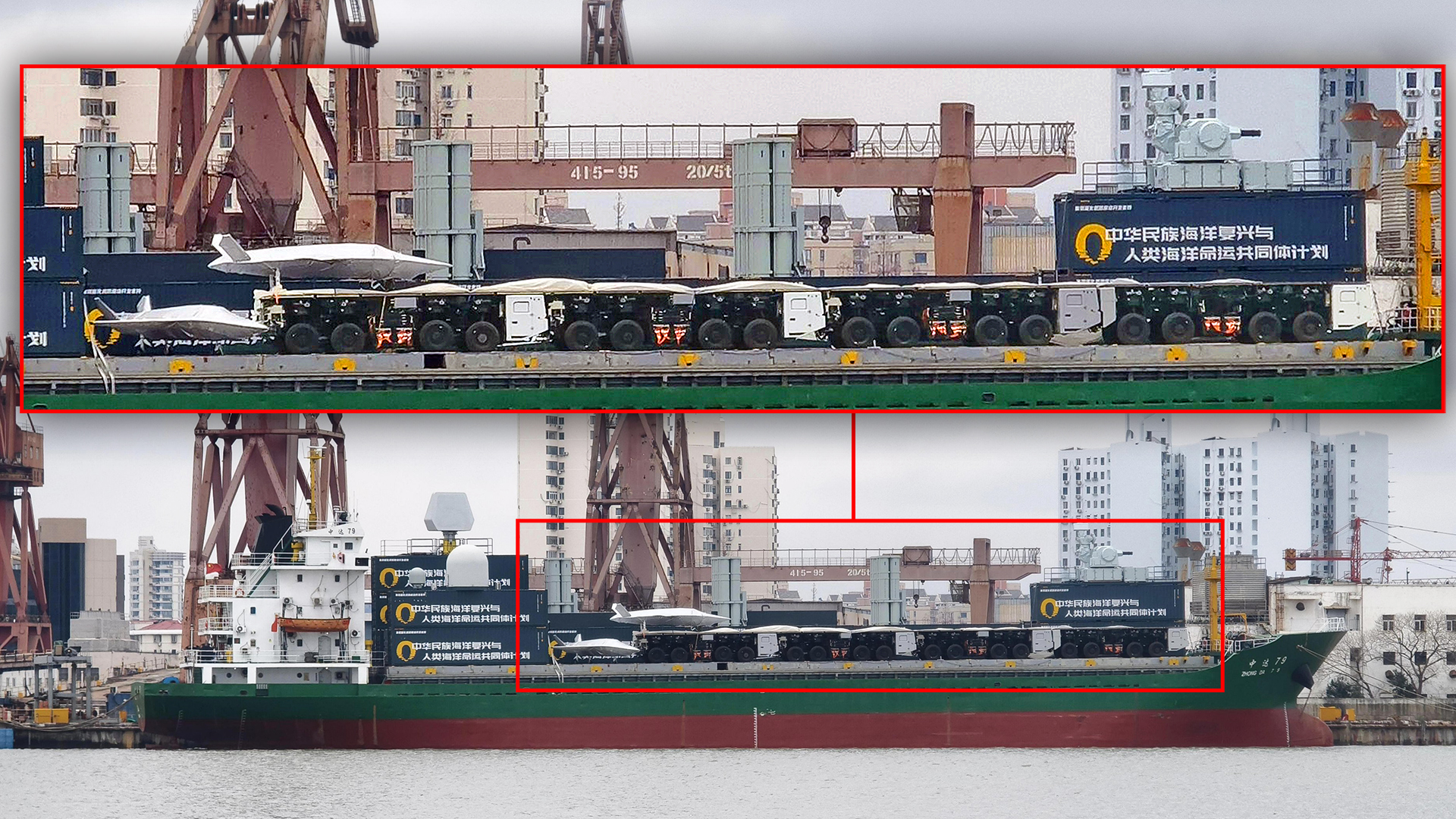
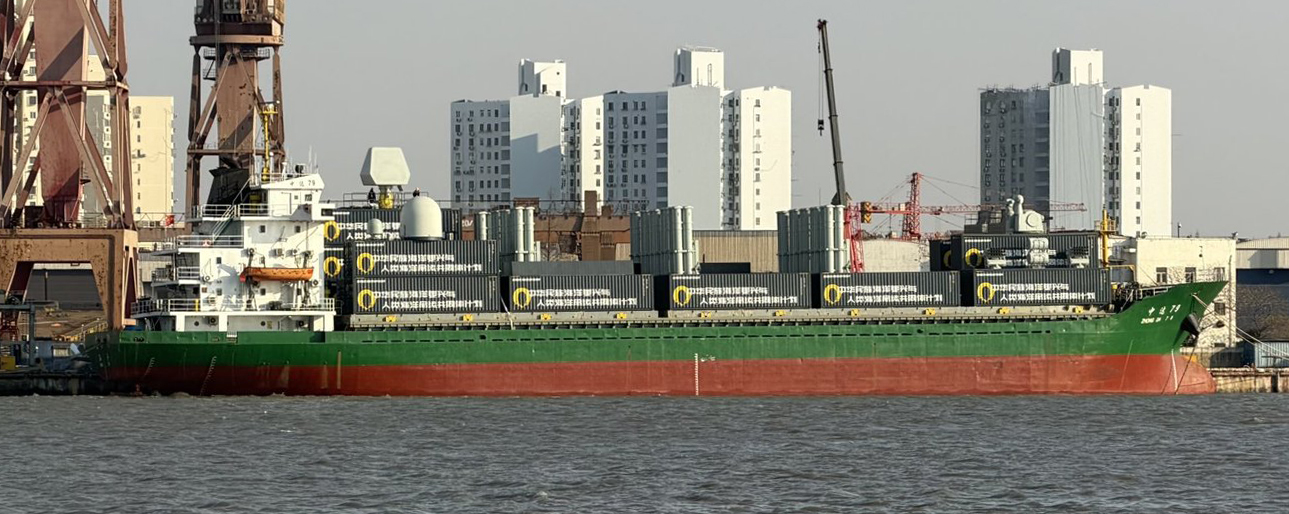
In a major follow-up to three of our recent stories on China’s weapons developments, we can now report that what appeared to be a modular, road-mobile, electromagnetic aircraft launch system (EMALS) catapult capable of flinging advanced fixed-wing combat drones into the air is now set up on a ship. And not just any ship, but the same medium cargo vessel that was recently configured as an improvised surface combatant, with roughly 60 containerized missile launch cells, radars, and close-in defenses. The ship was rapidly reconfigured over a few days to go from an arsenal ship of sorts to a multi-role advanced combat drone carrier.
This is the latest news to come out of the Shanghai-based Hudong-Zhonghua shipyard, where the converted cargo ship first appeared a week ago. Just down the dock from this vessel, the People’s Liberation Army Navy’s (PLAN) giant amphibious assault ship, the Type 076 Sichuan, sits in dry dock. That vessel features a built-in EMALS catapult for launching all types of drones.
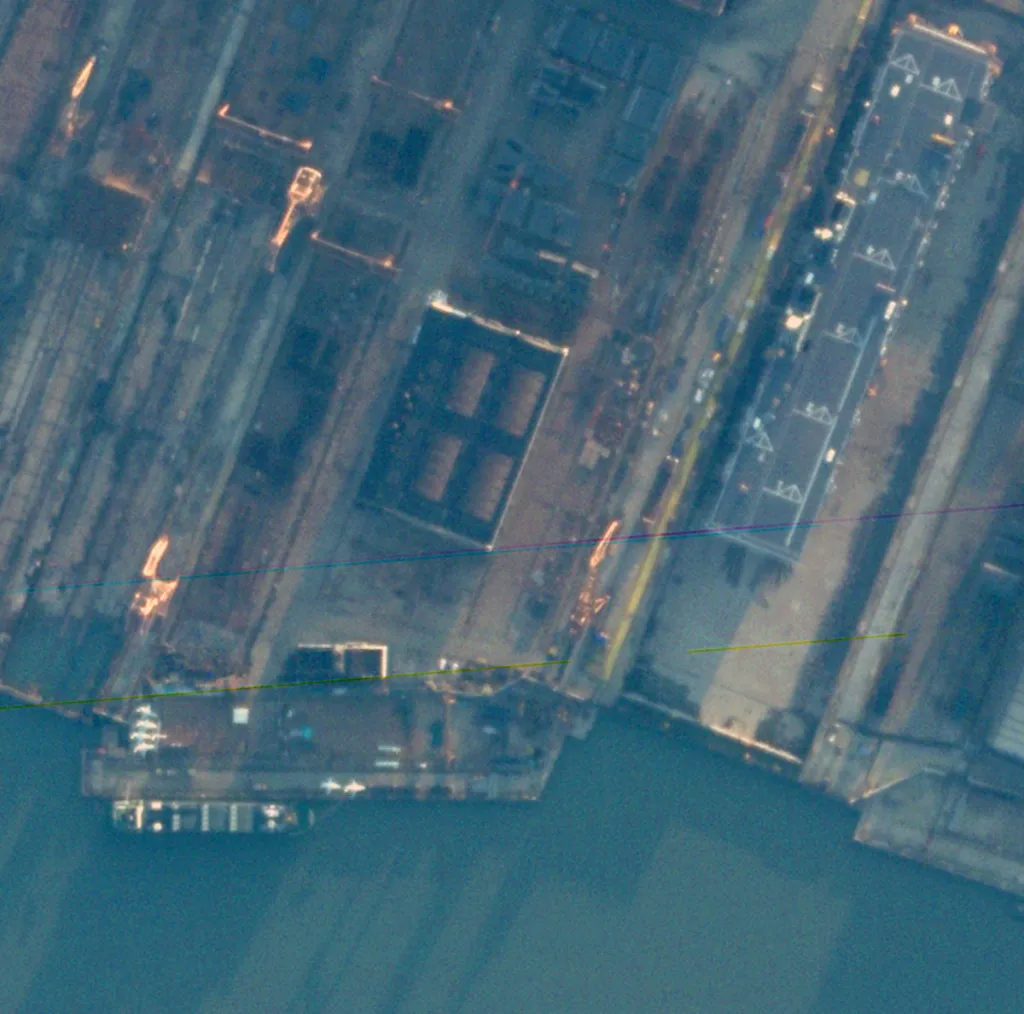
Not long after the converted cargo ship was spotted, the stealthy collaborative combat aircraft (CCA)-like drones (which may very well be mockups) were spotted on the dock next to the ship. Then the modular, vehicle-based EMALS system appeared, with each truck locking into the next, creating what seemed like a scalable catapult track. You can read our full report and analysis on it here.
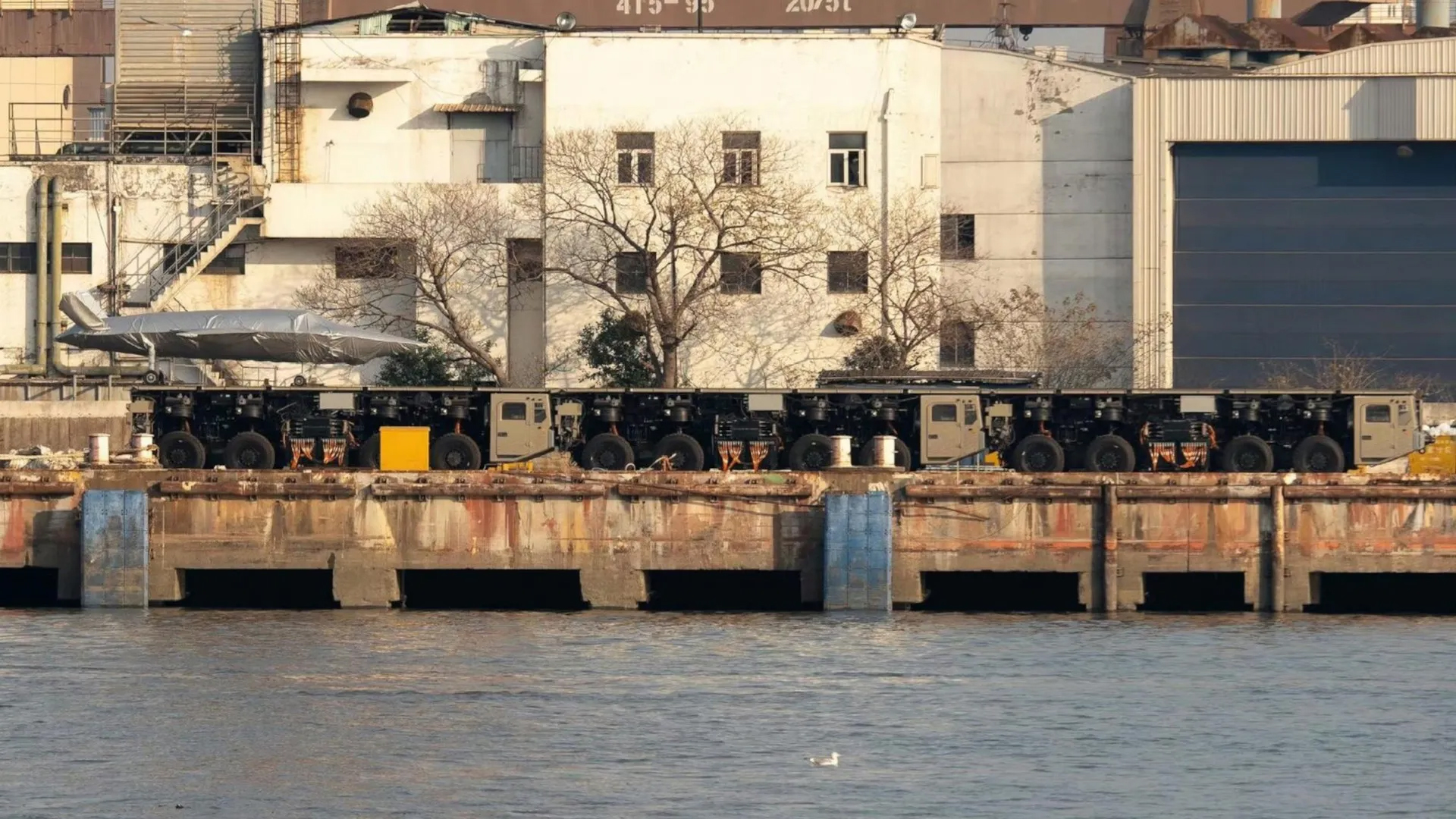

Such a capability would be a boon for land-based launch operations, but at the time of writing, we also stated:
“It is also worth noting that a modular electromagnetic catapult system might be usable on ships that do not have this capability built into their design. As mentioned, the drones and trucks seen at Hudong-Zhonghua shipyard were spotted near a cargo ship loaded with various containerized weapons and other systems. A drone launch capability of some kind would be a logical addition to a vessel with that configuration. At the same time, whether or not any catapult system made up of multiple segmented components would be stable enough for use on a ship rocking back and forth at sea is unclear.”
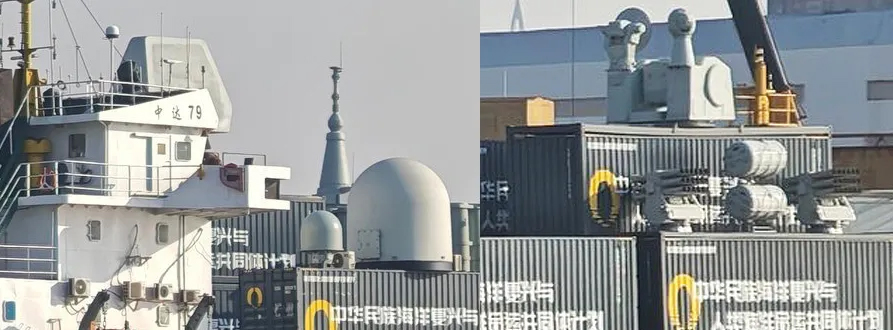
Now that the catapult system is indeed on the ship, there have been major configuration changes to the vessel to accommodate it. Just 24 of the 60 vertical launch cells remain, with six missile containers still on the ship, providing room for the catapult system and possibly other drones. The Type 1130 30mm close-in weapon system (CIWS), large phased array radar and other sensor and communications systems mounted on containers are also retained. The container on the starboard side of the 30mm CIWS that had decoy launchers and life rafts mounted on it is gone. It isn’t clear if the one on the port side remains. Regardless, when taken at face value, in this drone launching configuration, the ship would still be able to defend itself well (at least conceptually).
As for the catapult setup, we see four vehicles connected in a ‘train’ to create the catapult track, with a ‘ready to launch’ drone mounted atop the rear one and another sitting on the deck behind it. This is exactly the same configuration we saw on the dock in previous pictures, aside from the addition of the fourth catapult vehicle, although satellite images showed the fourth sitting nearby but not connected to the catapult train while pier-side. As we discussed in our previous piece, the length of the catapult could be presumably tailored to the aircraft types being launched and dimensional constraints of the launch area, creating a highly adaptable and mobile catapult launch system.
What isn’t perfectly clear is how much room remains on the deck with so many containers removed and the catapult train installed. If the remaining missile launcher containers are situated on the edge of the opposite side of the ship, there should be some room in between. As you can see in satellite imagery, the swept-wing, stealthy, advanced combat drone designs seen at the dock are quite large with a considerable wingspan.

Now we get into clearances needed for launch. It’s hard to tell the margin that exists vertically between the bow of the ship and an aircraft that would be careening off the catapult. It certainly doesn’t look like much, depending on the speed of the aircraft and where it would ‘liftoff’ from the catapult track. The clearance between the CIWS canister and the wing of the aircraft is also in question, although the container could be scooted over, presumably. With the catapult train on the opposite edge of the deck, clearing the wingtip should not be a problem.


The question of how this system would work on a rolling, heaving ship and how it would hold up to the harsh maritime environment while exposed on the ship’s deck is a major question that is totally unanswered at this time. In addition, such a system would require a lot of power to launch a relatively heavy swept wing drone over such a short distance. The drone would have to be engineered to deal with such a violent catapult stroke as well. So how feasible that is also isn’t clear.
There are no provisions for recovering the drones once they have finished their missions. This is a launch-only concept. Unless they can land with parachutes and air bags and be fished out of the water, refurbished and reused, and this would be tough to do all on this one ship, they would be going on one-way missions from this vessel. This kind of split operational concept is relevant in many scenarios though.
And that brings us to the biggest question of all: what are we really seeing here? What is real and what is aspirational? From the drones to the catapult train to the improvised surface combatant configuration for the cargo ship, this all could be a proof of concept or something more mature. There are indications toward the latter, as we have discussed in our previous posts, but this could still be exploratory and even somewhat performative — meant just as much for foreign consumption as it is for testing real systems.
From the start, this arsenal ship of sorts appeared configured for our viewing pleasure, and China knows full well what will ‘leak’ out in terms of most of its major military technological developments, if the government doesn’t have a direct hand in it itself. Now we are seeing another configuration change for this vessel in a very short period of time with some very impressive technology (mobile modular EMALS and advanced drones) needed to underpin it. All this screams “we can rapidly turn our vast commercial fleet into surface combatants and advanced drone carriers.” That is a powerful message and a troubling one for the U.S. and its allies that are already struggling to confront China’s massive naval expansion. The timing is also worth highlighting. A year ago to the week, a crescendo of major Chinese military technological developments also ‘leaked,’ ushering in a new year of highly impressive developments for the PLA. So this would fit that pattern.
While it does appear there is real technology and developmental thought put into all this, just how mature the mobile EMALS catapult system is for use on such a ship isn’t clear. But considering how fast China has been moving on pushing forward its defense technology repertoire, especially over the last year, it would be unwise to disregard the possible existence of such a capability.
UPDATE:
More images have emerged of the ship and the mobile catapult system on its deck, and they are of unusually high quality and close perspective. How exactly these were taken is unclear, but the fact that they are now floating around the internet points to the possibility that China wants these images out. They offer a clearer view of the layout of the ship in this configuration and the space available on the deck, as well as our first detailed look at the top of the catapult, which has a ‘seamless’-like track.
Contact the author: Tyler@twz.com
Loading comments…
Comments couldn’t be loaded. Please refresh the page.