
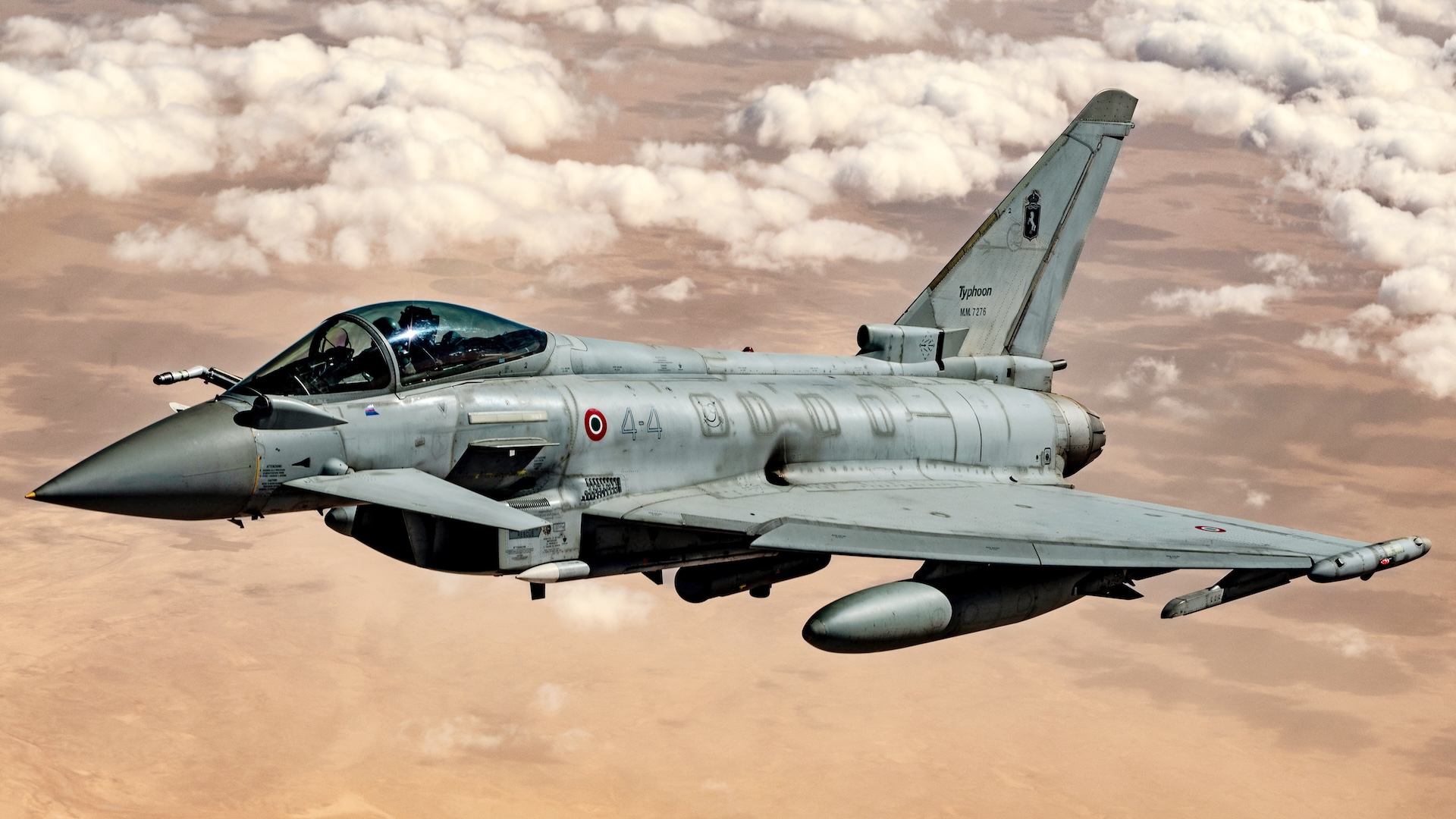
The Eurofighter Typhoon could become the next aircraft to add the air-to-air optimized variant of the laser-guided 70mm Advanced Precision Kill Weapon System (APKWS) rocket to its armament options. BAE Systems, manufacturer of APKWS and the British partner in the Eurofighter consortium, recently confirmed that feasibility studies for the integration of APKWS on the Typhoon were underway, an especially timely development considering that, earlier this week, NATO fighters were used to shoot down Russian drones that had entered Polish airspace, in an event that you can read about here.
Speaking yesterday at the Defense and Security Equipment International (DSEI) 2025 exhibition in London, Paul Smith, BAE Systems head of Typhoon Strategy Delivery, said that APKWS II was being assessed with a view to providing the Typhoon with a low-cost weapon for the counter-uncrewed air system (C-UAS) role.
“APKWS is a clear driver for that sort of capability, a low-cost kinetic effector, and it is just one of a range of weapons that we are assessing [and that] we’re doing feasibility studies on within the Typhoon product strategy. We are working with the customer nations to give them an answer to that [low-cost C-UAS] question,” Smith said.
According to Smith, BAE Systems (and Eurofighter more generally) is currently trying to understand the level of risk and integration maturity that Typhoon customers want when it comes to adapting the jet for the C-UAS role. “Clearly, we will have to prioritize that [C-UAS integration work] against other activities that the nations want us to look at.”
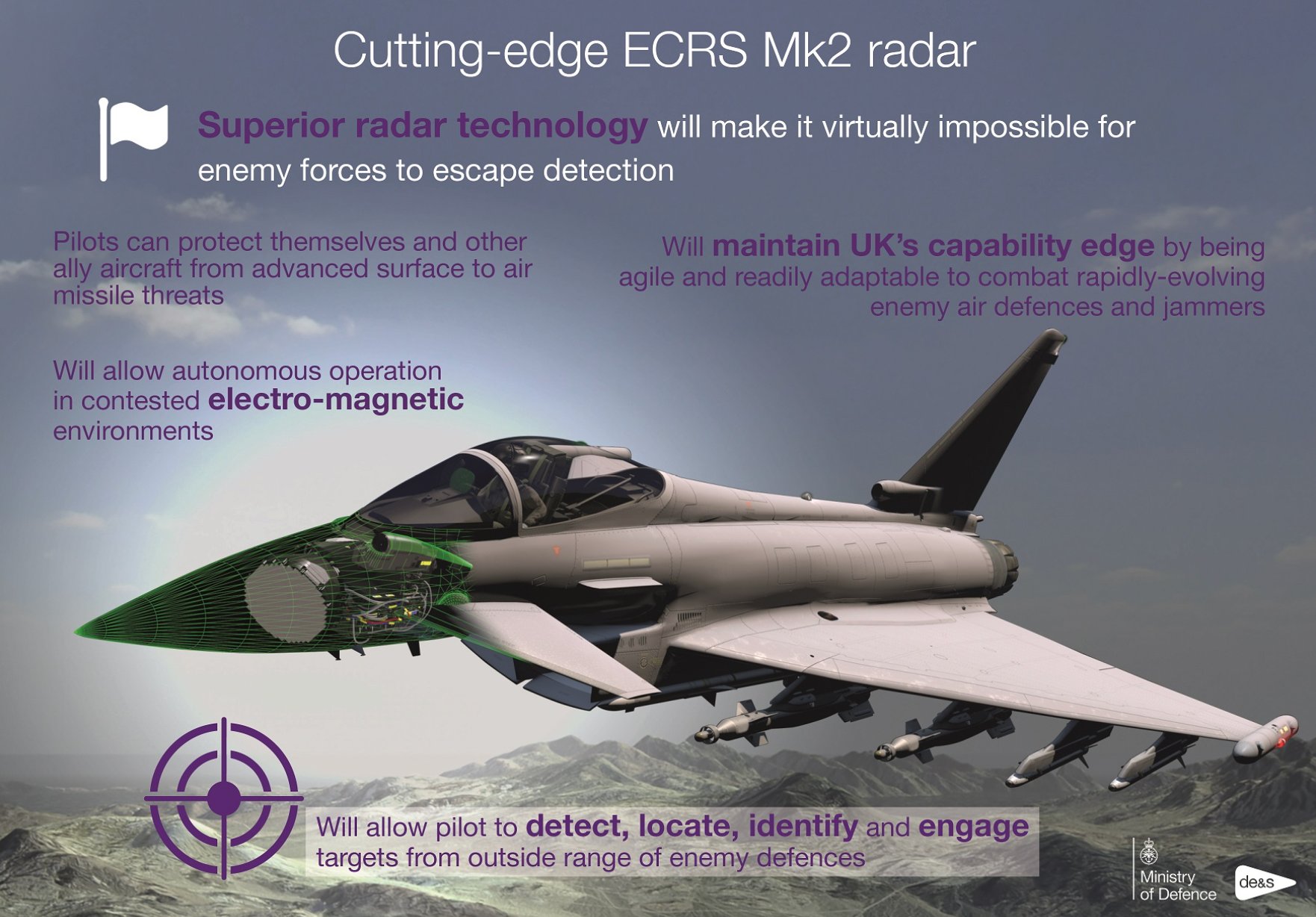
These activities include fielding a new and much more capable active electronically scanned array (AESA) radar in the Typhoon, as you can read about here. An AESA radar allied with APKWS would be especially useful for countering drones and cruise missiles. An AESA can find and track a target at a much greater range, more quickly, and with a greater degree of accuracy. This also applies to smaller threats, including those with limited radar signatures or flying at very low levels, which older radars find much harder to detect.
Nevertheless, C-UAS capabilities are currently very much an area of interest within NATO and beyond, spurred by developments in air combat in the Middle East as well as in Europe, where the lessons of the conflict in Ukraine are having a profound effect.
At the Paris Air Show in June of this year, Eurofighter CEO Jorge Tamarit Degenhardt confirmed that the C-UAS mission was one of growing importance for Typhoon customers and that he “needs to now have that conversation” with Germany, Italy, Spain, and the United Kingdom — the four Eurofighter partner nations that are responsible for developing, building, and sustaining the aircraft.
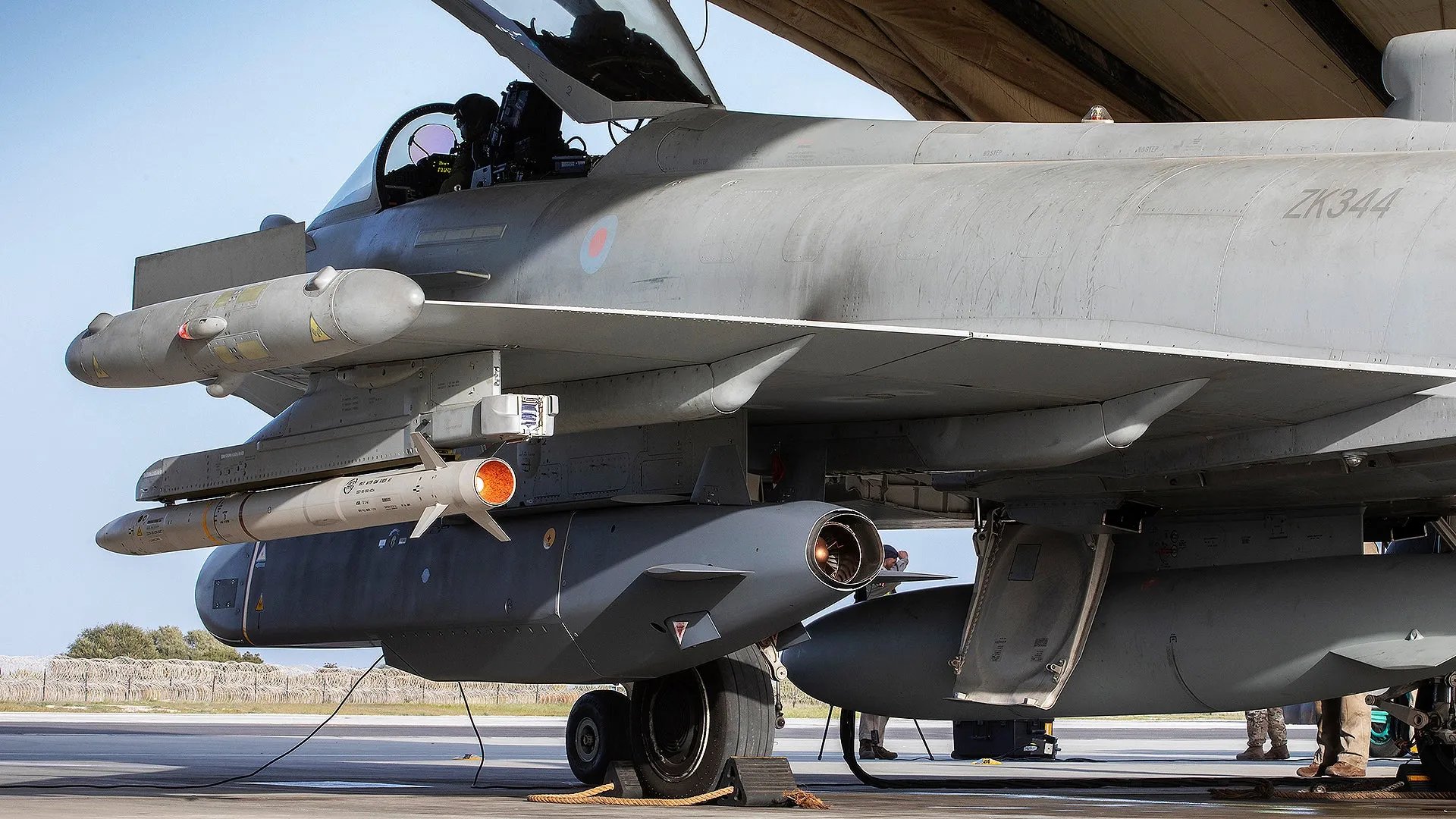
As pointed out previously, with APKWS being a product of BAE Systems, responsible for the U.K. share of the Eurofighter consortium, there could be an additional driver for integrating the weapon on the Typhoon. This should also serve to smooth the integration process. It’s noteworthy that previous efforts to integrate new weapons on the Typhoon have frequently been long and arduous, with standout examples being the Storm Shadow cruise missile and Brimstone precision munition.
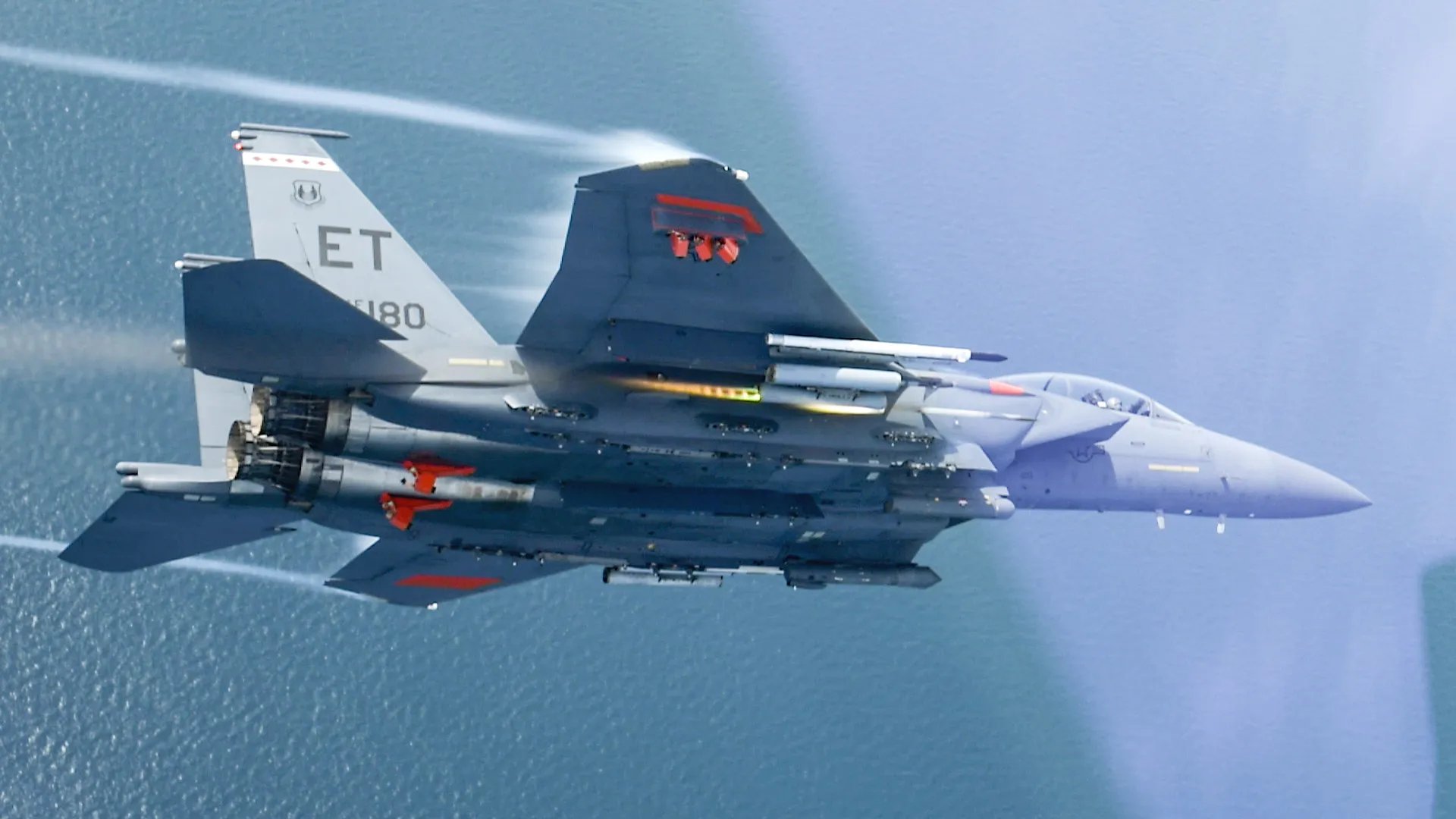
Meanwhile, an air-to-air APKWS capability is being rapidly added to an increasing number of U.S. military aircraft. U.S. Air Force F-15E Strike Eagle, F-16C Viper, and A-10 Warthog combat jets are known to be cleared to employ the weapon, with the expectation that other types, like the U.S. Navy’s F/A-18E/F Super Hornet, will receive it too.
Earlier this week, we got our first look at a U.S. Air Force F-15E actually firing air-to-air optimized variants of the APKWS, showcasing a capability that was rushed into service on the Strike Eagle earlier this year, which TWZ was first to report on. With the ability to carry up to 42 APKWS rockets, as well as traditional air-to-air missiles, the F-15E is an especially capable C-UAS ‘weapons truck.’
In U.S. military service, the laser-guided air-to-air rocket is known as AGR-20F, a variant of the APKWS II, also known as the Fixed Wing, Air Launched, Counter-Unmanned Aircraft Systems Ordnance (FALCO).
All versions of the APKWS rocket are made up of three basic components: a laser guidance section inserted between one of a variety of warhead options and a standard 70mm rocket motor in between.
For the air-to-air C-UAS role, the FALCO version is provided with a proximity-fuzed warhead and what the U.S. military describes as “air-to-air optimized guidance and sensing algorithms.”
There are also plans to make the rocket even more lethal as an air-to-air weapon, with the addition of a new dual-mode guidance package. This will feature an infrared seeker, offering something like a fire-and-forget capability, as you can read about here. The dual-mode APKWS II could also be used against targets on land and at sea, and will also allow aircrews to more rapidly engage multiple targets.

Even in its basic form, APKWS offers some significant benefits for the C-UAS role, compared with traditional air-to-air missiles. Its performance parameters make it especially suitable for bringing down relatively steady flying, non-reactionary, low-performance targets, whether drones or subsonic cruise missiles.
The small dimensions and podded launchers contribute to ‘magazine depth,’ with the standard pod being loaded with seven rounds. This takes up a weapons pylon that would otherwise normally be loaded with just one air-to-air missile.
The requirement to shoot down low-cost drones, in particular, has raised repeated concerns about the mismatch in cost between the target and air-to-air missiles that would otherwise be used for the role. For example, the latest variants of the AIM-120 Advanced Medium-Range Air-to-Air Missile (AMRAAM), which also arm the Typhoon, cost around $1 million each, while current-generation AIM-9X Sidewinders each have a price tag around $450,000. The standard short-range missiles on the Typhoon — IRIS-T and ASRAAM — are similarly expensive.
Meanwhile, the laser guidance section for an APKWS II rocket costs between $15,000 and $20,000, with only a few thousand dollars more needed to buy the rocket motor and warhead.
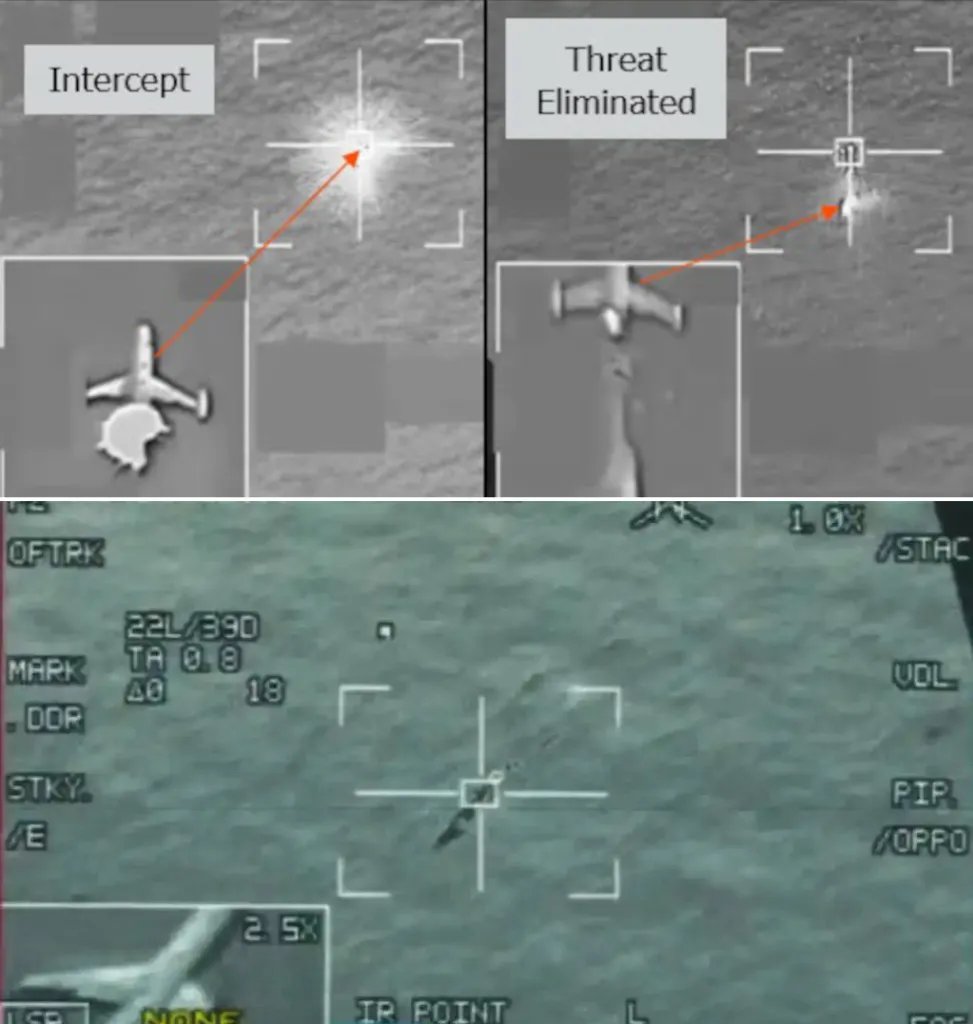
The U.S. Air Force had begun to look at using APKWS II as an air-to-air weapon against drones and cruise missiles in 2019 when the Air Force disclosed that it conducted a test of the weapon in that role from an F-16C. The first reports of the capability being used in combat use came last year, when U.S. Air Force F-16s began using the rockets to shoot down drones launched by Iranian-backed Houthi militants in Iran, as TWZ was first to report.

Since then, U.S. Air Force F-15Es and F-16s have repeatedly called upon the rockets to deal with Iranian drone and missile attacks in the Middle East. In particular, the rocket-armed fighters were very actively involved in defending Israel from Iranian drones and missiles. The same encounters saw F-15E crews running out of missiles when faced by large barrages of drones and missiles, a problem that APKWS II can help alleviate.
There is a large Typhoon customer base in the Middle East that could benefit from these capabilities, especially Saudi Arabia, which has a long history of using fighters armed with traditional air-to-air missiles to defend against drone attacks. This has resulted in a significant strain on expensive missile stockpiles, as we’ve reported in the past.
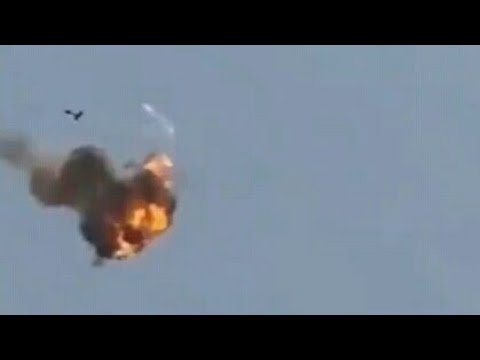
In the European context, Typhoon operators are also increasingly aware of the threat posed by lower-cost drones and missiles.
Earlier this week, 19 Russian drones entered the airspace of NATO member Poland, according to authorities there, with some of them being shot down by Polish and Dutch fighter jets. You can catch up to our reporting on the incident in our story here. Initial accounts suggest that AMRAAM and AIM-9 missiles were employed.
The Polish government has determined the Russian drone incursions into the country were not only deliberate, but they were a test of NATO’s ability to react to aerial threats. This has resulted in the closure of Polish airspace along the border with Belarus and Ukraine, and the provision of additional air defense support by NATO allies.
In the future, a large-scale conflict between NATO and Russia would likely see significant numbers of drones being employed, both armed and unarmed ones, to overwhelm air defenses and to strike less well-protected targets. The use of drones also fits with Russia’s hybrid or ‘gray zone’ warfare tactics that are of increasing concern to NATO in Europe.
In this context, it’s clear that the air-to-air optimized variant of the APKWS rocket would have particular value.
With the recent Russian drone incursion leading to alarm across Europe and triggering a wide range of actions, discussions about providing the Eurofighter Typhoon with a dedicated low-cost C-UAS capability could hardly be more relevant.
With thanks to Tim Robinson of the Royal Aeronautical Society for his help in preparing this story.
Contact the author: thomas@thewarzone.com
Loading comments…
Comments couldn’t be loaded. Please refresh the page.