
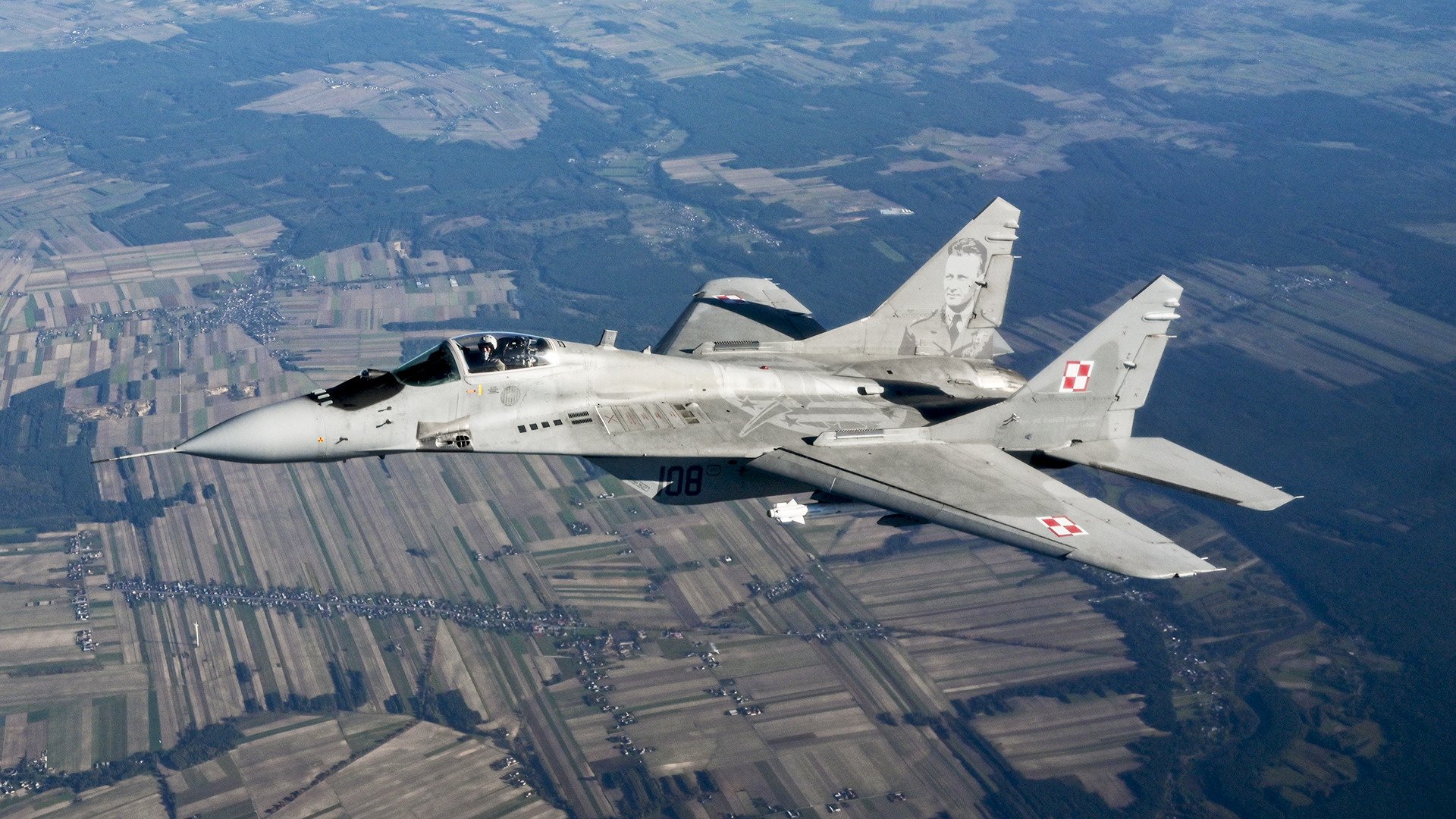
Poland won’t transfer additional MiG-29 Fulcrum fighters to Ukraine because Kyiv won’t provide drone production technology information, the country’s defense minister and deputy prime minister said. The move represents a pivot from policies of the previous Polish government and comes amid worsening relations between Kyiv and Warsaw.
As we have previously reported, under former President Andrzej Duda, Poland donated 14 of its MiG-29s to Ukraine, becoming the first country to commit to supplying combat jets to Kyiv. However, under new Polish President Karol Nawrocki, who was elected last August, the country is now seeking something tangible in return for the Fulcrums.
“I proposed what I believe was a very partnership-based approach. MiGs in exchange for drones,” Władysław Kosiniak-Kamysz, who serves as defense minister and deputy prime minister, told the Polish Polsat News outlet. “The Ukrainians initially agreed, but they did not honor this arrangement, so there will be no MiGs for Ukraine because Poland does not have drones or the capability to use them.”
TWZ cannot independently confirm the Polish defense minister’s claims.

The Polish defense minister lauded Ukraine’s defense technology.
“Ukraine has such significant capabilities in the field of drones that, in return for the military equipment it has received, it could have shared its know-how with Poland and provided partial access to its technologies,” he said.
Kosiniak-Kamysz added that he was not criticizing the previous administration’s policies toward Ukraine.
“I’m not going to bash them over this issue; that’s far from my intention,” he told Polsat. “They did the right thing—in fact, I’d go further: I would have done the same. They acted correctly, and Ukraine was in a much more difficult situation back then.”
The Polish move echoes U.S. President Donald Trump’s stance on Ukraine and the NATO alliance writ large. The American leader has frequently criticized the Biden administration for giving Ukraine military aid with no compensation and NATO for not doing enough to pay for its own defense.
Kosiniak-Kamysz’s pronouncement about halting the Fulcrum transfer follows Nawrocki’s confirmation last December that Poland would transfer the additional MiG-29 fighter jets to Ukraine in exchange for counter-drone systems.
“After the unnecessary and unclear public uproar surrounding this issue—unfortunately, public opinion has been somewhat misinformed about this matter—we are seeking a symmetrical strategic partnership,” Nawrocki said during a press conference with Ukrainian President Volodymyr Zelensky. “This exchange of MiGs for anti-drone systems does not contradict our policy.”
It is unclear exactly what drone technology Poland was seeking or what Ukraine refused to provide. Ukraine has yet to comment on the matter. However, Kosiniak-Kamysz’s comments come as Polish-Ukrainian relations are spiraling downward.
Earlier this month, Nawrocki stripped Zelensky of the Order of the White Eagle, Warsaw’s top award, escalating a row between the allies over the memory of WWII.
“Zelensky had infuriated Warsaw this month by naming a military unit after an insurgent army that took part in massacres against Poles in WWII,” AFP reported.
For much of this conflict, Poland has been one of Ukraine’s staunchest allies, serving as a logistics hub and providing military assistance. As we noted earlier in this story, Poland’s initial donation of MiG-29s opened the door for the transfer of dozens of others from several NATO nations. That was followed by the eventual provision of F-16 Vipers and later French Mirage 2000 fighters.
Despite receiving more modern fighters: “Zelensky has noted that Ukraine requires MiG-29 aircraft because its pilots are already trained to operate them,” according to the Ukrainian United24 media outlet. “He added that transitioning to F-16 fighters requires lengthy retraining, temporarily reducing combat readiness, whereas MiG-29s would allow Ukraine to maintain operational air capabilities more immediately.”
Regardless of the type, Ukraine has a great need for more combat jets. Its air force has lost at least 88 of various kinds since the start of the war, according to the Oryx open-source tracking group. Those figures are likely higher because Oryx only tabulates losses for which it has visual proof.
The list includes at least 38 MiG-29s, 20 Su-27 Flankers, four F-16s and a Mirage. Ukraine lost two more aircraft in recent days.
A MiG-29 Fulcrum went down during a nighttime combat mission in the central Poltava region on June 27, the Ukrainian Air Force reported, according to the Kyiv Post. Earlier this month, a Su-24M bomber crashed, resulting in the deaths of both crew members, the newspaper noted.
Meanwhile, as the Ukraine-Poland spat simmers, Kyiv has inked a number of deals to share defense technology with Arab states in the wake of the U.S.-Israeli war on Iran. Tehran has struck several Arab nations with missiles and drones in response to Operation Epic Fury, and they in turn reached out to Ukraine, which has gained air defense expertise after battling waves of Russian attacks for more than four years.
Earlier this week, Ukraine and Kuwait signed a bilateral defense cooperation agreement paving the way for joint defense projects, military-technical cooperation, and collaboration between the two countries’ defense industries.
As we noted in a prior story, during a tour of the Middle East earlier this year, Zelensky said he inked defense cooperation agreements with Saudi Arabia, UAE and Qatar, and had discussions with Jordan.
It is unclear how much these deals affected Poland’s MiG-29 decision, if at all. Nor is it known if there will be a cascading fallout on other drone deals Zelensky is trying to engineer with the U.S. and other nations. Regardless, while an additional 14 Fulcrums won’t change the course of the war for Ukraine, Poland’s refusal to provide them is another sign that a once-close relationship is now troubled.
Contact the author: howard@twz.com
Loading comments…
Comments couldn’t be loaded. Please refresh the page.