
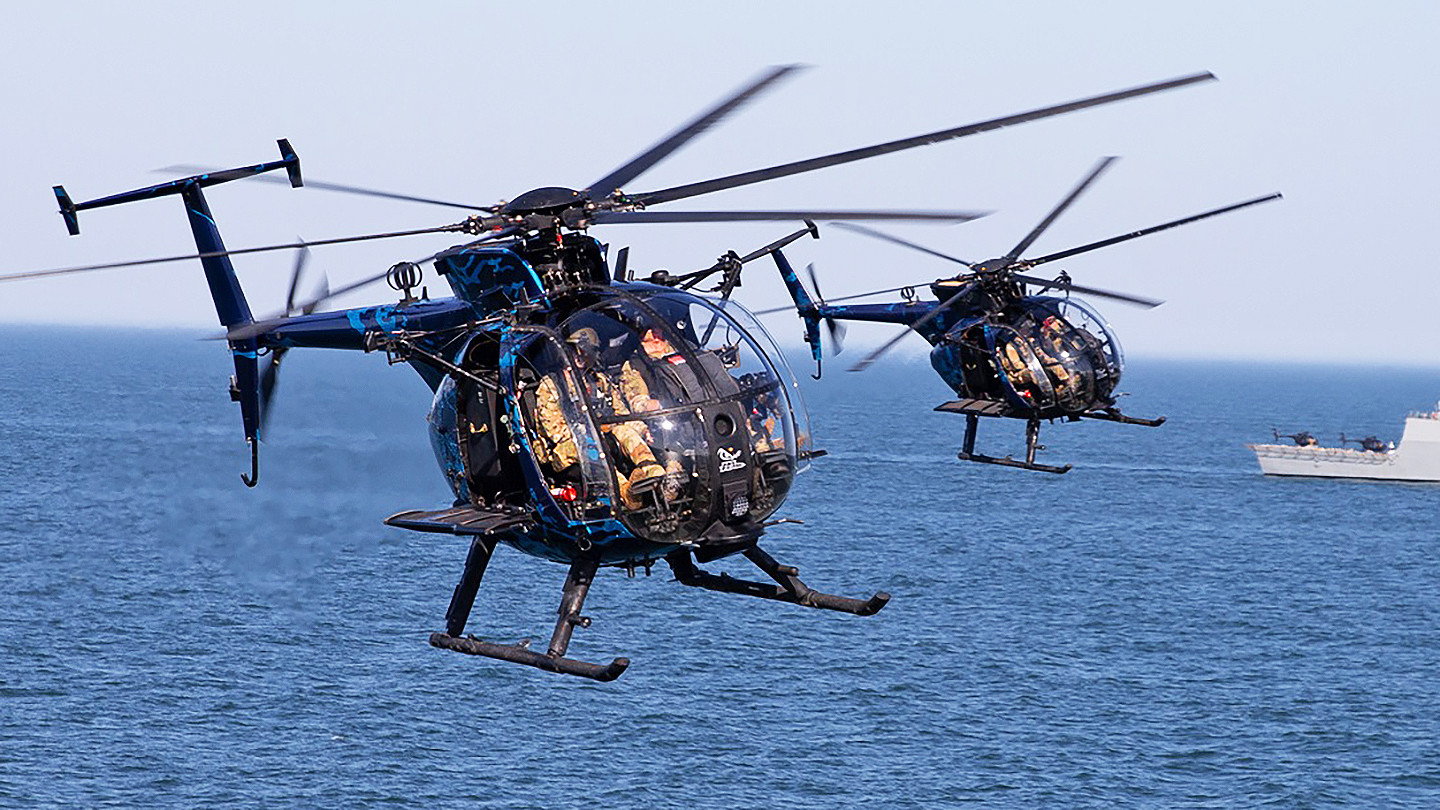
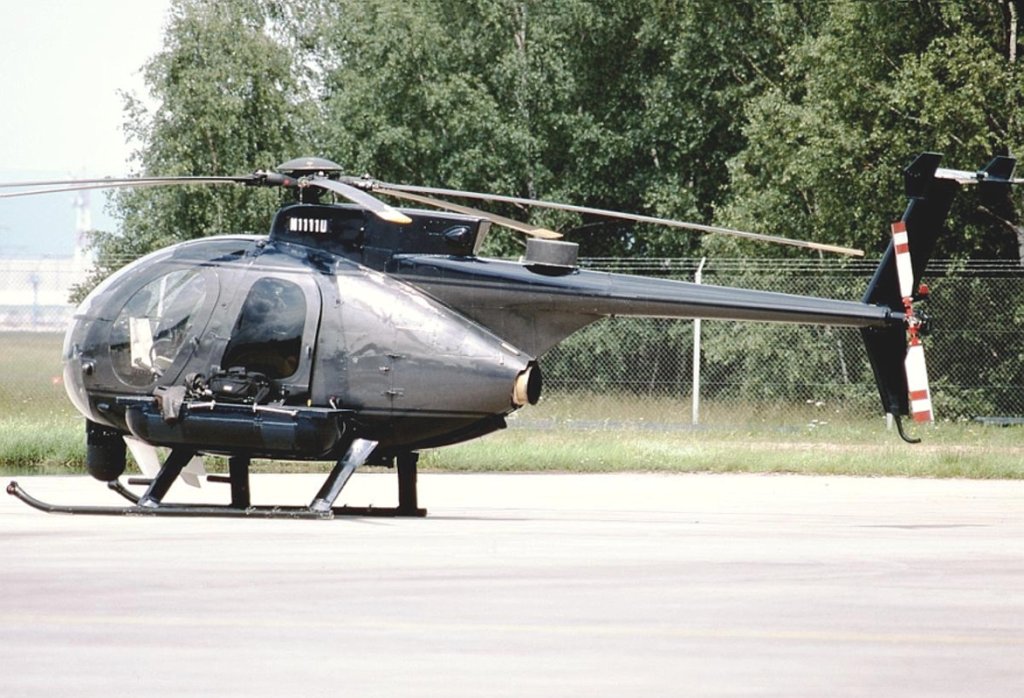
Images showing an MH-6 Little Bird taking part in today’s operation to seize the runaway Russian-flagged oil tanker Marinera, hundreds of miles away from the nearest land, were widely met with befuddlement. This is a relatively tiny special operations helicopter that cannot be refueled in flight and has a short range. However, its small size and incredible transportability means that it can appear from virtually anywhere, on land or at sea. These are among the capabilities that have long endeared the type to the U.S. Army’s elite 160th Special Operations Aviation Regiment (SOAR), better known as the Night Stalkers.
Readers can get up to speed on the operation targeting the Marinera with our reporting here.
Russian news outlet RT first published imagery said to have been taken from the deck of the reflagged Marinera, showing at least one MH-6 Little Bird approaching the ship. Fox News and CBS News have now reported that helicopters from the 160th SOAR brought in U.S. Navy SEALs to board the ship as it sailed in the North Atlantic. TWZ has been working to independently confirm the employment of the Little Birds, specifically, as well as other details about the operation. U.S. aviation assets, especially various special operations types, had been spotted pouring into the United Kingdom amid reports that an attempt to seize the tanker, formerly known as the Bella 1, looked increasingly imminent. The Night Stalkers had already had a monumental past week with their role in the operation to capture Venezuelan dictator Nicolas Maduro over the weekend.
The 160th SOAR currently operates a fleet of what are formally known as Mission Enhanced Little Birds (MELB), produced by Boeing. The MELBs are heavily modified with specialized avionics built to help with flying at very low-levels in complex environments and at night, as well as defensive systems and other capabilities that increase the egg-shaped helicopter’s survivability.
The MELBs can be readily configured and reconfigured as either MH-6 or AH-6 subvariants. The MH-6 is described as an “assault” configuration with planks on either side for special operators to ride on. The helicopters can land to insert those operators, or they can use the Fast Rope Insertion Extraction System (FRIES) to rappel down to their objective.
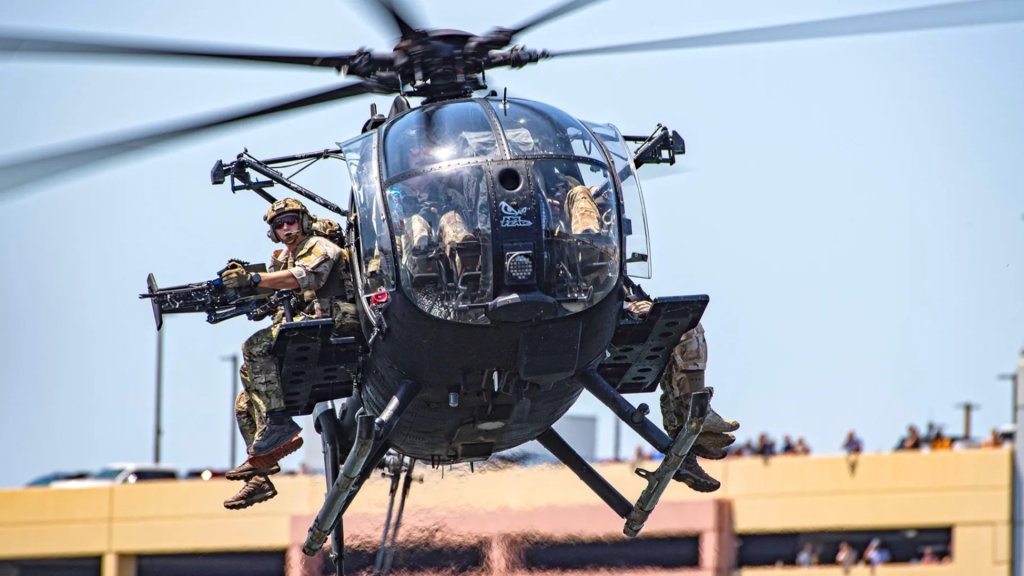
The AH-6 is a light attack configuration that swaps the personnel planks for mounting systems enabling the helicopter to carry an array of weapons, including Gatling-type machine guns, Hellfire missiles, and 70mm rockets.
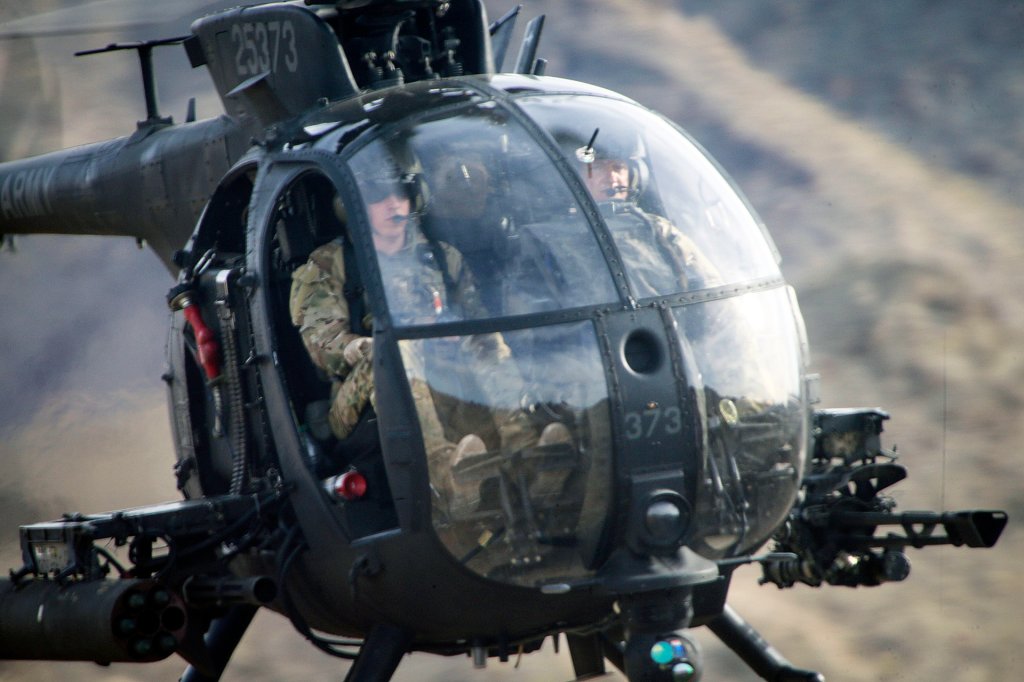
Where the Little Birds that took part in the Marinera boarding operation launched from is still unknown. As noted, 160th SOAR’s AH/MH-6s cannot refuel in flight and have relatively limited unrefueled range (officially stated to be 250 miles, per the 2025 edition of U.S. Special Operations Command’s Fact Book). Night Stalker Little Birds can be fitted with various types of range-extending auxiliary fuel tanks. Even so, whether they would have been able to fly to the tanker from a base on land in the region is unclear, but it seems unlikely, especially with special operators strapped to their outsides.
As already mentioned, the helicopters more likely flew from the decks of one of the vessels that supported the mission, which included a U.S. Coast Guard Legend class cutter and the British Tide class replenishment tanker RFA Tideforce. It is possible the Little Birds could have already been embarked on the Coast Guard cutter for a prolonged period before the actual operation today, and the 160th has trained for such operations in the past.
Regardless, the tanker seizure operation puts a spotlight on the unique operational independence and flexibility that the 160th’s Little Birds offer.
“It is your street fighter,” Paul Kylander, the product manager for the AH/MH-6s within U.S. Special Operations Command’s (SOCOM) Program Executive Office-Rotary Wing (PEO-RW), told TWZ and others at the annual SOF Week conference last year. “When the operators want to get to your front door, this is the aircraft that they’re going to use. Very surgical strike, very precision attack, is what you’re going to get from these platforms.”
The Night Stalker’s nimble Little Birds excel at getting in and out of extremely tight spots where no other helicopter can go. They are often seen dropping commandos off on building ledges and landing in very confined areas, or even flying down the streets of huge cities.
Though they have limited reach on their own, the small size of the Little Birds means significant numbers of them can be carried inside fixed-wing transport aircraft. Air Force Special Operations MC-130 tanker-transports can carry two in a near ready-to-fly configuration at once, while larger C-17s can transport at least five at a time. The helicopters have folding rotors and other features specifically designed to allow personnel on the ground to roll them off of larger aircraft and then get them operational very quickly. This is measured in minutes, not hours.

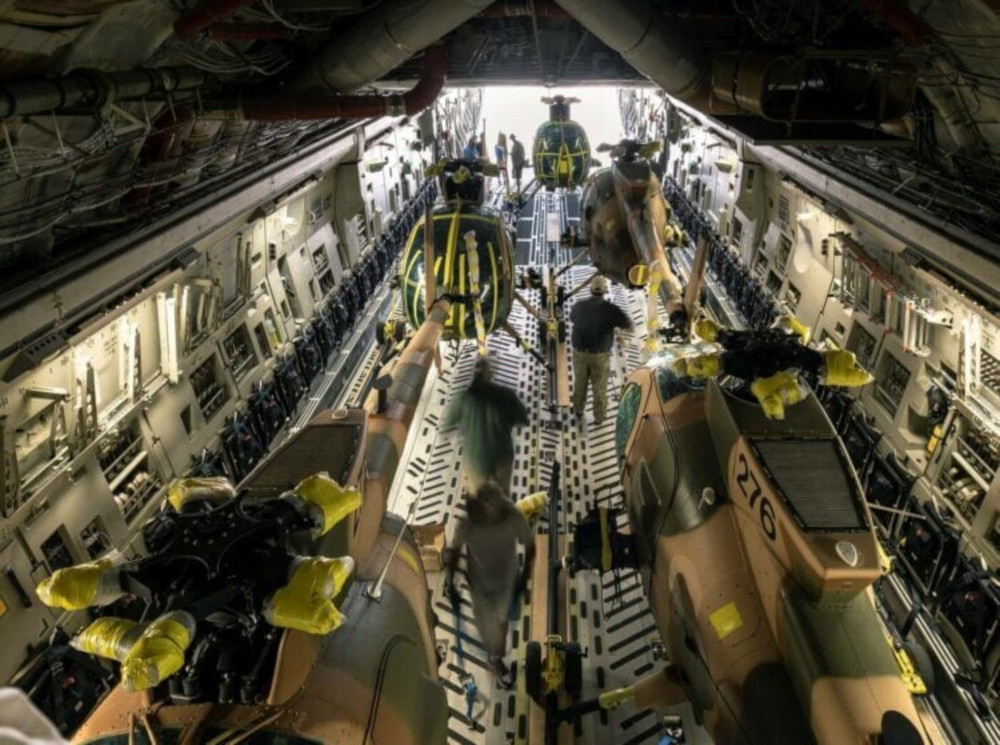
Transport aircraft can carry the AH/MH-6 helicopters across distances of thousands of miles, directly to forward operating locations far closer to their intended objectives. Those destinations could include far-flung sites with little, if any established infrastructure, including rough landing strips. With far less requirements for fuel and other support compared to the MH-60 Black Hawks and MH-47 Chinooks in the 160th’s inventory, the Little Birds also offer a different degree of ability to operate independently for prolonged periods after arriving in a forward area. AH/MH-6s do, of course, also regularly operate directly together with other Night Stalkers helicopters in highly integrated, seamless formations, as well as with other U.S. military aircraft, to a lesser degree.
The benefits that the Little Birds offer apply to operations from ships, as well as bases on land. AH-6/MH-6s require much less deck space than most other helicopters in service across the U.S. military, and more of them can also be tucked into hangars or in the holds on vessels that were designed to accommodate larger types or even no aircraft at all. They can also just be stowed in an area on the deck of a ship. They just need enough room to takeoff from. This unlocks a near endless list of vessel types they can operate from, which drastically expands their operational flexibility and can spell real trouble for an adversary.
Some of the diminutive helicopters famously operated from U.S. Navy warships, as well as barges turned into floating bases, during the so-called “Tanker War” sideshow to the Iran-Iraq war during the 1980s. In that instance, then-new “AH-58” Kiowa Warrior armed scout helicopters operated by conventional U.S. Army units eventually took the place of the Little Birds. Last year, TWZ explored the particular value of the 160th’s AH/MH-6s in maritime operations in more detail after one of the helicopters emerged wearing a blue camouflage wrap.

In addition, all of this allows for the employment of Little Birds, in general, with a very different level of discretion, as they can more readily be concealed even after being deployed. There have been claims that the 160th’s repertoire of tactics, techniques, and procedures has included being prepared to bring the helicopters to forward locations clandestinely inside civilian trucks, which we will come back to in a moment.
There is a long history of the use of members of the extended Little Bird family by U.S. special operations forces and intelligence agencies to support covert and clandestine missions, as TWZ has explored on several occasions in the past. With non-military style paint schemes, the helicopters can even blend in to a degree in the open. Versions of the Little Bird continue to see widespread civilian and commercial use globally, with the helicopter type being made famous after starring in Magnum, P.I. in the 1980s.
In his 2015 book Relentless Strike, author Sean Naylor offers a Little Bird anecdote that is especially relevant in relation to planning for a covert operation into Laos to rescue Americans captured during the Vietnam War, which was ultimately aborted. He writes:
“JSOC [Joint Special Operations Command] rehearsed extensively in Hawaii for the mission, which would involve a task force launching from the tiny Pacific island of Tinian in the Northern Marianas and using an abandoned and overgrown U.S. military airfield in Thailand as a forward staging base. With the airfield under control, C-5 transport planes would have landed, bearing JSOC’s own version of a Trojan horse: white, civilian-style eighteen-wheel trucks, each hiding two TF 160 [Task Force 160; another term used to refer to the 160th SOAR] AH-6 Little Birds with folded rotor blades. As Delta operators made their way overland to the prison camp TF 160 personnel would have driven the trucks close to the Laotian border, before stopping and launching the helicopters. TF 160 kept this rarely used technique known in JSOC as ‘Smokey and the Bandit’ after the 1977 trucker comedy starring Burt Reynolds up its sleeve for decades, because it offered a clandestine way to move a lethal capability close to a target. ‘Our guys were trained and even had the truck licenses,’ said a TF 160 veteran. The unit had its own trucks, but locally obtained vehicles would suffice ‘with maybe a couple of days’ work and some welding,’ he said. When the time came to launch the aircraft, the crew would roll them off the back of the truck and have them flying within three minutes. ‘You have to be really well trained,’ the TF 160 veteran said. ‘It’s absolutely an incredible capability.’

While TWZ cannot confirm the details in Naylor’s book, specifics about the planned prisoner of war rescue operation, nicknamed Operation Pocket Change, including the expected use of Little Birds, have been reported elsewhere over the years. The prospect that Americans remained in captivity in Southeast Asia for years or decades following the end of the Vietnam War has been and continues to be a controversial topic.
Regardless, Little Birds can be trucked clandestinely in commercial vehicles or shipping containers, even behind enemy lines, something other helicopters within the 160th SOAR’s stable can’t come close to doing.
All this speaks to why the 160th SOAR has continued to operate Little Birds long after non-special operations units with the U.S. military stopped flying other versions of the helicopter. Night Stalker AH/MH-6s now look set to remain in service even longer than might have been expected following the cancellation of the Army’s Future Attack Reconnaissance Aircraft (FARA) program in 2024. There had been plans to replace roughly half of the Little Birds with a special operations variant of the FARA aircraft.

It’s also worth noting here that Boeing announced its intention to shutter its Little Bird production line and “transition to a focus on sustainment and support for the platform’s customer base.” Separate production of versions of the Little Bird will continue through MD Helicopters.
Overall, much is still to be learned about the U.S. operation today to seize the tanker Marinera, and the role played by the 160th SOAR. However, what has already emerged has highlighted the ability of the Little Birds to do things, go places, and hide in areas that no other Night Stalkers helicopters can.
Contact the author: joe@twz.com
Loading comments…
Comments couldn’t be loaded. Please refresh the page.