
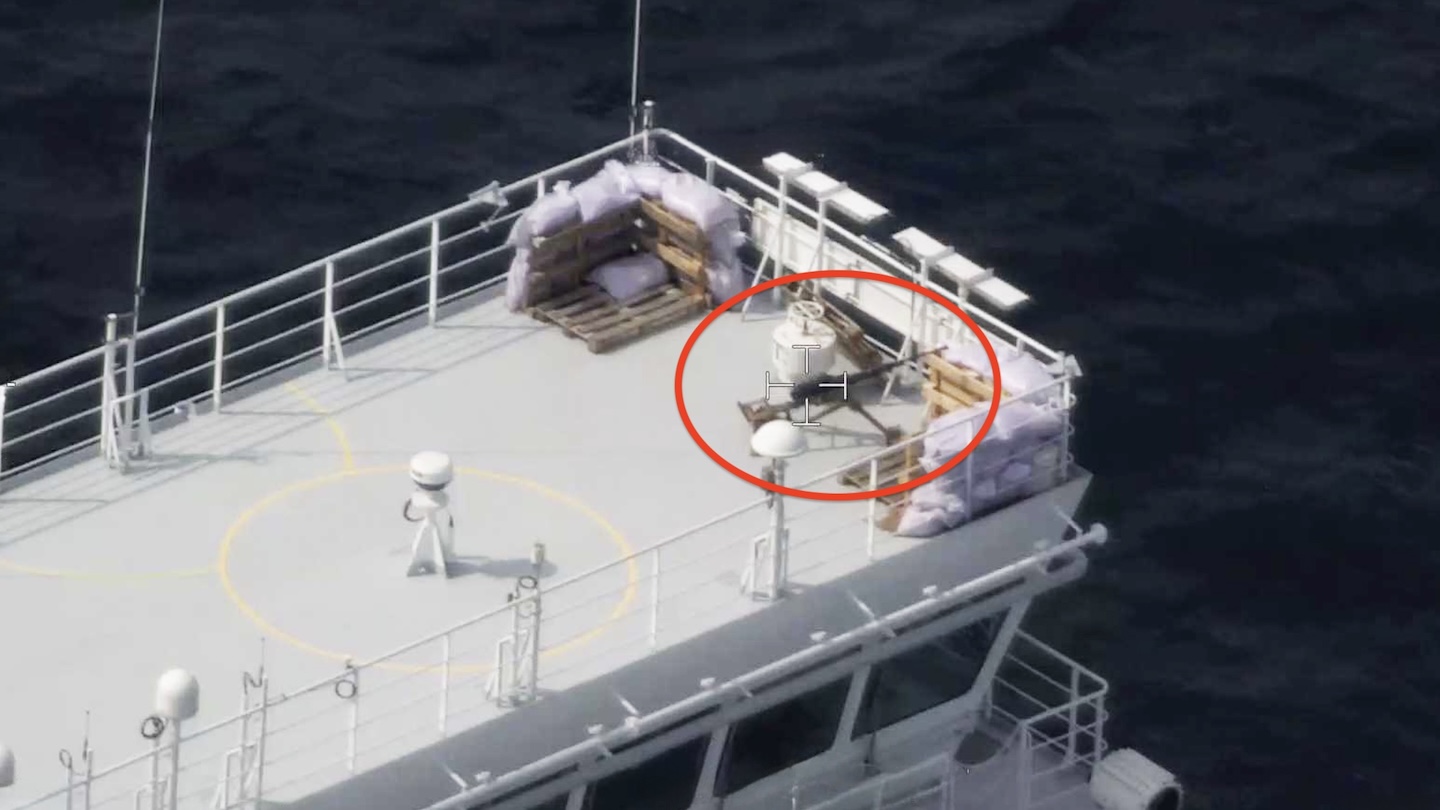
One of Russia’s commercially flagged vessels in the Baltic has appeared armed with heavy machine guns, and it isn’t just any cargo hauler. The weapons fit is likely intended to provide close-in protection against naval drone attacks but is also evidence of increasingly bold measures taken by Moscow to ensure that military bases in its strategically important Kaliningrad exclave continue to be supported. After all, the ship in question, the Marshal Vasilevskiy, is a highly strategic one — Russia’s only floating storage and regasification vessel — that plays a key role in supporting Kaliningrad.
This comes at the same time that Russia ramps up efforts to protect its notorious ‘shadow fleet,’ used to circumvent Western sanctions on oil exports, despite efforts to interdict it.
Evidence of the armed tanker development was brought to light in an exclusive report from Holger Roonemaa, an investigative journalist working for Delfi Estonia, an Estonia-based news website.
Roonemaa secured the release of imagery from the Estonian Border Guard showing the Marshal Vasilevskiy operating in the Baltic Sea last month, with machine gun positions on either side of the deck above the bridge.
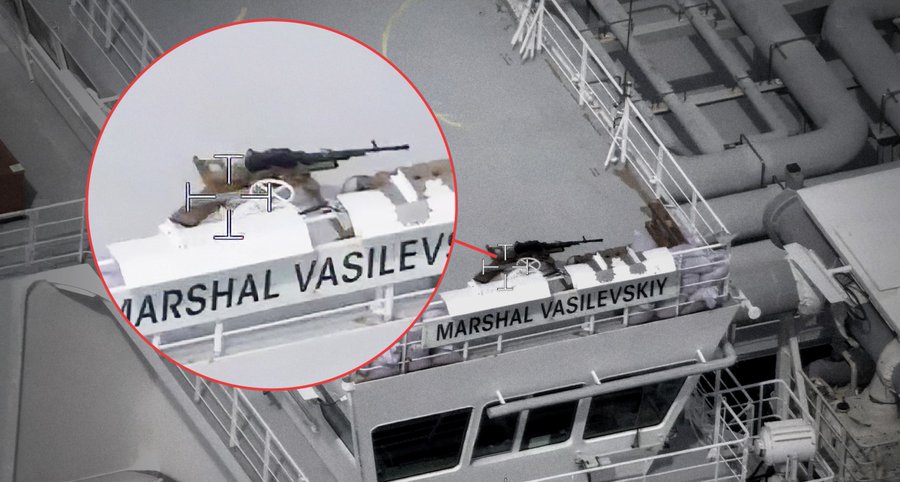
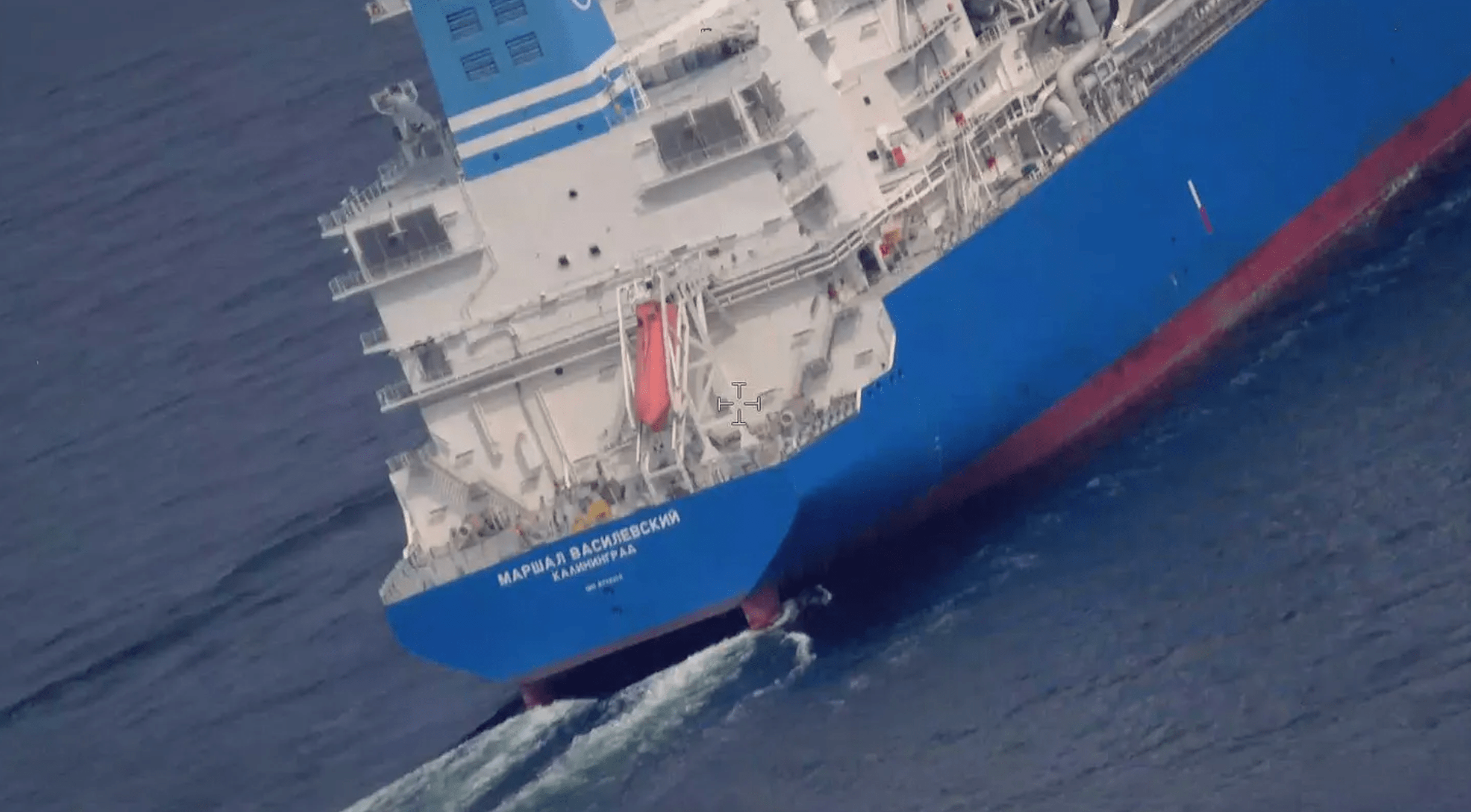
The Marshal Vasilevskiy, a 945-foot liquefied natural gas (LNG) tanker of 118,000 gross tonnage, was spotted by an Estonian Border Guard surveillance aircraft as it was sailing past Estonia’s western islands toward the Russian port of Bolshoi Bor in the Gulf of Finland.
The sandbagged gun positions were armed with 12.7mm Kord heavy machine guns, a belt-fed weapon that is used by infantry, as well as being mounted on vehicles and ships.

The Marshal Vasilevskiy is not a part of the shadow fleet, but it has been subject to sanctions. Moreover, this appears to be the first direct evidence of Russia installing weapons on a civilian ship in the Baltic region.
The vessel is owned by the Gazprom company and regularly supplies Kaliningrad with natural gas, with four such voyages identified since last August.
Almost certainly, the guns on the Marshal Vasilevskiy are intended to help defend against Ukrainian drone attacks.
The Kord fires at a rate of 600-650 rounds per minute and has an effective range of around 2,000 yards.
Earlier this month, Ukraine used aerial drones to attack the prestigious Russian Navy base at Kronstadt, near St. Petersburg, in what appears to have been the first strike of its kind against the Baltic Fleet.
By targeting Kronstadt, Ukraine signaled the opening up of a new front in its drone war with Russia, namely against the Baltic Fleet while it is in port.
Previously, Ukraine’s naval campaign had focused overwhelmingly on the Russian Black Sea Fleet. Many successful attacks have been recorded against Black Sea Fleet vessels and facilities, forcing the general evacuation of Russian naval assets from occupied Crimea and to bases in Russia proper. Ukrainian attacks on Russian-linked shipping have also extended, to a more limited extent, into the Mediterranean.
These attacks have also involved a growing and increasingly advanced array of uncrewed surface vessels (USVs, or ‘drone boats’) as well as uncrewed underwater vessels (UUVs).
Ukraine’s proven ability to launch long-range aerial drone attacks, as seen in the video below, as well as to bring kamikaze drones closer to Russian targets, and strike them from short range, underscores the potential vulnerability of Russian tankers working the Baltic, too.
While Ukraine, as far as is known, has not launched any USV or UUV attacks in the Baltic, it would certainly be within its capabilities to do so.
At the same time, Russia has no doubt also considered the possibility of an Operation Spiderweb-type attack in the Baltic, in which short-range drones could be launched covertly, in mass, from locations much closer to their targets.
In the same way that Operation Spiderweb used commercial trucks as covert launch platforms for one-way aerial attack drones, any suitable vessel could be used in the same way by Ukraine in the Baltic, whether to launch aerial drones, USVs, or UUVs.
In this context, the Marshal Vasilevskiy would be a particularly prized tanker. It is currently Russia’s only floating storage and regasification vessel, a ship that takes on board super-cooled LNG and then converts it into gas that is then fed into pipelines, in this case, in Kaliningrad.
As well as countering potential drone attacks, putting guns on the Marshal Vasilevskiy sends a signal to NATO forces not to interfere with it. Warning shots could be fired to send a message to boarding parties or helicopters. Russia’s willingness to use warning shots was demonstrated in the English Channel earlier this month. With the Kord gun, the vessel could bring down a helicopter with ease, forcing a boarding force to kinetically attack the ship before attempting boarding.
Typically, the crew of a vessel such as the Marshal Vasilevskiy would not be trained to operate heavy machine guns. This raises the likelihood that the ship’s crew includes members of the Russian military or, more likely, the Federal Security Service (FSB), Russia’s principal security agency. It is not inconceivable that man-portable air defense systems (MANPADS) could also be stowed below decks to defend against an aerial drone attack.
The development comes as Russia takes increasingly forceful measures to protect the vessels of its shadow fleet. These provide Russia with a critical lifeline, allowing oil to be sold and funds generated to continue the country’s war against Ukraine. Both China and India regularly accept such deliveries.
Over the past year, European authorities have intercepted shadow fleet tankers on several occasions, typically on the grounds of flying a false flag or for being suspected of damaging undersea cables.
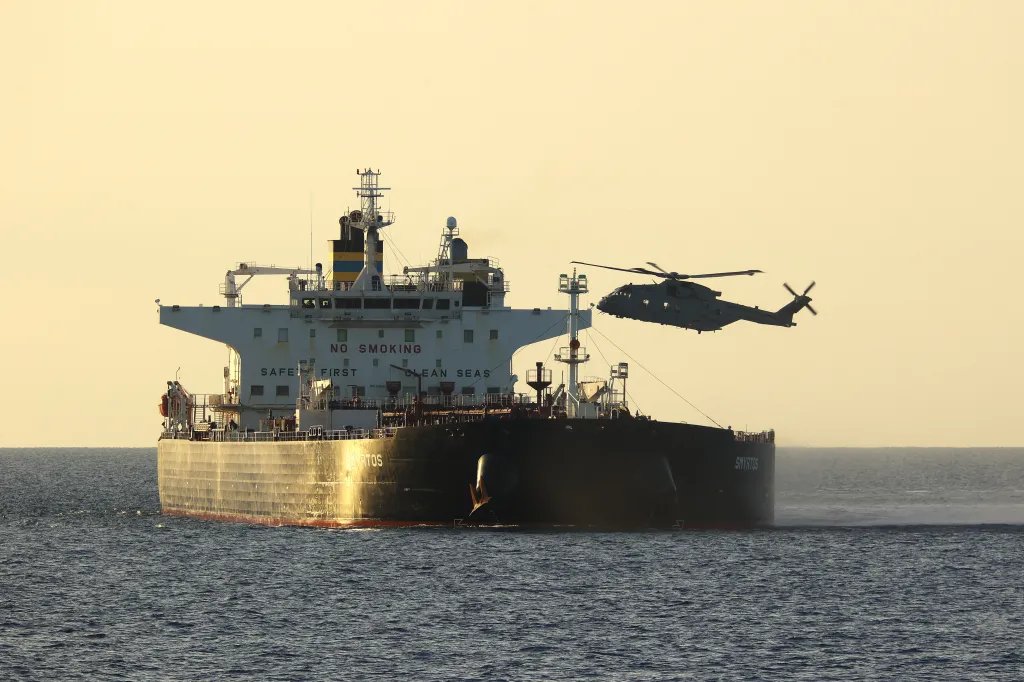
There have been previous reports indicating that shadow-fleet oil tankers regularly include former mercenaries and soldiers among their crews.
Holger Roonemaa has helped establish that almost half of the “passengers” listed as going aboard the Marshal Vasilevskiy also have backgrounds in the Russian military, the National Guard, and/or the FSB.
At the same time, Russian Navy warships are increasingly used for escort, monitoring, and security missions for shadow fleet tankers as they transit the Baltic Sea carrying sanctioned Russian oil to markets prepared to bypass Western restrictions. You can read more about this here.
Returning to this vessel, the appearance of heavy machine guns on it is significant because it illustrates Russia’s militarization of civilian shipping supporting critical operations. There are many historical precedents of merchant vessels being armed during wartime, but it remains unusual to see a commercially flagged tanker openly carrying heavy machine guns in this region. In areas with piracy, it is not uncommon for security crews on vessels to be equipped with small arms, but this is a different kind of weapon, and the ship is operating in waters with no piracy risk attached.
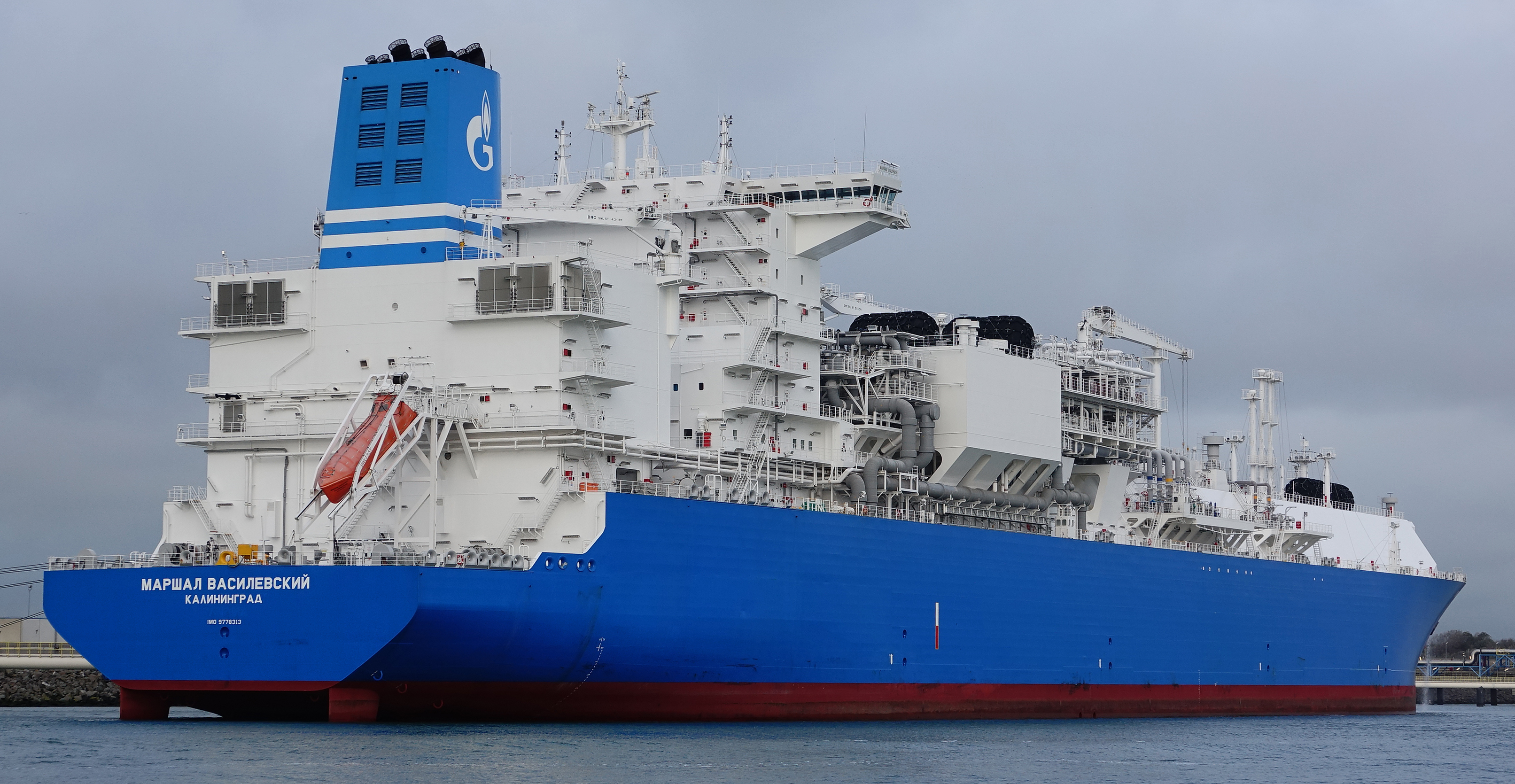
In practical terms, a pair of Kord machine guns could be effective against small drones or boats at close range, but would offer little protection against larger, coordinated attacks, let alone modern anti-ship missiles.
With that in mind, it’s possible Russia might further boost the weapons fit of the Marshal Vasilevskiy to provide a more comprehensive defense. After all, this vessel is a critical asset, due to its unique capabilities in the Russian merchant fleet, and its special role supporting Kaliningrad. This makes it a strategic vulnerability that demands protection. If lost, it could have an asymmetric impact, threatening the ability to keep military assets in the exclave operational.
More broadly, this is evidence of Russia’s growing concern that logistics vessels, including civilian ones supporting critical infrastructure, could become targets in the Baltic region, too, as the war increasingly extends beyond traditional battlefields and further from Ukraine.
Contact the author: thomas@thewarzone.com
Loading comments…
Comments couldn’t be loaded. Please refresh the page.