
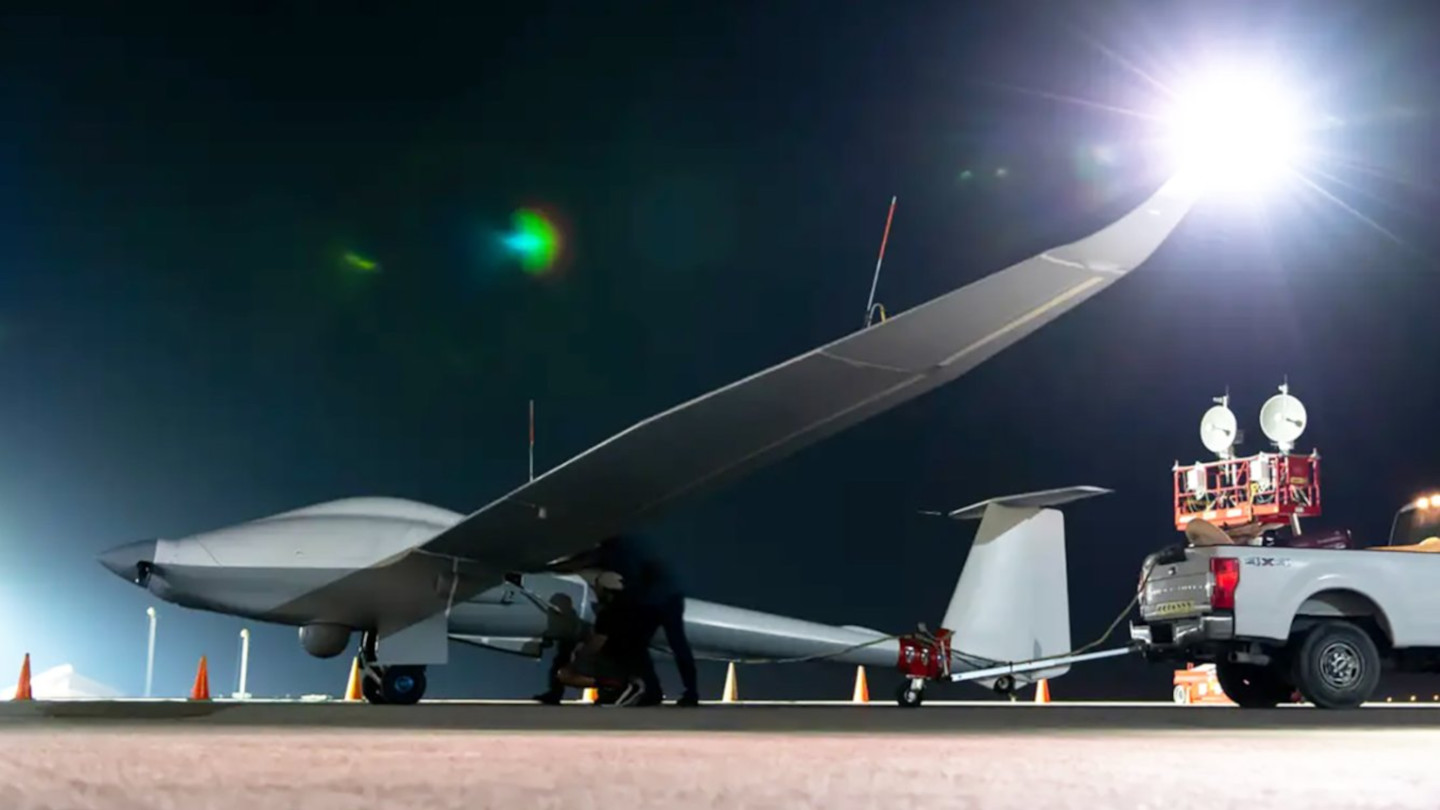
The U.S. Air Force plans to send a new version of the glider-like Unmanned Long-endurance Tactical Reconnaissance Aircraft (ULTRA) drone with a turbocharged engine to the Middle East for an operational evaluation. The ULTRA Turbo can fly faster and higher than the original design, while still being able to stay aloft for multiple days at a time.
Earlier examples of the ULTRA drone, developed by DZYNE Technologies, have conducted at least one previous operational evaluation in the Middle East, back in 2024. Run by the Air Force Research Laboratory (AFRL), the ULTRA program is one of several avenues the service has pursued in recent years to find ways to provide additional persistent aerial intelligence, surveillance, and reconnaissance (ISR) coverage and do so at a relatively low cost. The importance of this added capacity in the Middle East, in particular, has only been underscored by recent active combat operations against Iran and the ongoing blockade of Iranian ports. These capabilities that would be valuable elsewhere globally, too, including during operations across the broad expanses of the Pacific.
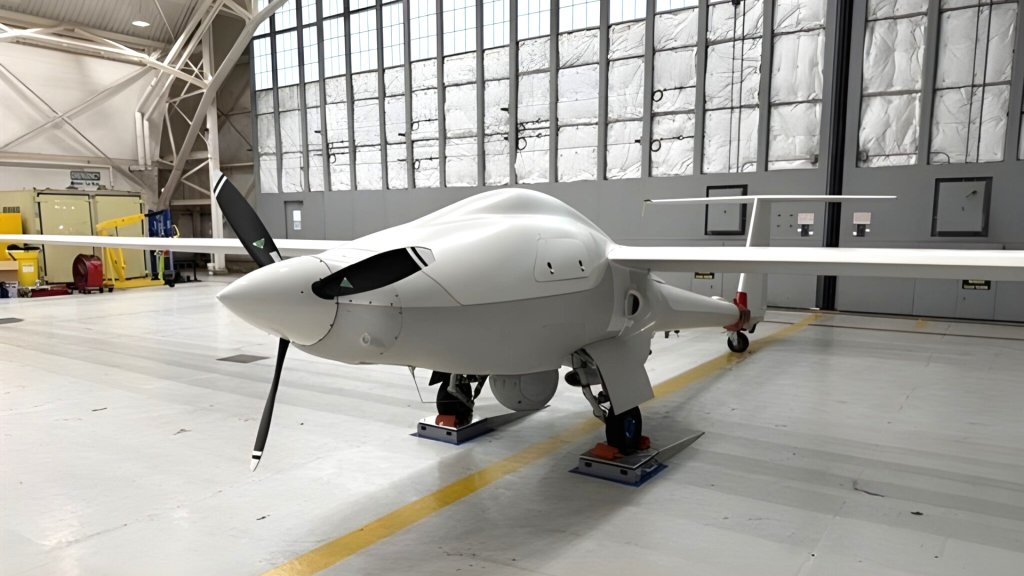
The Air Force’s 2027 Fiscal Year budget request includes details about the new planned operational evaluation and other plans for the ULTRA program. In April, DZYNE announced that it had secured a new contract to supply additional ULTRA Turbo aircraft to AFRL.
“FY26 [Fiscal Year 2026] funding will support an OCONUS OA [operational assessment outside of the continental United States] in CENTCOM’s [U.S. Central Command] Area of Responsibility (AOR), which is the next step (operational testing and evaluation) in developing the ULTRA system,” according to the Air Force’s budget documents. “This assessment will begin with the OCONUS OA in FY26. FY27 funding will continue the OA and fund needed capability improvements to meet user requirements.”
The Air Force’s ULTRA drones have a so-called “Multi-INT” configuration, according to the service’s budget documents, but no further specifics are provided. This term is generally used to refer to a mixture of sensors that could include electro-optical, infrared, or hyperspectral cameras; radars with synthetic aperture imaging and ground moving-target indicator modes; and/or signals intelligence suites. ULTRA drones have been seen previously at least with sensor turrets under their fuselages.
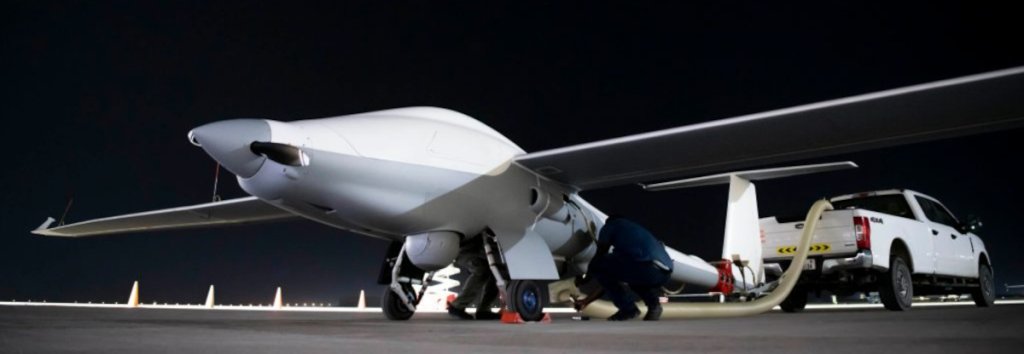
The budget documents also note that the new version of the drone is powered by a Rotax 916, a four-cylinder piston aircraft engine. The Rotax 916 is also used on a number of civilian ultralight aircraft, as well as other drones designed for military use, including the Hermes 900 from Elbit in Israel.
“The new engine unlocks power and operational capability at altitudes above 25,000 feet which enhances ULTRA’s mission flexibility and improves resilience in adverse weather,” DZYNE said in a press release announcing the new version’s first flight last year.
In February, DZYNE announced that the ULTRA Turbo had “completed a mission-representative flight achieving 60 hours at 25,000 feet altitude and 100 knots true airspeed (KTAS).”
At the time of writing, the company’s website says the baseline ULTRA design can stay in the air for more than 70 hours, fly at altitudes up to 25,000 feet and speeds up to 96 knots, and carry a payload weighing 450 pounds. ULTRA Turbo looks to trade some endurance (maximum flight time stated to be more than 60 hours) for increased speed and operational ceiling (120 knots and up to 30,000 feet).
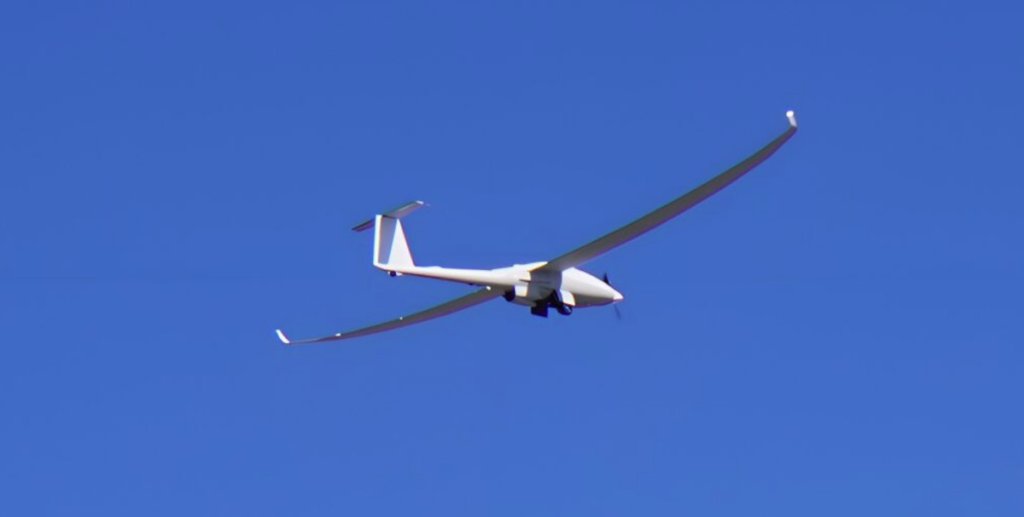
A boost in speed would reduce the time needed to get to and from a designated operating area, especially one that is very far from the point of launch. This could also increase on-station time.
Especially for a glide-like design, being able to fly at higher altitudes can offer benefits when it comes to fuel economy. It also expands the available field of view for sensors, including when using a slanted flight pattern to peer deeper into a target area from a stand-off distance. As DYZNE has noted in past press releases, being able to operate at a higher ceiling offers benefits when it comes to getting above bad weather, as well.
DYZNE has also described the ULTRA family, the core design of which is based on a commercial sport glider, as being relatively cheap to acquire and operate, though the exact unit cost and cost per hour to fly are unclear. The drones are also said to have a small deployed footprint. The Air Force is currently asking for $16.57 million to continue work on the entire ULTRA program in the 2027 Fiscal Year.
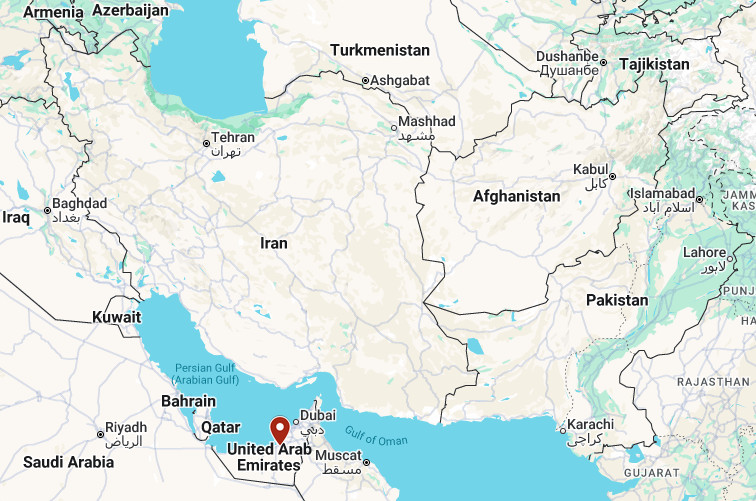
What we know about the 2024 operational evaluation provides a more practical sense of the capabilities the ULTRA design offered even before getting a new turbocharged engine. There were indications that it involved drones flying sorties from Al Dhafra Air Base in the United Arab Emirates to Afghanistan, thousands of miles away, and back again. At the time, the Air Force was also using MQ-9 Reapers for these missions, but those drones offered only limited time on station after transiting from the Persian Gulf via the Arabian Sea and Pakistan.
As an aside, lower-flying MQ-9s have continued to be a key element of the U.S. military aerial ISR ecosystem in the Middle East since the ULTRA operational evaluation in 2024. At a hearing last week, Air Force Chief of Staff Gen. Kenneth Wilsbach said the Reaper had been “perhaps the most valuable player” in the latest conflict with Iran, despite dozens of reported losses. The continued demand for MQ-9 coverage, but also the growing vulnerability of those drones, had already been highlighted during previous operations targeting Houthi militants in Yemen.
As noted, active combat operations against Iran and the continued blockade of the country’s ports have only underscored the U.S. military’s immense appetite for persistent ISR coverage. In April, TWZ explored these demands in great detail in the context of the emergence of a very stealthy, extremely long-endurance, very high-altitude ISR drone commonly (but unofficially) referred to as the RQ-180, or an evolution thereof, in Greece. The RQ-180 and related designs are, of course, in an entirely different class from the ULTRA family.
As mentioned, ULTRA is also not the only effort the Air Force and other branches of the U.S. military have pursued in recent years to help provide more persistent ISR coverage in environments that do not require a highly exquisite asset like the RQ-180. Drones and balloons designed to operate in the stratosphere have also been major areas of interest, including for use in and around the Middle East and the Pacific. These are platforms that can be used as high-altitude communications nodes and even potentially for launching smaller payloads, including drones or munitions.
The continued work on ULTRA comes at a time when the Air Force is looking again at what might succeed the MQ-9. The requirements the service has put forward publicly so far, including a range of up to 932 miles and a 20-hour endurance, point to a design that would have less reach than ULTRA or ULTRA Turbo. The service also wants the Reaper replacement to be lower-cost and readily producible, allowing for greater “mass” to be committed more freely in higher-risk environments. This might leave open an operational space that an enlarged fleet of ULTRA drones could slot into as part of a larger mix of capabilities.
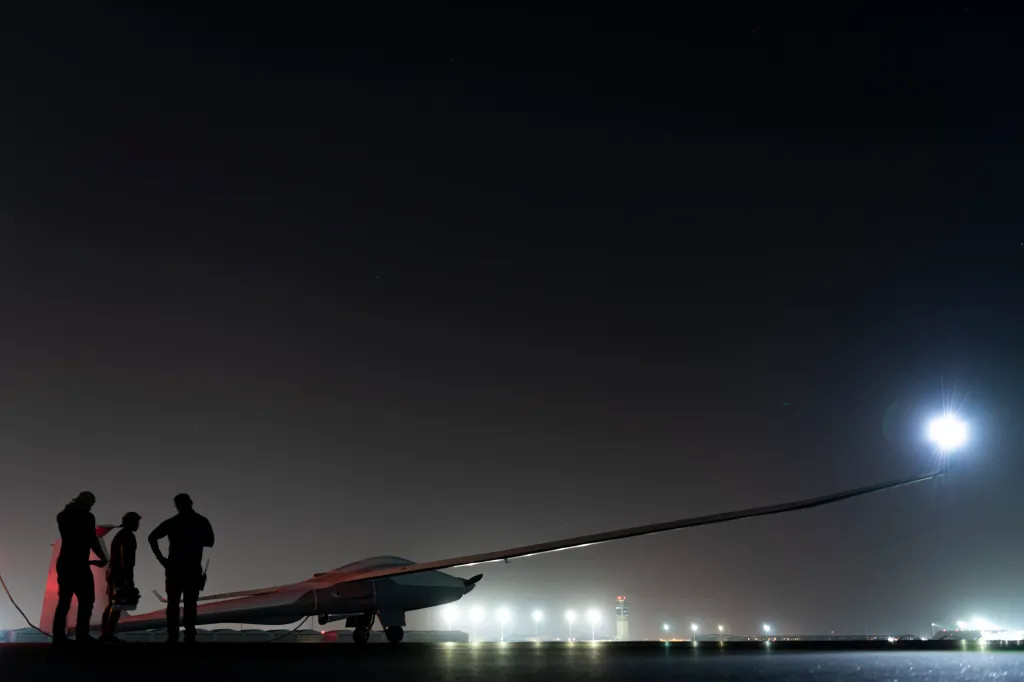
Altogether, though the ULTRA program is still relatively small, it does continue to expand in scale and scope, with the drones now heading back to the Middle East with new turbocharged engines.
Contact the author: joe@twz.com
Loading comments…
Comments couldn’t be loaded. Please refresh the page.