
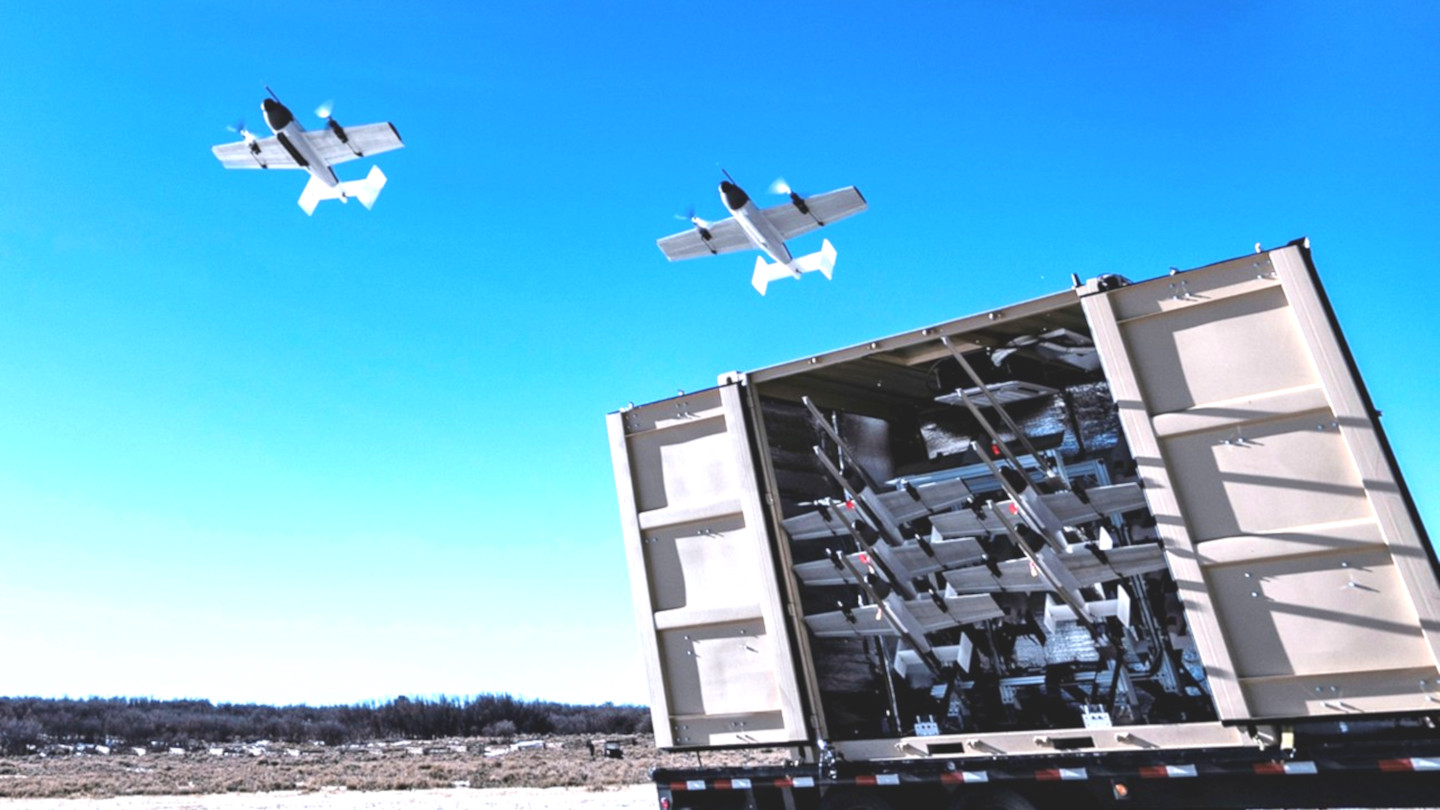
DZYNE Technologies has shared new details about its recently unveiled lower-cost Blitz drone and the accompanying containerized BlitzBox launch system. BlitzBox, the largest version of which can launch a wave of up to 100 drones, is perhaps the more interesting development. There have been two separate calls for proposals from the Pentagon for exactly this kind of capability in the past four months.
Our Howard Altman talked with DZYNE’s Connor Toler, the project manager for Blitz, on the show floor at the annual SOF Week conference today. Blitz and BlitzBox were first unveiled last week.

“It’s fitting that gap between multi-rotors [quadcopter-type drones] and then longer – a little bit larger Group 2s. So you’re really fitting that mid-range range [sic] and endurance, while keeping an operationally relevant payload,” Toler explained. “What really makes it special is its modularity. So, the ability to be able to swap out payloads at a time of need, not having pre-configured systems, and also allowing the end user to adapt those payloads and those modules themselves.”
In U.S. military parlance, Group 2 drones have maximum total weights between 21 and 55 pounds, can fly up to an altitude of 3,500 feet, and have top speeds of 250 knots or less. Group 1 covers everything below Group 2, capability-wise, including Blitz and the even smaller multi-rotor drones, Toler mentioned.
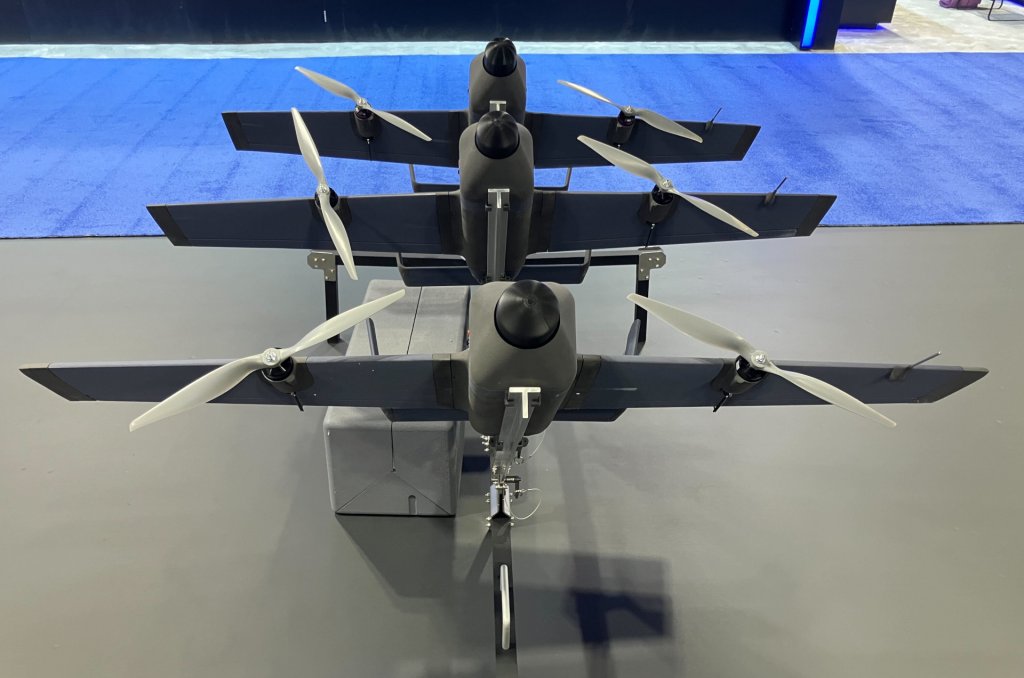
The Blitz drone itself is a small, highly modular fixed-wing design. It is propelled via a pair of electrically powered propellers, one in each wing. It can cruise at speeds between 40 and 75 Knots Equivalent Air Speed (KEAS).
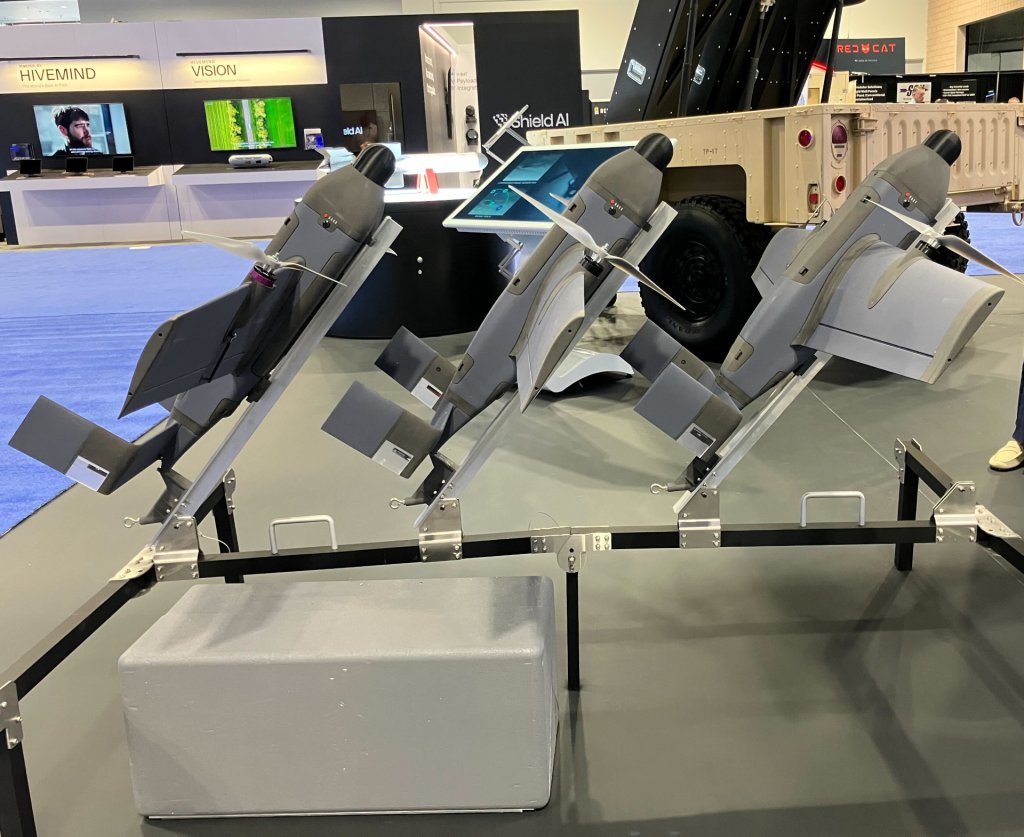
There are two battery options for Blitz. The standard one offers a maximum range of 50 miles (80 kilometers) and total endurance up to one hour. The extended range type allows the drone to fly out to 93 miles (150 kilometers) and boosts its endurance to two hours. The drone is designed so that the choice of battery does not otherwise impact the total payload capacity, which does have additional impacts on range and endurance.
Blitz has a stated maximum payload capacity of five pounds. It has two payload bays in the main body, as well as nose and tail sections that can be readily swapped out. None of this requires special tools. The tail is notably where the drone’s communications package sits, making it easier to fit different specific radios to meet customer requirements.
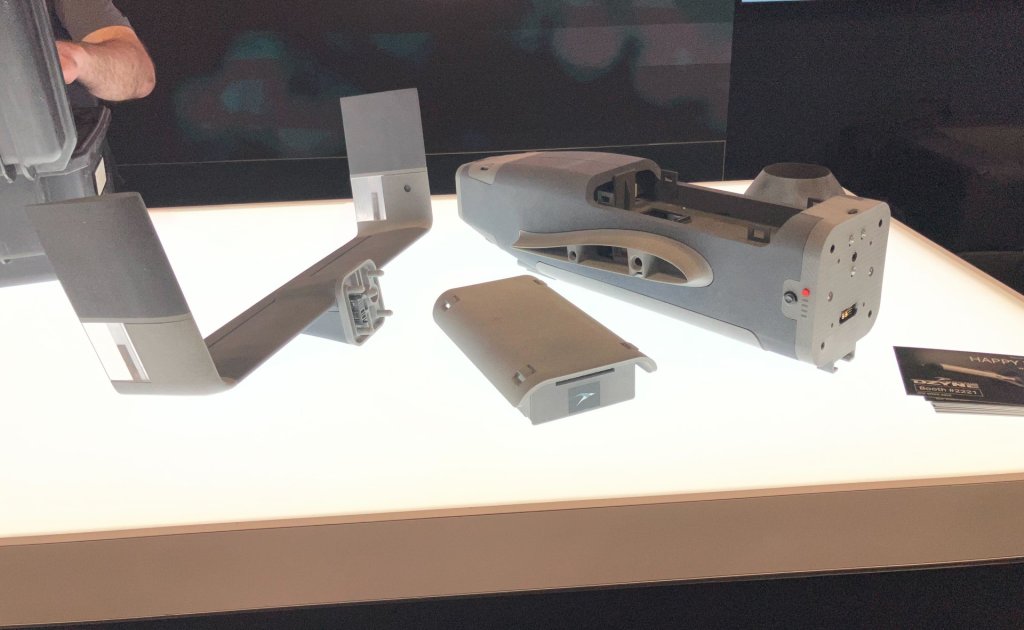
One of the payload options is a two-pound fragmentation warhead from MMS Products based on that company’s Mjolnir design. Mjolnir was originally designed to be dropped from small drones.
In the press release it put out last week, DZYNE had also highlighted Blitz’s ability to be configured for intelligence, surveillance, and reconnaissance (ISR) and electronic warfare (EW) missions, as well as for “deception, and other mission effects.” Deception in this case could mean acting as a decoy.
“Blitz offers a lot of flexibility in the electronic warfare space, [and] some of the deception space, as well,” Toler, the Blitz project manager, reiterated today. “We’re able to run antennas out to the wing tips. So, there’s channels on the wings and mounting points on the wing tips.”
“One of the benefits is that it’s not tube-launched, and why is that a benefit is that you’re actually able to put things that are volumetrically unoptimized, per se, and you’re not constrained to a tube,” he also noted. “So you’re really allowed flexibility and creativity when it comes to what you can solve.”
In terms of guidance, currently, Blitz’s main means of getting to the designated target or target area is via satellite navigation using pre-set coordinates.
“We also do have a visual-based navigation module that basically allows you to navigate in a [GPS-]denied environment, which is optional,” according to Toler. This allows the drone to navigate by comparing imagery of the terrain below against an internal database preprogrammed in advance.
Using pre-set coordinates for targeting alone would preclude attacking anything on the move. Whether some degree of automated targeting capability is already available for Blitz, or on the horizon, is unclear. DZYNE says that Blitz can also be employed in an operator-in-the-loop mode, which would require an active control link to the drone during flight. Advances continue to be made in automated target recognition and engagement capabilities, driven by parallel developments in artificial intelligence and machine learning, as you can read more about in this past TWZ feature. This, in turn, could reduce the importance of having a mode of operation involving direct, if any, operator control. For its part, the U.S. military says it sees humans continuing to be involved, at least to some degree, in the operation of drones for the foreseeable future.
Whether the operator remains in the loop or not after launch, mission planning and control of Blitz drones can be done via handheld tablet-like devices. A software “plugin” to support the drones has already been integrated into the Android Tactical Assault Kit (ATAK) suite in service across the U.S. military, as well as with foreign armed forces.

However, right now, “typically, how they work is you predetermine what area you’re going to fly, that gets loaded onto the aircraft before you launch, and then we’re off to the races,” according to Toler. “Within the plugin itself, when you’re operating Blitz, you’re not flying an aircraft. What you’re doing is you’re planning effects over some area, and then you’re assigning aircraft to that mission.”
In its current form, Blitz is also designed to be lower-cost and, by extension, expandable, though a specific cost target has not yet been provided. Toler said today that there is a “path” to making the drone more recoverable and potentially reusable, but primarily for training rather than operational purposes.
“What’s really unique about Blitz is that, regardless of any of those different scenarios, it’s actually the exact same thing. You’re not modifying the aircraft to fit into any of those employment options,” Toler added. “So not only is it incredibly flexible from a payload perspective, but it’s also incredibly flexible from an employment perspective.”
Blitz takes off under its own power and is small enough to be hand-launched. It can also be deployed via four-rail launchers, which can be carried by small teams on the ground, as well as installed on ships and boats. Individual Blitz drones can be carried inside a container that provides an integrated charging station, as well.
And then there is the containerized BlitzBox launch system. As part of its announcement last week, DZYNE showed one example utilizing what outwardly looked like any other 10-foot shipping container. Up to 16 Blitz drones on four separate rail launchers can fit inside. Toler confirmed today that DZYNE has also been working on a 40-foot type, which can hold up to 100 of the drones.
BlitzBox opens up significant additional operational possibilities for Blitz. Containerized systems present inherent benefits for expeditionary or distributed operations as they can be readily deployed and redeployed via truck, as well as by cargo aircraft and ships. Groups of container launchers could be positioned far forward, or even behind enemy lines, and operated remotely. Since they look like any other shipping container from the outside, this also creates targeting challenges for opponents.
The containerized launch system “can be configured to be as autonomous as you liked [sic] it to be,” according to Toler. He said DZYNE has already demonstrated the ability to operate BlitzBox remotely at extended ranges via satellite communication. He specifically highlighted SpaceX Starlink and its government-focused cousin Starshield as examples of networks that could be used to manage the containers and the drones inside.
BlitzBox launchers could be loaded with dozens of drones in different configurations to perform various tasks as coordinated by a single user. Currently, there is no fully-autonomous swarming or cooperative capability, though DZYNE’s software can help deconflict operational plans prior to launch.

Toler described a notional scenario in which “Let’s say, if you’re operating a BlitzBox, I want to assign 30 aircraft for that mission. And the software will deconflict those aircraft and launch them in a sequence to make sure that you know there’s no mid-air collisions, and they time the effects appropriately.”
“Right now, what Blitz uses is basically pre-coordinated cooperation, and what I mean by that is the vehicles, once they launch, they’re not talking to each other,” he added. “One of the benefits of that is, that when you’re in [a] denied environment, you can’t ensure that the vehicles are going to be able to talk to each other. So our current implementation allows you to still have coordinated effects without relying on that.”
The way BlitzBox is designed, each one of the containers can also just be used to store drones, either for reloading other launchers or for use in other modes.
“So, you can imagine having a BlitzBox with aircraft in a ready-to-launch state, as you see them there, and perhaps a separate container with aircraft in their box state as this reloads,” Toler explained. “But now that container not only allows you to grab reloads from the BlitzBox itself, but let’s say your CONOP [concept of operations] changes and now you want to just throw a handful in the back of a Razor [Polaris MRZR] or in [the] back of a vehicle, and operate from somewhere else. You can just go grab those reloads and take them.”

Toler said DYZNE has already “worked with several customers across the DOW [Department of War]” in regard to Blitz and BlitzBox. However, it is unknown whether or not any branch of the U.S. military has moved to acquire these drones and launchers, or may have already begun fielding them.
That being said, as mentioned right at the start, this kind of containerized drone launch capability is something the U.S. military is very actively pursuing. In February, the Pentagon’s Defense Innovation Unit (DIU) put out a call for proposals for a Containerized Autonomous Drone Delivery System (CADDS). Last month, the Defense Advanced Research Projects Agency (DARPA) put out a separate contracting notice seeking concepts for drones with a high degree of autonomous operation, as well as containerized launch systems to go with them. DARPA also outlined a notional concept of operations involving a largely self-sustaining “autonomous constellation” able to support networked swarms consisting of as many as 500 drones at once.
TWZ has previously called particular attention to the threat that unassuming containerized drone launchers can pose, given their ability to hide in plain sight. Ukraine has already demonstrated the effectiveness of this kind of drone attack with its Operation Spiderweb last year, which succeeded in destroying prized bombers and other aircraft at several Russian airbases. Israel’s near-field attacks from within Iran during the opening phases of the 12 Day War are another example of how this kind of capability could be employed deep within enemy territory. DZYNE says Blitz and BlitzBox have been in development since before Operation Spiderweb, but there are clear similarities in the company’s proposed concepts of operations.
As we also previously wrote after DIU’s CADDS announcement:
“Even in an overt operational context, readily deployable containerized systems capable of acting as hubs for drone operations across a broad area with limited manpower requirements could offer a major boost in capability and capacity. Ships, trucks, and aircraft, which could themselves be uncrewed, could be used to bring them to and from forward locations, even in remote areas. If they can support a ‘heterogeneous mix’ of uncrewed aerial systems, a single container could be used to support a wide array of mission requirements, including intelligence, surveillance, and reconnaissance, electronic warfare, kinetic strikes, and/or communications signal relay.”
…
“Drone swarms are only set to become more capable as advancements in autonomy, especially automated target recognition, continue to progress, driven by parallel developments in artificial intelligence and machine learning, as you can read more about here. Future highly autonomous swarms will be able to execute various mission sets even more efficiently and in ways that compound challenges for defenders. Massed drone attacks with limited autonomy already have an inherent capacity to just overwhelm enemy defenses. In turn, electronic warfare systems and high-power microwave directed energy weapons have steadily emerged as some of the most capable options available to tackle swarms, but have their own limitations. Even powerful microwave systems have very short ranges and are directional in nature, and electronic warfare systems may simply not work at all against autonomous drones.”
It should be noted that a number of other companies in the United States and elsewhere globally have already put forward other concepts for containerized drone launchers. Many countries around the world have fielded containerized or container-like drone launchers, especially mounted on trucks, or are in the process of doing so. China has been particularly active in this regard. Israel has also long been a pioneer in developing these kinds of capabilities as part of its work on long-range kamikaze drones. As seen in the video below, Iran is now another major actor in this domain.

DZYNE’s BlitzBox, coupled with its new Blitz drone, could still be reflective of a larger trend set to emerge now, especially in response to the clearly growing demand from the U.S. military.
Contact the author: joe@twz.com
Loading comments…
Comments couldn’t be loaded. Please refresh the page.