
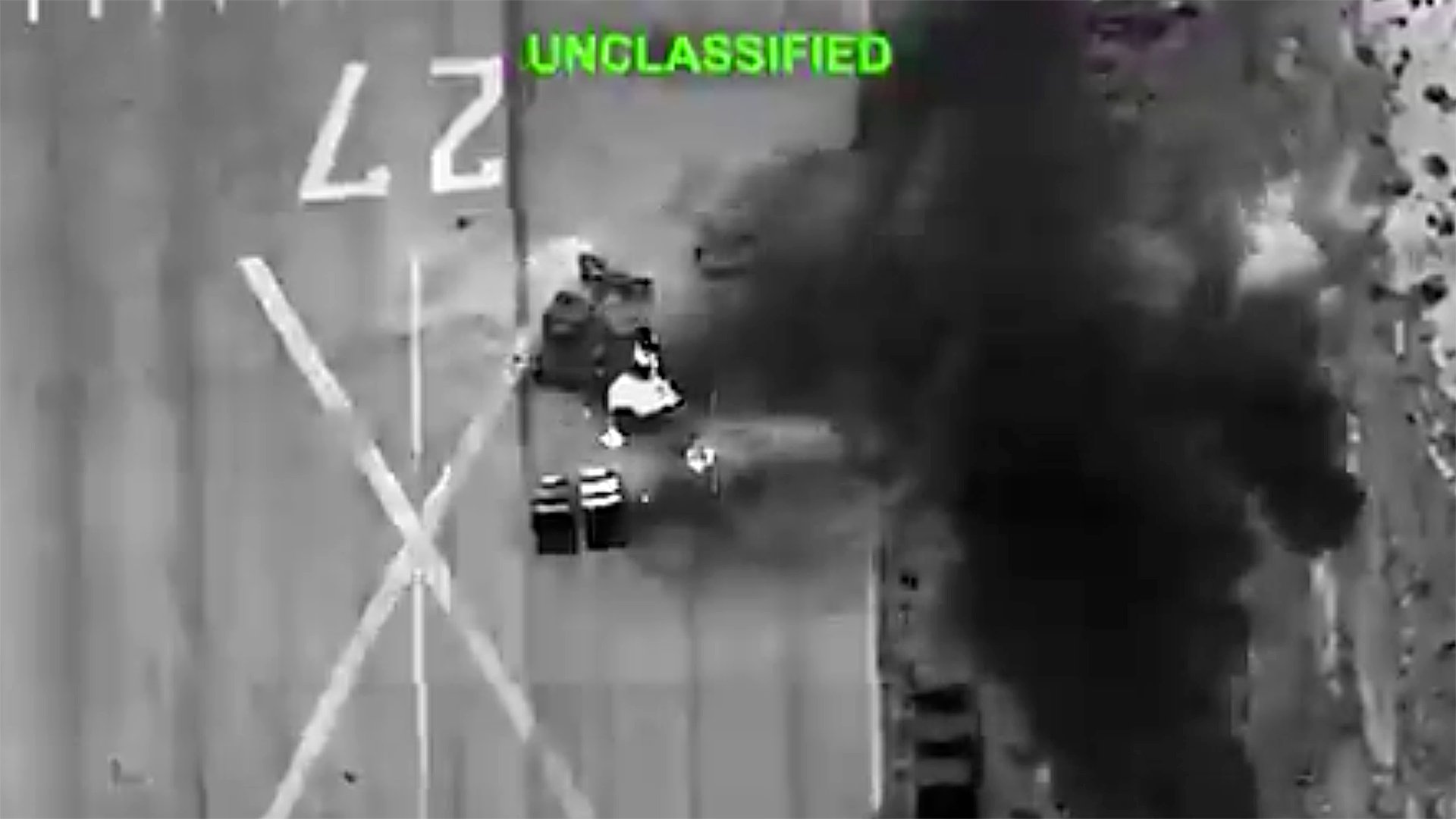
The U.S. Embassy in Jordan on Thursday warned Americans about “missiles, drones, or rockets…in Jordanian airspace.” The warning came as the U.S. and Iran reportedly exchanged fire amid resumed hostilities that have entered a third day. This latest round of fighting was touched off Tuesday when Iran attacked three ships in the Strait of Hormuz. On Wednesday, President Donald Trump and Iranian officials declared that the shaky ceasefire agreed to on April 8 was over.
“Seek overhead cover and shelter in place immediately,” the U.S. Embassy in Jordan cautioned this morning. “Remain indoors and pay attention to local announcements and alerts. The U.S. Embassy in Jordan will continue to review the situation and provide additional information as needed.”
The Jordan Armed Forces-Arab Army (JAF) General Command said the country’s air defense systems “intercepted and shot down eight missiles launched from Iran toward Jordanian territory on Thursday. The interception operations resulted in the fall of missile debris, but no casualties or property damage were reported.”
“JAF is closely monitoring regional developments and remains at the highest level of operational readiness to safeguard the Kingdom’s airspace and defend its sovereignty and territorial integrity,” the command added. “JAF will not allow any party to violate Jordanian airspace under any circumstances.”
The Islamic Revolutionary Guard Corps (IRGC)-connected Tasnim media outlet claimed “that multiple explosions occurred at the Muwaffaq Salti Air Base in Jordan,” and that “Iranian forces also targeted American ships stationed off the coast of Bahrain with cruise missiles.” However, no visual proof of that has emerged. U.S. Central Command declined to provide any new operational details.
Muwaffaq Salti, as we have previously reported, has come under attack numerous times. The air base has long been a major regional hub for U.S. operations, and is being very actively utilized in the current conflict. It hosts the greatest concentration of U.S. tactical aircraft in the region, and thus is an extremely important target, where even one ballistic missile landing on an apron could destroy multiple prized fighter aircraft and take the lives of U.S. service members.
Iranian officials also claimed the U.S. carried out new strikes in southern Iran, including on the perimeter of the Bushehr nuclear power plant.
“According to the deputy governor of Bushehr Province, a U.S. projectile hit the perimeter area of the facility, which had already been hit several times during the current conflict prior to the April 8 ceasefire,” the Jerusalem Post reported Thursday.
Today’s attacks follow a series of strikes carried out on Wednesday by U.S. Central Command (CENTCOM). The U.S. attacked scores of targets across Iran after President Donald Trump warned on Wednesday that “we’ll probably hit them hard again tonight.”
“U.S. forces struck approximately 90 Iranian military targets including air defense systems, coastal surveillance assets, missile and drone storage sites, naval capabilities, and military logistics infrastructure along Iran’s coastline,” the command said in a statement on X. “The latest strikes follow successful execution of offensive strikes in Iran the night before.”
Iran, however, claims the attacks took place further inland, including on a railway bridge for a line linking the cities of Tehran and Mashhad, where former Supreme Leader Ayatollah Ali Khamenei is scheduled to be laid to rest. He was killed on the first day of the U.S.-Israeli attacks on Iran. The official Iranian IRIB media outlet claimed on X that the bridge attack interrupted rail service.
There were also unconfirmed reports from official Iranian media, an independent media outlet and eyewitnesses that another bridge in that region was attacked. The Agh Tekeh Khan Bridge in Iran’s northern Golestan province is a key link in a railway line running to Central Asia and ultimately Russia and China. The line has reportedly been an important means of trade between Iran, China and Russia during the now paused U.S. naval blockade on Iranian ports.
Where all this leaves the ongoing negotiations between the U.S. and Iran remains unclear. As we have frequently noted, the two sides signed a 14-point Memorandum of Understanding (MoU) on June 17. The MoU provided a 60-day extension of the ceasefire to iron out an agreement to end fighting throughout the region, including Lebanon, prevent Iran from seeking nuclear weapons, end U.S. sanctions and resume the flow of traffic through the Strait of Hormuz among other points.
Control over the Strait has proven to be the biggest flashpoint, as evidenced by the aforementioned flare-up of fighting sparked by Iranian attacks on shipping there.
As we mentioned earlier in this story, both sides have declared the ceasefire over.
Speaking to reporters aboard Air Force One yesterday after departing the NATO Summit in Ankara, Turkey, Trump claimed Iran still wants a peaceful solution.
“They called a little while ago,” the president proclaimed. “They want to make a deal so badly — I just don’t know if they’re worthy of making a deal. I don’t know that they’re going to honor the deal. That’s the problem.”
The American leader also called the Iranians “cuckoo.”
Given all this, the future of diplomacy is an open question.
UPDATE: 2:50 PM EDT –
The official Iranian Mehr news outlet is reporting on Telegram that new explosions in Iran’s southern port city of Bandar Abbas, Bushehr and Choghadak. TWZ cannot independently confirm this and CENTCOM declined comment.
UPDATE: 3:13 PM EDT-
A U.S. official told the Jerusalem Post that the explosions in Iran are not a U.S. airstrike.
UPDATE: 3:49 PM EDT –
The official Iranian IRNA news outlet stated on X that the source of the explosions could be the armed forces’ defense systems, enemy fire or a downed drone.
Contact the author: howard@twz.com
Loading comments…
Comments couldn’t be loaded. Please refresh the page.