
The prospects for a peace deal between the U.S. and Iran have reached the most perilous point since the two warring parties agreed to a ceasefire in April. A day after ordering the most intense wave of airstrikes on Iran since that agreement went into effect, President Donald Trump on Wednesday proclaimed that he could resume striking Iran as early as tonight and restore the naval blockade after saying he believed the ceasefire was over.
His comments came after Iran attacked tanker ships in the Strait of Hormuz. There were also unconfirmed reports that Iran fired missiles and drones at U.S. warships.
You can read about yesterday’s exchange of fire in our story here.
Meanwhile, Iranian official media declared that the Memorandum of Understanding extending the ceasefire for 60 days to continue negotiations, worked out in Pakistan, is no longer in effect.
“The Islamabad Agreement is Dead,” the Islamic Revolutionary Guard Corps (IRGC)-connected Tasnim media outlet stated on Telegram.
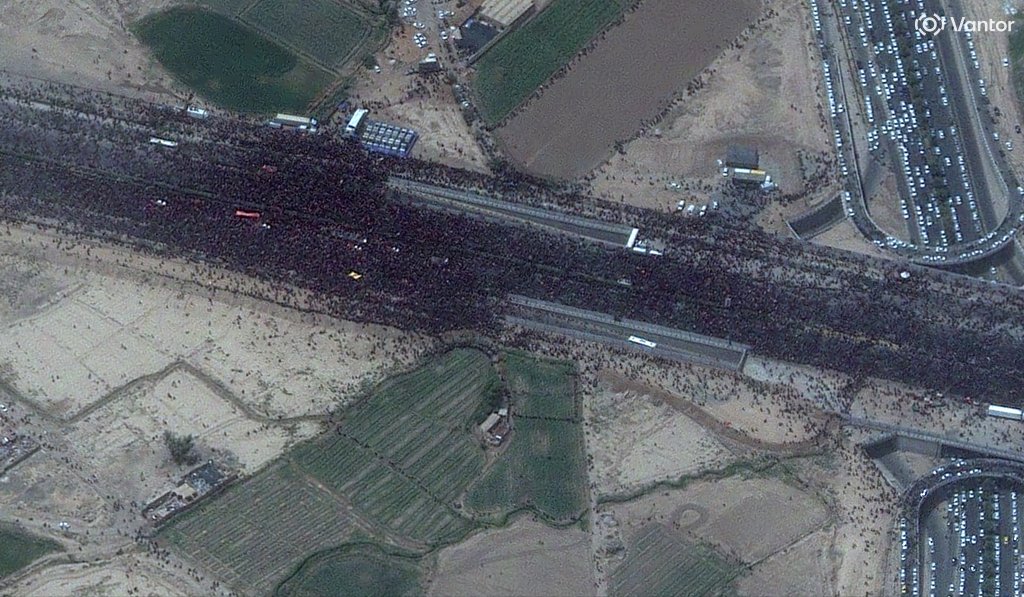
This latest and most serious flare-up of tensions came after Iran struck three ships in the Strait of Hormuz on Tuesday, as we reported. The attacks came during a pause in negotiations for the week-long funeral procession for the former Supreme Leader of Iran, Ali Khamenei, who was killed on the first day of the U.S.-Israeli attacks.
In response to those attacks, U.S. Central Command (CENTCOM) said it hit 85 targets across southern Iran, including “air defense systems, command and control networks, coastal radar sites, anti-ship missile capabilities, and more than 60 Islamic Revolutionary Guard Corps small boats in and near the strait to degrade Iran’s ability to continue attacking international commerce flowing through the international trade corridor.”
Wednesday morning, Trump amped up the rhetoric during several bilateral meetings at the NATO Summit in Ankara, Turkey.
“We hit them very hard last night — very, very hard — and we’ll probably hit them hard again tonight,” Trump proffered. “They’re cuckoo. There’s something wrong with these people. For 47 years, they’ve been the bully of the Middle East… It’s very simple: they can’t have a nuclear weapon.”
Trump also shed additional light on yesterday’s attacks by CENTCOM.
“We attacked Kharg Island last night, knocked out a piece,” Trump stated. “I said, ‘Don’t touch the oil, because maybe we’ll take over Kharg Island.’ We may take over Kharg Island. It’s not a thing they can do about it, but I said, ‘Don’t hit the pipes, just hit everything else,’ and they hit it. They may hit it again tonight.”
You can read about what it would take to attack Kharg Island in our story here.
Trump also hinted that the naval blockade on Iran, lifted when the MoU was signed on June 17, might be resumed.
“And we may put down the blockade,” the American leader suggested. “We may put it back… and it will only be a blockade for Iran.”
Secretary of War Pete Hegseth said the Pentagon was prepared to resume attacks at an even higher level.
“Anything used to harass shipping in the Strait of Hormuz. Anything they thought they had rebuilt or capability they were using was a target last night—and tonight, if we need to, on your order, Mr. President, we will hit even more, and even deeper,” he said.
All this came after Trump professed that the ceasefire had ended.
“To me, I think it’s over,” Trump exclaimed. “I don’t want to deal with them, but they’re scum. You know what scum is? They’re scum, they’re sick people, they’re led by sick people, and they’re vicious, violent people. And if they had a nuclear weapon, they’d use it.”
Iran, for its part, said that it struck 85 targets in Kuwait and Bahrain after the U.S. attacks.
Kuwaiti officials said they downed all the missiles and drones fired at them.
A U.S. official told us that damage to American facilities in the region was minimal.
“Regarding last night: No U.S. injuries. All missiles and drones fired by Iran were intercepted or failed to hit anything or cause major damage,” said the official, speaking on the condition of anonymity to discuss operational details. “Bottom line, Iran’s response was defeated.”
As for the future of negotiations, as we noted earlier in this story, Iran is also painting a grim picture.
“Trump, the self-proclaimed terrorist, officially announced the end of the Islamabad Agreement; an agreement that, although earnestly pursued by Iranian negotiators who emphasized the continuation of the struggle and acknowledged that dishonesty is inherent in the United States, was from the beginning clearly understood to be an agreement that would not be honored by the Americans, especially if Iran insisted on its rights,” Tasnim stated. “Trump and the terrorist U.S. government failed to implement the most important clause of the agreement, Clause 1, from the very beginning. Despite the efforts of officials, this agreement was essentially dead from the start, due to the Americans’ broken promises, and only last night was its death officially announced.”
Aside from taking swipes at Iran, Trump also lashed out at Spain for failing to allow the U.S. to have access to its airspace during Operation Epic Fury. The U.S. has several key military installations there, including Naval Station Rota and Moron Air Base. Both facilities had been used as staging grounds ahead of the attack on Iran.
“Spain is a terrible partner in NATO,” Trump complained at a news conference in Ankara with NATO Secretary-General Mark Rutte. “They don’t participate. They don’t pay. I don’t want anything to do with Spain. Cut off all trade with Spain, please, including visits.”
Meanwhile, Rutte noted that Spain was an outlier when it came to supporting the U.S. war.
“I would say these are isolated cases; 5000 planes taking off from European airports in support of Epic Fury, it was Europe as one, big platform of power projection for the United States helping with Epic Fury,” Rutte explained.
As we have frequently seen since Operation Epic Fury was launched, tough talk from Trump or the Iranians does not always translate into action and things can and have quickly changed. Still, given what is at stake, we will continue to monitor this situation and provide updates when warranted.
UPDATE: 2:05 PM EDT –
Despite all these harsh statements from both sides, one former CENTCOM commander tells us that a resumption of full-scale hostilities is not inevitable.
“I think the immediate way forward will be controlled escalation focused on a military campaign to degrade the regime’s ability to disrupt activities in the Gulf,” Joseph Votel, who led the command from March 2016 to March 2019, told us. “The targets struck last evening seem to support this and I suspect this is where we are heading.”
“I would expect, as the President said, that we will reimpose the blockade against ships transiting to and from Iranian ports,” added Votel, now a Distinguished Military Fellow at the Middle East Institute. “I think this is what we will see for the next few days until there is greater clarification on where all this is leading.”
The future, however, remains uncertain.
“I don’t know if there is an immediate off-ramp – the next day or two will tell us that,” Votel surmised. “If we strike tonight – that may lead to Iranian counter-strikes against U.S. partners hosting American forces. I think Iran will continue to try to impose costs on us by disrupting the Strait and targeting of Gulf nations that support us.”
As for the Strait of Hormuz (SoH), Votel said: “I think we will see (at least in the short term) control of the SoH to be similar to what we saw before the signing of the June 17th MOU – the U.S. largely in control but with Iran continuing to periodically disrupt and impact shipping and commerce.”
Meanwhile, a high-ranking Israeli Defense Forces (IDF) official we spoke with said a resumption of full-blown hostilities or Israel carrying out a new wave of attacks is not a foregone conclusion.
“My assessment is that the current ceasefire is fragile, but I do not believe we are on the verge of a return to full-scale war,” said the official, speaking on condition of anonymity to discuss operational details. “Despite President Trump’s recent remarks, I think his preferred course of action will be to restore and tighten economic sanctions while preserving the option of limited, targeted military strikes against specific Iranian assets if necessary. I do not believe the United States has a strategic interest in becoming involved in another prolonged military campaign unless Iran fundamentally changes the situation through a major escalation.”
The official added that the IDF is ready to resume attacks on Iran if called upon, but that whether it will be remains unknown.
“The IDF itself is not the limiting factor. Israel remains highly prepared, and the military retains credible operational options across the region,” said the official. “Readiness, however, should not be confused with intent. Military capability exists regardless of whether the political leadership decides to employ it.”
“Ultimately, I believe the decisive variable is Washington rather than Jerusalem,” he added. “Any major Israeli operation against Iran would almost certainly require at least tacit American political support and close strategic coordination with the United States. For that reason, I have greater confidence in assessing Netanyahu’s preferences than in predicting President Trump’s decisions.”
Trump “has demonstrated that he is capable of taking decisive military action when he believes it serves American interests, but he has also shown that he is pragmatic and willing to halt escalation when he concludes that continued conflict no longer advances those interests,” the IDF official postulated.
“In short, my expectation is that the near-term strategy will be one of deterrence rather than renewed war: tighter economic pressure on Iran, continued intelligence and covert activities, and the option of limited military strikes if required,” the official continued. “A return to a broad regional conflict remains possible, but in my view it would most likely require a significant Iranian escalation rather than being initiated by either Washington or Jerusalem.”
UPDATE: 5:30 PM EDT –
The U.S. has resumed striking Iran as Trump said he would, according to CENTCOM.
“At the direction of the Commander in Chief, U.S. Central Command forces have started conducting additional strikes against Iran to further degrade their ability to threaten freedom of navigation in the Strait of Hormuz,” the command stated on X. “The United States is holding Iran accountable for recent unjustified aggression against commercial shipping and civilian crews freely navigating a vital international waterway.”
Videos purporting to show those attacks are emerging online.
UPDATE: 5:51 PM EDT –
“This is in retribution for yesterday’s bombing of ships by Iran,” Trump posted on Truth Social. “If it happens again, it will get much worse!”
Contact the author: howard@twz.com
Loading comments…
Comments couldn’t be loaded. Please refresh the page.