
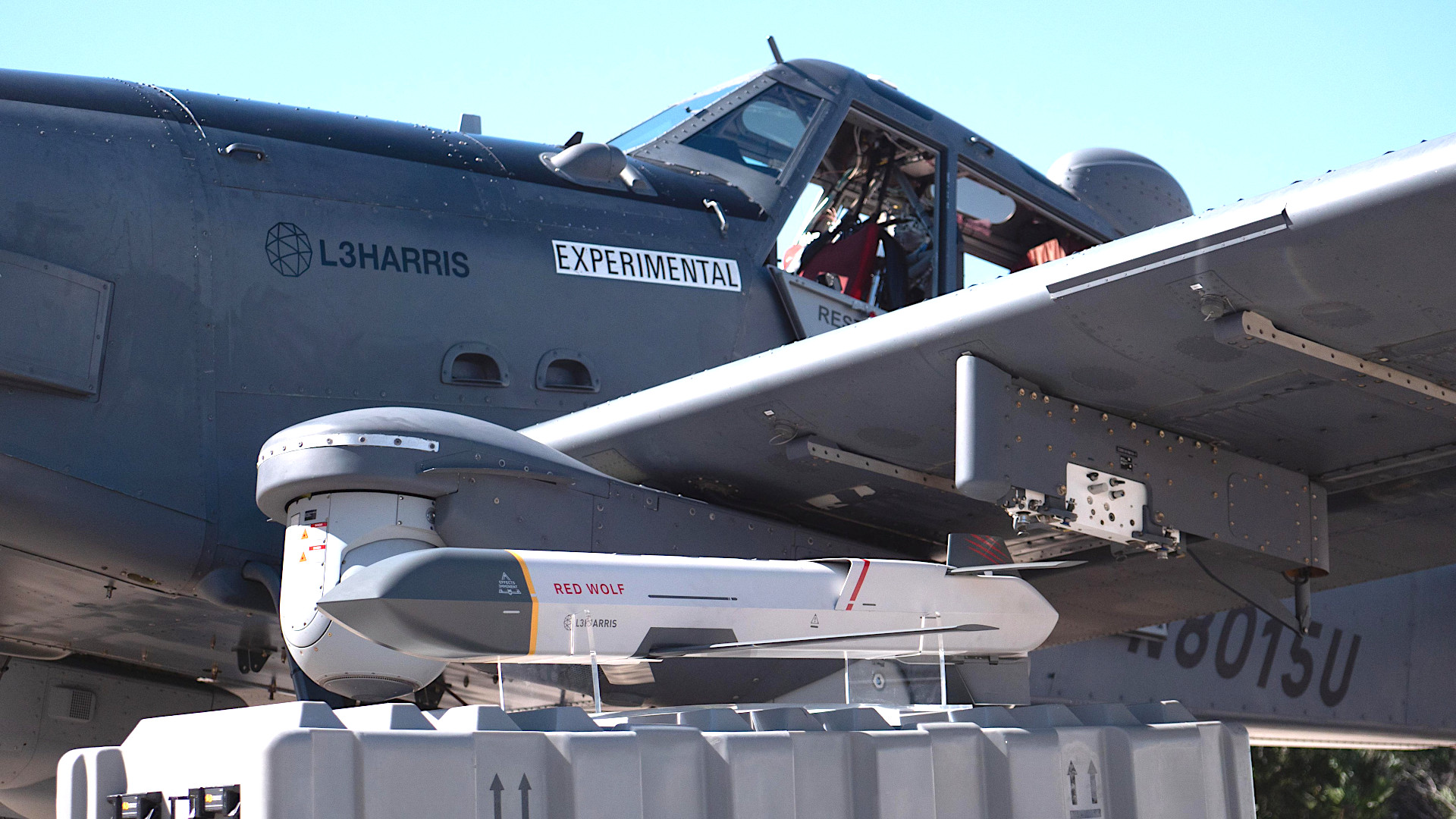
L3Harris has highlighted the potential benefits of pairing its Red Wolf miniature cruise missile with the U.S. Air Force’s OA-1K Skyraider II. Standoff munitions like Red Wolf could help the OA-1K, originally designed for close air support and surveillance and reconnaissance in support of low-intensity operations, find a role in future high-end conflicts, but questions about the value of doing so remain. The U.S. Marine Corps is already acquiring the Red Wolf to provide a boost in capability for its AH-1Z Viper attack helicopters for the same general reasons.
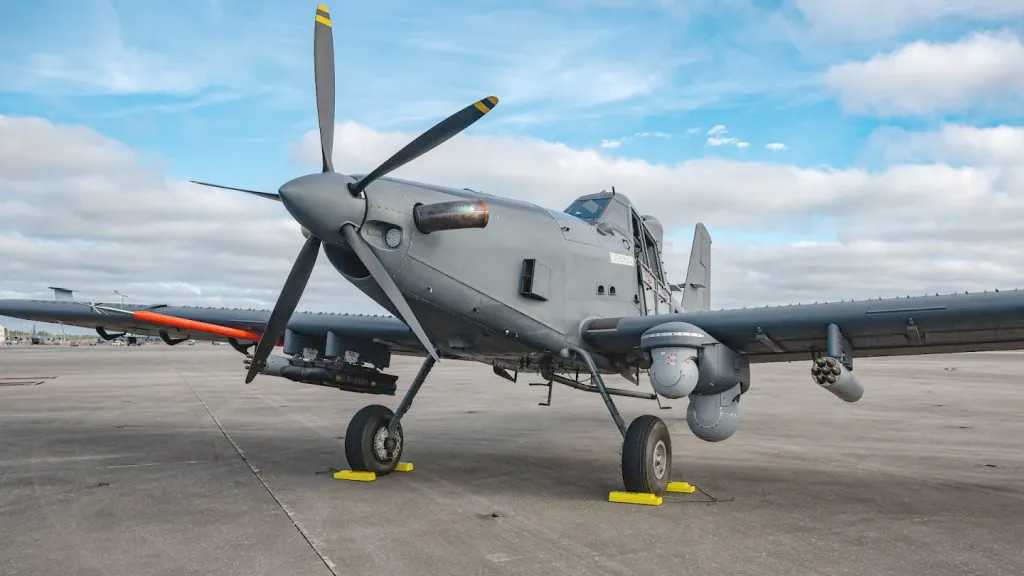
L3Harris announced today that it had shown “the ability to integrate” Red Wolf on its Sky Warden aircraft. The Sky Warden is based on the Air Tractor AT-802 single-engine turboprop crop duster. In 2022, the Air Force declared the two-seat Sky Warden the winner of its Armed Overwatch competition, subsequently giving the plane the designation OA-1K and the official nickname Skyraider II. The Air Force is planning to eventually acquire 75 OA-1Ks, which will be operated by units under the umbrella of Air Force Special Operations Command (AFSOC).
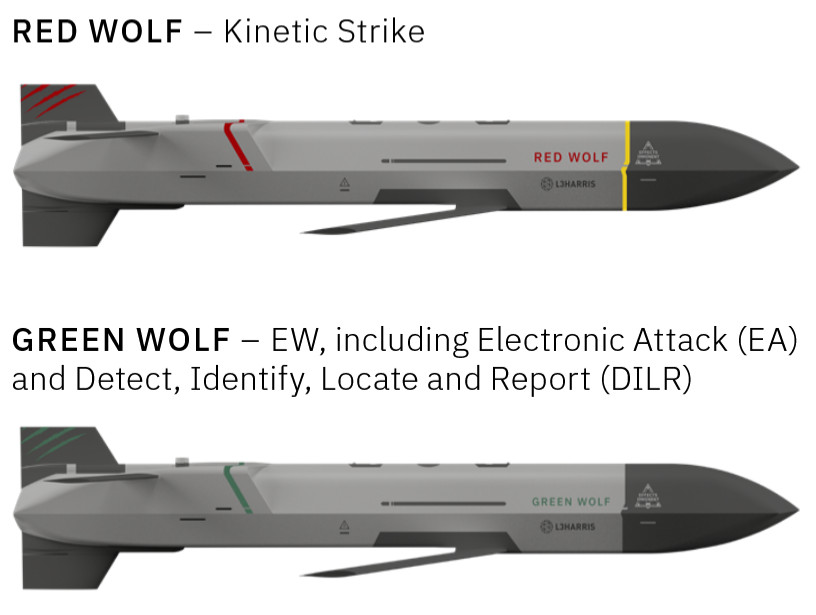
L3Harris officially unveiled Red Wolf, as well as the companion Green Wolf (fitted with an electronic warfare payload instead of a high-explosive warhead), last July. However, the development of the “Wolf” family of systems dates back to 2020.
“Our customers demand a lean, agile aircraft that can fly, take off and land anywhere, anytime, outfitted with a wide range of payloads,” Jason Lambert, President for Intelligence, Surveillance and Reconnaissance, Space and Mission Systems at L3Harris, said in a statement today. “Bringing together Red Wolf and Sky Warden demonstrates the rapid reconfiguration and customization of key L3Harris capabilities.”
The OA-1K can carry up to 6,000 pounds of munitions and other stores on as many as eight pylons, four under each wing. L3Harris has also said in the past that aircraft has a “robust suite of radios and datalinks providing multiple means for line-of-sight (LOS) and beyond line-of-sight (BLOS) communications.”

Adding Red Wolf to the Skyraider II’s arsenal would turn the aircraft into a true standoff weapons delivery platform. This, in turn, would help keep the aircraft further away from potential threats, reducing the risk to the crew.
The members of the “Wolf” family are all in the 250-pound class. They have a missile-like core design, powered by a small turbojet, and with at least a degree of low-observability (stealthiness). They are in the 250-pound weight class. “Their endurance has been proven in flight testing, demonstrating high subsonic speeds – 200+ nautical mile range at low altitudes and 60+ minutes duration,” per L3Harris.
Details about how Red Wolf or Green Wolf are guided are limited, but L3Harris says they are capable of “autonomous over-the-horizon engagements.” The Marine Corps, in cooperation with the U.S. Navy, has used tablet-based control systems as part of the engagement process in past testing of Red Wolf.
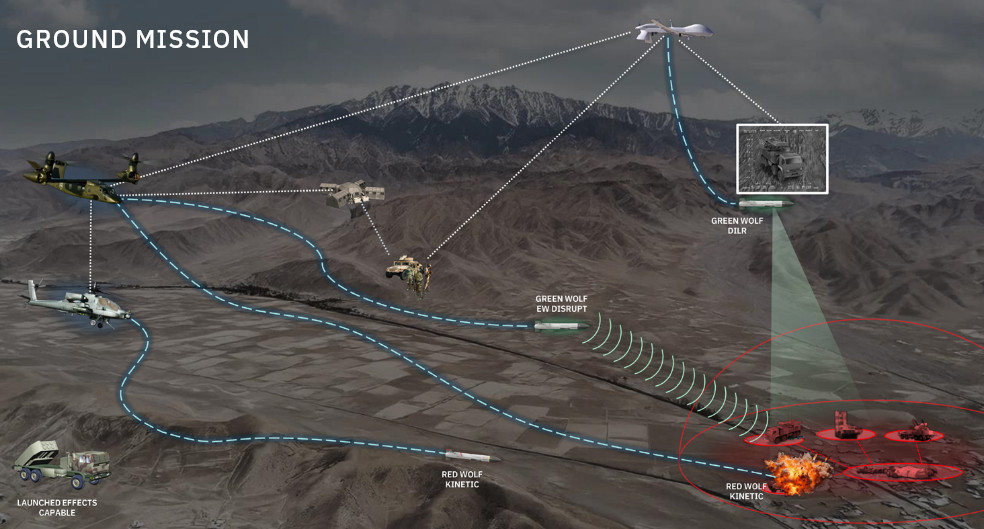
L3Harris has also talked in the past about how members of the Wolf family could work together. The Green Wolves could help locate targets, especially hostile air defense assets, by zeroing in on their signal emissions, as well as clear a path for Red Wolves to actually strike them.
Red Wolf or Green Wolf are also only the start of what L3Harris hopes to be a larger family of configurations based around the central design. At least one Red Wolf was reportedly employed at the U.S. Army’s Experimentation Demonstration Gateway Event in 2021 (EDGE 21) configured as an airborne signal relay node rather than a munition.
“We can adjust the size of the warhead, the fuel tank, we can even put a parachute on the back of it, and we have,” Matthew “Guicci” Klunder, Vice President for Business Development at L3Harris, said in a promotional video released last year, seen below. “It can be a kinetic effect, it could be a non-kinetic effect, it could even be a decoy.”

Changing the size of the warhead would have impacts on range and endurance, as well as the terminal effect on the target. This also opens up the possibility of fitting different types of warheads, including ones with increased penetrating capability. A parachute system would allow for recovery and, by extension, potential reuse.
Overall, L3Harris describes the “Wolf” family collectively as “launched effects vehicles.” The U.S. military uses the term “launched effect” to refer to a broad swath of uncrewed aerial systems that can be deployed from platforms in the air, on the ground, and at sea, and that can be configured as one-way attackers or to perform other missions. The Wolf family is just one of a growing number of modular, relatively cheap, and small systems that fall under that broad umbrella. Many of them increasingly blur the line between uncrewed aerial systems, especially longer-range kamikaze drones, and cruise missiles, as well as decoys.
As mentioned, just integrating Red Wolf onto the OA-1K would give it a standoff strike capability it currently does not have. Adding Green Wolf to the mix would further expand its capability, including adding a valuable, if not potentially critical, way to suppress hostile air defenses that might suddenly pop up.
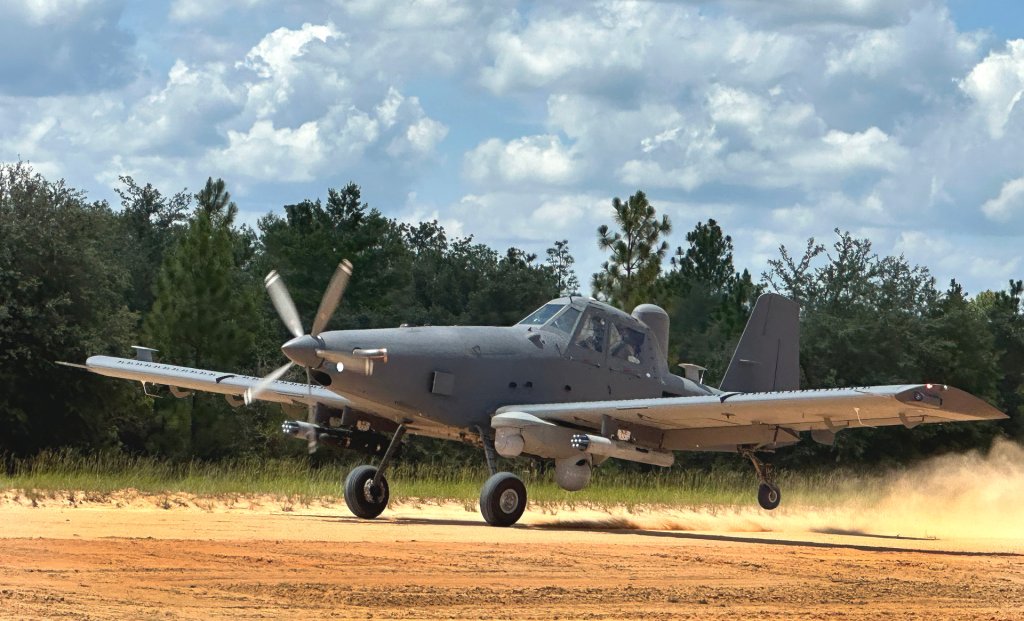
In general, standoff capabilities for the Skyraider II could open up important new avenues to employing the aircraft in the context of future large-scale conflicts, including across the broad expanses of the Pacific. When the Air Force first initiated the Armed Overwatch program, U.S. military operations globally were defined by counter-terrorism operations in countries like Afghanistan, Iraq, and Syria with entirely permissive airspace. By the time the decision was made to acquire the OA-1Ks, a shift was underway across the U.S. military to reorient toward preparing for high-end fights.
“How could we support them [friendly forces] if it’s in the Pacific or anywhere else? The OA-1K certainly has some roles and missions that can [provide] support there. And then in a large-scale combat operation, we are looking at, in partnership with other components of SOCOM [U.S. Special Operations Command], what are some of the things that it could do,” a high-ranking Air Force official told TWZ in an interview last year. “Can it employ air-launched effects, at range, at standoff, in a flexible way that would provide value?”
“The beauty of the OA-1K is that it’s modular, it’s adaptable, and for a relatively small aircraft can carry a lot of payload. And so in a perfect world, in a resource-unconstrained world, I want to be able to have as big a menu as possible of things that I could hang from a hardpoint on there, or attach as a sensor,” Air Force Lt. Gen. Michael Conley, head of AFSOC, also told TWZ later in the year on the sidelines of Air & Space Forces Association’s main annual conference. “I’d love to be able to use long-range standoff mission munitions on multiple airframes.”
Conley was responding to a question specifically about integrating Black Arrow, also known as the Small Cruise Missile (SCM), onto the Skyraider II. Leidos is developing Black Arrow for AFSOC now, but primarily as a new standoff capability for the AC-130J Ghostrider gunship. Questions have also been raised about how to ensure the future relevance of the Air Force’s AC-130 fleets in high-end fights.

At the same time, exactly how great the benefit would be to making the OA-1K into a standoff shooter is a matter of debate. A key benefit the Skyraider II offers is its ability to operate with a very small logistical footprint from far-flung locales, including ones that are very austere and close to or even within contested areas. As such, an OA-1K would be able to launch munitions like the Red Wolf from within the enemy’s own weapon engagement zones or from other surprise vectors, and fly low and slow to literally stay out of the gaze of distant radars.
At the same time, the OA-1K’s range and speed are limited, with the aircraft said to have a combat radius of roughly 200 miles with six hours of loitering time once arriving on station. The Skyraider II’s ability to survive in highly contested areas, even with a standoff capability like that offered by Red Wolf, is also questionable at best.
OA-1Ks could still provide useful support during a high-end fight, but in areas further away from hostile threats. As TWZ has pointed out in the past, in a Pacific scenario, the aircraft could provide force protection and surveillance on a localized level around forward operating locations, including island outposts.
AFSOC’s Conley, among others, has also stressed in the past that AFSOC will still continue to be called upon to conduct lower-intensity missions that require the kinds of capabilities that the OA-1K was originally designed for, as well.
Regardless, the market space for munitions like Red Wolf and Black Arrow is steadily growing, and includes many other designs already that might also find their way onto the OA-1K, as well as other platforms in the air, ground, and maritime domains.
Red Wolf does have the additional benefit of already being elsewhere in the U.S. military ecosystem. As noted, the U.S. Marine Corps and U.S. Army have been testing it in recent years. In January, L3Harris announced that the Marine Corps (by way of the Department of the U.S. Navy) had chosen Red Wolf for its Precision Attack Strike Munition (PSAM) requirement for a new air-launched standoff weapon primarily to arm the AH-1Z Viper attack helicopter. The Marines have been facing their own questions about how to keep the AH-1Z, as well as the companion UH-1Y Venom armed utility helicopter, relevant in future high-end fights.

Further orders for different members of the Wolf family from other branches of the U.S. military, and potentially foreign operators, could be advantageous when it comes to sharing the cost burden and driving down unit prices through economies of scale. There could be interoperability and other operational benefits from multiple services operating versions of the same platform, as well.
Whether Red Wolf or Green Wolf ultimately become part of the OA-1K’s arsenal, the demand for launched effects like this only looks set to grow across the U.S. military and globally. For the Skyraider II, some mixture of standoff capabilities increasingly looks to be in the plane’s future to expand its relevance beyond lower-intensity conflicts.
Contact the author: joe@twz.com
Loading comments…
Comments couldn’t be loaded. Please refresh the page.